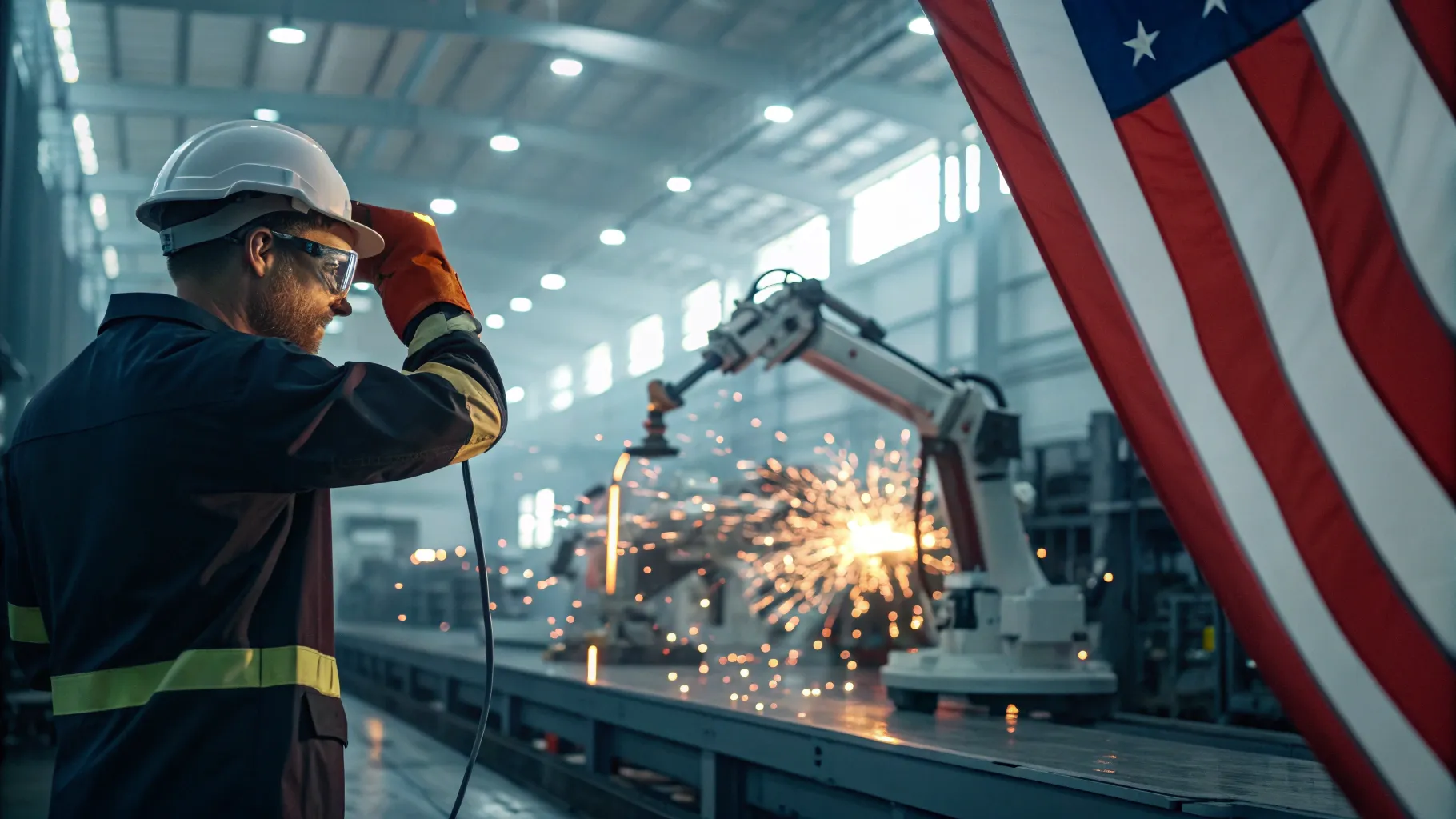
I remember when Jensen Huang asked a simple, urgent question: "How do we bring industrial back to America?" That question hangs over the conversation about manufacturing, innovation, and economic resilience. Jensen followed with a clear diagnosis: we have to get more efficient, squeeze more productivity out of people, and get more out of machines. Then he added a concise prescription: "AI can do that."
I agree. But that answer deserves unpacking. Reviving and reshaping industrial capacity in the United States is not about moving factories like chess pieces. It is about making industry smarter, faster, and more resilient. It is about empowering people with tools that amplify their abilities and machines with intelligence that lets them collaborate, adapt, and learn. It is about productivity at every layer, from the shop floor to design studios to global supply chains.
🔧 The challenge: reviving industry, not just reshoring
The headline "bring industrial back to America" sounds straightforward, but the reality is complex. Global manufacturing networks evolved over decades based on cost arbitrage, trade policy, and specialization. Reshoring raw capacity without addressing productivity gaps would be expensive and unsustainable.
So the real challenge is not merely where production sits geographically. The real task is creating competitive advantage that makes American industry the best place to design, iterate, and scale high-value products. That means higher productivity per worker, lower failure rates, faster time-to-market, and the ability to customize at scale.
Key structural obstacles to address:
- Legacy processes that resist automation and modern workflows.
- Skills mismatches between available workers and new digital tools.
- Supply chains optimized for cost, not resilience or agility.
- Capital allocation that favors short-term returns over strategic manufacturing investments.
Answering Jensen's question requires addressing each obstacle with a mix of technology, policy, and workforce strategy. AI is the multiplier that ties these elements together.
🤖 AI as the productivity multiplier
When I say AI can do that, I mean AI can exponentially improve how we design, build, and maintain products and factories. Artificial intelligence is not a single tool. It is an entire stack of capabilities: data ingestion, simulation, perception, planning, and control. Together, they let humans and machines co-evolve into more capable production systems.
Here are the core ways AI drives productivity in industry:
- Design automation: Generative design and AI-driven simulation let engineers explore far more design alternatives in a fraction of the time. That leads to lighter, stronger, and cheaper parts with less material waste.
- Predictive maintenance: Machine learning models identify failure patterns from sensor data, enabling repairs on schedule rather than after catastrophic failure. That raises uptime and reduces inventory of spare parts.
- Process optimization: AI can continuously tune manufacturing parameters for quality and throughput, reacting to raw material variability and environmental conditions in real time.
- Robotics and autonomy: Perception and planning models allow robots to handle complex, variable tasks like assembly and inspection alongside humans, improving safety and throughput.
- Supply chain intelligence: Forecasting, demand sensing, and scenario simulation make supply chains more resilient to shocks and more responsive to shifting market signals.
In short, AI does not replace industry. It augments it. It lets a smaller, better-trained workforce achieve the output and quality levels that used to require many more hands. That is the productivity story at the heart of bringing industry back.
🏭 Getting more out of people: human-centered augmentation
When Jensen said, "We got to get more out of people," he did not mean exploiting human labor. He meant empowering workers to perform higher-value work and to be more productive while learning new skills. I think about this as shifting humans from repetitive tasks to creative, supervisory, and exception-handling roles.
Here are pragmatic pathways to do that:
- Deploy assistive AI tools on the floor. Augmented reality and AI-enabled assistants can guide technicians through complex procedures step by step, reducing errors and shortening training cycles.
- Use AI for continuous training. Personalized learning systems analyze performance data and suggest targeted skill-building exercises, shortening the path from novice to expert.
- Redesign jobs around human strengths. Machines excel at repeatable precision. Humans excel at judgment, creativity, and communication. AI can free humans from rote tasks so they can focus on improvements and innovation.
- Measure productivity thoughtfully. Metrics should reward outcomes and learning, not just hours on the job. That encourages adoption of AI tools rather than resistance.
Case in point: imagine a maintenance team that historically runs reactive fixes. With AI-driven diagnostics and guided repair instructions, a junior technician can confidently perform repairs that previously required much more experience. That raises mean time between failures and flattens the learning curve.
How to approach workforce transformation
I recommend treating workforce change as a program, not a one-time investment. It should include:
- Skills mapping to identify which roles will be augmented by AI.
- Curriculum development tied to real-world tasks and AI tools.
- On-the-job mentorship amplified by AI tutors and virtual coaches.
- Metrics for learning outcomes and productivity improvements.
Companies that invest in their people now will not only improve productivity, they will retain talent and build a culture of continuous improvement.
⚙️ Getting more out of machines: smarter, not just faster
"We got to get more out of machines," Jensen said. That is the hardware and control story: how do we make equipment more flexible, more observant, and more cooperative? Machines equipped with AI become partners in production instead of just tools.
Key technical strategies:
- Sensor-rich environments. Add high-fidelity sensors to machines so AI models can perceive vibration, temperature, sound, and visual cues that indicate health and performance.
- Edge AI. Run inference and control algorithms close to where actions happen to reduce latency and ensure safety-critical responses are fast and reliable.
- Digital twin simulations. Create virtual replicas of machines and entire production lines to test changes before applying them in the physical world, reducing downtime and risk.
- Adaptive control systems. Replace static control parameters with learning-based controllers that adapt to changing materials, wear, and environmental conditions.
Machines that learn over time reduce scrap, increase yield, and extend equipment life. Those advantages compound across a factory, delivering step-change improvements in total cost of production.
Example applications on the shop floor
- Vision inspection with deep learning to detect subtle defects that traditional rules-based systems miss.
- Real-time process control where machine learning models adjust welding, casting, or deposition parameters for consistent quality.
- Collaborative robotics that interpret human intent and work safely alongside operators on complex assembly tasks.
These capabilities are not theoretical. They are practical, deployable, and increasingly affordable as hardware and software stacks mature.
📈 The business case: efficiency, speed, and resilience
Investing in AI for manufacturing has to be justified with clear business outcomes. The upside is compelling:
- Lower unit costs through reduced scrap, optimized cycle times, and better machine utilization.
- Faster innovation cycles because simulation and generative design compress the iterate-test-learn loop.
- Improved quality with fewer escapes to customers and lower warranty costs.
- Greater resilience in supply chains by enabling rapid scenario planning and agility in sourcing and logistics.
From a financial perspective, these translate into higher margins, quicker time-to-revenue for new products, and reduced working capital tied up in excess inventory and emergency repairs.
🔬 Concrete technologies powering the transformation
It helps to look at the specific classes of technology that form the AI manufacturing stack. Each layer contributes to extracting more value from people and machines.
- Data infrastructure: High-throughput data pipelines, time-series databases, and secure data lakes that collect everything from sensor telemetry to quality measurements.
- Modeling and simulation: Physics-based and learned simulators for digital twins, structural analysis, and fluid dynamics, allowing rapid what-if analysis.
- Deep learning: Convolutional models for vision, sequence models for time-series forecasting, and reinforcement learning for control policies.
- Edge computing: Low-latency inference at the line level to keep the physical process responsive and safe.
- Robotics and automation: Perception stacks, motion planners, and force control that let robots handle variability.
- Developer tools and frameworks: Open libraries, pre-trained models, and domain-specific SDKs that accelerate application development.
The synergy across these layers is what makes AI more than the sum of its parts. A factory that integrates data infrastructure with edge AI and digital twin simulation unlocks capabilities that are otherwise impossible.
🧭 A practical roadmap for companies
If you are leading an industrial organization and you want to bring advanced manufacturing back or build it anew, here is a pragmatic roadmap I recommend. It blends strategy, technology, and workforce development.
- Define strategic outcomes: Identify the few metrics that matter most: throughput, yield, downtime, or lead time to market.
- Assess data readiness: Audit what sensors, logs, and quality measurements you already have and where the gaps are.
- Pilot high-impact use cases: Start with use cases that deliver visible ROI within months, such as defect detection or predictive maintenance.
- Build an industrial data platform: Centralize ingestion, labeling, and model management so insights scale from pilot to plant fleet.
- Scale by proving returns: Use measured gains from pilots to fund broader rollouts and workforce programs.
- Institutionalize learning: Create cross-functional teams that continuously update models and production practices.
This is not a one-off transformation. It is an ongoing program that evolves with new models, sensors, and product requirements.
🇺🇸 Policy levers and public-private approaches
Technology alone will not be enough to bring industrial capacity back. Public policy plays a critical role in shaping incentives, lowering risk, and aligning training pipelines with industry needs. When I discuss making America competitive again in manufacturing, I always think about systemic levers that combine with AI to produce sustained change.
Important policy and public investment areas include:
- Tax incentives and credits for investments in smart factories, robotics, and AI adoption.
- Grants for workforce development tied to credentialing programs that teach AI-augmented manufacturing skills.
- Public-private partnerships that finance shared facilities, advanced testbeds, and regional innovation hubs.
- Standards and safety frameworks for industrial AI and collaborative robotics to reduce deployment friction.
When government policy reduces risk and co-invests in infrastructure, companies are more likely to take the long-term bets necessary to rebuild advanced industrial capacity domestically.
🔁 Supply chain resilience: AI for greater agility
Recent global disruptions taught us that efficient supply chains can also be fragile. Rebuilding industry in a way that emphasizes resilience requires smarter supply networks that can adapt to shocks without excessive stockpiles.
AI helps by:
- Demand and supply forecasting that blends macro signals, point-of-sale data, and supplier telemetry.
- Scenario planning with simulation to evaluate alternative sourcing and production strategies under stress.
- Logistics optimization that dynamically routes shipments, schedules production, and allocates inventory across regions.
These capabilities enable manufacturers to respond to disruptions with agility rather than panic, preserving reliability for customers while controlling costs.
⚖️ The economic trade-offs and strategic choices
There are trade-offs to consider. Raising automation increases capital intensity. Moving production closer to customers can increase labor costs. Embracing AI requires up-front investment in sensors, compute, and talent. The strategic question businesses must answer is whether the long-run benefits outweigh the short-term expenses.
Here is how I think about the trade-off calculus:
- Higher-margin, high-complexity products are prime candidates for reshoring when AI and automation lower per-unit labor costs and accelerate innovation cycles.
- Commodity, low-margin items will remain cost-sensitive; reshoring will depend on whether automation can close the unit-cost gap.
- Industry ecosystems matter. Regions with strong supplier networks, skilled labor, and research institutions will more easily attract advanced manufacturing.
Decision-makers should use pilots and digital twins to model these trade-offs before committing to large capital expenditures.
🧩 Case studies: where AI already moves the needle
Concrete examples help illustrate how these ideas translate into results. I see three recurring patterns where AI delivers tangible value.
1. Reduced downtime through predictive maintenance
Factories instrumented with sensors and anomaly detection models move from reactive to proactive maintenance. The result is higher equipment availability and reduced emergency repairs. In practice, this yields immediate reductions in unplanned downtime and maintenance costs, and it increases the predictability of production schedules.
2. Higher yield and fewer defects through vision AI
Deep learning-based inspection systems find defects that were invisible to human inspectors or rule-based systems. Those systems reduce scrap and warranty costs, and they free engineers to focus on root-cause analysis and design improvements.
3. Faster product innovation through simulation and generative design
By coupling physics simulation with AI-driven optimization, engineers generate designs that meet constraints for strength and manufacturability while reducing material usage. This compresses development cycles and lowers prototyping costs.
Wherever I see these patterns, I also see another advantage: the gains compound. Reduced downtime improves data quality, which improves models, which further reduces downtime. The virtuous cycle is real.
📊 Measuring success: metrics that matter
To ensure investment in AI yields returns, measure outcomes with clear KPIs. I recommend a combination of operational and financial metrics.
- Operational KPIs: Overall equipment effectiveness, defect rates, mean time between failures, and cycle time variability.
- Financial KPIs: Cost per unit, warranty expenses, and inventory carrying costs.
- People KPIs: Speed of onboarding to competency, retention of trained workers, and percentage of tasks augmented by AI tools.
Regularly review these metrics and link them to decision points about scaling pilots and allocating capital.
🏁 Roadblocks and how to overcome them
There are practical roadblocks that slow adoption. I want to be candid about them and offer ways to address each.
- Data quality and integration: Many plants have siloed systems and inconsistent data. Start with data standardization and invest in a robust ingestion pipeline.
- Talent shortages: There is high demand for data scientists and ML engineers. Train existing engineers in AI tools and partner with local universities and community colleges for pipelines.
- Cultural resistance: Workers can be skeptical. Involve frontline staff early and demonstrate how AI reduces drudgery and improves outcomes.
- Regulatory and safety concerns: Work with regulators and adopt safety-first testing in digital twins before deployment.
Overcoming these challenges is achievable with a programmatic approach that treats technology, people, and processes as integrated components.
🤝 The role of partnerships and ecosystems
No company builds advanced industrial systems in isolation. Partnerships between OEMs, equipment suppliers, software vendors, and governments accelerate adoption and reduce risk. Shared testbeds and open standards let companies validate approaches more quickly and port solutions across plants.
Important collaboration models include:
- Joint innovation centers that co-develop AI-enabled manufacturing techniques.
- Open model repositories for industrial use cases that shorten development cycles.
- Consortia for standards that ensure interoperability of sensors, control systems, and data formats.
When ecosystems align around common platforms and APIs, the marginal cost of applying AI across an industry falls dramatically.
🚀 What I recommend to leaders now
Here is a concise action plan for executives and policymakers who want to make measurable progress within 12 to 36 months.
- Identify 2 to 3 high-impact use cases that will show ROI within six to twelve months. Typical candidates are predictive maintenance and visual inspection.
- Fund cross-functional pilot teams with a mandate to deliver measurable KPIs and a clear path to scale.
- Invest in data infrastructure to ensure models have the telemetry they need and can be deployed at the edge.
- Launch workforce programs to retrain technicians and engineers in AI-augmented workflows.
- Engage in policy dialogues to secure incentives, standards, and regional partnerships that reduce deployment risk.
These steps are feasible and practical. They move organizations from experimentation to industrialization of AI capabilities.
📣 A call to action
"How do we bring industrial back to America? Well, we got to get more efficient. We got to get more out of people. We got to get more out of machines. AI can do that." — Jensen Huang
I believe that quote captures both urgency and possibility. The path forward is not simple, but it is clear. Use AI to make people more capable, machines more intelligent, and supply chains more resilient. Pair that with public investment in skills and infrastructure, and you create a powerful foundation for advanced manufacturing.
Bringing industrial capability back is not an act of nostalgia. It is a strategic choice to invest in a future where American innovation designs, iterates, and scales products faster than anyone else. AI is the accelerator. But the work requires coordinated action across companies, communities, and governments.
If you lead a manufacturing organization, start with clear outcomes and deploy pilots that prove the value of AI. If you are in policy, design incentives that reduce risk and build skills at scale. If you are an engineer, embrace tools that let you iterate faster and build better products. Together, we can make industry not only bigger, but smarter and more resilient.
AI is not a magic wand, but it is a potent set of technologies that can unlock competitiveness and opportunity. The question Jensen posed is a challenge, and it is also a roadmap. We get more efficient by combining human ingenuity and machine intelligence. I intend to be part of that effort.


