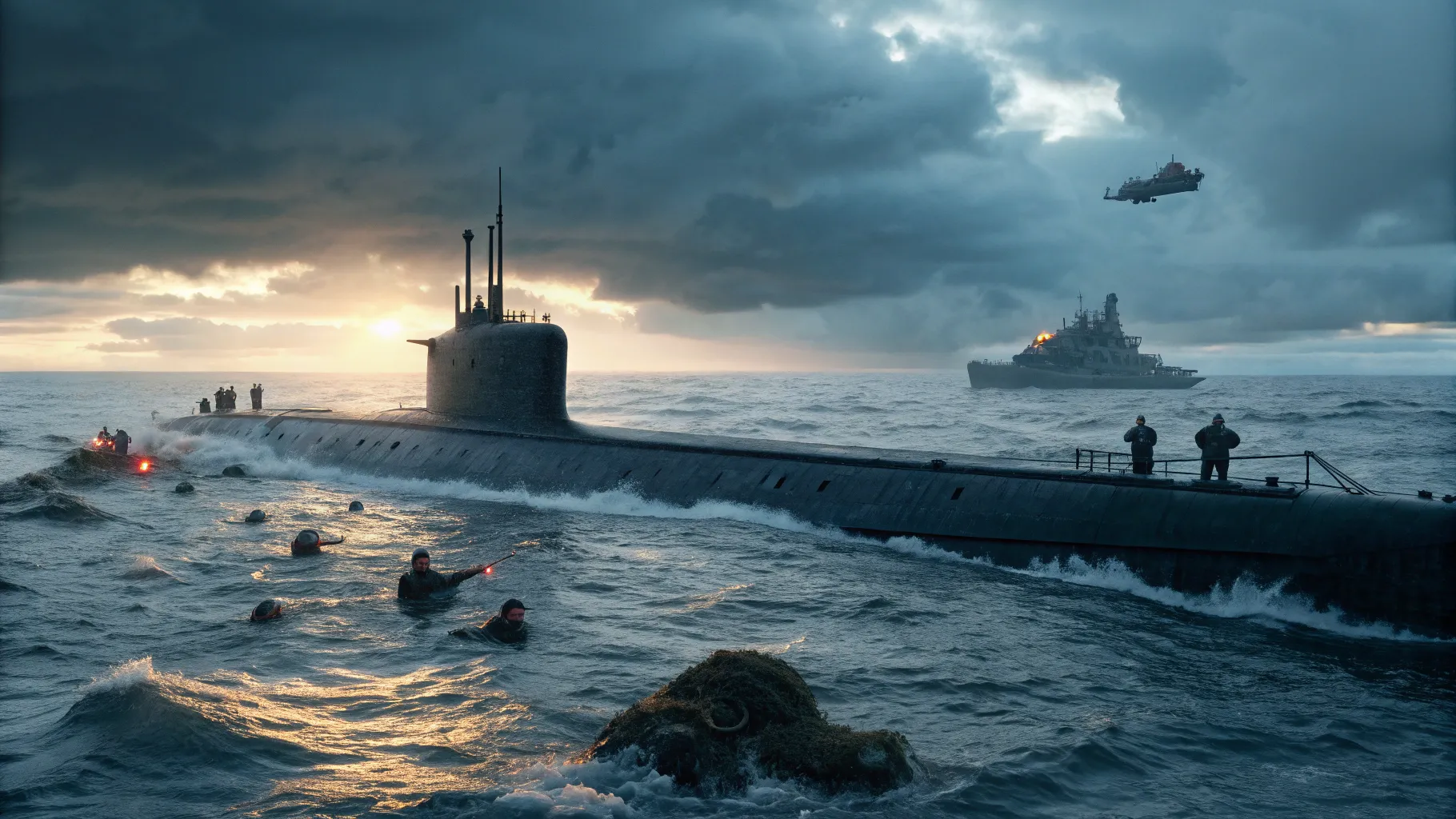
“The ocean was an invisible stage of silenced crimes.” That sentence captures the paradox of submarine warfare: instruments of strategic surprise that also hid decisions whose human cost was often measured in thousands. I have spent time examining the darker side of undersea operations in the Second World War—cases where tactical calculation merged with cruelty, and where commanders transformed submarines into engines of mass death or into instruments that blurred the line between military necessity and war crime.
Below I present a clear, evidence-focused account of the most lethal—and most morally contested—submarine commanders of that conflict. Each profile is structured like a report: the vessel and theater, the key incidents, the human toll, and what followed in terms of accountability or historical judgment. My aim is to show how operational pressures, ideology, personal temperament, and wartime cultures produced different kinds of violence under the waves.
🌊 Aleksandr Marinesko — The Soviet Commander Who Sank the Wilhelm Gustloff
Aleksandr Ivanovich Marinesko emerged from Odessa and naval training with a temperament perfectly suited for submarine warfare: bold, restless, and contemptuous of routine restraint. By the end of the war he commanded S-13 and sailed into the Baltic at a moment when the sea had become a mass evacuation route.
Key incident
- Date: 30 January 1945
- Target: MV Wilhelm Gustloff
- Context: Operation Hannibal—the massive German evacuation of military personnel and civilians ahead of the Soviet advance.
- Outcome: S-13 fired torpedoes that struck the Gustloff; over 9,000 people perished, making this the single deadliest maritime disaster in history.
Marinesko’s conduct under the periscope was methodical. He calculated speed and torpedo depth, assessed escorts, and launched. The immediate scene in his conning tower was not triumphalism. He watched the liner list, fill, sink. The crew aboard S-13 remained silent. For many in the flotilla his action restored professional prestige that his reputation for indiscipline had endangered.
Consequences and controversies
Two weeks later Marinesko repeated this pattern against another transport, the Steuben, again with staggering loss of life. The combined deaths approach 14,000 from the two sinkings—numbers unmatched by any single submarine commander in the war.
Yet Marinesko’s legacy is paradoxical. His brilliance as a submarine tactician coexisted with chronic alcohol problems and clashes with superiors. He was never awarded the highest Soviet honor during his life and was later demoted and sidelined. Only in 1990, during the period of Soviet reassessment, did he receive formal recognition—long after his death in 1963.
From a legal or moral standpoint, the Gustloff and Steuben attacks raise difficult questions. Both ships carried military personnel and were legitimate military targets by rules commonly applied at the time. Still, the human scale of the catastrophe and the presence of many civilians and wounded survivors have ensured that Marinesko’s name remains contested: a heroic figure for some and a commander of extraordinary lethality for others.
🔪 Tatsunosuke Ariizumi — The I-8 and the Terror at Sea
Tatsunosuke Ariizumi transformed the Japanese submarine I-8 into a platform for systematic terror. I-8 was large, fast enough, and armed for extended ocean patrols—perfect for commerce raiding. Under Ariizumi’s command the boat’s operations repeatedly crossed into personal cruelty and murder.
The Salak massacre
- Date: 26 March 1944
- Ship: SS Salak (Dutch)
- Outcome: After torpedoing and boarding, survivors were taken aboard I-8, bound in pairs, beaten, and executed by clubbing, stabbing, or firearm; only a handful survived.
The pattern was appalling: after the initial sinking Ariizumi’s men forced sailors and passengers onto the deck, tied them, then executed many in front of their comrades. Some victims were filmed, and crew laughter was reported by survivors. Ariizumi personally supervised and sometimes participated in interrogations and executions.
Repeat offenses and tactics
Two months later Ariizumi repeated the same script with the American Liberty ship Jean Nicolet: torpedoing, forcing survivors aboard, and carrying out beatings and executions. Survivors recounted brutal interrogations, public punishments, and deliberate abandonment of bound men during emergency dives that left many to slowly drown.
Ariizumi never stood trial—he killed himself in August 1945 as his submarine faced surrender. His death closed the possibility of judicial reckoning and left the atrocities largely to the testimony of a few survivors and postwar historians. The I-8 cases are emblematic of deliberate, personal sadism applied in the maritime environment: not merely killing as a byproduct of combat, but killing as an intentional, systematic, and theatrical act of punishment.
🚑 Hajime Nakagawa — The Commander Who Attacked a Hospital Ship
One of the clearest violations of wartime norms occurred under Hajime Nakagawa’s command. The AHS Centaur sailed under the Red Cross, clearly marked as a hospital ship. International law provided such vessels special protection. Yet Nakagawa torpedoed her without hesitation.
The Centaur sinking
- Date: May 1943
- Ship: AHS Centaur (Australian hospital ship)
- Casualties: 281 dead, 64 survivors
Eyewitnesses and evidence strongly indicate that the Centaur displayed the correct markings and lighting. Nakagawa ordered the torpedoing nonetheless. This was not just an error of identification; it was a deliberate strike on a protected vessel. The crime was compounded in subsequent actions: Nakagawa carried out or authorized firing at survivors of other sinkings, including the British tanker British Chivalry.
Postwar fate
Nakagawa was tried after the war and sentenced to execution. The Centaur incident became, and remains, a focal point in Australian memorialization of wartime atrocities. Attacks on hospital ships were a particularly grave breach of the rules of war—an affront to the concept that even amid total conflict some categories of human life must be shielded.
🧨 Heinz Eck — U-852 and the Peleus Affair
Not all those who ordered or carried out mass killings were Japanese or Soviet. The German U-boat force produced its own notorious cases. Heinz Eck, commander of U-852, offers a study in the fatal calculus that some U-boat captains adopted: the elimination of evidence, taken to murderous extremes.
The Peleus sinking and aftermath
- Date: Night of 13 March 1944
- Ship: SS Peleus (Greek merchant ship)
- Action: After torpedoing Peleus, Eck ordered his boat to fire on wreckage and survivors to destroy any debris that might reveal the attacker’s position.
- Survivors: Only a handful survived; their testimony and a seized war diary proved decisive.
U-852’s doctrine emphasized stealth. Field practice in the Atlantic, increasingly hunted by aircraft, made any floating debris a hazard. Eck converted a survival tactic—destroying telltale wreckage—into the deliberate shooting of survivors who might reveal the submarine’s location. Testimony from survivors, combined with a captured Kriegstagebuch (war diary), documented the sequence of events in detail.
Trial and sentences
Eck was tried by a British military tribunal in Hamburg in 1945. The court rejected his argument that the killings were an operational necessity. Eck and two officers received the death penalty. Their case helped establish postwar precedent: removing evidence does not justify murder of shipwrecked sailors. Eck’s trial stands as one of the rare Wartime naval prosecutions where those who fired on survivors were held criminally responsible.
⚓ Mochitsura Hashimoto — The Commander of I-58 and the Sinking of USS Indianapolis
Mochitsura Hashimoto is a key example of how legitimate military action—torpedoing a warship—can generate a humanitarian catastrophe because of circumstances beyond the attacker’s knowledge.
The attack on Indianapolis
- Date: 29 July 1945
- Target: USS Indianapolis (heavy cruiser)
- Outcome: Hashimoto’s I-58 fired torpedoes; Indianapolis sank in 12 minutes. Approximately 1,196 sailors went into the water; only 316 survived the subsequent days adrift—many succumbing to exposure, dehydration, and shark attacks.
Hashimoto calculated and executed a textbook attack on a valid military target. He did not know Indianapolis’s complete mission or the disastrous failure in transmitting her distress. In legal and operational terms his actions were legitimate; in human terms the scale of suffering was overwhelming.
How history judged him
Hashimoto later testified at a court-martial involving the Indianapolis’s captain, offering the view that his actions would have succeeded regardless of the crew’s maneuvers. For many Americans the sinking became mythic, and Hashimoto’s name became associated with one of the worst single-event losses of U.S. Navy personnel. He maintained that he had performed his duty and never expressed contrition. He survived the war and later published memoirs that framed the attack as a professional accomplishment rather than a moral calamity.
🔬 Wolfgang Lüth — Methodical Efficiency and an Icy Indifference
Wolfgang Lüth became one of the Kriegsmarine’s most successful and celebrated U-boat commanders. What differentiates him from the most grotesque perpetrators is the nature of his violence: methodical, industrial, and emotionally detached rather than sadistic or theatrical.
Operational profile
- Service: Reichsmarine to Kriegsmarine, U-boat ace
- Notoriety: 47 ships sunk, over 225,000 tons of shipping
- Style: Precise, leadership-focused, obsessed with tonnage as a metric of success
Lüth was not infamous for ordering mass slayings of survivors, yet testimony from those who encountered his command recorded a chilling indifference to human suffering. He treated undersea warfare as an exact art: locate, approach, strike, withdraw. The human aftermath—men in life rafts, the injured flailing in oil-slicked water—was collateral to the metric of achievement he pursued: tonnage sunk.
Ideology and legacy
Lüth embraced National Socialist rhetoric and accepted the role that the Nazi regime cast for naval heroes. He was used in propaganda and presented as an exemplar of martial virtue. After the war his life ended violently: he was accidentally shot by a German sentry in May 1945. This abrupt death denied any postwar trial or comprehensive moral accounting of his choices. His reputation today remains split between technical brilliance and association with a regime that normalized mass death as policy.
🔥 Fritz-Julius Lemp — The Man Who Torpedoed Athenia and Lost the Enigma
The war’s opening days produced decisions with outsized consequences. Fritz-Julius Lemp torpedoed the passenger liner SS Athenia on 3 September 1939—only hours after Britain declared war on Germany. Athenia was a civilian vessel, carrying more than 1,400 people, including many women and children.
Athenia and its fallout
- Date: 3 September 1939
- Victims: 118 dead, including 28 Americans
- Immediate reaction: German authorities attempted to conceal the truth; the U-boat log was falsified and propaganda used to shift blame.
The attack risked drawing neutral powers deeper into the conflict. Berlin’s decision to protect Lemp politically—no court-martial followed—reflected the regime’s need for aggressive U-boat commanders. Yet Lemp’s later career contained a different kind of error with massive strategic effect. In May 1941 his later boat, U-110, was captured by the Royal Navy, which seized an intact Enigma machine and codebooks. The event gave Allied codebreakers a decisive advantage in the Battle of the Atlantic.
Lemp disappeared during that action. Some accounts say he was shot while trying to return to his boat; others suggest he drowned. He did not stand trial for Athenia. His career illustrates a bitter irony: a commanding officer who committed a notorious early-war atrocity also contributed—by failing to destroy cryptographic materials—to the Allied victory in the Atlantic.
🌴 Helmut Witte — The Caribbean Predator
Helmut Witte and his U-159 operated in the Caribbean and off the Atlantic approaches to South America and Africa, where British merchant traffic remained vulnerable. Witte’s record shows both striking operational success and repeated allegations of firing on survivors.
Operational record
- Service theater: Caribbean, South Atlantic, Indian Ocean
- Notable sinkings: Several vessels, overall tonnage approaching six figures in a short period
Witte’s approach was to use surface gunnery to finish burning ships and to neutralize visible wreckage. Multiple survivor accounts later stated that U-159 opened fire on survivors in life rafts—sometimes from the deck or using the submarine’s deck gun. That pattern matches a broader, unwritten practice among some U-boat commanders: destroy evidence and eliminate potential witnesses.
Death in action and legacy
Witte’s career was cut short: U-159 was sunk by a Catalina flying boat in July 1943. He and his crew perished, and with that demise legal reckoning never occurred. He entered historical memory as a brutal but successful captain; his death prevented any formal trial that could have verified or refuted survivor claims.
🇺🇸 Dudley "Mush" Morton — Aggressive Leadership and the Buyo Maru Controversy
Dudley "Mush" Morton was the archetype of the charismatic, aggressive American submarine skipper. He revived the fortunes of USS Wahoo and turned the boat into a terror for Japanese shipping. Morton's name is remembered in U.S. naval lore as a model of bold command—yet a single torpedo attack stained that legacy.
The Buyo Maru incident
- Date: 26 January 1943
- Ship: Buyo Maru (Japanese transport)
- Contested facts: Wahoo torpedoed Buyo Maru. Morton later ordered surface fire on survivors, believing them to be enemy soldiers who would simply return to fighting if rescued. Unknown to Morton, the transport carried hundreds of Indian prisoners of war.
Morton’s intense focus on denying the enemy reinforcements led him to order machine-gun and deck-gun fire on men in the water. Many of the dead were not Japanese soldiers but colonial troops captured by the Japanese—individuals who should have been treated as prisoners, not as legitimate targets. The episode remained largely obscured during the war; Morton was celebrated at home and awarded decorations.
Aftermath and historical reassessment
In the decades since the conflict, declassified records and survivor testimony have forced a re-evaluation. Morton never faced charges. The case exemplifies how operational narratives and propaganda can bury inconvenient facts, and how moral scrutiny can arrive only when detailed documentation and comparative testimony are available.
⚖️ Patterns, Motives, and the Legal Aftermath
After examining these cases, certain patterns emerge. Commanders who crossed ethical lines usually did so for one or more of the following reasons:
- Operational pressure. Air reconnaissance made floating debris dangerous. Some captains chose elimination of evidence as survival strategy. Eck’s defense that debris could betray a submarine’s location is an extreme example, but that fear was real.
- Ideology and dehumanization. Commanders shaped by intense nationalist or racist doctrines (notably in the Japanese and Nazi contexts) were more likely to treat enemy and civilian lives as expendable.
- Personal temperament. Some officers—Arizumi, Nakagawa—displayed a streak of sadism or public humiliation that goes beyond a calculus of survival or mission success.
- Culture and reward systems. Tonnage counts, medals, and propaganda elevated certain behaviors and sometimes discouraged restraint. When the metric of success is sunk tonnage rather than humane conduct, incentives distort judgment.
Legally, the war produced uneven results.
- Some perpetrators were tried and executed or imprisoned (Heinz Eck, Hajime Nakagawa).
- Others died before accountability could be pursued (Helmut Witte, Tatsunosuke Ariizumi by suicide, Fritz-Julius Lemp in combat), or were sheltered by their home governments for political reasons (Wolfgang Lüth’s propaganda status).
- Some clear crimes were never legally addressed—either because evidence was lacking or because the victor states prioritized other prosecutions and narratives.
Two legal conclusions that surfaced from trials and postwar jurisprudence stand out:
- Operational necessity does not justify deliberate killing of shipwrecked survivors. The Peleus trial established this principle.
- Following orders is not an absolute defense. Commanders retained moral agency and responsibility for actions taken under their control.
🕯️ Memory, Myth, and the Politics of Remembrance
The way societies remember these commanders tells us as much about postwar politics as about wartime behavior. Propaganda elevated certain figures into heroic archetypes. States often preferred tidy narratives of valor over messy accounts of questionable conduct that would tarnish national myths.
For example:
- Soviet memory. Marinesko was a complicated figure: brilliant at sea, marginalized ashore. He was rehabilitated late, during a period of reassessment in the final decades of the Soviet Union.
- Japanese memory. Some perpetrators were quietly reintegrated into postwar society or evaded trial; others committed suicide and left no accountability trail.
- Allied memory. Figures like Morton were celebrated immediately, and inconvenient episodes were suppressed or minimized to promote morale and the wartime narrative.
That selective remembrance has consequences. When crimes go unpunished or are whitewashed, survivors and families remain without closure. Historical truth becomes contingent on which archives are opened and which testimonies are heeded. In this sense, the ocean’s silence after a sinking can become an institutional silence sustained for decades.
📚 What Survives as Evidence
Investigating these incidents depends on several kinds of documents and testimony:
- Survivor testimony. The accounts of those who were rescued are central. They provide the human details that raw tonnage figures cannot.
- War diaries and logs. The Kriegstagebuch of U-852 is a classic example: a documentation that can both exonerate and condemn depending on how it is read.
- Allied intelligence and codebreaking. In the case of U-110, the capture of Enigma material provided operational leverage and later helped reconstruct U-boat activities.
- Postwar tribunals and archives. Trials created a public record; the absence of trials leaves gaps that historians must try to fill via other sources.
Each type of evidence has limits. Memory fades. Logs may be falsified. Propaganda can obscure facts. Yet taken together, these sources make a persuasive composite portrait of behavior, decisions, and consequences at sea.
🔍 Lessons and Reflections
Studying the most violent submarine commanders of the Second World War offers hard lessons:
- Wartime incentives matter. Structures that reward quantifiable destructive success without parallel checks on humane conduct will inevitably produce abuses.
- Operational fear is not a moral refuge. The risk that wreckage could reveal a submarine position did not justify indiscriminate killing. Effective rules of engagement and command restraint are essential.
- Documentation matters. Where diaries, survivors, and captured materials exist, they often become the difference between impunity and prosecution.
- Memory can be corrected, but only with commitment. Historical reassessment requires political will, archival access, and moral courage to face uncomfortable truths.
These lessons remain relevant. Modern naval operations continue to pose dilemmas about surveillance, the protection of noncombatants, and the treatment of survivors. The wartime culture that produced these commanders is not ancient history; it is a cautionary precedent.
🔚 Conclusion — Between Strategy and Crime
I have laid out the contours of a grim gallery: commanders who combined technical skill with brutal choices, the legal and moral debates that followed their actions, and the ways in which states have either punished or protected them in the aftermath. The ocean’s depths provided anonymity and the illusion of finality. Yet for many victims, for history, and for the legal record, these acts did not vanish without trace.
Submarine warfare in World War II cannot be reduced to tactical success or statistical achievement. It must also be judged by its human consequences. Whether a commander acted out of professional rigor, ideological conviction, or personal cruelty, the lives taken and the suffering inflicted were real and measurable. The trials, the silence, the propaganda, and the late reckonings together form a complex legacy: a reminder that even the most technically efficient instruments of war are operated by fallible and sometimes monstrous humans.
"When the ocean turned to night and everything left of a man was wakefulness and vertigo, that was where some felt most alive—and some felt empowered to destroy beyond warfare's rules."
I report these events not to sensationalize but to underline a practical truth: accountability and restraint matter in war as much as firepower. The sea kept many secrets for a long time. It is our responsibility to remember what washed up on its surface and to learn from it.


