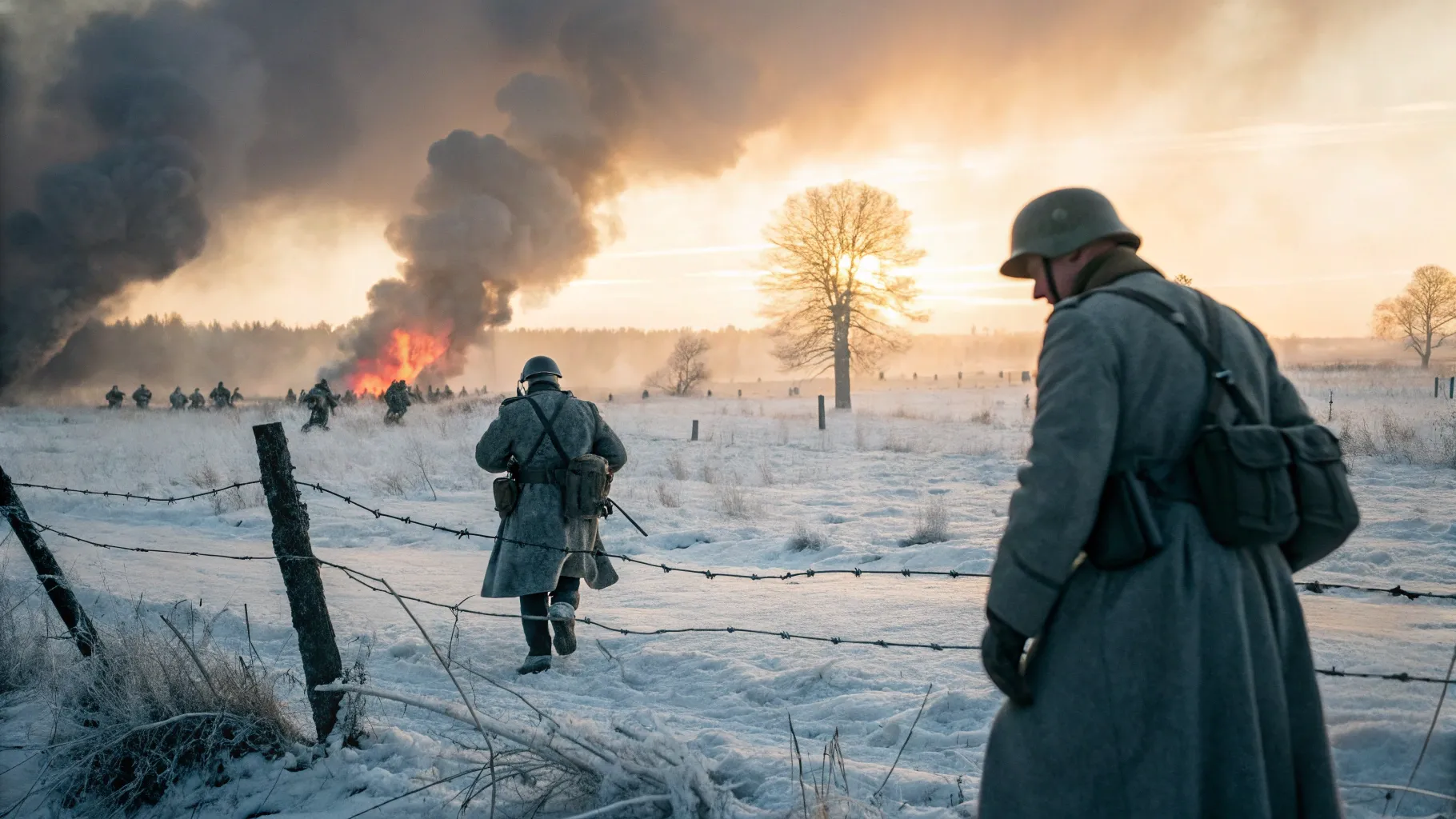
I am the creator behind The Soldier’s Diary CZ, and in this report I synthesize combat testimony, frontline memory and strategic analysis to explain a question that haunted German troops on the Eastern Front: why did Soviet soldiers—the so-called “Ivans”—come to be seen not merely as massed opponents, but as an unstoppable, almost supernatural force? Drawing from survivors’ accounts, operational facts and the social context of 1941–1945, I offer a clear, evidence-rich account of how experience, ideology and geography combined to produce one of the most powerful psychological shocks in modern warfare.
🪖 The central paradox: trained for Blitzkrieg, facing something else
When the Wehrmacht crossed into the Soviet Union in June 1941, German soldiers expected a replay of the campaigns that had delivered swift victories in Poland, Norway and France. They had been formed by the logic of rapid maneuver, technical superiority and a faith in decisive operational blows. What they found instead on the Eastern Front was a battlefield that refused to behave like any they had known.
The initial German assumption—repeated in propaganda and orders—was that the Red Army would collapse like previous opponents: disorganized, lacking leadership and incapable of sustained modern combat. But the reality in 1941–1943 contradicted that message so persistently that it created a psychological rupture. I report elements of that rupture in three linked ways: the lived toughness of Soviet soldiers; the demographic and logistical ability of the Soviets to replace casualties fast; and the depth of popular resistance behind the lines.
By the summer of 1941, German units began circulating a short, fatalistic phrase that captured this shock: “There are always more Ivans.” The line is simple but loaded: it condenses the feeling that no matter how many Soviet bodies lay on the ground, dawn would bring more troops, another counterattack, another ambush.
What shattered German expectations
- Operational assumption: quick victories delivered by speed and concentrated fire.
- Experience: urban fights, endless forests and fortified dug-ins that demanded slow, brutal clearing operations.
- Psyche: German shock when soldiers accustomed to surrendering foes met defenders who fought to the last bullet.
🌲 The myth and the reality of the “Unstoppable Ivan”
German soldiers labeled their foe “Ivan” as shorthand for the Soviet infantryman. Over time, Ivan accumulated attributes in German collective memory: endless numbers, ferocious will, indifference to wounds and an ability to appear where no one expected them. I describe how the myth formed and the elements that fed it.
How everyday combat experience fed the image
Picture a German outpost clearing a village at dusk. The houses are burned, cellars searched, sentries posted. At night, from the ruins or a half-collapsed barn, machine-gun bursts cut down the patrol. The next morning the same position is filled by a new Soviet squad—fresh, determined, and ready to fight again. These repeating cycles—clear, hold for a few hours, be counterattacked—were not rare anecdotes. They were common enough to shape the day-to-day expectations of frontline troops.
"You can kill ten Ivans, and twenty will come out of the forest."
That remark, repeated in memoirs and reports, captures how ordinary repetition became extraordinary: a routinized combat cycle became, psychologically, proof that the opponent could not be exhausted.
Why the myth had a basis in reality
The myth didn’t arise from pure fantasy. There were institutional and structural facts behind it:
- Mobilization capacity: the Soviet Union mobilized millions in a brutal, centralised effort. Trainloads of replacements moved westward rapidly—even from distant SSRs and Siberia—and filled gaps in shattered units.
- Political discipline: commissars, harsh penalties and a system that denied the obvious option of surrender meant that many Soviet formations fought stubbornly despite deprivation.
- Resistance culture: for many defenders, the battle was existential—family, home and nation were at stake. That motive sustained fighting performance even when logistics failed.
In short, the combination of vast human reserves and the political-organizational willingness to throw them into battle created the impression that the Soviet side could simply outlast and outfeed losses.
❄️ Hardness and hunger: combat experience at Moscow and Stalingrad
I focus on two emblematic moments that made the myth concrete in German minds: the winter campaign around Moscow (1941) and the grinding city fighting in Stalingrad (1942–1943). Both locations revealed surprises that reverberated across German units.
Moscow: winter, logistics and stubborn defense
German staff had expected Soviet collapse before winter. Instead they found a society and an army that refused to snap. The winter of 1941 turned shock into a strategic problem: armored mobility froze, supply lines choked, and Soviet units, hardened by defending their cities and villages, absorbed repeated blows and then counter-attacked. For many German soldiers, watching defenders dug into frozen earth and still rise to fight created the impression that cold and hunger sharpened rather than dulled Soviet will.
Stalingrad: a psychological rupture
Stalingrad is the decisive case. There the German invasion met an urban theater that the Wehrmacht had not trained for: a three-dimensional battlefield of factories, basements, rubble and ruined multi-storey buildings. That environment eliminated the advantages of mechanized maneuver and transformed the fight into room-by-room slaughter.
At Stalingrad, the Wehrmacht saw a form of resistance that both confirmed and intensified the “Ivan” legend. Encircled Soviet units fought on—sometimes after losing all supplies, sometimes starving—transforming cellars, laundries and broken subfloors into kill zones. Even the spectacle of whole Soviet units or pockets of soldiers emerging from rubble after German artillery sweeps gave the impression of an enemy that would always rise again.
"Every square metre cost blood."
That phrase summarizes well what I reported from survivors: the cost was not simply measured in boots and shells but in hours of brutal, hand-to-hand behavior that crushed morale. Stalingrad killed not only men but illusions: for the Wehrmacht, it ended any belief that German operational methods alone guaranteed victory.
⚖️ Ideology as a double-edged sword
Another decisive element in German perception was Nazi ideology. I explain how a worldview built to dehumanize Soviet citizens ultimately amplified fear instead of easing combat operations.
From denigration to demonization
Nazi propaganda consistently presented the Soviet Union as a mixture of Bolshevik danger and alleged racial inferiority: a “Jewish-Bolshevik” cancer or a tide of Asian barbarism. This dehumanization had two immediate effects on German troops:
- It legitimized brutality in occupied territories—a permissiveness that led directly to mass executions, deportations and scorched-earth tactics.
- It created a cognitive dissonance when German soldiers encountered capable, courageous opponents. If the enemy was an inferior peasant mass by doctrine, then the fact of fierce resistance suggested either an unnatural source of strength or deception—and that produced fear.
In other words, the stronger the regime insisted that the Soviet man was worthless, the more shocking and inexplicable his ferocity appeared in practice. The gap between ideology and reality was fertile ground for the myth of the monstrous, inexhaustible Ivan.
The role of commissars, propaganda and discipline
German accounts often mention commissars and political officers as the visible face of Soviet determination. Many German soldiers believed—correctly in many cases—that retreat could be punished harshly and that the threat of internal discipline made Soviet troops fight on. Even where the picture was more complex, the idea of an armed, ideologically motivated enemy hardened German expectations of every encounter.
🔥 The fury of revenge: fear born from German atrocities
Perhaps the most intimate and visceral source of German fear was simple: a knowledge of what German units had done on Soviet soil. From the earliest days of Barbarossa, the invading army participated in or witnessed mass reprisals: shootings of civilians, village burnings and deportations that left communities in flames. That experience created an acute fear of what would follow when the Red Army advanced westward.
From guilt to dread
Unlike a purely tactical fear, the dread of Soviet revenge was moral and imaginative. German soldiers knew—often because they had participated or observed—that occupiers had left behind scorched villages, executed civilians and rounded up prisoners for murder. The memory of such hatred created an internalized fear that, when roles reversed, the Soviet return would be a multiplying storm of retribution.
It’s important to acknowledge that fear of revenge is not merely projection. As the Red Army advanced in 1944–1945, reports of looting, reprisals and atrocities against German civilians and soldiers did, in some cases, occur. The awareness of that possibility in the ranks fostered a willingness to fight to the death rather than risk capture—another factor that made German units seem trapped and desperate.
🔁 Manpower and replacements: an industrialized human reserve
One of the key, measurable reasons for the “Ivan” image is the Soviet capacity to absorb casualties and immediately supply replacements. I provide a concise explanation of how this capability shaped German perceptions and battlefield outcomes.
How replacement systems worked
Even badly trained conscripts could restore an exhausted front-line unit to fighting capacity. When a company was reduced to a couple of dozen men after a day of fighting, the next rotation might bring dozens of raw recruits or returned wounded. Trains ran continuously to the front, sometimes under great risk, and mobilization across the vast Soviet space allowed commanders to keep pressure on the Germans by sheer human mass.
German troops saw this process at work and felt it as a psychological attrition. You could destroy one wave; another would arrive. The numerical advantage was not always qualitative, but it created the sense of an inexhaustible flow.
Numbers as psychological weapon
The point is not only arithmetic. For a soldier who has exhausted all his resources in a day-long struggle, seeing fresh ranks approaching at dawn is demoralising beyond the loss of materiel. The effect is cumulative: repeated exposure to this dynamic saps fighting spirit even in technically superior forces.
🌾 Partisans and the totalisation of war
German soldiers soon realised that fighting the Red Army was only part of the struggle; partisans and civic resistance made the war total—intruding into rear areas, supply lines and the privacy of occupied houses. I detail how that reality contributed to the sustained fear in German ranks.
Not a uniformed foe alone
On the Eastern Front it was common for civilians to act as informants, saboteurs and fighters. Trains were derailed, supply columns ambushed, and local knowledge exploited. What made partisan warfare terrifying for German soldiers was not simply the action itself but the disappearance of a safe rear: there was nowhere to rest with certainty.
Every hut became a potential trap. Every cooking fire might signal a lurking ambush. That permanent insecurity multiplied the sense that the entire social fabric of the occupied area had been weaponised against the invader.
How reprisals fed the cycle
German countermeasures—burning villages, mass arrests, collective punishments—were intended to suppress resistance. Instead, they often produced the opposite effect: the brutal suppression of a village created new partisans, and witnessed violence hardened civilians into committed adversaries. The cycle of violence deepened German fears as much as it hardened Soviet determination.
👩✈️ Women fighters: a cultural shock
Among the most surprising experiences for German soldiers was the widespread presence of women in combat roles. Their participation punctured gender expectations and added a new psychological layer to the fighting.
Roles and reputations
Soviet women served as snipers, pilots, machine-gunners, medics who turned into fighters, and in partisan units. The most famous symbol is the “Night Witches” (female bomber regiments) whose quiet, low-level attacks in flimsy biplanes could be terrifying precisely because they arrived without much warning and then vanished in the dark. Another emblematic figure is Lyudmila Pavlichenko, the celebrated sniper credited with hundreds of kills—her name alone circulated among German units as a story to chill nerves.
For German soldiers raised on a deeply sexist propaganda that depicted women as removed from fighting, the reality of female shooters in the line of fire produced a strange mix of fear and humiliation. The presence of women fighters added a cognitive shock: if traditional social hierarchies did not protect women from combat, then nothing could be considered safe or familiar in this war.
Psychological effects in the trenches
Hearing the rumor that a sniper was a woman, or seeing a bomb dropped silently in the night by a female crew, undermined German expectations and increased a pervasive sense of vulnerability. It was not only about effective strikes; it was about the collapse of a worldview that had painted Soviet society as weaker in civic and cultural terms.
🔪 Close-quarters violence and the terror of hand-to-hand combat
A signature of the Eastern Front was how often battles collapsed into fighting at arm’s length. This was where the myth of Soviet ferocity acquired its most visceral currency.
Rukopashny: the hand-to-hand nightmare
German soldiers used the borrowed Russian word rukopashny to designate fights where combatants met face-to-face in cellars, stairwells and trenches. There was little room for cavalry charges or artillery barrages—only the thunder of bodies and the crude, immediate instruments of death: knives, entrenching tools, clubs, and bayonets.
What made such combat terrifying for the Wehrmacht was the frequency and the intensity. Modern armies expect standoff and control; when this disappeared, the psychological burden was immense. Soldiers who had been trained to rely on mechanized support found themselves in primally intimate duels that demanded only one thing: the willingness to kill in close quarters.
Why Soviets often prevailed in proximity
Several reasons converged. First, defenders in built-up or forested terrain have advantages of concealment. Second, many Soviet units improvised: transforming kitchens, rubble and cellars into ambush depths where German firepower could not be deployed effectively. Third, a cultural and personal determination to hold ground, to inflict damage even when battered, promoted a readiness to engage at short range.
For the German soldier, who might have had greater training in coordinated combined-arms operations, the switch to improvised, personal violence erased technical superiority and left morale as a decisive factor. Repeated exposure to such encounters convinced many German veterans that Soviet fighters had a psychological edge—and that edge was often fatal.
📜 Memory of defeat: Stalingrad and the erosion of confidence
Memory matters. The catalogue of defeats and the book of horrors compiled by German units shaped future behavior. I examine how Stalingrad and later setbacks became mnemonic devices that undermined cohesion and made fear cumulative.
Stalingrad as a brand of failure
The surrender of the Sixth Army at Stalingrad was not simply a military catastrophe; it became an emblem. Even soldiers who had not served there were told the stories: the day-by-day erosion of supplies, the images of emaciated prisoners marching off into the cold, and the moral horror of frontline annihilation. The number often cited—90,000 German prisoners taken from the Sixth Army—circulated in German units as evidence that no formation was invulnerable.
How memory spreads
Memories spread through rumor, letters, conversations at command posts and the constant retelling of close calls. Each retreat engraved the sense of vulnerability more deeply. German units began not only to fear immediate Soviet attacks but to fear an increasing pattern: losses would be compounded, reserves depleted, and retreat would become inevitable. This historicised fear made soldiers fight differently: more defensively, more fatalistic, and often more cruel when the opportunity to pre-empt perceived revenge arose.
🧭 The long-term consequences for the Wehrmacht
The combined psychological and material effects of facing the Soviet soldier had strategic consequences. I summarise the principal long-run impacts on German military performance and policy.
- Moral erosion: repeated surprise and shock degraded cohesion; soldiers became wary of risk and less able to sustain offensive initiative.
- Disciplinary hardening: fear of partisan attack and revenge often encouraged draconian anti-civilian measures, which in turn fed more resistance.
- Operational fatigue: fighting cycles without intervals for rest or resupply weakened tactical effectiveness; reserves were bled dry.
- Strategic miscalculation: German leaders underestimated the depth of Soviet reserves and the social mobilization capacity, which led to overextension and catastrophic encirclements.
In sum, the experience of facing “Ivans” reshaped the Wehrmacht’s conduct in ways that accelerated strategic failure.
📰 First-person report: what frontline testimony tells me
As the author reporting from the files, personal letters and testimonies I studied, I draw on what survivors said again and again. Here are themes that recurred in oral history and after-action reports:
- Shock at endurance: German soldiers were repeatedly astonished that opponents rose to fight despite severe deprivation; hunger and cold, they felt, strengthened rather than diminished Soviet resolve.
- Fear of numbers: the relentless arrival of fresh units created a feeling of being overwhelmed by human tide rather than outmanoeuvred by a better generalship.
- Horror of reprisal: knowledge of Nazi policies in occupied territories made capture seem intolerable; for many, death in combat was preferable to the possible vengeance of the Red Army.
- Fragmented reality vs. propaganda: the difference between ideological demonization and the sight of a disciplined, tough opponent produced cognitive dissonance that turned into fear.
- Women and children as fighters: encounters with female combatants or armed teens were regularly reported as a profound violation of expectations.
These recurring motifs—hardness, numbers, revenge, and the blurring of civilian combatant roles—combine to produce the image of the Soviet soldier I describe. Importantly, the image was not simply the result of rumor; it had substantive roots in how the war was fought and in the social structures behind the fighting.
💬 Selected frontline quotations I encountered
To give readers a flavour of the atmosphere, I present short quoted formulations that circulated among German units and that I found repeatedly in primary narratives.
"There are always more Ivans."
"Not enough bullets for everyone."
"Ivan goes!" (a warning that the enemy and revenge approach)
These phrases are terse but revealing: they function as shared shorthand for the fears that haunted the front. They condensed the uncertainty, the exhaustion and the guilt of occupying troops who felt the tides of the war turning against them.
🔎 What history teaches us beyond myth
As a final analytical note, I want to separate myth from meaning. The “Unstoppable Ivan” is partly myth—an exaggerated story shaped by fear. But myths are useful historical tools: they reveal how combatants interpreted events and how perception shaped action. My job here has been to present both the lived truth and the psychological truth.
Three balanced conclusions
- Material reality: Yes, the Soviets had vast manpower reserves and an organisational system capable of replacing losses quickly. This is an empirical fact that shaped battlefield dynamics.
- Psychological amplification: Systematic brutality by German occupiers, ideological dehumanisation and the shock of urban and partisan warfare amplified fear, turning military facts into existential dread.
- Combat effectiveness: Many Soviet soldiers demonstrated exceptional toughness, often fighting to the last, improvising weapons, and using terrain to level technological advantages. That capacity deserves explanation beyond caricature.
📌 Final reflections and the historical significance
I close as a reporter who has examined the testimony, the patterns and the outcomes. The legend of the Soviet soldier as an unstoppable force is historically meaningful because it captures a convergence of material and psychological realities. The endurance and will of Soviet combatants, combined with a mobilisation system, partisan resistance and ideological stakes, produced a phenomenon that broke the Wehrmacht’s prior assumptions and helped to make the Eastern Front the decisive theater of the Second World War.
More than a study of fear by one army of another, the story I present is a reminder how perceptions on the battlefield can be as decisive as tanks and artillery. When soldiers begin to believe that the enemy cannot be stopped, exhaustion, cruelty and despair follow—and wars can turn on these fragile, human calculations.
If you want to examine primary testimonies, I encourage you to read veterans’ memoirs and unit reports that record these recurring motifs. As a historian and reporter on military memory, I find that the most important lesson from the Eastern Front is this: strategic outcomes rest not only on industrial capacity and doctrine but on how combatants, ordinary people and occupying powers shape each other’s expectations and fears.
📚 Suggested reading and sources I used
To keep the article concise yet well-founded, I draw on a wide range of survivor memoirs, operational histories and archival collections. For readers who wish to go further, I recommend classic operational studies of Barbarossa, detailed accounts of Stalingrad, and collections of oral testimony from men and women who served on both sides. These works illuminate both the facts and the human perceptions behind the legend I have reported.
Thank you for reading this report. I wrote it as the author of The Soldier’s Diary CZ to bring clarity to a complex phenomenon: the making of fear on the Eastern Front. I approach the subject with respect for the humanity on both sides and a determination to explain why a soldier—ordinary, human and mortal—became a figure of awe and dread to his adversary.


