🎬 Introduction — Reporting from the Aftermath
I watched the documentary produced by The Soldier’s Diary CZ and felt compelled to write a detailed report about what happened in the months and years after Nazi Germany’s collapse. In this article I retrace the decisions, debates, personalities and courtroom drama that culminated in the Nuremberg Trials — the moment the world attempted to turn fury into law and revenge into precedent.
What follows is my news-style account: rooted in the historical record, anchored in the voices and actions of the men who shaped the tribunal, and attentive to the human drama performed on the stage of the Justice Palace in Nuremberg. I write as a reporter and a reader of history — trying to make sense of how and why the victorious powers chose to try, rather than summarily execute, the architects of the Third Reich.
🔎 From Vengeance to Procedure — The Immediate Desire for Revenge
At the end of World War II, the mood among Allied leaders and the broader public mixed triumph with a deep, elemental anger. Images of liberated concentration camps, mountains of corpses and the harrowing testimonies of survivors ignited a fierce desire for punishment. In the immediate aftermath, the dominant instinct among many was not to hold meticulous legal proceedings but to mete out instant retribution.
In private and public discussions across Washington, London and Moscow, extreme options were considered. Some proposals were chillingly blunt: mass executions, summary shootings, and even the idea — reportedly entertained in conversation at the highest levels — of decimating German command structures with mass killings to “break the backbone” of militarism. Such views were expressed by influential figures of the era, including Franklin D. Roosevelt and Winston Churchill, and were echoed by generals who had led Allied forces on brutal battlefields.
General Dwight D. Eisenhower, commanding Allied forces in Europe, used the vernacular of the army when he conveyed his feelings about captured Nazi leaders — advocating that they be “shot when they try to escape,” a phrase that captured the impatience and hard calculus of wartime commanders. Walter Bedell Smith, Eisenhower’s chief of staff, argued that indefinite imprisonment would allow Nazi elites to reconfigure and resurrect their networks. Henry Morgenthau, the U.S. Secretary of the Treasury, went still further: his plan envisioned an agrarian, deindustrialized Germany that could never again threaten Europe.
These were not marginal voices. They were the reactions of men weighed down by the costs of war: millions dead, cities razed, terror institutionalized. But while understandable, such impulses carried enormous moral and practical risks. Execution without trial would deny the world an authoritative account of the crimes and provide fertile ground for propaganda and conspiracy theories. The question then loomed: should victors administer instant punishment, or should they create a process that resembled, and sought to establish, justice?
🧭 Stalin’s Surprise and the Turning Point
In a striking reversal of expectations, Joseph Stalin — leader of the Soviet Union, whose regime had presided over its own brutal purges and summary executions — argued for formal trials. He recognized, with cynical clarity, that a public legal process would confer legitimacy on the verdicts in a way that wholesale executions could not. Stalin insisted that a court would make the Allies' actions look like principled justice rather than simple elimination of rivals.
Stalin’s motive was not humanitarian. It was strategic. He understood propaganda and the optics of legitimacy much better than many Western leaders anticipated. If the Allies wanted to present the dismantling of Nazi leadership as a matter of law and international order, trials were the better path.
This Soviet insistence opened a path toward a new form of accountability: a multinational tribunal with procedures, records and — critically — public visibility. That pivot made it possible for men like Robert H. Jackson to push their own vision of a rigorous, document-based process that would aim not just to punish but to create legal precedent.
⚖️ Robert H. Jackson’s Role — From Doubter to Architect
I find Robert H. Jackson to be the central figure in the transformation of raw appetite for revenge into a legal experiment of global significance. Appointed by President Harry S. Truman as the chief U.S. prosecutor, Jackson traveled to London and then to Nuremberg, carrying with him a belief that law — even if imperfect — could do something other than spectacle.
Jackson was no ivory-tower jurist. He had become an Associate Justice of the U.S. Supreme Court through practical work and political service. He had opposed mass internment in the United States during WWII, demonstrating a sensitivity to rights and legal principles even when they ran counter to wartime sentiment. Initially, Jackson admitted he preferred “direct military execution over a fake tribunal aimed at condemning.” Yet as the project developed he embraced the task of making it a real, rule-based court.
Jackson’s first challenge was political: convincing London, Moscow and Paris to accept a tribunal governed by procedure and evidence, rather than by expedient retribution. He argued that the purpose of the trial should be to establish precedent — to show the world that the planning and execution of aggressive war and systematic mass murder could be legally condemned. He proposed that crimes be framed broadly enough to capture the nature of the Nazi state’s criminality: conspiracy to wage aggressive war, war crimes and crimes against humanity.
His opening address in Nuremberg remains a defining moment. He spoke for over four hours, calmly and forcefully explaining that the point of the proceedings was not vengeance but to prevent future wars by creating legal standards. He presented documents — orders, meeting minutes, signed directives — as the backbone of the case. For Jackson, documents were less theatrical props than sovereign evidence: the signatures and memos of Nazi leadership proved that atrocities were planned, organized and systemically implemented.
📜 The London Charter and the Legal Architecture
The road to Nuremberg required a formal charter. Negotiations in London produced the document that established the International Military Tribunal and defined the categories of crimes. These talks were fractious, revealing the rifts that would later define early Cold War tensions.
Each of the four powers had distinct aims that had to be reconciled in a fragile compromise. The Americans pushed for a broadly framed tribunal that could set a legal precedent. The British feared a long, potentially propagandistic trial that might grant the accused a stage. The French insisted that crimes on their soil be given particular emphasis. The Soviets pressed for swift, punitive procedures and wanted to hold Germany accountable for crimes that were more political than strictly legal, including crimes they attributed to Germany like Katyn — a claim that later proved contentious.
The final charter created a hybrid institution: an international tribunal with judges and prosecutors from the four Allied powers, four categories of criminality, and rules about procedure that were meant to ensure basic fairness — the right to counsel, the right to present evidence and witnesses, and the right to confront the prosecution’s case. It was an unprecedented experiment: an ad hoc court designed to serve both legal and political ends.
🎭 The Trial as Theatre — Nuremberg’s Global Stage
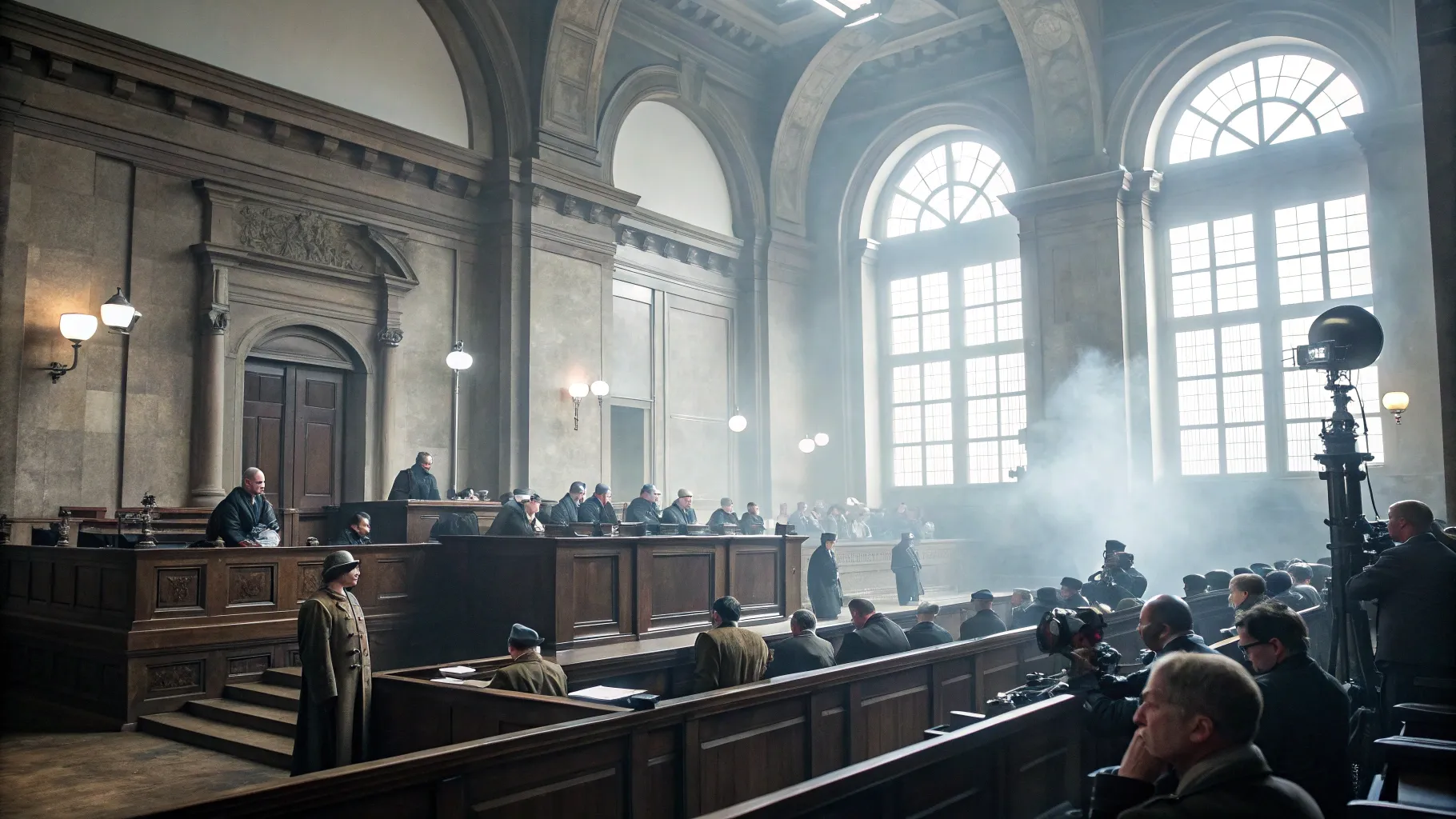
When the trials opened in the Palace of Justice on November 20, 1945, the world watched. The courtroom was set up not only to hold a legal proceeding but to broadcast the meaning of what was happening: a multinational bench, simultaneous interpretation booths, projection equipment, and film cameras. This was the first time a trial had been staged with such global reach.
In my reporting I emphasize that Nuremberg operated both as a courtroom and as an orchestrated public event. Day after day, journalists, diplomats and observers filled the galleries or consumed the proceedings through newsreels and newspaper reports. The trials had immediacy: the films of the camps, the meticulous reading of top-level directives, and the visual of leading Nazis sitting together on one bench made for an unforgettable tableau.
The prosecution’s methodical presentation of documentary evidence — maps, orders, memos — made the case concrete. Jackson’s team did not rely primarily on rhetoric; they wanted the paper trail to speak. When films of concentration camps were projected, they had an effect that no speech could match. The courtroom images were then transmitted to cinemas and dailies; the world saw and assimilated a coherent, documented story of state-directed genocide.
🕴️ Hermann Göring: The Protagonist on the Bench
Of all the figures on the defendants’ bench, Hermann Göring became the central protagonist. He entered the courtroom with an air of command, wearing decorations and exuding confidence. In a sense, Göring transformed the trial into a new theatre for Nazi rhetoric. He spoke with practiced bravado, sarcastically challenging prosecutors and positioning himself as a statesman wronged by circumstance.
Göring’s performance was paradoxical. In private interrogations he at times admitted culpability and boasted about measures taken against Jews and political opponents. Publicly, however, he deflected blame onto Hitler or framed Nazi policy as a reflection of global statecraft, arguing that every great power used propaganda and force. His rhetorical skill won him a kind of wary respect among journalists and even fellow defendants.
Yet Göring’s bravado could not erase the documentation of his actions. When the Court read memos and orders he had signed, the paper trail undercut his public posture. Göring’s physical condition and dependency on morphine were also a factor: he experienced withdrawal under Allied medical supervision and yet rallied during the trial to dominate the proceedings. He died by suicide the night before his scheduled execution, using a cyanide capsule. In that final act he once more reclaimed an element of control over his fate, denying the Allies the image of him being hanged.
6️⃣ The Birth of “Six Million” in the Courtroom
One of Nuremberg’s most enduring legacies is its role in solidifying — for the global public — the figure of six million Jewish victims. Before the trials there were disparate estimates and scattered reports. Some accounts suggested two or three million, others higher numbers. What the Tribunal did was gather demographic, documentary and testimonial evidence into a single, comprehensible narrative.
American and British statisticians, demographers and legal teams compared pre-war census data with postwar realities, combined deportation records, railway manifests, Einsatzgruppen reports, camp registries and survivor testimonies. Jackson’s opening statement and the prosecution’s evidence invoked cumulative numbers that would resonate beyond the legal proceedings. The image of millions being executed and extinguished — often shown literally on film in the courtroom — crystallized into the emblematic figure of six million.
It is important to note that the number was not created to be a precise demographic map but rather to provide a scale for the unprecedented crime. Historians and demographers later refined estimates, but at the time the six million figure performed an essential function: it conveyed magnitude to a shocked global audience and anchored the legal category of crimes against humanity to the reality of genocide.
🛡️ The Defence: Strategies and Surprises
In court, the defendants adopted a range of defense strategies, some predictable and some surprising. These ranged from outright denial and fanatical defiance, to technical legalism, to expressions of remorse — often tactical rather than heartfelt.
Several noteworthy approaches stood out:
- Denial and Provocation: Julius Streicher, for instance, remained defiantly abusive to the end, hurling anti-Semitic invective in the dock. His strategy was theatrical martyrdom; it sealed the severity of his sentence.
- Amnesia and Insanity: Rudolf Hess claimed memory loss and erratic mental status, a posture that muddied how the Court and public read his responsibility.
- “I Was Only Following Orders”: Wilhelm Keitel and others attempted to reduce liability by asserting strict obedience to superior orders — a defense the tribunal largely rejected, emphasizing that moral agency and high-level decision-making could not be washed away by formal obedience.
- Technocratic Denial and Partial Admission: Men like Albert Speer acknowledged collective guilt and presented themselves as apolitical technocrats who regretted moral blindness. Speer’s partial admission and apparent contrition likely saved him from the death penalty and earned him twenty years in Spandau.
- Diplomatic Disavowal: Joachim von Ribbentrop claimed his role was purely diplomatic and procedural, despite extensive documentary evidence of his participation in policy planning and agreements that enabled crimes.
- Comparative Argument: Karl Dönitz and others argued military legality or parity with Allied conduct — e.g., naval warfare or strategic bombing — to mitigate moral responsibility for specific charges. This produced complex debate but did not absolve key culpability.
The defenses were often creative and occasionally persuasive on narrow grounds. Some defendants were acquitted or received more lenient punishments because the evidence proved insufficient to meet the tribunal’s legal standards for individual guilt — a reminder that justice requires proof, not simply indignation.
🤝 Allied Tensions and the Fragile Compromises
Nuremberg was a multinational show of force, but the four Allied powers were never fully aligned in method or purpose. Behind the image of unity lay suspicion and divergent priorities. Negotiations over the charter and the proceedings themselves exposed deep differences:
- Soviet Emphasis on Narrative Force: The Soviet delegation prioritized spectacular, decisive verdicts and wanted to include in the record crimes they attributed to Germany even when the evidence was problematic, such as the Katyn massacre attribution.
- British Caution: The British sought a shorter, more controlled process to avoid giving the defendants a platform and to curtail a prolonged spectacle.
- American Juridical Ambition: The Americans, led by Jackson, wanted a robust legal framework that could establish norms against aggressive war and crimes against humanity.
- French Claims: The French demanded that crimes committed on their soil — deportations, suppressions, and abuses during occupation — be treated with priority and displayed prominently in evidence.
Negotiations over language, process and evidentiary standards were constantly tense. The Soviets’ insistence on including certain charges and the Western powers’ reluctance to antagonize the coalition complicated proceedings. Yet the four powers maintained the courtroom coalition because collapsing it would have been politically devastating. The Cold War shadowed the trials even as they tried to be a forum of postwar moral clarity.
📣 Verdicts: Deaths, Prison Terms and Controversies
When verdicts were announced in October 1946, the tribunal handed down twelve death sentences, several life sentences and varied prison terms — and, in some cases, acquittals. The outcomes provoked mixed reactions.
Those sentenced to death included some of the most prominent architects of the regime: Wilhelm Keitel, Alfred Jodl, Joachim von Ribbentrop and Julius Streicher among others. Hermann Göring was sentenced to death as well, but he committed suicide the night before his scheduled execution.
Albert Speer’s twenty-year sentence surprised many and remains debated. Speer’s combination of partial admission and claims of limited knowledge yielded a more lenient result; some saw it as a recognition of different kinds of responsibility, others as an injustice that allowed a senior technocrat to escape the harshest penalty.
Hjalmar Schacht and Franz von Papen were acquitted — decisions that enraged some observers and the Soviet press, which saw them as signs of a flawed or partial justice. The acquittals and lighter sentences underscored a central paradox: the tribunal sought to punish the greatest offenders while also adhering to legal standards that did not permit convictions without sufficient, specific proof. That approach protected the tribunal’s credibility even as it produced political criticism.
🧠 Inside the Cells — The Psychological Story
Beyond legal strategy and public performance, Nuremberg was a theatre of psychological collapse and resilience. The Tribunal placed defendants in close quarters, under 24-hour observation and with their private conversations recorded. These quiet hours revealed unexpected details about those who had exercised total power.
Psychiatrists commissioned to study the defendants described a variety of profiles. Göring displayed public hauteur while privately expressing anxiety and clinginess to authority. He behaved as a commanding personality even behind bars, organizing other inmates and projecting confidence.
Rudolf Hess presented either genuine mental disturbance or an effective strategic performance of amnesia and detachment. Wilhelm Keitel clung to military discipline even as he faced execution, saluting guards and trying to maintain order as his world collapsed.
Albert Speer combined intelligence with a pragmatic will to survive: his controlled demeanor and carefully framed acceptances of ‘collective guilt’ might be read as strategic self-preservation as much as conscience. Julius Streicher, by contrast, remained unrepentant and unhinged — the fanaticism of his beliefs seemed to deepen even as defeat loomed.
These psychological portraits mattered. They showed that even absolute power could not immunize men against fear, self-deception and the wrenching consequences of facing a moral mirror. The recordings, interviews and psychiatric notes from the Nuremberg cells are a lesser-known, but crucial, archive of how perpetrators confronted their acts when stripped of power and audience.
🔚 The Executions and the End of a Chapter
On October 16, 1946, the executions were carried out. Göring had taken his life the previous night. The others sentenced to death — including Keitel, Jodl and Streicher — were hanged. Witness accounts described varied final moments: ritual salutes, last shouts of defiance and, in some cases, long, public deaths. The executions closed a chapter but did not erase the controversies.
The acquittals and lighter sentences continued to fuel debate. Critics argued that Nuremberg, being a tribunal set up by victors exclusively against vanquished leaders, could not be free of political taint. Supporters responded that legal procedure, rigorous evidence collection and the public record distinguished Nuremberg from a merely vengeful act. Both critiques hold some truth: the tribunal was both legal innovation and political instrument.
📚 Legacy: Legal Precedent and the Language of Atrocity
Nuremberg’s most enduring contribution is its establishment of legal categories that shape international law to this day. The tribunal articulated crimes against humanity and held that waging aggressive war could be criminal. It created a legal language to describe state-led atrocities and set precedents for later international tribunals (Tokyo, the International Criminal Tribunal for the former Yugoslavia, Rwanda, and ultimately the International Criminal Court).
Those categories matter because they made accountability possible. They also carried conceptual pitfalls — notably the charge of “victors’ justice” — because the tribunal tried only defeated leaders. Still, the Nuremberg rulings provided a framework that later activists, jurists and states would build upon to push for more universal enforcement mechanisms.
Another profound legacy was the moral and historical consolidation of the Holocaust’s scale and character. The courtroom, through documents and images, helped fix the Holocaust in global consciousness. The “six million” figure became a focal point of memory. Whether one debates precise demographics or not, Nuremberg made the intentional, bureaucratic and pan-European character of genocide visible and legally readable.
🧾 My Analysis — Why Nuremberg Mattered
As I reflect on the entire process, I see Nuremberg as both a legal experiment and a political performance. It was an attempt to translate the horrors of total war into a new legal vocabulary and to create a public record that would inoculate future generations against denial and revisionism. Here are the core reasons it mattered:
- Legal Innovation: For the first time in modern history, international law attempted to directly criminalize state leaders for aggressive war and crimes against humanity.
- Documentary Authority: The tribunal privileged documentary evidence — signed orders, meeting minutes, transport manifests — which made the narrative of atrocity tangible and undeniable.
- Public Memory: The trials broadcast images and figures that formed the bedrock of Holocaust remembrance. The world could no longer claim ignorance.
- Deterrence and Precedent: Even if imperfect, the trials established the idea that leaders could be held personally accountable for state crimes, a principle that informs global justice efforts today.
- Moral Education: The trials forced postwar societies to confront questions about obedience, complicity and responsibility — questions still relevant when examining modern atrocities.
🔍 Remaining Controversies and Honest Questions
Nuremberg is not without its debates. I think it’s essential to face them directly:
- Victors’ Justice: The tribunal tried only Axis leaders; the Allied conduct — strategic bombing campaigns, wartime internments, or actions taken in theaters beyond Germany — were not subjected to the same scrutiny. This asymmetry raises legitimate concerns about selective justice.
- Political Compromise: The concessions made to keep the four powers aligned — for instance, tolerating disputed Soviet allegations — complicate the tribunal’s moral clarity.
- Prosecutorial Strategy: Some felt the prosecution’s breadth risked creating a precedent for criminalizing high-level political decision-making in the future. Others argued the breadth was necessary to capture the systemic nature of the crimes.
- Individual versus Collective Guilt: Debates over how to assign responsibility — for example, to technocrats like Speer versus ideologues like Streicher — remain unresolved in public opinion and legal scholarship.
Those open questions do not render Nuremberg illegitimate; rather, they make it a living subject for lawyers, historians and ethicists. The Tribunal was a beginning, not an endpoint. It established tools — legal concepts, evidentiary practices and public narratives — that subsequent institutions have had to refine and test.
📌 Conclusion — The Trials as a Historical Turning Point
When I look back at the Nuremberg Trials, I see a pivotal moment when the world tried to make law out of catastrophe. The victory that closed World War II could have been followed by wholesale retribution. Instead, the Allies — under pressure, amid suspicion and through compromise — convened a courtroom that aimed to document the crimes of a state and build a legal basis to prevent their recurrence.
Robert H. Jackson’s leadership, Stalin’s unexpected insistence on a trial, the dramatic presence of figures like Hermann Göring, the forging of the “six million” narrative, and the spectrum of defense strategies together produced a complex, flawed, and historically transformative enterprise. Nuremberg combined juridical rigor with theatrical presentation to ensure that the deeds of the Nazi regime would be recorded, adjudicated, and remembered.
In reporting on Nuremberg I remain struck by the human dimensions: the prosecutors who labored over documents, the defendants who played their roles — sometimes with candor and sometimes with evasion — and the victims and survivors whose testimonies gave moral urgency to the law. The trials did not close the story of justice in the twentieth century, but they opened a legal and moral conversation that persists to this day.
For anyone seeking to understand how modern international law confronted state-led atrocity for the first time on a global stage, Nuremberg is indispensable. It is a testament to the difficulties of combining law with politics, to the importance of documentary evidence, and to the painful but necessary work of naming crimes so that they might not be repeated.
I encourage readers to explore original sources, court transcripts and contemporary commentary to deepen their understanding. The Tribunal left a vast archive of legal argumentation, psychiatric reports, transcripts and film. That record still speaks — reminding us of what was done, who allowed it, and why the world tried to respond with law instead of only punishment.


