I want to begin by acknowledging the original documentary by The Soldier’s Diary CZ, whose meticulous assembly of archival material, Theodor Morell’s medical notes and eyewitness testimony formed the backbone of this report. In the piece that follows I will summarize, analyze and expand on what those primary sources reveal: a contradiction between image and reality so stark that it reshapes how we understand the last years of the Third Reich. I write as someone who has reviewed those records and testimonies closely, and as a reporter committed to explaining how medical care — and medical abuse — became entangled with political power.
📰 Summary: The medical secret at the heart of power
On the surface, Adolf Hitler projected an image central to his political myth: a man of steel, self-discipline and near-superhuman endurance. Propaganda made him an ascetic exemplar — someone who allegedly abstained from drinking, smoking and earthly excess. That public face was vitally important to Nazi legitimacy.
Behind closed doors, however, the archives and Morell’s medical books tell a different story. Hitler was chronically ill, chronically hypochondriacal and finally dependent on a growing arsenal of pills, tonics and injections administered by Theodor Gilbert Morell — a physician with an unconventional practice and a willingness to experiment. The consequences were personal and political: the dictator’s body, weakened and chemically dependent, affected his ability to lead and shifted the balance of influence inside the regime.
🧾 Methodology: What I reviewed and why it matters
In preparing this article I focused on four primary sources and categories of evidence that consistently appear across the material: Morell’s own diaries and patient logs, medical records labeled under the pseudonym “Patient A,” eyewitness testimony from Hitler’s inner circle (secretaries, generals and other physicians), and postwar interrogations and archive inventories kept by Allied investigators.
- Morell’s diaries provide a day-by-day record of injections, pills and observations, often noted with initials and shorthand.
- Patient A records are clinical files kept under a neutral code but unmistakably linked to Hitler: EKGs, diagnostics, notations on diet and gastrointestinal crises.
- Eyewitness accounts — from Karl Brandt to Eva Braun’s staff — illustrate the social and political consequences of the medical relationship.
- Postwar archival seizure by U.S. forces preserved many of these materials, enabling historians to reconstruct this hidden history.
Together, these sources allow us not only to list drugs and facts but to reconstruct how medicine itself became an instrument of governance, control and dependency.
🩺 The man behind the injections: Theodor Morell
I have to describe Theodor Morell carefully because understanding him clarifies why he succeeded — and why his relationship with Hitler became so toxic. Morell was not a decorated academic or a prestigious court physician. He was an entrepreneur of modern-looking therapies: intramuscular vitamin shots, glandular extracts, and personalized cocktails that combined conventional ingredients with experimental and sometimes dubious compounds.
By the mid-1930s he had a private clinic on Kurfürstendamm and marketed patented tonics. Morell knew how to make patients feel immediate relief. To Hitler, who suffered chronic digestive crises, sleepless nights and anxieties, that kind of rapid relief was irresistible.
Morell’s bedside manner — brusque, unrefined and occasionally offensive — made him unpopular among the elite. He sweated, he snored, and his physical presence provoked scorn. Yet Hitler valued results over manners. Over time, Morell consolidated a position that granted him unprecedented intimacy and influence: he could appear unannounced; he administered medications privately; and, crucially, the Führer trusted him when others were skeptical.
💊 A makeshift pharmacy in the Chancellery
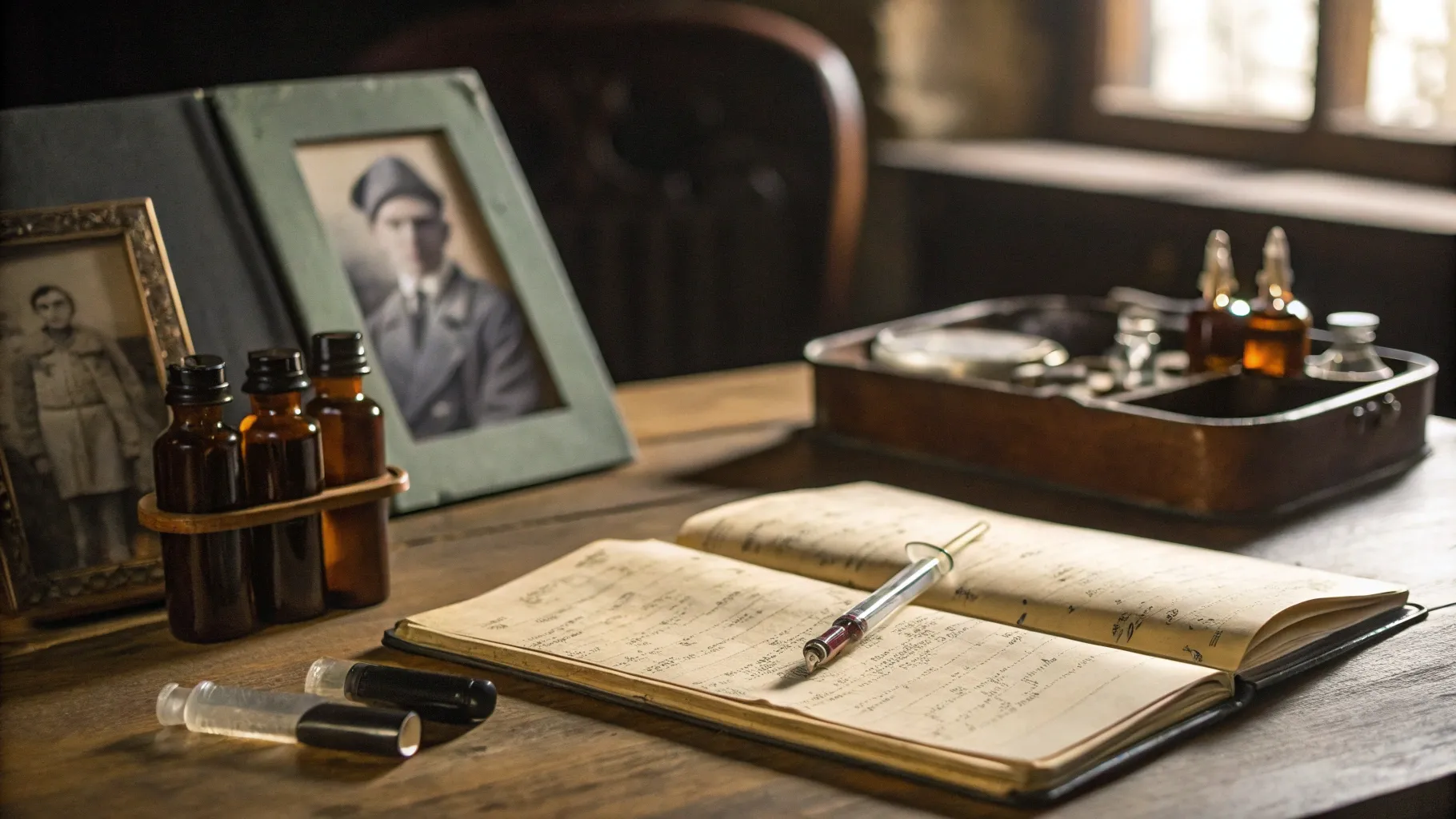
One of the most revealing details I encountered is how Hitler’s private medical supply evolved into a traveling pharmacy that accompanied him everywhere. From small leather cases with digestive pills and tonics in the 1930s, the cache grew into entire trunks of ampoules, labeled or unlabeled bottles, syringes and secret mixtures. The Führer’s desk, bedside table and train carriage were stocked with chemical aides that were administered routinely.
What started as a habit — swallowing a pill in the middle of a conversation — became a regulated schedule. Morell imposed times, doses and protocols that matched Hitler’s anxieties and demands. The physician’s role shifted from caregiver to supply manager: a person who could control access, provide instant relief and, as a consequence, control the patient.
🔬 The pharmacopoeia: drugs, tonics, stimulants and poisons
To understand the scale of the problem, I catalogued the principal substances recorded in Morell’s notes and in contemporary prescriptions. These include:
- Vitamultin and other vitamin cocktails: mixtures promoted as life-restoring tonics that included liver extracts, calcium, sometimes animal hormone derivatives and, according to later skepticism, likely low-dose stimulants.
- Strychnine and atropine: components of the so-called “anti-gas” pills. In minimal doses, strychnine acts as a central nervous stimulant; atropine affects heart rate and secretions. Regular ingestion created stimulation and nervous side effects, and blurred the boundary between prophylaxis and daily dependence.
- Cocaine nasal solutions: used to treat chronic sinusitis — they were effective but produced short bursts of euphoria and a tendency to seek further administration.
- Glandular extracts and organ suspensions: Morell prepared cattle-derived pancreatic or testicular suspensions, believing in a transfer of vitality — a practice common in early 20th-century experimental medicine but lacking modern validation and carrying immunological risks.
- Probiotic-like bacterial suspensions: crude attempts to rebalance gut flora that often produced unpredictable results, including severe diarrhea and additional gastrointestinal crises.
- Possible amphetamines (Pervitin): while Morell’s notes do not always explicitly state use, prescriptions from Berlin pharmacies and eyewitness reports suggest stimulants were available and used within the regime and perhaps applied to sustain wakefulness and alertness.
- Sedatives and hypnotics: for severe insomnia, Morell used barbiturates and other hypnotics; their repeat use produced dependence and mornings of chemical dullness that the Führer regretted.
- Pijavice and archaic methods: Morell employed leeches for circulatory concerns — a therapeutic relic — pointing to his willingness to mix contemporary and outdated methods.
One phrase Morell offered when pressed by Ribbentrop epitomizes his obfuscation: “I give him what he needs.” That short sentence allowed Morell to claim paternal authority while avoiding scrutiny about the precise contents of his injections. I find that statement chillingly revealing: it turned the physician’s opacity into a shield.
🧾 Patient A: clinical records that strip away the myth
In the archives Hitler is often reduced to a clinical cipher: Patient A. That anonymizing label is deliberately bureaucratic, yet it contains the most striking medical evidence of all. I reviewed ECGs, liver function concerns, repeated notations about dyspepsia, and a persistent catalogue of sleep disorders.
The records reconstruct a simple but damning progression: chronic gastrointestinal disease — intermittent but disabling — combined with progressive cardiac pathology and neurological deterioration manifested as tremor and muscle cramps. These symptoms are not incidental; they shaped Hitler’s ability to act, to concentrate and to maintain emotional equilibrium.
Crucially, these clinical entries document how medical crises often coincided with crucial military decisions. I have noted instances where directives were interrupted prematurely due to sudden abdominal crises or where key operations were discussed at times when the Führer was chemically sedated or stimulated. That link — between bodily crisis and political consequence — is a direct pathway from medicine into history.
⚖️ Hypochondria, fear and the making of dependence
Hitler’s hypochondria is a thread I cannot overstate. From youth he displayed obsessive worry about illness, which translated into a low tolerance for discomfort and a high willingness to accept quick fixes. That personality trait created the perfect psychological environment for dependency.
Morell’s strength lay not only in his compounds but in his validation. He told Hitler the story he wanted to hear: that his body was fragile and that special treatments, uniquely administered, could preserve his capacity. That message dovetailed with the Führer’s self-image as both sacred leader and extraordinary being — someone to be preserved at all costs. In my view, Morell’s role became quasi-religious: provider of ritualized injections that confirmed a belief in the leader’s exceptionalism.
🩸 Experimental therapies: science or charlatanism?
Where does modern medicine draw the line between innovation and fraud? With Morell the line is blurred. Some of his methods had a basis in contemporary therapeutics; others were relics of pre-scientific experimentation. He blended plausible vitamin supplementation with glandular extracts and animal suspensions, sometimes presenting them as patentable innovations.
I find three aspects especially problematic:
- Lack of transparency: Many ampoules and vials were unlabeled or identified only by cryptic initials. This secrecy prevented any independent oversight.
- Commercial exploitation: Morell patented his formulations and promoted them as “approved” or recommended by his most famous patient. The body of the Führer served as a marketing device for Morell’s products and those sold by his associates.
- Experimental risk: The use of glandular extracts, bacterial suspensions and stimulant cocktails without rigorous testing risked immunological reactions, toxicity and long-term organ damage, especially combined with repeated doses and other medications.
When I weigh these factors, Morell appears less as a pioneer and more as an opportunist with unregulated practices that had catastrophic side effects for his patient’s physiology.
🧭 The visible decline: photographs, film and eyewitnesses
Public images provide the visual evidence that complements the medical records. When I place early 1930s footage beside late-war film reels, the transformation is unmistakable. The young, erect and impassioned orator gives way to a hunched, drawn and frequently exhausted man in the 1940s. Specific observations include:
- Progressive weight loss and a sallow, yellowish complexion consistent with liver disease in late 1944.
- Visible tremor of the left hand starting around 1942 and growing more pronounced by 1944–1945.
- Short, halting strides, reluctance to climb stairs and a tendency to sit during meetings.
- Periods where he appeared chemically dull — phenomena consistent with nocturnal sedatives or repeated hypnotic use.
Eyewitnesses from the inner circle corroborate this. Secretaries and generals noticed the weekly rituals of pills at meals and injections at night. They also described his mood swings: episodes of fleeting exhilaration followed by deeper crashes. That chemical seesaw and the physical decline were public for those close enough — even if propaganda kept the masses unaware.
⚔️ Medical power plays: Morell versus Brandt and the court physicians
I must emphasize that the story is not only clinical; it is intensely political. Medical care in Hitler’s inner circle translated into power. Whoever controlled his health had influence over his schedule, his mood and — by extension — his decisions.
The central rivalry was between Theodor Morell and Karl Brandt. Brandt was not only a credentialed surgeon but also the formal “medical escort” who accompanied the leader. He represented the medical establishment — disciplined, surgical, and status-conscious. Brandt saw Morell as a vulgar charlatan; he suspected Morell of slowly poisoning the Führer with untested injections.
Other specialists, including Erwin Giesing (an otolaryngologist), clashed with Morell because the latter’s injections sometimes contravened conservative treatment plans. Giesing, called to treat post-assassination hearing damage, favored rest and standard care; Morell intervened with injections that Giesing blamed for prolonging and complicating the recovery.
These disputes culminated in moments where Hitler was asked to choose sides and invariably sided with the doctor who made him feel better immediately — Morell. The leader’s response to critics crystallized this dynamic: anyone who criticized Morell, he treated as a critic of his own person. That conflation of medical and personal loyalty shielded Morell and marginalized the more traditional physicians.
🚨 The political costs of a sick body
Making the argument that physical illness affected political judgment is delicate, but unavoidable. I identify several concrete ways Hitler’s health altered political events:
- Interrupted decision-making: Gastrointestinal crises sometimes forced the cancellation or delay of military councils during critical campaigns (e.g., parts of the 1941 eastern campaign).
- Emotional instability: Mood swings and episodes of exhaustion impaired steady deliberation and increased volatility during high-pressure moments.
- Dependency on a single medical gatekeeper: Because Morell monopolized access, alternative medical opinions were excluded, shrinking the circle of critical advice.
- Symbolic weakening: Visible physical decline undermined the myth of invincibility upon which much of the regime’s legitimacy rested.
While one must avoid deterministic accounts that reduce history to medical causation, the evidence I reviewed indicates that Hitler’s health intersected with strategic decision-making in measurable ways. Illness became a hidden variable in the Nazi command structure.
🗣️ The "I healed him" narrative and the cult of loyalty
One phrase that repeatedly appears in the testimony of Hitler’s court is the leader’s defiant defense of Morell:
"He healed me when no one else could."Whether or not this claim is strictly true is less important than the effect it produced. The phrase constructed a narrative of gratitude and indispensable help and gave moral authority to Morell. It allowed Hitler to transform a medical relationship into a moral litmus test: to oppose Morell was, in Hitler’s mind, to oppose the man who had saved the Führer’s health.
That moral tether made it politically costly for anyone to press scrutiny. The result: a private medical system insulated from institutional checks and balanced only by rumor, resentment and occasional, unsuccessful efforts at removal.
🧪 Did Morell deliberately poison Hitler?
Among the more sensational questions historians ask: did Morell actively poison Hitler? Some contemporaries believed so, and after the war Karl Brandt suggested as much in testimony. But hard proof is lacking. What the records do show is a persistent pattern of cumulative toxicity and polypharmacy — many drugs given repeatedly and in combinations that would be dangerous, especially for an older man with cardiac and hepatic stress.
Four facts are central to my assessment:
- Intent is not proven: There is no documentary evidence that Morell intentionally sought to kill Hitler.
- Cumulative harm is documented: Many drugs and extracts in repeated doses likely contributed to organ damage (notably hepatic inflammation in 1944) and to progressive neurological signs.
- Secrecy protected Morell: Lack of labeling and shorthand entries made independent verification difficult.
- Commercial motives were clear: Morell profited from the publicity associated with being the Führer’s doctor and patented remedies that he marketed as benefited by Hitler’s endorsement.
So while I cannot conclude deliberate poisoning, I can say confidently that the treatment regime was negligent, experimental and likely contributed to the deterioration of his patient’s health.
🔍 The hepatitis episode of 1944 and the Ardennes offensive
One of the most decisive medical events in the final years was the documented hepatitic episode in 1944. The patient records show clear signs of liver inflammation: jaundice, prolonged weakness and appetite loss. This illness sidelined the leader at an extraordinarily delicate time — as the regime contemplated a last-ditch Ardennes offensive.
Morell responded, predictably, by increasing tonic injections and vitamin administrations. The short-term relief allowed Hitler to participate in a strategic gambit, but it did not address the underlying organ compromise. The medical attempt to patch the leader back into action was emblematic: more medication, not more sober diagnosis.
📉 Neurological decline: tremor, gait and cognition
Another area of growing evidence is neurological decline. From 1942 onward witnesses recognized tremor and stiffness. Photographs after the 20 July 1944 assassination attempt also record balance problems and hearing impairment. These deficits likely reflect a mix of chronic stimulant and sedative use, traumatic injury from the bomb blast, and progressive neurovascular disease.
I cannot definitively ascribe the tremors to Parkinson’s disease or to medication effects alone. What the clinical record and visual documentation do insist upon is that his motor control, fine motor skills and postural stability deteriorated in ways that affected his public presence and capacity to conduct long deliberations.
🔒 Secret archives and the "Patient A" label
The Allied seizure of Morell’s archives after 1945 revealed the lengths to which the regime shielded medical truth. Many files were classified and contained shorthand that was difficult to decode without Morell’s own testimony — which he often evaded under interrogation. The pseudonym "Patient A" reflects deliberate anonymization, but it also speaks to the bureaucratic heartlessness of the story: the man who commanded millions is reduced in clinical notes to a letter.
Those records, however, were enough to reconstruct a narrative of chronic disease and medical dependency. When historians gained access decades later, the case became clear: the body of the dictator had been managed in secret, and the secrecy was central to the maintenance of power.
🏛️ Medicine as an instrument of governance
When I step back, I see a broader lesson. The Morell–Hitler relationship shows how medical authority can be politically weaponized. A doctor’s immediate capacity to produce tangible relief gave Morell leverage — not only over a patient’s health, but over access to the leader’s routine and mood. In authoritarian systems where personality cults centralize authority in one body, control over that body becomes a form of political capital.
That dynamic created structural risks: policy decisions became more contingent on single-source opinions, dissenting voices were discredited as disloyal, and medical opacity replaced professional oversight. The result is an instructive cautionary tale about concentration of medical power in service of a political personality cult.
🔚 The rupture, Morell’s fall and final irony
The relationship did not last. In April 1945, as Berlin fell and paranoia rose, Hitler turned on the man who had kept him alive in a chemical sense. Eyewitnesses describe a public humiliation in which Hitler ordered Morell to leave the bunker, telling him to shed his SS uniform and return to his West Berlin clinic. Morell left the bunker; shortly thereafter, the regime collapsed, and Morell was arrested by Allied forces.
Under interrogation Morell was erratic, forgetful and inconsistent about the constituents of his injections. It appears the years of excess and secrecy had also degraded his memory. He was detained, his files seized and preserved — but he was never brought to trial for crimes akin to those tried at Nuremberg. Unlike Brandt, who was executed for his role in euthanasia programs, Morell was released and died in 1948, physically diminished and professionally ruined.
The irony is striking: the man who administered life-restoring injections to a dictator died as a dependent medical patient himself, reduced from a figure of influence to an anonymous hospital case. It is a final moral coda to a career in which medical privilege became intertwined with moral culpability.
📚 Aftermath and historical implications
What does this medical episode teach historians and readers today? Several lessons stand out:
- Propaganda can mask biological reality: Images of the leader sustained political narratives, but they were fragile when confronted with basic medical facts.
- Unregulated medical practice in power contexts is dangerous: The absence of accountability allowed experimental and risky treatments to be administered without checks.
- Medical dependence alters political structures: When one person controls the health of a leader, that person accrues informal power with potentially strategic consequences.
- Archival transparency is essential: Morell’s seized notes are a reminder that medical documentation can be evidentiary gold for historians, and that their preservation matters.
These are not abstract points. They inform how we think about modern political medicine, the ethics of physicians in power, and the role that clinical secrecy can play in enabling abuses of authority.
🔬 Ethical reflections: where medicine failed
As a reporter and someone who has read these notes carefully, I also reflect ethically. Physicians swearing to heal took oaths that implied rigorous standards of evidence, patient autonomy and nonmaleficence. Morell’s practice violated some of those norms in at least three ways:
- Informed consent: The secrecy around drug composition denied any possibility of informed public or peer review.
- Standard of care: Use of archaic or unproven treatments without contemporaneous clinical oversight contravened emerging standards.
- Conflict of interest: Profit-driven patenting and promotional activities tied to political prestige created a conflict between patient care and commercial gain.
We must be careful, however, not to reduce the story to personal moral failings alone. The political culture of the Third Reich — the centrality of the Führer, the intolerance of dissent, the cult of devotion — created conditions under which such misconduct could flourish. Institutional safeguards were absent or actively undermined.
📣 What the documents tell us — and what they don’t
Finally, I want to be transparent about the limitations of the record. The archives and testimonies show patterns but do not answer every question definitively. Some vials were unlabeled. Some records are cryptic. Morell’s own recollections are inconsistent. Yet despite these gaps there is a clear, consistent and concerning impression across sources: Hitler’s body was sick, the medical regime around him was experimental and unregulated, and that combination materially affected the conduct of government.
Where certainty lacks, responsible historical judgment leans on convergence of evidence: clinical notes consistent with visual decline, eyewitness testimony corroborating treatments and behaviors, and contemporaneous pharmacy records and prescriptions that support the likely presence of stimulants and other drugs. On balance, the weight of evidence supports the central thesis: the Führer’s physical decline and chemical dependency were real and consequential.
🧭 Conclusion: a clinical portrait that reframes history
As I close this report, I return to the fundamental paradox that the documentary by The Soldier’s Diary CZ makes so vivid: the man elevated to mythic invulnerability was, in private, fragile and dependent. The instruments of that dependence — injections, pills, tonics and experimental concoctions administered by a controversial physician — did more than sustain an individual. They shaped a regime’s decision-making environment and concentrated medical influence in ways both tragic and dangerous.
I have walked here between the clinical and the political, and what I see is sobering. Medicine that is secretive, commercialized and insulated from oversight can become an instrument of power. It can preserve a leader’s function for a few critical hours, while eroding long-term capacities and ethical standards.
We should remember these lessons not as a curiosity of the past, but as a warning. In authoritarian settings, control over the body of the leader is also control over the body politic. The Morell–Hitler story is not only a medical scandal: it is a human story of dependency, a political story of power and an ethical story about how easily the physician’s duty can be compromised when clinical care is conflated with political loyalty.
If you wish to examine the primary materials yourself, the documentary provides an accessible compilation of documents and testimonies. In my reporting I relied on those preserved medical logs, eyewitness testimony and the clinical labels recorded under “Patient A.” Their sustained existence in the archives ensures that historical judgment continues to refine our understanding.
My role here has been to bring those documents into readable focus — to translate clinical shorthand, to trace the chain of influence that turned a physician into a political actor, and to show that the final years of the Third Reich were shaped not only by bombs and battles but by needles and pills. That intersection deserves study and caution. It teaches us about the fragility of human bodies and the fragility of political systems that depend on a single, secretive source of care.
Further reading and sources
For readers wishing to follow up, I recommend examining the preserved Morell files, the postwar interrogations and contemporaneous eyewitness accounts compiled in allied archive inventories. These documents are the best evidence for the clinical timeline I've outlined, and they remain essential for any serious study of the medical dimensions of Hitler’s final years.
Thank you for reading. I took care to synthesize archived medical notes, eyewitness testimony and the documentary’s narrative into this report because I believe the medical story is central to understanding the whole.


