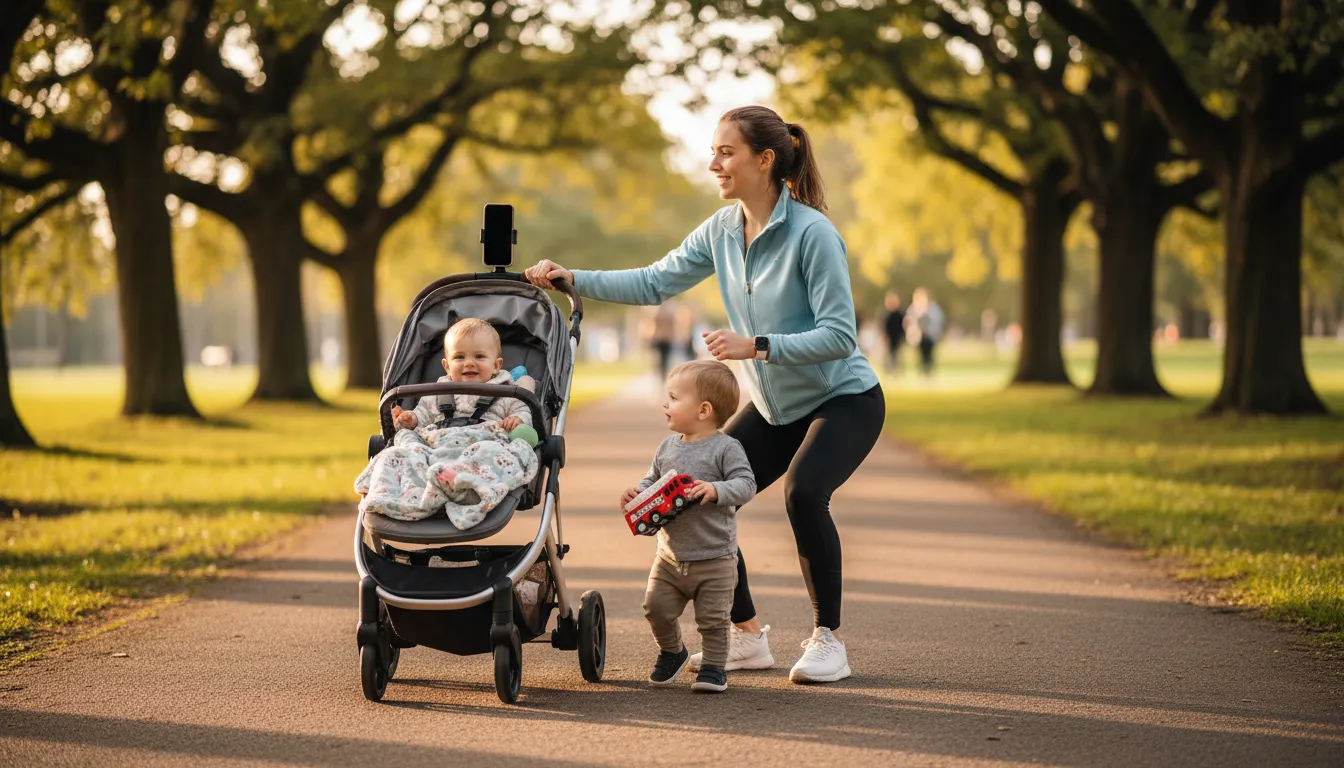
As a mom of two toddlers, I am constantly negotiating a tricky trade-off: the instinct to put my children first and the quiet, pressing need to take care of myself. I wanted a strategy that fit into the unpredictable rhythms of my life—short, flexible, effective, and stroller-friendly. What followed was a practical experiment in using an AI tool as a pocket coach to design quick workouts, plan around naps and feeds, and carve out micro-sessions of movement that actually stick.
📰 What I tested and what I learned
I set out to answer a simple question: what can I do with 20 minutes while the kids are in the stroller? My goal was not to train for a marathon. It was to increase my daily movement, get my heart rate up, strengthen my muscles, and preserve some sense of myself beyond the roles of caregiver and chauffeur.
I used an AI assistant to generate short, stroller-friendly workouts and variations I could do on walks, in the park, or in my living room when outdoor time wasn’t possible. The results were surprisingly practical: a handful of routines I could repeat, tweak, and build on depending on how the day unfolded.
Along the way I discovered three things:
- Small windows add up. Twenty minutes of purposeful movement is better than waiting for a perfect hour that never comes.
- Flexibility is essential. The best sessions were the ones that offered options for intensity, equipment, and interruptions.
- Guidance matters. Having a plan delivered in the moment—simple cues and progressions—kept me consistent.
"I am trying to figure out the balance of mom life and taking care of myself." — Lauren
🤸 Why short, flexible workouts actually work for busy parents
There is a tendency to think that fitness requires long, uninterrupted blocks of time. That belief creates a barrier for parents who face constant interruptions. But research and practical experience show that shorter sessions provide meaningful benefits when they are targeted and repeatable.
Physiologically, short high-quality sessions can:
- Raise heart rate enough to improve cardiovascular health if repeated several times per week.
- Stimulate muscle strength through bodyweight or loaded movements by focusing on compound exercises.
- Improve metabolic rate. Short bursts of effort can increase calorie burn and help maintain muscle mass.
Practically, short workouts are more likely to happen. If I can complete a 20-minute routine while the kids nap or during a stroller walk, then it becomes part of my routine rather than a hopeful plan that fades.
🏃 My 20-minute stroller workout: a repeatable plan
The session below is built around a stroller and basic bodyweight moves. It assumes you have a stroller that locks and is stable when paused, and that your kids are safely strapped in. I designed this for use on sidewalks, trails, or at a park bench. It’s a balanced mix of warm-up, cardio, strength, and mobility.
Overview
- Total time: 20 minutes
- Equipment: stroller (as support), optional resistance band or light dumbbell
- Structure: 3-minute warm-up, 14-minute circuit (2 rounds), 3-minute cool-down
Warm-up (3 minutes)
- Walk briskly for 90 seconds with exaggerated arm swings to engage the shoulders and increase breathing.
- Stop for dynamic mobility: 30 seconds of hip circles (15 seconds each direction) and 30 seconds of ankle rolls and gentle lunges to prime the legs.
Main circuit (14 minutes total; 2 rounds of 7 minutes)
Each round: 45 seconds work, 15 seconds transition or rest. Choose a pace that raises your breathing but still allows safe supervision of the kids.
- Stroller push intervals: Push the stroller hard for 45 seconds—fast, purposeful pace up a slight incline if available. This increases heart rate and loads the legs.
- Incline push-ups (hands on stroller handle): 45 seconds. Angle depends on fitness level—hands higher for easier, lower for harder.
- Walking lunges holding the stroller handle: 45 seconds. Focus on stability and range of motion; go slower if surfaces are uneven.
- Stroller deadlift (hip hinge): 45 seconds. Stand behind the stroller, hinge at the hips, keep a neutral spine, and "hinge" while controlling the stroller—this targets posterior chain muscles.
- Standing rows with resistance band (loop the band around the stroller): 45 seconds. Squeeze shoulder blades together on each rep.
- March in place or high knees: 45 seconds. Raise the knees high and pump the arms to bring heart rate up again.
- Plank at stroller handle: 45 seconds. Hands on the handle for an incline plank or forearms on a park bench if available. Modify to 20–30 seconds if needed.
Cool-down (3 minutes)
- Slow walking for 60 seconds, focusing on deep breathing.
- Standing quad stretch for 30 seconds each side.
- Shoulder rolls and gentle forward fold (30 seconds) to release tension.
This routine balances cardio and strength while using the stroller as a stable prop. It is intentionally modular: if a toddler fusses, pause and resume; if you have more time, add additional rounds; if you are postpartum or recovering from injury, scale back intensity or reduce work intervals to 30 seconds.
🛠️ Modifications and safety tips
Every parent’s body and circumstances are different. Here are ways to make the 20-minute workout safer and more effective for your situation.
Postpartum and returning to exercise
If you recently gave birth, prioritize core and pelvic floor recovery. Start with gentle breathing, pelvic floor activation, and slowly reintroduce hip hinges and leg work. Avoid heavy abdominal strain until you have clearance from a healthcare provider.
For lower fitness or mobility limitations
- Reduce work time to 30 seconds with 30 seconds rest.
- Replace dynamic moves with slower, controlled versions: step-ups onto a curb instead of lunges, wall push-ups instead of incline push-ups.
- Use a resistance band for assisted movements rather than bodyweight-only high-intensity efforts.
For higher fitness levels
- Add a third round or increase intervals to 60 seconds with 15 seconds rest.
- Carry a light backpack for extra resistance during stroller pushes.
- Integrate short sprints pushing the stroller for 20–30 seconds if the terrain and safety allow.
Safety checklist
- Ensure your stroller is stable and the brakes are engaged when you step away from pushing or performing strength moves that require stillness.
- Keep an eye on the kids at all times. If they are fussy or need attention, pause and return to the workout or shorten the interval.
- Wear supportive shoes and stay hydrated. Bring a small water bottle if on a longer walk.
- If you have diastasis recti, pelvic pain, or recent surgeries, consult a medical professional before attempting core-dependent moves.
💬 How I used ChatGPT as a pocket coach
I asked the assistant to generate workouts that fit the constraints of my life: 20 minutes, stroller-friendly, variable intensity, and safe for a postpartum body. The interface acted like a coach in my pocket—giving me a plan when I had a spare moment and adjusting based on my feedback.
The value came in three forms:
- Idea generation: It suggested movements and structure I might not have combined on my own, like pairing stroller deadlifts with incline planks or using the stroller as an anchor for resistance band rows.
- Adaptability: I could ask for simpler or harder variations, or for alternatives if I didn’t have equipment. That made the plan resilient to changing days.
- Accountability prompts: I saved prompts and set reminders. Even small nudges like "Try a 20-minute stroller session today" were surprisingly motivating when I was teetering between options.
"It always gives me new ideas and things that I never thought of before." — Lauren
To be concrete, I kept three types of prompts ready:
  1) Give me a 20-minute stroller workout that mixes cardio and strength.
  2) Modify the workout for low-impact and postpartum recovery.
  3) Suggest a 10-minute mobility flow I can do at a park bench.
Having these prompts saved meant I could open the assistant, paste my current restriction (toddler asleep, rainy day, or uphill route), and get a tailored plan in seconds. That eliminated the barrier of "what should I do?" which is often the biggest mental block.
📅 Practical tips for making short workouts stick
Consistency beats intensity for long-term results. Here are the practical strategies I used to turn occasional workouts into a habit.
Choose a rhythm
I decided on two core windows: stroller walks and nap windows. Stroller walks became my primary opportunity for movement because they are predictable multiple times per day. Nap windows became the time for slightly more focused, indoor sessions.
Micro-commitments
I framed workouts as micro-commitments: "I'll do 10 minutes and see how I feel" rather than a full 40-minute session. More often than not, I continued and completed the planned 20 minutes.
Visual cues and packing
Having my workout shoes and a small resistance band in the stroller was a small change with a big effect. When everything is already packed, it's easier to act on intention.
Use supportive social structures
I told my partner and a friend about my plan. That created gentle accountability. If I missed a planned stroller session, I texted my friend, and she encouraged me to try again the next day.
Be realistic about the unpredictable
Some days the kids refused the stroller or we had a meltdown. On those days, I prioritized small bouts of movement at home: 10 squats here, 30-second plank there. Those fragments still contributed to the overall goal and kept me in the habit of moving intentionally.
📈 Tracking progress and measuring success
The scale is only one metric and often a poor indicator of meaningful change. I tracked other signs of progress that mattered more to me: energy levels, mood, sleep quality, and how clothes fit.
Metrics I used
- Frequency: How many 20-minute sessions did I complete per week?
- Perceived exertion: On a scale of 1–10, how hard did the sessions feel?
- Functional gains: Could I climb stairs with less effort or carry groceries without breathlessness?
- Mental health: Did I notice reduced stress or improved patience during the day?
Tracking these outcomes helped me prioritize behaviors over short-term appearance changes. When my mood improved and I had more energy for the kids, the workouts were clearly worth the time invested.
🔧 Common barriers and troubleshooting
No plan is immune to obstacles. Here are the most common barriers I encountered and how I addressed them.
Toddler unpredictability
If a child refuses the stroller, I shift to a 10-minute indoor routine and label it a win. If both kids are engaged in play for a predictable chunk of time—great opportunity for a 20-minute session.
Weather and terrain
Rainy or hot days require contingency plans. For wet days, indoor circuits or a simple living-room strength session is a solid alternative. For hot weather, schedule walks early morning or late evening.
Low motivation
I prepared a playlist and kept my prompts ready. When motivation lagged, I told myself I would at least start for five minutes. Often that was enough to continue.
Time fragmentation
Days get fragmented, so I embraced movement snacks: two 10-minute sessions instead of one 20-minute session. It’s about cumulative volume.
📆 A sample weekly plan
This sample shows how to balance short stroller sessions with recovery and variety. It assumes children are in daycare some days or that you have one longer walk window each day.
Weekly outline
- Monday: 20-minute stroller circuit (strength + cardio)
- Tuesday: 10-minute mobility flow in the morning, 10-minute brisk stroller push in the afternoon
- Wednesday: 20-minute low-impact session (postpartum-friendly)
- Thursday: Walk with 3 x 1-minute stroller sprints and recovery
- Friday: 20-minute mixed circuit, heavier focus on posterior chain
- Saturday: Longer family walk (30–45 minutes) at an easy pace
- Sunday: Active recovery—gentle yoga or mobility, 15–20 minutes
This plan emphasizes variety and recovery and treats the stroller workout as a repeatable core. It also ensures at least three meaningful strength-oriented sessions per week.
🧭 Prompts I saved and used often
If you want to replicate what worked for me, here are compact prompts I used to get practical plans quickly. Paste them into your assistant or keep them in a note.
  - "Create a 20-minute stroller workout with no equipment that mixes cardio and strength. Include warm-up and cool-down."
  - "Modify the above workout for postpartum recovery with lower-impact options."
  - "Give me a 10-minute park-bench mobility routine I can do while the kids play."
  - "Suggest a three-exercise circuit I can repeat for 15 minutes when a toddler refuses the stroller."
Customize these prompts with constraints like "no stairs," "incline available," or "only one free hand" to get plans that match real-world conditions.
📚 Resources and practical reading
If you want to deepen your understanding of returning to exercise postpartum or building short high-intensity sessions, consult reliable sources:
- Guidelines from a qualified physiotherapist or doctor for postpartum return to exercise
- Evidence-based summaries on high-intensity interval training and its benefits
- Parenting forums and local mom groups that share stroller-route ideas and safety tips
Local community groups are often goldmines for stroller-friendly walking routes and social workouts that make fitness social and sustainable.
🔍 What I learned and what I recommend
This process of treating AI as a pocket coach helped me move from intention to action. It didn’t replace professional advice when needed, but it simplified the planning friction that often stops an idea from becoming habit.
My pragmatic recommendations:
- Start small and repeat. Twenty minutes, three times a week, is a realistic and effective place to begin.
- Keep the plan flexible. Prepare alternatives for indoor days, low-energy days, and solo outings.
- Use prompts as templates. Save a few go-to prompts and tweak them on the fly for conditions like weather, mood, or fatigue.
- Measure non-scale wins. Track energy, mood, and function rather than obsessing over numbers on a scale.
The broader takeaway is simple: self-care does not need to be grand to be meaningful. When I prioritized small, regular action and used an assistant to remove planning friction, the balance between motherhood and personal health felt more achievable.
🏁 Final note
Balancing motherhood and self-care is an ongoing process. There are no perfect days, and the best plan is the one you can actually do. If you are juggling toddlers and wondering how to fit yourself back into the equation, try a short, planned session during a stroller walk or nap window. Keep the intensity realistic, the structure simple, and the expectations kind.
Over time those 20-minute windows add up to greater energy, resilience, and a more balanced life. I found that asking for help—both human and digital—made that possible. The most important step is the first one: decide to move, even if it is only for 20 minutes.


