Table of Contents
- 📰 A life saved — what happened and why it matters
- 📉 The problem: a capacity crisis in diagnostic medicine
- 🔬 How specialist medical AI can change that
- 🧪 Why most off-the-shelf AI falls short
- 🏆 Validation: the FRCI Rapid 2B Exam and beyond
- 📈 Scale matters: why one validated model can change systems
- 🌍 Real-world footprint and impact
- 🧭 Human-centered design: clinicians remain at the core
- ⚖️ Safety, regulation, and the ethics of deployment
- 💡 Reinforcement learning with radiologists: a practical note
- 🔍 Why early detection changes the equation
- 🧩 Where AI fits in a clinician’s day-to-day
- 🚧 Real risks and common concerns
- 🔁 The path to trustworthy adoption
- 🌐 Global deployment: lessons from different healthcare systems
- 📊 Measurable benefits: beyond anecdotes
- 🔭 What’s next: ambitious but focused goals
- 🗞️ A newsroom final note from me
- ❓FAQ
- 🔚 Closing thoughts
📰 A life saved — what happened and why it matters
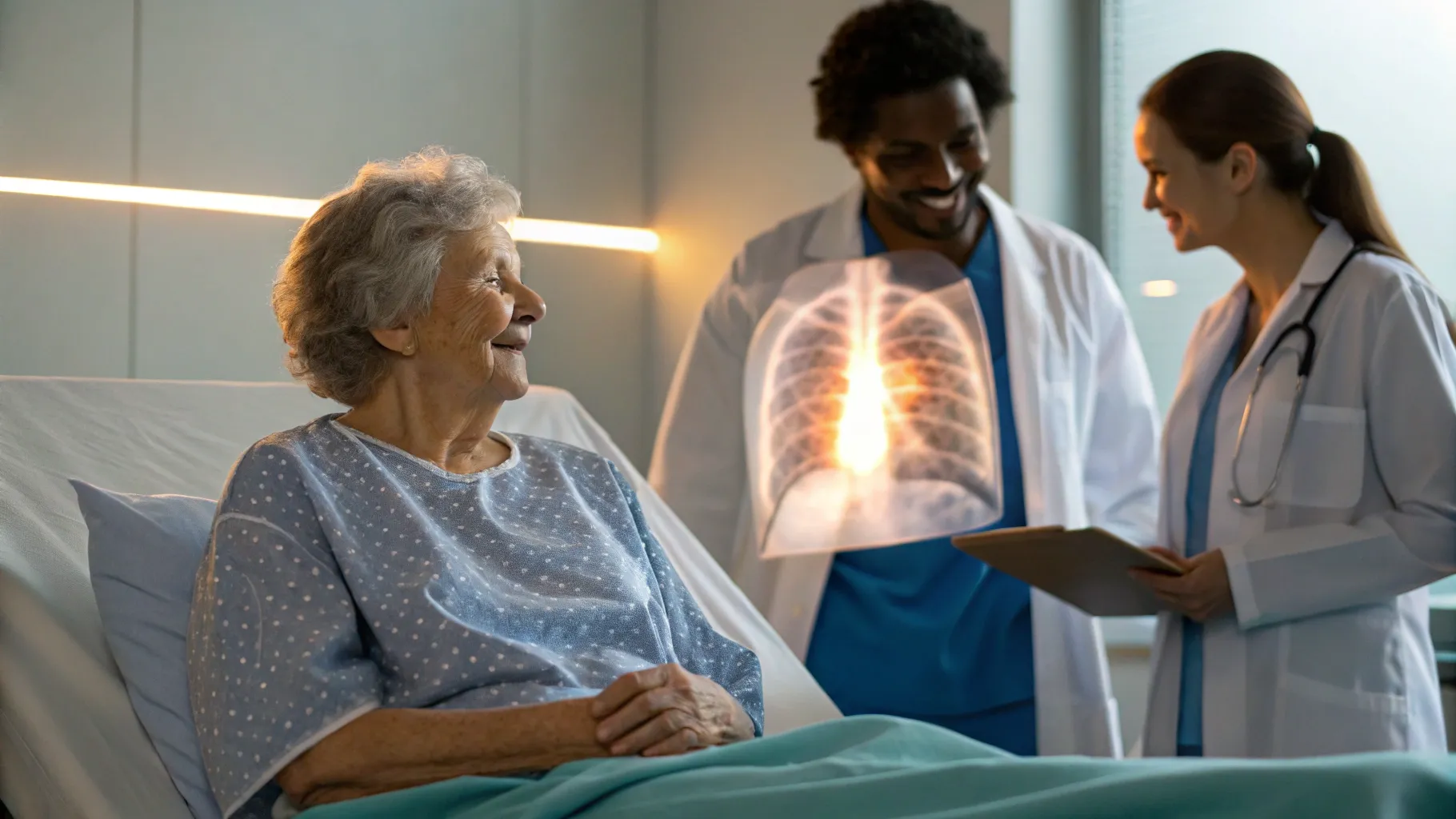
I want to start with a story because numbers alone do not move people the way one person’s life does. Diane, a 69-year-old retired hospital worker, went to the Royal Surrey Hospital with a cough. Her chest x-ray was read as normal by the care team and she was sent home. Hours later, an AI system from Harrison.AI, newly switched on that day, reanalyzed her image and flagged a subtle abnormality — stage one lung cancer. The finding meant surgery and a real shot at a full recovery. Diane put it simply and plainly: I never really understand AI, but I think it might have just saved my life. She said the diagnosis gave her options and a second chance at life.
I use that case as a headline because it captures two things I care about: the human impact of technology and the practical gap we face every day in clinical care. That gap is the reason I left clinical practice and started building specialist medical AI systems. When technology actually shifts outcomes like that, it is no longer an academic exercise. It becomes a matter of survival for thousands.
📉 The problem: a capacity crisis in diagnostic medicine
Healthcare systems around the world are straining under demand. Training a doctor is a long game — I spent six years at the University of New South Wales and would have needed roughly nine more years to subspecialize. Even as training pipelines expand, the shortfall in qualified radiologists is stark. In Australia we are short around 1,000 radiologists. The numbers are even larger in places such as the United States and China.
That shortage has two predictable consequences. First, patients wait longer for scans to be read. Second, radiologists who are stretched thin spend less time per case, and human error rises. The outcome is painful and simple: delays and missed findings can change a curable condition into a terminal one. The math on early detection is brutal and clear: diagnosing certain cancers even a year or so earlier can dramatically increase five-year survival rates.
🔬 How specialist medical AI can change that
I design and build AI systems specifically for medical imaging. These are not chatbots trying to guess answers based on general internet text. This is targeted engineering: algorithms trained on millions of anonymized medical exams and then fine-tuned with radiologists in the loop. The aim is straightforward — make diagnosis faster, more accurate, and more consistent so clinicians can spend their time where it matters most.
Here are the core functions these systems deliver:
- Detect and characterize critical conditions — flag findings that require urgent attention, such as suspected lung cancer, pneumothorax, or acute heart failure.
- Prioritize workflow — bring urgent scans to the top of the worklist so human clinicians see them faster.
- Automate documentation — generate report drafts and structured data to reduce time spent on mundane paperwork.
- Integrate with care teams — provide clear, clinically actionable outputs that fit into existing electronic health systems.
Those features may sound incremental, but in aggregate they can shave hours or days off time-to-diagnosis and reduce missed critical findings. For patients like Diane, that difference is the line between curable disease and something far worse.
🧪 Why most off-the-shelf AI falls short
There is a lot of hype around large language models and general AI. They shine in natural language tasks but fall short in high-stakes medical diagnosis. One reason is data. Open internet datasets lack the millions of high-quality, well-annotated medical images needed to train reliable diagnostic models. Another reason is task mismatch: generating plausible-sounding text is not the same as identifying a subtle radiographic sign that changes patient management.
To be clinically useful, an AI must be trained, validated, and fine-tuned for that exact diagnostic task. That means high-quality medical images, expert-labeled data, careful clinical study design, and iterative feedback from clinicians who use the system. Without that, accuracy will at best be inconsistent and at worst dangerously misleading.
🏆 Validation: the FRCI Rapid 2B Exam and beyond
Validation against human standards matters. One benchmark I often reference is a radiology credentialing test: the FRCI Rapid 2B Exam. It’s designed by the Royal College of Radiologists to credential radiologists before they practice independently. The maximum score on that exam is 60 percent. Credentialed radiologists average about 50.64 percent on that test — which illustrates how difficult real-world radiology decision-making is even for trained clinicians.
Many general AI models perform only marginally better than random guessing on such tasks. That is not surprising. The distinction between a text-based language model and a specialist medical AI is the difference between knowing facts and reliably applying clinical pattern recognition where it matters most. When systems are trained on millions of anonymized exams and refined using reinforcement learning with expert clinicians in the loop, performance improves significantly in those clinical contexts.
📈 Scale matters: why one validated model can change systems
The beauty of software — especially validated medical software — is that it scales. Once you build a model and demonstrate safety and efficacy, it can be deployed across hospitals and clinics at near-zero marginal cost per additional scan. That capacity is especially valuable during surges: pandemics, seasonal spikes in respiratory disease, and the effects of aging populations on healthcare demand.
Think of it as an auto-scaler for clinical expertise. If a hospital needs more diagnostic capacity tomorrow, the software can ramp up immediately rather than waiting years to train more specialists. That kind of elasticity is one of the fundamental technical advantages AI brings to healthcare delivery.
🌍 Real-world footprint and impact
We did not invent the idea; we focused on execution and integration. The laboratory results are not the whole story — real-world adoption is. Today, systems like the ones I help build are processing significant volumes of clinical imaging. For example:
- 35 percent of chest x-rays in England are processed by our tools in some hospitals.
- Every public emergency hospital in Hong Kong can run our AI to support urgent care through cloud compute.
- In Australia, roughly half of all radiologists use these tools as part of their routine workflows.
- Our systems analyze upwards of 10 million scans per year.
Those numbers matter because they show traction at scale. The more systems are used responsibly in clinical contexts, the more lives are affected for the better. Our early target — an audacious one — was to impact one million recurring lives daily through diagnostics. Achieving widespread, safe deployment is how you move from a single saved life to thousands every year.
🧭 Human-centered design: clinicians remain at the core
I left clinical practice because I believed software could multiply the reach of clinicians, not replace them. The systems I build put humans at the heart. That manifests in three practical ways:
- Radiologists in the loop — AI provides decision support, not final, autonomous decisions. The clinician makes the diagnosis and determines management.
- Actionable outputs — alerts and reports are designed to be clear, concise, and clinically relevant so they actually speed up appropriate care.
- Usability — integration into existing workflows and electronic records means adoption is realistic and sustainable, not a bolt-on novelty.
When clinicians trust the tool, they use it. When they use it properly, patient outcomes improve. Trust is earned through transparency, consistent performance, and a track record of clinical benefit.
⚖️ Safety, regulation, and the ethics of deployment
Deploying medical AI responsibly means we must be rigorous about safety and regulation. Systems must be validated on diverse populations to avoid biases that could hurt underrepresented groups. They must meet regulatory requirements where they are used, which can differ between countries. And there must be robust monitoring in production — continuous performance checks, post-market surveillance, and processes to quickly iterate when issues arise.
Transparency is also crucial. Clinicians must understand how the system arrives at recommendations at a level that supports clinical judgment. Black-box outputs that cannot be interrogated create discomfort and risk. The better path is to provide interpretable evidence: supporting images, confidence metrics, and links to the radiologic features that triggered the alert.
💡 Reinforcement learning with radiologists: a practical note
One method we use to refine models is reinforcement learning with clinician feedback. The idea is simple: models make predictions, clinicians respond with corrections or confirmations, and the learning system updates iteratively based on those real-world corrections. Over time, models learn the subtle mistakes they previously made and bias toward clinically accurate decisions.
That loop requires careful engineering. Feedback must be captured as structured signals that can be safely used for retraining. It must be anonymized and handled according to privacy and governance rules. It also requires clinicians who are willing to spend a small amount of time correcting the model in exchange for a system that improves and makes their downstream work easier.
🔍 Why early detection changes the equation
Early detection saves lives in a way that treatment advances alone cannot always overcome. To illustrate: a small change in stage at diagnosis can shift five-year survival rates dramatically. In some cancers, diagnosing a patient 12 to 18 months earlier can mean the difference between a 5 percent five-year survival and a 65 percent five-year survival for a cohort of patients. Those are not theoretical numbers; they are clinically observed differences based on stage migration and the treatments available at earlier stages.
That is why a tool that nudges diagnosis earlier, systematically, across thousands of scans a day, is transformative. The aggregate impact on survival, quality of life, and health system costs is large.
🧩 Where AI fits in a clinician’s day-to-day
AI is not a silver bullet that fixes every problem overnight. It is a multiplier for existing clinical capacity. Here are the practical ways AI integrates into daily practice:
- Triage: AI flags urgent exams so radiologists and emergency clinicians can review them sooner.
- Quality assurance: AI acts as a second reader to catch things that human readers may miss during fatigue or high workload.
- Draft reporting: AI proposes structured report elements that clinicians can edit, saving documentation time.
- Population health: AI can scan historical imaging to identify patients who might benefit from follow-up care.
These are practical saves in time and attention, and they change the clinician’s relationship with the data flowing through their systems.
🚧 Real risks and common concerns
I hear the skeptical questions every day: Will AI replace radiologists? Will AI make mistakes that harm patients? Who is liable if an AI misses something? These are valid questions and deserve direct answers.
First, AI is a tool. It augments, it does not replace. The current and appropriate model is collaborative: the clinician remains the decision-maker. Second, AI will sometimes be wrong. That is why validation, redundancy, and clinician oversight are essential. Third, liability is still evolving legally, and health systems must plan governance structures, informed consent where appropriate, and clear accountability for diagnostic decisions.
Ultimately, responsibly deployed AI reduces net harm by catching missed diagnoses and by reducing clinician burnout so human expertise is applied where it adds the most value.
🔁 The path to trustworthy adoption
Building trust means moving beyond marketing claims. Here are the practical steps I believe institutions should demand before adopting medical AI:
- Independent validation studies in populations that match the hospital’s patient demographics.
- Regulatory approval or clearance appropriate for the jurisdiction and indication.
- Integration testing to ensure the AI's outputs fit into clinical workflows without adding cognitive load.
- Ongoing post-deployment monitoring and a clear process for rollback or rapid iteration if performance drifts.
- Education programs so clinicians understand strengths and limitations of the tool.
These are not optional if the goal is to improve outcomes reliably and ethically.
🌐 Global deployment: lessons from different healthcare systems
Deployment in one country does not guarantee success elsewhere. Healthcare systems differ in workflow, standards, and patient demographics. But there are common lessons:
- Cloud-based compute enables rapid scaling where on-premise infrastructure is limited.
- Local clinical champions are essential to tailor workflows and gain clinician trust.
- Training and education must accompany technical deployment; clinicians need to understand how to interpret AI outputs.
- Regulatory navigation must be handled country-by-country, and good partnerships with regulators speed responsible adoption.
For example, seamless cloud deployments enabled emergency hospitals in Hong Kong to run AI consistently across the network. In England, integrating with PACS and reporting workflows allowed AI to process a significant share of chest x-rays. In Australia, high clinician adoption followed careful workflow design and clinician engagement.
📊 Measurable benefits: beyond anecdotes
Anecdotes like Diane’s are motivating, but systems need measurable impact. The benefits to track include:
- Time-to-diagnosis — how much faster are urgent cases reviewed?
- Missed critical findings — are fewer serious conditions overlooked?
- Report turnaround time — does documentation time decrease?
- Clinician satisfaction — does burnout reduce when administrative load drops?
- Patient outcomes — are survival and morbidity metrics improving?
Health systems that implement robust monitoring can show that AI contributes to measurable improvements across these dimensions.
🔭 What’s next: ambitious but focused goals
When Harrison.AI started five years ago, the aim was bold: build technology that could impact one million recurring lives daily. Two years after initial scaling we had already surpassed analyzing one million scans per year, and we now analyze about ten million scans annually. Those numbers are encouraging, but the mission remains far from complete.
The future work is not about building more novelty. It is about deepening reliability, widening deployment in underserved regions, reducing bias, and continuously improving clinical outcomes. The most powerful thing about validated software is that it can be deployed everywhere. That means the next phase is operational: ensuring hospitals can adopt the technology smoothly and safely so patients benefit worldwide.
🗞️ A newsroom final note from me
I believe the most defensible position on medical AI is pragmatic optimism. I am optimistic because I see systems that now genuinely change outcomes. I am pragmatic because I know the work required to make those systems safe, equitable, and usable at scale. The result of that combination is what I aim to build: AI that keeps humans at the heart of care, multiplies clinical expertise, and saves lives.
❓FAQ
What exactly does Harrison.AI's technology do in a clinical setting?
The technology analyzes medical images such as chest x-rays and CTs to detect and characterize critical conditions, prioritize urgent cases for review, and generate draft reports to reduce documentation time for clinicians. It flags findings that need urgent attention and integrates with hospital workflows so care teams can act quickly.
Will AI replace radiologists?
No. The current and appropriate model is augmentation. AI acts as a decision support tool, triaging and highlighting cases, automating routine documentation, and serving as a second reader. Radiologists remain the final decision-makers, using AI to extend their reach and reduce cognitive load.
How accurate are specialist medical AI systems compared to human experts?
Accuracy varies by task and by how the system has been trained and validated. When models are trained on millions of anonymized exams and refined with clinician feedback, they can achieve clinically useful performance. Benchmarks like the FRCI Rapid 2B Exam show how challenging radiology tasks are; the key is domain-specific training and robust validation rather than generic AI solutions.
How is patient data protected when used for AI training?
Patient data used for training must be anonymized and handled under strict governance frameworks. That includes de-identification, secure data storage, access controls, and compliance with local regulations like GDPR or HIPAA. Ethical oversight and transparent data-use policies are essential.
What happens if the AI makes a wrong call?
Clinician oversight is the safety net. Systems are designed to support decisions, not replace them. Additionally, monitoring, post-deployment surveillance, and iterative updates help reduce systematic errors. Health systems should have governance and incident-response plans to handle any issues that arise.
How does reinforcement learning with radiologists work?
Models generate predictions on cases and clinicians provide feedback — confirming, correcting, or annotating findings. That structured feedback becomes training signal for the model, enabling iterative improvements. This loop requires careful capture of feedback, anonymization, and secure retraining pipelines.
Where are these systems already in use?
Adoption is growing globally. Examples include processing a significant portion of chest x-rays in England, deployment across emergency hospitals in Hong Kong, and use by about half of radiologists in Australia. The exact footprint varies by vendor and health system partnerships.
How do hospitals evaluate whether to adopt medical AI?
Hospitals should demand independent validation studies, regulatory clearance where required, workflow integration tests, clinician training, and post-deployment monitoring plans. The decision should prioritize demonstrated clinical benefit and patient safety over marketing claims.
What are common pitfalls to avoid with medical AI?
Common pitfalls include deploying models without local validation, ignoring integration with clinician workflows, failing to monitor performance over time, and not addressing data privacy and bias. Successful adoption requires planning for these risks up front.
How can clinicians get involved in refining AI tools?
Clinicians can participate by providing structured feedback during routine use, joining validation studies, and partnering with vendors or health systems to guide product development. Clinician involvement ensures the tools remain clinically relevant and trustworthy.
🔚 Closing thoughts
I am driven by the idea that great technology should make life better on the ground. When a tool helps a clinician catch a subtle early cancer or frees up time to have one more meaningful conversation with a patient, that is proof the technology is working. Momentum matters, but so does humility. The task now is to keep scaling responsibly, keep clinicians at the center, and ensure the benefits reach patients everywhere who need them.
No links were provided. Below are suggested 1–3 word anchor texts and the paragraph contexts where a link would be appropriate. When you have URLs to add, these anchors can be inserted directly into the indicated sentences.
- lung cancer — in the Diane story (first paragraph) where the AI flagged a subtle abnormality.
- Royal Surrey — in the opening sentence naming the hospital that cared for Diane.
- radiologists — in the "capacity crisis" paragraph discussing shortages of specialists.
- chest x-rays — in the paragraph about core functions or the real-world footprint where chest x-rays are referenced.
- clinical validation — in the Validation section referencing the FRCI Rapid 2B Exam and benchmarking.
- regulatory approval — in the "path to trustworthy adoption" or "Safety, regulation" sections discussing approvals and clearance.
- reinforcement learning — in the practical note on model refinement with radiologists.
- post-deployment — in the Safety/regulation section where monitoring and surveillance are described.
- early detection — in the paragraph explaining how earlier diagnosis changes outcomes.
- triage — in the "Where AI fits" list item about prioritizing urgent exams.
If you provide a list of URLs, I will return a JSON "links" array with exact 1–3 word anchor texts mapped to those URLs and, if requested, insert them into the article at the specified locations.


