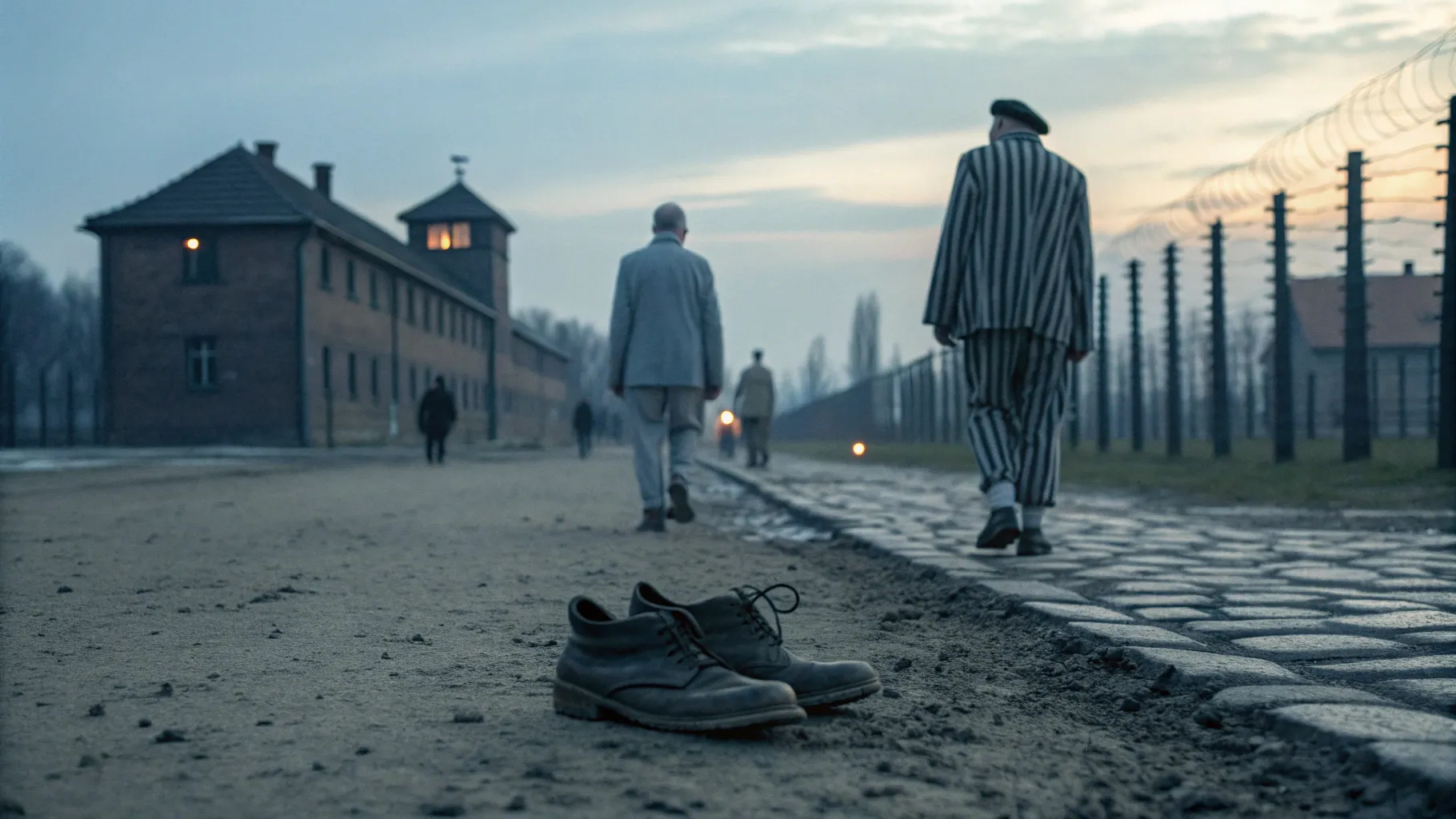
I produced the original video on this subject for my channel, The Soldier’s Diary CZ, and here I report in detail on what those men endured. I write as both creator and witness to the stories I researched and narrated: this is a news-style account of the Sonderkommanda—prisoners forced to operate the crematoria and burning pits in Auschwitz-Birkenau and other death camps. My goal is to present the facts clearly, respectfully, and with the testimony of survivors such as Filip Müller, Henryk Tauber, Shlomo Dragon, Shlomo Venezia, Alter Feinzilber, Dario Gabay and others who risked everything to tell the world what they saw.
📌 Who were the Sonderkommanda and why their story matters
The Sonderkommanda were not a voluntary workforce, nor were they a single homogeneous group. They were prisoners selected on arrival or from within the camp population and concentrated into small, tightly controlled units. Their daily task was the most intimate, brutal and secretive part of the Nazi extermination process: to remove the bodies from gas chambers, to process the dead—remove personal items, extract gold teeth, cut hair—cremate the remains in ovens or in open-air pyres, and reduce bones to powder. They were separated from the rest of the camp population, housed in guarded barracks, and kept as working witnesses to the machine of murder.
This story matters because the Sonderkommanda occupy a unique and painful place in the history of the Holocaust. They were victims forced into complicity by coercion, survival needs, and the immediate threat of death. After the war, survivors faced suspicion, misunderstanding, and silence. Many could not speak for decades. Their testimony is essential not only to document atrocity but also to understand the ethical and human complexity of survival under systems designed to obliterate both life and memory.
🌅 Routine before dawn: the beginning of a forced day
I begin my reporting at the start of the Sonderkommando day because everything—heat, smell, noise and mechanical tempo—was set long before a transport arrived. According to witnesses like Filip Müller and Henryk Tauber, men in the Sonderkommando woke in separate barracks before dawn. They were guarded at all times and ate a minimal, forced breakfast: a piece of coarse bread and weak coffee. The hunger and nausea were constant companions, but so was the understanding that moments of comfort would be impossible to keep during shifts because of the overpowering smells and the physical nature of the work.
When they arrived at the crematoria, preparation began immediately. Roasts and furnaces were checked; previous day’s residue had to be cleared. The air often still held smoke from the night before—an invisible film that clung to the walls and to the breath of anyone who entered. The work area had the eerie quiet of a factory before production starts, punctuated by the screech of metal trolleys and clanking tools.
SS men were present not to help but to control. Some checked the ovens and the gas chambers, others smoked or adjusted belts—small gestures of ordinary routine that sharpened the surreal juxtaposition between industrial normalcy and systemic killing. When the engines of death were functioning at full capacity, the rhythm of commands was unmistakable: "Faster! Next batch! Do not stop!" These orders were both mechanical and existential. Any delay could provoke beatings or executions; rapidity was enforced as strictly as order and silence.
Daily checks and the first breath of fire
- Roasts and furnace grates checked for damage.
- Ventilation examined and pressure tested to avoid blockages that would halt the process.
- Tools sharpened and cleansed, clothes prepared to face heat and ash.
When a technical fault occurred—broken grates, clogged chimneys—the urgency rose to an almost unbearable level. Camp mechanics were brought under SS supervision to repair parts while men continued to work with long iron tongs and hooks, often searing themselves in the process. There was never a true rest. The short allowances of time were consumed by cleaning instruments, sharpening hooks, and preparing the next load.
🔥 Inside the crematoria: the mechanics of a living nightmare
Filip Müller’s descriptions are precise and devastating. Inside the crematoria, atmosphere and mechanics merged into a continuous assault on body and mind. Doors opened with a dry clack and a wave of scalding air hit workers’ faces; inside, bodies were often packed so closely that hair or skin stuck together—so tight that when doors opened the mass would fall forward as a single block and had to be torn apart.
The warmth was not the heat of a domestic oven; it had substance, a weight. Witnesses described the sound of burning—a wet, irregular cracking as flesh surrendered and bones fractured. The air tasted metallic. Breathing was often by mouth, which meant swallowing particulate matter that scraped the tongue and inflamed the throat for hours after a shift. Every movement had to be quick and efficient: remove the bodies, place them for cremation, close the door, wait the limited time, then open and remove the remainder.
“Every time we opened the doors the air blew out like the mouth of a furnace, and we breathed what had been human.” — Filip Müller
When the crematoria were overwhelmed, bodies burned in open pits. In these cases physical labor increased—digging, building wood walls to contain heat, draining fluid that collected in the bottom of pits. Witnesses like Henryk Tauber described rainy days when water mixed with rendered fat to create a thick, viscous paste—an image that underscored the grotesque intersection between natural elements and industrialized death.
The material reality of decomposition and combustion
- Tissues adhered to each other and to tools; skin could peel at the slight touch, sticking to gloves.
- Bone fragments and whole bones remained after burning; they were broken with heavy mallets into powder.
- Popel—ashes—coated everything: shoes, clothing, hair, and skin. Even when washed, the taste and smell lingered.
The methods of reducing bone to a form unrecognizable as human were brutal and repetitive. Palices and pestles, iron clubs and grinders were used to crush the toughest residues, generating clouds of dust that the workers inhaled. This dust stuck to sweat and hair, forming a grey crust that was difficult, sometimes impossible, to remove. Open wounds commonly became infected—there was no time for treatments or basic care—and the pain of these injuries added another layer to daily suffering.
🧳 Handling personal effects: the theft of identity
One detail that keeps recurring in testimonies is the removal and sorting of victims' personal effects. Before bodies were cremated, belts, shoes, and metal objects were stripped to prevent damage to the furnaces. Gold teeth and metal crowns were extracted with small tools. Letters, when found in pockets, were sometimes so damp they disintegrated at first touch. Nothing could be kept; everything had to be turned over to SS stores.
This routine changed death from an event into a process of depersonalization. Where there had been lives, now objects were treated as part of an inventory: hair was cut, dentures removed, jewelry sorted for use elsewhere. The Sonderkommanda served as both executioners (under duress) and unwitting clerks of dispossession. Their hands touched the last remnants of lives—rings, buttons, spectacles—and those objects, stripped of context, were transmitted into bureaucratic channels that further erased identity.
“I found letters folded and wet in pockets. They fell apart when I touched them. Nothing could be kept. Everything had to be handed over.” — Filip Müller
SS officers sometimes joked and smoked while men were forced to pull these items from corpses. That juxtaposition—a man placing a gold tooth into a box while another at arm’s length lit a cigarette—was reported repeatedly and haunted survivors’ memories. It became emblematic of the normalcy with which perpetrators treated mass murder and the surreal daily life in proximity to atrocity.
🌫️ Burning in open-air pits: the ritual of erasure
When crematoria could not keep pace with arrivals, burning switched from indoor ovens to open-air pyres. Men like Henryk Tauber and Shlomo Dragon described how entire layers of bodies were stacked alternately with wood and other fuels. Once ignited, the rendered human fat fed the flames, which would flare several meters high and emit a foul, thick smoke. This smoke smelled of heated flesh and saturated the camp—clinging to clothing, hair and skin, and even settling into food handed to prisoners.
Pyre burning was not merely an improvisation; it was an extension of the system’s objective to disappear evidence quickly and efficiently. Bones and unburned fragments had to be handled afterward: large bones were collected with tongs, then crushed with industrial bone grinders or manually with heavy mallets until they became powder. Ash and bone dust were then disposed of—sometimes thrown into rivers, sometimes spread over fields or used as road fill. These acts were intended to obliterate physical traces of mass murder.
Logistics and mechanics of open-air cremation
- Excavation of deep pits and construction of wooden walls to retain heat.
- Use of rails or metal beams as makeshift grills for air circulation beneath layers.
- Layering technique to maximize burning efficiency: bodies, wood, liquid fuel, repeat.
- Collection and crushing of unburned remains using tongs and mallets.
- Final disposal of ashes—rivers, fields, or filling trenches to remove visible traces.
Witnesses emphasize how the pit’s smoke rose into the sky like a column visible for kilometers. It was a terrifying sign not only of death but of systematic erasure: the camp had a functional chain that converted human beings into combustible matter and ash, then removed those traces from sight. For those who labored there, the work left a sensory imprint that persisted for decades—taste of smoke, eyes and throats perpetually irritated, clothes that never truly shed the smell.
⚙️ Methods to speed cremation and the system behind them
The extermination apparatus was not only cruel; it was engineered for efficiency. The camps used methods and tools designed to sustain an uninterrupted flow of murder. In the largest complexes, like Auschwitz-Birkenau, crematoria were fitted with multi-muffle ovens manufactured by German firms such as Topf & Söhne. These ovens could be run continuously and were sometimes overloaded with more bodies than their official capacity.
In the highest-activity periods, operators intentionally stacked bodies in ways to optimize fat-driven burning and reduce external fuel consumption. The SS collected data—number of bodies processed, fuel usage, hours of operation—and expected shop-floor precision from the Sonderkommanda. Records and survivor testimonies reveal an almost clinical approach to murder: efficiency metrics, technical notes about ovens, and an insistence on minimizing "evidence" and conserving resources.
“They talked in terms of loads and capacity, as if they were supervising a factory line not of people but of material to be processed.” — a survivor
In open-air cremations, the practice of alternating layers, using liquid fuel and igniting once to maintain a sustained blaze, was a method of maximizing throughput. Bodies and wood were arranged to create draft and heat, and rendered fat served as an accelerant. When ovens failed or could not cope, this method allowed mass disposal that deliberately emphasized speed over dignity or any pretense of humanity.
Technical innovations and their moral implication
- Multi-chamber ovens designed to process multiple corpses simultaneously.
- “Optimized” layering strategies that mixed corpses of different body mass to sustain the flame.
- Use of human fat as a complementary fuel to reduce coke or coal consumption.
- Mechanical crushing—bone grinders and pulverizers—to render remains unrecognizable.
- Record-keeping that quantified murder as production statistics.
Notably, witnesses reported SS officers discussing how to improve efficiency, how to get more from fewer resources. That kind of bureaucratic, technocratic attitude toward mass murder remains one of the most chilling aspects of the system: the normalization of numbers and mechanical performance in the context of genocide.
🪖 Discipline, supervision and the role of the SS
Discipline inside and around the crematoria was ironclad. SS guards, KAPOs and administrative officers enforced silence, pace and compliance. Sonderkommanda men lived separated from other prisoners, in guarded quarters surrounded by barbed wire and watchtowers. Their work was monitored at every step: counts of bodies, verification of fuel used and time measured for cremations. Reports were made—sometimes written records documented the number of processed bodies and performance metrics.
SS men rarely performed the physical labor themselves. Their function was to maintain order, to supervise removals of bodies, to extract goods from the dead, and to ensure that no evidence or survivors remained. Yet testimonies show that some SS officers displayed macabre indifference or outright sadism—smoking cigarettes as men worked on bodies, making jokes, or verbally humiliating them. That casualness intensified the psychological strain. It presented murder not as an exceptional act but as a daily routine to be observed, measured and administrated.
“They kept their distance but not their power. They counted, they weighed, and they ensured silence.” — Henryk Tauber
The supervisory structure also included rotation and planned liquidation of the Sonderkommanda. The SS regularly replaced working groups both to preclude the accumulation of knowledge and to prevent organized resistance. This practice ensured that few witnesses survived long-term, and it added an extra layer of terror: surviving one day did not guarantee another. Men knew they were temporary cogs in a machine designed to consume them as it consumed others.
🧠 The psychological toll and moral dilemmas of survival
The psychological consequences of working in the crematoria are difficult to overstate. Survivors described a process of emotional numbing that was at once adaptive and traumatic. Initially, horror and paralysis were common reactions—men remembered faces and voices even as their hands accomplished the tasks required for survival. Over time, automatism set in: tasks became routine, which was itself a form of survival. But the routine carried a moral cost that outlasted the physical danger.
Many of the surviving testimonies emphasize this conflict: the need to survive versus the inner conviction of complicity in destroying others. That dilemma haunted men like Filip Müller, who recorded the paradox bluntly—if they left the camp alive, how would anyone believe that they had done what they had to do? He wrote about "moral weight," a burden he felt as if the outside world might condemn him for acts committed under coercion.
“If I come out of here, nobody will believe what I have done; they will call me a collaborator. The truth is I had no choice.” — Filip Müller
Stigma became a second punishment. After the war survivors of the Sonderkommanda were sometimes viewed with suspicion by other survivors and contested in public discourse. Their extraordinary position—as coerced actors in the core process of annihilation—defied simple categorization. This reality shaped the post-war silence of many and delayed full acknowledgment of their witness. Testifying meant reliving scenes of unspeakable brutality. Even when they spoke, they often faced incredulity and blame.
Trauma: symptoms and long-term effects
- Recurrent nightmares and flashbacks tied to sounds and smells of crematoria.
- Chronic respiratory problems from inhaling ash and particulate matter.
- Long-term social isolation and mistrust due to stigma.
- Physical scars—burns, infections, and chronic pain—that were never fully treated.
- Psychological isolation: inability to describe the experience without intense distress.
For many survivors, living with the memories was an ongoing battle. Some found a duty in speaking out, motivated by the need to prevent denial and to preserve truth. For others, silence remained their refuge; only later, sometimes decades after the events, did they find the voice and the context to share their experiences publicly.
✊ Resistance, testimony and the act of preserving memory
Resistance inside Auschwitz took many forms. The Sonderkommanda are perhaps best known for the October 1944 uprising, a desperate and courageous act that destroyed crematoria IV and V in Birkenau and demonstrated that despite the system’s overwhelming power, prisoners still fought back. That revolt, and other acts of passive and active resistance, were enabled, in part, by knowledge gleaned within the crematoria and by the courage of those who refused to be only instruments in the machine.
Beyond armed or structural resistance, an act of supreme defiance was to document and bury testimony. Some Sonderkommanda members wrote notes, diaries and lists of names and then hid or buried these pieces of paper near the crematoria. After the war, archaeologists recovered some of these manuscripts—vivid, raw, and immediate records of the daily mechanics of murder. These "writings from the depths" became crucial evidence and testimony during post-war trials and in historical research.
“They wrote on scraps of paper and shoved them into the ground. It was a way to resist being erased.” — survivor account
Early testimonies took time to be heard. In 1945 and 1946, some former Sonderkommanda testifed before Soviet commissions and other tribunals. Their accounts detailed the functioning of gas chambers and crematoria in ways that were precise and sometimes technical—necessary for courts and for historians. These statements later fed into major trials, including the Frankfurt Auschwitz Trials in the 1960s, where survivors like Müller and Tauber provided critical evidence against perpetrators.
From hidden notes to public testimony
- Buried manuscripts and notes that were later recovered became documentary evidence.
- Early witness statements helped form the basis of war crimes prosecutions.
- Some survivors spoke immediately after the war; others waited decades to testify publicly.
- Testimony was often re-traumatizing—speaking meant reopening wounds, but it was essential for truth.
These acts of witnessing were both personal and civic. They aimed to preserve names, chronologies and mechanics of atrocity, and to challenge later denial or distortion. For survivors, testimony offered a way of transforming private pain into a public record that could outlive them and thereby confront historical falsification.
🕯️ Aftermath: survivors, silence and late recognition
After liberation, many survivors of Sonderkommanda struggled to rebuild lives. Some emigrated to Israel, the United States, or other countries. Others stayed in Europe. Many faced suspicion even within survivor communities, and all faced deep psychological scars. For years some kept silent—either from shame, the impossibility of conveying the experience, or fear of being judged as collaborators. As time passed and Holocaust historiography matured, broader understanding grew. Trials in the 1960s and later, combined with scholarship and memorial work, gradually placed Sonderkommanda testimony in its rightful historical role.
Not all wounds healed. Some men never spoke of what they had been forced to do; others wrote memoirs, testified at trials, or gave interviews. Shlomo Venezia, one of the later public voices, said he decided to speak not for himself but so future generations would not believe deniers who claim the extermination never occurred. He and other witnesses transformed their trauma into testimony that has become a central part of Holocaust memory.
“I do not speak for myself but to ensure no one can say it never happened.” — Shlomo Venezia
In the late 20th and early 21st centuries the historical community began to integrate Sonderkommanda testimony into museum narratives, educational curricula, and public memorials. Their voices are now present in exhibitions, documentaries, and academic analyses. Yet ethical debates persist about representation: how to depict the forced actions of victims without blaming them, how to make sense of coercion under constant threat of death. Historians, ethicists and survivor advocates continue to wrestle with these questions—always prioritizing dignity, accuracy and context.
🌍 Why the Sonderkommanda story matters today
Reporting on the Sonderkommanda is not an exercise in voyeurism or sensationalism. It is an obligation to history, to memory and to truth. Their story forces us to confront several universal lessons:
- The mechanics of genocide are social and technical. The Holocaust was enabled by bureaucratic, engineering and organizational systems designed to achieve mass murder efficiently. Understanding those systems prevents us from reducing genocide to abstract evil—genocide required procedures, tools, chain-of-command and labor. The Sonderkommanda were inside that chain.
- Victimhood and coerced complicity can coexist. The Sonderkommanda were victims forced into intolerable choices. Their experience challenges simplistic moral binaries and demands nuanced understanding of coercion, survival imperatives and moral injury.
- Testimony is fragile yet essential. Survivors who spoke out risked re-traumatization and social stigma, yet their accounts became crucial evidence against deniers and apologists. We must protect their testimonies and amplify them responsibly.
- Remembering prevents erasure. The system attempted not only to kill but to erase. The efforts of Sonderkommanda members to bury notes, to testify and to survive were acts of resistance against historical erasure.
When I reported this story in the video, I emphasized that memory is both a moral and civic duty. We use this memory to educate, to keep alive the names and faces that were targeted for elimination, and to build social and legal mechanisms that intervene early when groups are dehumanized and systems begin to operate with the logic of disposability.
📢 Reporting responsibly: how we tell the story
As a reporter and the author of the original video, I have two responsibilities: to bear witness and to respect the dignity of those whose lives were violated. This means several concrete commitments in both research and presentation:
- Prioritizing survivor testimony and primary documents when available.
- Placing individual testimonies within the broader context of Nazi structures and policies to avoid individualizing systemic crimes.
- Avoiding graphic sensationalism; describing details only insofar as they illuminate processes without exploiting suffering.
- Highlighting ethical complexity without producing moral equivalence between perpetrators and coerced victims.
The accounts I have drawn from—Filip Müller, Henryk Tauber, Shlomo Dragon, Shlomo Venezia, Alter Feinzilber, and others—are painful, but they are also precise. They allow us to reconstruct operational routines, the daily pressures, the small acts of humanity and the small acts of cruelty. They reveal the mechanized face of genocide without diluting the human cost.
🔎 Important testimonies and what they reveal
Below I summarize key testimonies and the distinct contributions each made to our understanding.
- Filip Müller — Provided detailed, procedural descriptions of crematoria operations. His testimony is notable for the way it alternates between technical precision and raw emotion, especially in moments describing the extraction of bodies and the removal of possessions.
- Henryk Tauber — Described the specific sensory environment: the taste of smoke, the texture of ash, the way water and fat mixed in pits. He also detailed logistic improvisations in times of overflow.
- Shlomo Dragon — Offered vivid descriptions of open-pit burning, the tactile labor of moving bodies, and the psychophysical exhaustion of prolonged exposure to smoke and ash.
- Shlomo Venezia — One of the later public voices who emphasized the need to record and teach what happened against growing denial; his testimony carried moral weight in public memory.
- Alter Feinzilber and Dario Gabay — Recounted the difficulty of separating bone fragments, extracting dental gold, and the daily physical injuries inflicted by heat and repetitive work.
Each testimony adds a facet to the picture: the mechanical, the sensory, the administrative and the ethical. Combined, they create a multi-dimensional portrait of a system that was industrial in method and genocidal in intent.
🧭 Practical reminders for researchers, educators and readers
When engaging with the Sonderkommanda story, certain practical and ethical points should guide further reading or teaching:
- Use primary sources when possible and contextualize them with archival records and scholarly analysis.
- When teaching, prepare students for the difficult content—provide frameworks and support for emotional reactions.
- Distinguish clearly between coerced behavior and voluntary collaboration; emphasize the absence of choice under life-threatening conditions.
- Elevate survivor testimony while respecting survivors’ dignity—avoid graphic sensationalism.
- Address the systemic nature of genocide: it requires structures, resources and a supporting bureaucracy, not merely a few malevolent individuals.
✅ Conclusion: bearing witness so memory prevails
Reporting on the Sonderkommanda is reporting on the most intimate mechanics of industrialized murder: the quotidian details reveal how technology, bureaucracy and human cruelty were combined to produce efficient death. My video and this article aim to honor the memory of those who suffered and of those few who survived to tell us what happened.
To close, I restate what survivors themselves insisted upon: testimony matters. Some of the Sonderkommanda hid notes in the earth, hoping someone would find them. Others spoke in tribunals or wrote memoirs. I bring their words forward now as a news-style account because the facts of how the killings were organized, mechanized, and hidden are essential to preventing denial and to educating future generations.
If you engage with this report, do so as an act of memory. Read testimonies carefully, respect the fragility of witnesses, and consider supporting educational efforts and memorial institutions that preserve this history. For those who created and shared testimony—Filip Müller, Henryk Tauber, Shlomo Dragon, Shlomo Venezia, Alter Feinzilber, Dario Gabay and many others—speaking was a final service: they converted private horror into a public record so that truth might survive when lives could not.
I remain committed to reporting with care, accuracy and respect. If you want to learn more I encourage reading survivor memoirs and visiting reputable museum exhibitions where these testimonies are preserved and interpreted in full context. This is not only history; it is a continuing lesson about humanity’s capacity for harm and, crucially, for bearing witness.


