🔧 Why physical AI is the industrial game changer
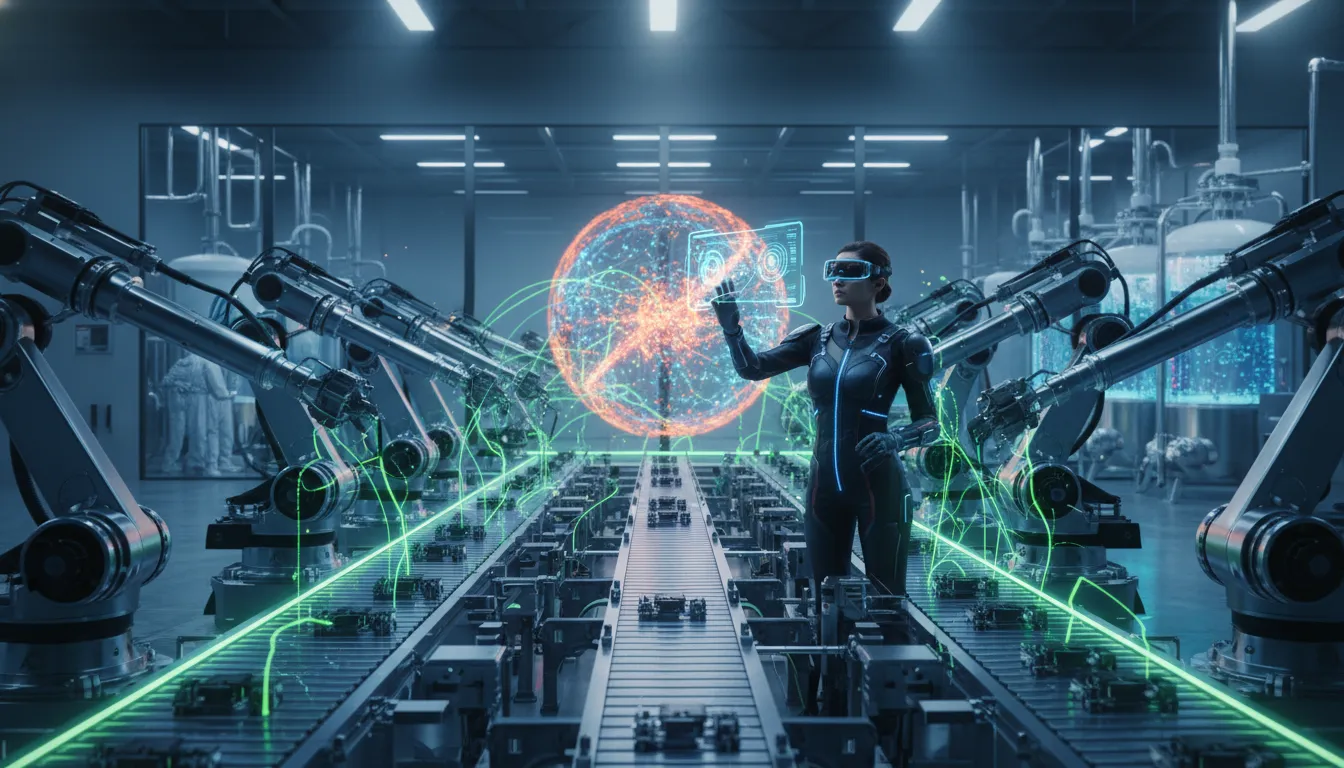
I believe we are witnessing a fundamental shift in how intelligence is applied to the world: from screens and services to motors, conveyors, and robotic arms. The phrase I use for this is physical AI. It describes AI systems that perceive, reason, plan, and act in the physical world—systems that drive real machinery and synthesize the digital and material worlds.
This shift matters because the global economy is building factories at a scale and speed we have not seen in decades. New fabs for semiconductors, facilities for AI hardware, biomanufacturing plants for life-saving drugs, and massive automated warehouses are all coming online. At the same time, many regions face a growing labor shortage. That gap is not just a short-term hiring problem; it is a structural challenge for productivity, resilience, and competitiveness.
Physical AI answers that challenge by enabling automation that is smarter, safer, and more adaptable. It reduces the need for manual intervention, speeds up time to market, improves yield and quality, and helps factories respond to unexpected events. The result is a new industrial paradigm where computing power and intelligence are embedded throughout the industrial lifecycle—from concept and design to production and operations.
🤝 The strategic partnership: Siemens and NVIDIA
When industry leaders combine deep domain expertise with computational breakthroughs, real transformation follows. Siemens brings nearly two centuries of experience building and operating industries. NVIDIA brings a modern software and hardware stack that has redefined what is possible with compute, simulation, and machine learning.
Together, they are integrating software and platforms to accelerate the adoption of industrial AI. The integration stitches NVIDIA’s CUDA-X libraries, AI models, and the NVIDIA Omniverse platform into Siemens’ portfolio of EDA (electronic design automation), CAE (computer-aided engineering), and digital twin tools.
That combination is significant because it couples domain-specific industrial workflows with the advanced compute and simulation tooling that modern AI demands. Instead of bolt-on AI experiments, this integration embeds GPU-accelerated simulation and AI into the core processes companies use to design, validate, and operate physical systems.
🔬 What exactly is being integrated?
The engineering behind this partnership is multilayered. To understand the impact, it helps to unpack the key components and how they complement one another.
CUDA-X libraries
CUDA-X is NVIDIA’s collection of GPU-accelerated libraries, tools, and technologies for scientific computing, AI, and graphics. By integrating CUDA-X into industrial software, compute-heavy workloads—such as finite element analysis, computational fluid dynamics, and AI model training—increase their throughput dramatically.
The practical effect is faster design iterations, shorter simulation runs, and the ability to run more complex models in the same amount of time. That reduces prototyping cycles and shortens time to production.
NVIDIA AI models
AI models tailored to perception, control, and optimization are part of the stack. These models can power robotics, predictive maintenance, quality inspection, and process optimization. Embedded into Siemens’ toolchain, the models become accessible as part of domain workflows rather than separate proof-of-concept projects.
NVIDIA Omniverse
Omniverse is a platform for building highly realistic, collaborative simulations and digital twins. It enables photorealistic rendering, physically accurate simulation, and multiuser collaboration across different software tools.
That matters because training AI and validating robotic systems in a simulated environment requires convincing realism. Omniverse provides a shared virtual world where mechanical engineers, EDA teams, process designers, and AI researchers can test interactions before they hit the factory floor.
Siemens EDA, CAE, and digital twin platforms
Siemens’ tools cover the essential stages of industrial engineering: electronic design automation for chips and control electronics, computer-aided engineering for mechanical and thermal simulation, and digital twins that mirror assets, lines, and entire plants.
Bringing NVIDIA technologies into these tools means higher fidelity simulations, scalable AI-based optimizations, and a unified environment for cross-domain problem solving.
🛠 How physical AI transforms the industrial lifecycle
The industrial lifecycle can be divided into four broad phases: design, simulation and validation, production and commissioning, and operations and maintenance. Physical AI impacts every phase—and often accelerates them simultaneously.
Design: Iterate faster and innovate bolder
Early in the lifecycle, I focus on reducing uncertainty. GPU-accelerated simulation and AI-driven optimization let engineers explore design spaces that were previously infeasible due to compute limits. This matters for:
- Semiconductor design: EDA tools integrated with GPU acceleration compress the time to simulate circuits and run layout verification.
- Mechanical systems: CAE workflows can iterate more designs in the same timeframe and evaluate performance across more operating conditions.
- Process design for pharmaceuticals: Digital experiments can test process parameters and scale-up options before committing to costly pilot runs.
The result is fewer physical prototypes, faster development cycles, and the freedom to pursue more innovative designs.
Simulation and validation: Create realistic digital twins
One of the most powerful changes is the rise of the digital twin: a live, data-driven model of a physical asset, process, or entire plant. Using Omniverse and GPU acceleration, I can produce digital twins that are not only visually realistic but physically faithful.
That fidelity is key for:
- Training robotic control policies using simulated sensors and dynamics.
- Stress-testing systems under rare or hazardous scenarios without risking equipment or people.
- Validating safety-critical control logic before deploying to hardware.
Digital twins become more than documentation. They are the environment where AI learns, engineers test, and operators rehearse.
Production and commissioning: Shorten ramp-up time
Commissioning a new production line is traditionally time-consuming and expensive. With high-fidelity simulation and integrated AI, I can precertify behaviors, refine robot trajectories, and sequence machinery before the physical line exists.
That means production lines start at higher yield rates and require fewer on-site adjustments. In high-value industries—semiconductors or biologics—each day of faster ramp-up translates into substantial value.
Operations and maintenance: From reactive to predictive
Once systems are running, physical AI keeps them efficient. AI models continuously analyze sensor streams and digital twin states to identify anomalies, predict failures, and recommend optimizations.
The benefits are tangible:
- Predictive maintenance reduces unplanned downtime and extends equipment life.
- Process optimization squeezes higher yields and lower energy consumption out of the same equipment.
- Autonomous operations enable safer human-robot collaboration and allow plants to run with smaller, more skilled teams.
🤖 Solving the sim-to-real gap for robotics and automation
One of the toughest technical hurdles for robotics and physical AI is the sim-to-real gap: differences between simulated environments and the real world cause AI trained in simulation to fail when deployed.
The combination of Omniverse’s photorealism and NVIDIA’s compute enables several strategies to mitigate that gap:
- Domain randomization: By varying textures, lighting, and physical parameters during training, robots learn policies robust to real-world variability.
- Synthetic sensor data: Cameras, LiDAR, and force sensors can be simulated at scale to train perception models without costly data collection on the floor.
- High-fidelity physics: Accurate dynamics make control policies more realistic, reducing surprises when transferred to hardware.
In practice, these tools let me train robotic systems for tasks like precision assembly, bin picking, and collaborative work with humans in a fraction of the time and cost of traditional methods.
📈 Business impacts and industry benefits
When industrial AI moves from lab experiments to integrated workflows, the business outcomes multiply. I see six categories of impact that often drive investment decisions.
1. Faster time to market
Reducing simulation and validation times shortens development cycles. For product teams, that means new products and process improvements reach customers sooner.
2. Higher yield and quality
AI-driven process control and defect detection increase throughput and reduce scrap. In industries where yield matters—semiconductors and pharmaceuticals—the dollar impact is enormous.
3. Operational resilience
Digital twins and predictive diagnostics make plants more resilient to supply shocks, equipment failures, and demand fluctuations. Resilience translates into reliability for customers and partners.
4. Labor augmentation and safety
With global labor shortages, physical AI augments human capabilities rather than replaces them. Workers can focus on higher-value tasks—process improvement, oversight, and design—while robots handle repetitive or hazardous work.
5. Cost reduction
Automation, optimized energy management, and fewer prototypes reduce operating and capital costs. Over time, the ROI on simulation and AI investments compounds.
6. Sustainability
Better process control lowers material waste and energy consumption. Sustainable manufacturing is both an ethical obligation and a regulatory reality; industrial AI helps meet both.
⚙️ Technical enablers driving industrial AI adoption
Delivering on this promise requires more than hype. It requires a stack of technologies working together. I focus on a few technical pillars that are particularly important.
GPU-accelerated compute
GPUs power the heavy numerical workloads required for simulation, model training, and real-time inference. CUDA-X libraries make it easier for developers to accelerate domain-specific workloads without reinventing the compute layer.
Scalable simulation platforms
Platforms like Omniverse enable large-scale, collaborative simulation environments. Accessibility matters: subject matter experts should be able to join simulations without steep learning curves.
Edge compute and networking
Many industrial applications need low latency and local inference. Edge GPUs and optimized inference stacks let me run models close to the machines they control, reducing reliance on centralized clouds.
Integrated EDA and CAE workflows
Embedding AI into domain tools avoids stove-piped solutions. When EDA tools, CAE solvers, and digital twin platforms share models and data, cross-domain optimization becomes feasible.
Data orchestration and standards
High-quality data is the lifeblood of AI. I make sure data pipelines capture, curate, and version sensor data, simulation results, and operational logs. Open standards for model exchange and interoperability accelerate adoption.
⚖️ Challenges, risks, and the responsible path forward
Despite the upside, industrial AI brings challenges. I think they are manageable, but companies must address them deliberately to avoid costly mistakes.
Data privacy and security
Industrial data often carries commercial sensitivity. Protecting design IP, process recipes, and operational metrics is essential. That means secure enclaves, access controls, encryption, and careful vendor governance.
Safety and verification
When AI controls physical systems, safety is nonnegotiable. Rigorous verification, fail-safe mechanisms, and layered redundancy must be part of any deployment plan. Simulations help validate behaviors under many scenarios, but real-world testing and certification remain crucial.
Workforce transition
Automation changes the nature of jobs. I emphasize retraining and role redesign. Upskilling existing employees to become AI operators, simulation engineers, and data stewards preserves institutional knowledge and delivers better outcomes than wholesale replacement.
Integration complexity
Industrial environments are heterogeneous: legacy equipment, multiple vendors, and different OT protocols. Integration programs benefit from modular architectures, standardized interfaces, and strong systems engineering practices.
Regulation and compliance
Highly regulated industries—pharma, aerospace, medical devices—require validated processes and traceable models. Industrial AI must produce auditable evidence that changes and decisions comply with regulations.
🗺 A practical roadmap for adopting industrial AI
If you are starting or scaling an industrial AI initiative, I recommend a pragmatic, staged approach that balances quick wins with long-term value.
- Assess the opportunity: Map the factory or process to find high-impact use cases: yield improvement, downtime reduction, speed to market, safety. Prioritize cases with measurable outcomes.
- Secure executive sponsorship: Industrial AI often requires capital and cross-organizational coordination. A sponsor who understands both business impact and technical risk helps clear impediments.
- Start with pilots: Choose a contained line, a specific machine type, or a single product family. Use GPU-accelerated simulation and synthetic data to accelerate development.
- Integrate into domain tools: Embed models into EDA, CAE, and digital twin workflows so subject matter experts can use them naturally.
- Measure outcome and scale: Define KPIs—cycle time reduction, yield improvement, downtime avoided—and scale successful pilots across plants and products.
- Invest in people and processes: Train engineers, create operating procedures for AI-driven controls, and establish governance for model lifecycle management.
🌍 Industry examples where this is already changing outcomes
I see several industries where integrated industrial AI is already making a measurable difference.
Semiconductors
Chip manufacturing is capital-intensive and sensitive to yield. AI-assisted EDA and CAE tools shorten design cycles, accelerate verification, and improve layout. Digital twins of fabrication equipment enable predictive maintenance and process optimization, increasing wafer yield and reducing cycle time.
Pharmaceuticals and biologics
Biomanufacturing benefits from simulated process optimization and digital twins that reduce scale-up risk. AI models help control fermentation and purification steps, improving product consistency and reducing waste.
Automotive and aerospace
Complex supply chains and strict safety requirements make simulation and validation indispensable. High-fidelity CAE and digital twins lower certification costs, enable virtual testing of failure modes, and improve vehicle assembly through robotic automation.
Logistics and warehousing
Robotic picking, autonomous vehicles, and real-time inventory optimization benefit from perception models trained in simulation and optimized motion planning that reduces collisions and increases throughput.
🔮 The future I expect: an industrial renaissance
Physical AI will not simply automate old ways of working. It will enable new business models and capabilities that were previously impossible. I expect to see:
- Factory-as-software: Plants designed and optimized in virtual environments, continuously updated by operational data and AI-driven feedback loops.
- Distributed manufacturing: Digital twins and standardized automation enable geographically distributed factories to operate as synchronized plants, improving resilience and responsiveness.
- Rapid customization: With flexible automation and validated digital twins, production runs can shift quickly between variants without lengthy retooling.
- Increased sustainability: AI-enabled optimization reduces waste and energy consumption, making manufacturing greener at scale.
These trends will blur the line between software and hardware, where industrial systems are maintained, updated, and improved through the same model-driven processes used in modern software development.
💬 A note on vision and responsibility
I often return to the idea that this is the beginning of a new industrial revolution—an era where intelligence powers physical systems across entire industries. That potential is enormous, but it comes with responsibilities: we must design safe, secure, and equitable systems. We must invest in people and processes so the benefits of industrial AI are shared broadly.
"We stand at the beginning of a new industrial revolution, the age of physical AI built by NVIDIA and Siemens for the next age of industries."
Those words capture the ambition I see. The technical building blocks are here: GPU-accelerated compute, realistic simulation, AI models, and mature domain tools. The next step is pragmatism—deploying these technologies where they create measurable value and scaling them responsibly.
🚀 Getting started: what I would do tomorrow
If I were leading a manufacturing or industrial engineering organization, my immediate priorities would be:
- Identify a high-impact pilot that can demonstrate yield, time, or cost improvements within months.
- Set up a small, multidisciplinary team including process engineers, data scientists, simulation experts, and IT/OT staff.
- Invest in a compact GPU cluster and Omniverse licenses to run simulations and iterate models quickly.
- Build a data pipeline that captures high-quality sensor, log, and production data for model training and validation.
- Partner with vendors who can integrate AI into domain tools—this reduces time to production and avoids reengineering the stack.
Early wins create credibility. Credibility builds funding. Funding scales capabilities. That virtuous cycle is how industrial AI moves from experiment to strategic advantage.
📌 Final thoughts
The convergence of Siemens’ industrial expertise and NVIDIA’s compute and simulation stack marks a practical—and timely—step forward for industrial AI. By embedding GPU-accelerated libraries, AI models, and realistic simulation into the tools engineers already use, we can accelerate design, reduce risk, and operate safer, more efficient facilities.
I am optimistic. The technologies exist to deliver a measurable uplift in productivity, resilience, and sustainability. The key to success is disciplined engineering: start small, measure rigorously, and scale the solutions that demonstrably improve outcomes.
Industrial AI is not an abstract future. It is a set of practical techniques and integrated tools that, when combined with deep domain knowledge, will reshape how the world makes things.


