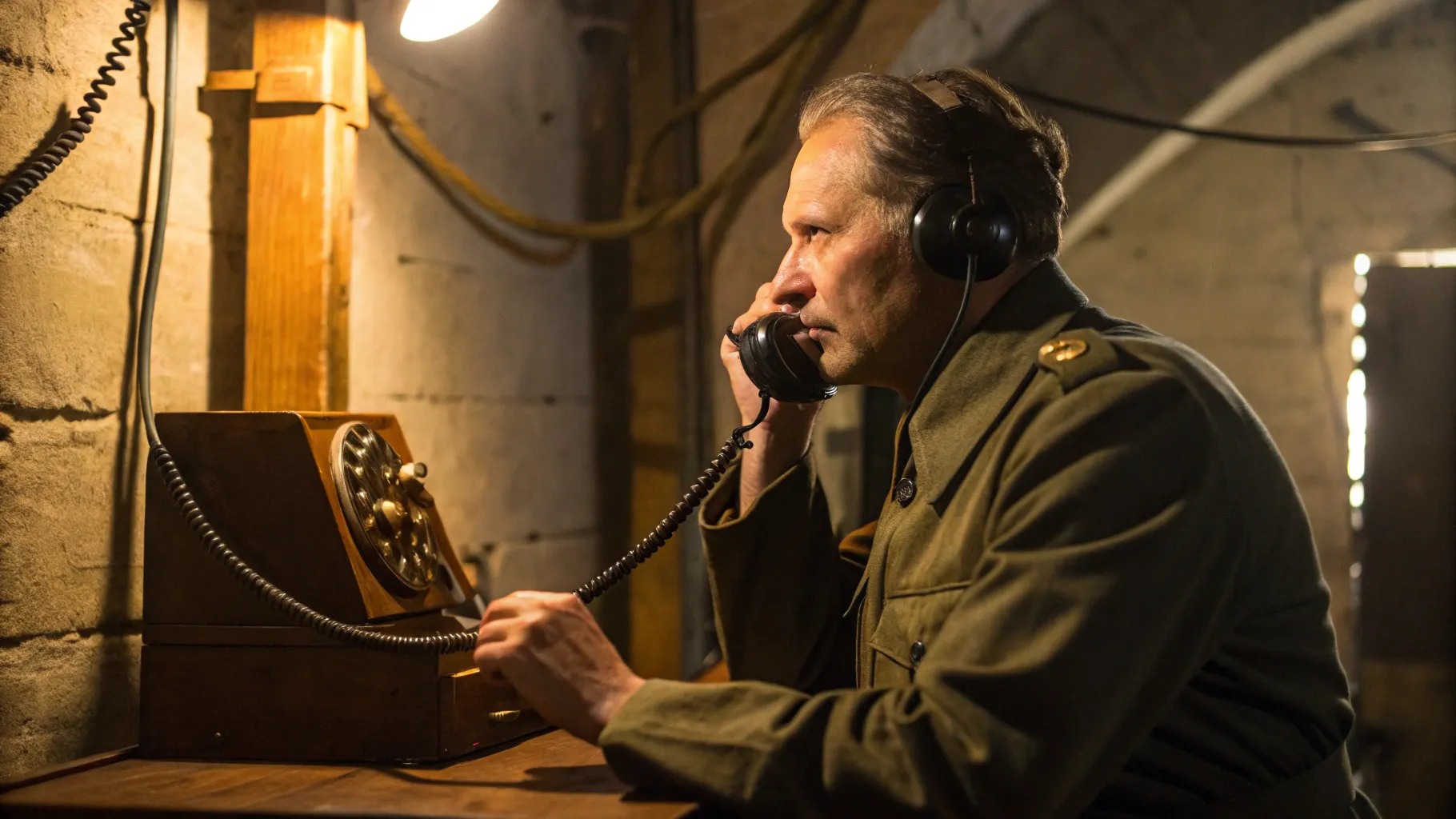
In my documentary produced for The Soldier’s Diary CZ, I told the inside story of Rochus Misch — the telephone operator, courier and member of Adolf Hitler’s personal guard who remained at the center of the Führerbunker until the very end. I write this report as a first‑person account of what I recorded, verified and reflected upon: a chronicle that moves from the everyday routine of a man who "just did his duty" to the claustrophobic final hours when ideology collapsed into ash, fire and silence.
📜 Introduction: Why this account matters
As a reporter and the creator of that documentary, I approached Rochus Misch’s testimony with two priorities: faithful reconstruction of events and sober reflection on responsibility. Misch was not a general, a strategist or a decision-maker. He was an operator — a man who lived at the center of power, who ran the switchboard that connected Hitler to his staff and to the remnants of the war machine. That vantage point makes his story invaluable: he watched the ritual of power, he handled the instruments of command, and he heard the last words of a collapsing regime. Because of this, his testimony is both documentary and moral: it forces us to confront how ordinary duties can be entangled with extraordinary crimes.
In the following report I present a structured, accessible account of Misch’s life, work and witness. I report events as they happened in the rooms and corridors of the Reich Chancellery and the Führerbunker, and I intersperse analysis of what these events mean for historical memory. My voice is that of someone who interviewed, researched and narrated — therefore I often write from the inside out, as both chronicler and eye‑witness to the stored memory he left behind.
🧭 From Silesia to the SS: Rochus Misch’s early life and selection
I start with the background because it explains how Misch arrived at the epicenter of the Third Reich. Born in 1917 in Silesia, Rochus Misch grew up orphaned and isolated: his father died in World War I, his mother passed away in 1919, and a brother drowned later. He was raised by grandparents, with no family photographs to anchor his identity. These early losses carved out a certain anonymity and a desire for belonging.
As a young man, Misch trained as a painter and decorator and later won a scholarship to the Academy of Fine Arts in Cologne. He loved sports, drawing and women; he was not drawn to politics. Yet the Germany of the 1930s was militarizing. In 1937, during his compulsory military service, he encountered recruiters for the SS. They offered a path into an elite unit: the Leibstandarte SS Adolf Hitler — the bodyguard and prestige formation created to be the living embodiment of the regime’s image.
Selection for the Leibstandarte was as much about aesthetics as about skill: height, posture, photogenic looks and facial features mattered. Misch, at 1.85 meters tall, stood out. Out of 139 recruits, only twelve were chosen for the Leibstandarte, and Misch was among them. He arrived in Berlin and was assigned to the Fifth Company, to a training where physical conditioning, drill and a photogenic presence were prioritized over military depth. His new life was a life of uniforms, polished boots and a strict code: be seen, not heard; represent, not question.
Training, routine and the aesthetics of power
The Leibstandarte’s training was relentless yet focused on appearance. Athletes trained alongside Olympic medallists. Misch excelled at the 400 meters and learned boxing, swimming and climbing. The point was to prepare men who could be placed in photographs, who could flank leaders and give every public image a symbol of order and vigor. The political education offered was minimal. Misch did not join the Nazi Party; he never attended ideological lectures. He adapted by learning discipline and anonymity. "My task," he later said, "was simply to be." That sentence is at the core of the ethical tension his testimony raises.
📞 Inside the Reich Chancellery: the role of the telephone operator
In May 1940, everything changed for Misch in a single order. After being wounded on the Polish front — a shell fragment had torn his chest and he had to undergo surgery and recovery — he received a directive that would place him inside the Reich Chancellery. On 6 May 1940 he reported to Berlin and took up duties as a courier, telephone operator and member of Hitler’s personal escort.
His role was technical and ritualized. He sat at a switchboard in a small, windowless office behind the Reich Chancellery and ran the Führer’s private telephone exchange: connecting, disconnecting, enabling encryption, relaying papers and standing, invisible and silent, in the shadow of command. Hitler’s desk was only a few metres away. The phone he maintained was as near to the Führer as anybody outside of the inner circle.
The architecture of daily life
I recorded Misch’s meticulous descriptions of the space. The Reich Chancellery apartment where Hitler lived was compact: a study, a bedroom, a dressing room and Eva Braun’s adjacent quarters. Portraits lined the walls; the portrait of Frederick the Great presided over Hitler’s study. Hitler’s routine was obsessive and exacting: late breakfasts, short walks, records in the evening, intensive letter-writing. He rarely raised his voice.
Misch’s encounters with Hitler were not those of a confidant but of an employee who happened to be present every day. Hitler greeted him in the corridors. When Misch fell ill, Hitler sent his personal physician. When Misch married, Hitler sent two cases of wine and a special bonus. Those gestures shaped Misch’s perception: they softened the image of the dictator to the immediacy of a "boss who cared," a perception that would later be a focus of controversy.
🚆 On the road with the Führer: the Sonderzug and field headquarters
My reporting followed Misch through the places where the Reich’s communications were extended beyond Berlin. Wherever Hitler went, his infrastructure had to follow. Misch’s job became mobile: he traveled ahead to install encrypted switchboards at the Berghof in the Bavarian Alps, at Wolfsschanze (the Wolf’s Lair) near Rastenburg, at the Führerheadquarters scattered across occupied Europe. He was the first to arrive and the last to leave, often sleeping by the machines he had set up.
The Führersonderzug — the Führer’s special train, sometimes called "Amerika" by Hitler — was itself a traveling power center: multiple carriages including one armored car and cars for staff, security and communications. When the train moved, stations were cleared, perimeters established and the entire journey ghostly in secrecy. On board, silence was a rule. Hitler spent hours in his compartment. Misch maintained the telephone line that linked the train to Berlin and the military commands. He was exhausted, but he was alive and far from frontline attrition — and that made him both witness and survivor.
Field life and cultural oddities
In the Berghof, Misch recorded small details that reveal the contradictions of the regime. There were afternoons of cycling, film nights and a collection of records — even records by Jewish artists — that Hitler listened to despite the ideology he enforced. I found that paradox important: personal habits did not erase policies. These details humanize the environment without absolving it. They are crucial to understanding how a regime’s inner life can display mundane forms of normalcy while the outer world faces brutality.
⚠️ The shift in atmosphere: 1941–1943, from confidence to alarm
During the early years of war, the Reich Chancellery still functioned with a rhythm that suggested forward momentum. But by 1941 through 1943, I documented a subtle but definitive change. Reports from the front became grimmer. Himmler, Göring, Goebbels and Bormann moved through the halls with different expressions. Political infighting and suspicion increased. Misch heard parts of conversations; he overheard an order in May 1941 concerning Rudolf Hess, a reaction that was cold, directive: "Delete him from all official mentions." Such incidents signalled the regime’s intent to control memory and erase inconvenient figures.
By the time of Stalingrad in 1942–43, the tone of exchanges shifted from optimism to damage‑control. Where once discussions emphasized advance and conquest, they now revolved around consolidation, shoring up positions and managing losses. Misch noticed a different timbre in commanders’ voices on the other end of his lines: stress, a hardening that presaged collapse.
Power dynamics in the inner circle
Inside, a new balance emerged. Martin Bormann — the Nazi Party chancellor of the party apparatus — grew more central, controlling access and information. Joseph Goebbels maintained visibility and theatrical flair, while Heinrich Himmler began to look elsewhere, eventually seeking separate deals. Misch described Goebbels as affable to staff, but Bormann as distant and unforgiving. These relationships mattered because they shaped responses when everything unraveled: who stayed, who fled, who betrayed whom.
🕳️ Into the depths: transfer to the Führerbunker
By early 1945, Berlin was no longer the center of expansion but a crumbling capital surrounded by the Soviet advance. The decision to withdraw to the underground complex beneath the Reich Chancellery — the Führerbunker — transformed the nature of power into a tomb. The bunker was not merely an air-raid shelter; it was a reinforced concrete fortress with separate rooms, independent ventilation and a private communications network. It was built to be the last nucleus of command.
Misch moved his switchboard into the bunker. The environment changed abruptly. No sun, poor ventilation, cold damp air and constant smell of smoke and smoke-tainted cigarettes. The operating routine persisted: connect, encrypt, relay. But the communications were a shrinking echo chamber: fewer external lines, more internal messages, and increasingly catastrophic content.
Daily life in the bunker
In the bunker Hitler’s health visibly deteriorated. He became smaller, withdrawn and occasionally trembling. He spent hours dictating, brooding or listening to records. Eva Braun occupied a tiny, private room next to his. The bunker’s inhabitants kept up ritual formalities — tea, private cinema screenings, card games — while the city above burned. Misch, perched at his switchboard, could observe comings and goings of historic figures: Bormann, Goebbels, Keitel, Krebs, Junge. He could hear fragments of orders, whispers and the intermittent rumble of artillery from outside.
💥 The siege of Berlin and the countdown to April 30, 1945
April 1945 accelerated every failing system. Soviet artillery grew relentless, and by 16 April the fighting had encroached into the suburbs. By 25 April Berlin was effectively isolated. Lines to the western army were severed by 27 April. The bunker became not only a command node but a sealed crypt. On 28 April communication was largely internal. Tension and paranoia increased: rumors swirled that Bormann might order the bunker destroyed, or that certain staff might be executed to prevent information leaks.
Under that pressure, ritual persisted. Hitler’s meals, Goebbels’ rehearsed speeches, Eva Braun’s attempts at normalcy — everything continued in a grotesque mimicry of order. On the morning of 30 April 1945 I reconstructed the timeline from Misch’s testimony: Hitler held his last meeting with his closest staff at 14:30, gave final instructions, and then retired with Eva Braun to his private room. Misch, at his post, was not summoned to the private chamber. At 15:30 the report he and others heard was a single, dry gunshot.
The immediate aftermath: the bodies, the fire, the burial
Otto Günsche and Heinz Linge opened the door and found Hitler slumped on a sofa, a PPK pistol at his head. Eva Braun lay beside him, lifeless from poison ingestion. Günsche had firm orders: do not let Hitler’s corpse be captured or paraded. They carried the bodies to the garden above the Chancellery, placed them in a shallow crater formed by debris, doused them with petrol and attempted to burn them. Misch, stationed inside, felt the smoke and heard the footsteps of men returning from the garden. The attempt to cremate the bodies failed to be complete: heavy rain and the damp piled against chances of total combustion. Nevertheless the scene represented a final, desperate ritual to prevent the Führer from being publicly consumed by the enemy.
🧒 The darkest hour: the murder of the Goebbels children
There are moments in history when bureaucratic routine collides with moral abyss. The murder of the six Goebbels children in the bunker is one such moment. Magda Goebbels — who had brought her children to the bunker in late April — and Joseph Goebbels resolved that the children should not survive the fall of the Reich. Around the evening of 1 May the order was carried out: the children were sedated, given poisoned cyanide capsules and died quietly in their sleep. Who inserted the capsules — Magda herself, a doctor, or both — remains debated in witness accounts. Misch never saw the act performed, but he was told immediately afterwards and heard the silence that descended on the upper levels of the bunker.
Reports of the event are clinical, horrifying and precise. I recorded how the scene persisted in Misch’s memory as a defining wound: toys scattered in a room where the dead lay; a stillness that was heavier than bombardment noise. Magda and Joseph Goebbels then left for the garden where, by most witness accounts, they took their own lives. Their deaths, and the murder of their children, were a grotesque final expression of fanaticism: the decision to end innocents as a ritual of "loyalty" to an ideology that had already collapsed.
"I learned of the children’s deaths not by seeing, but by the silence," Misch told me. "Everyone knew. Nobody did anything."
That line — "Nobody did anything" — haunts the testimony. It is not only an admission of knowledge but of shared inability and moral vacancy. When I spoke with Misch, I recorded his inability to pronounce condemnation. He said simply, "We all knew it." The evidence points to a chilling truth: ordinary obedience and the muffled silence of those who performed small duties allowed monstrous acts to go unchallenged.
🔗 The final hours and the collapse of communication
After Hitler’s death, the bunker’s organizational structure disintegrated rapidly. Goebbels briefly assumed the ceremonial role of Reich Chancellor, but it was a function without a territory. Signals were intermittent. Bormann tried to organize evacuation but the Soviet positions had sealed escape routes. The bunker’s phones still rang, but their calls were ghosts. Mish’s last recorded calls included one on 1 May, a question from the outside: "Is it true the Führer is dead?" Misch hung up, unable to answer beyond the silence the world now occupied.
The collapse of external communication was symbolic and practical: a government that could no longer issue orders or receive reports ceases to be a government. I documented how the bunker’s internal rituals — cards, films, tea — continued for hours as if to stave off the final realization that power had been reduced to a handful of tired bodies and an exhausted generator.
⛓️ Captivity and the long silence: Misch after the bunker
When the Soviet troops finally reached the bunker, many survivors were arrested and interrogated. Misch was captured and spent nearly eight years in Soviet detention — from 1945 until 1953. During interrogation he insisted on the same core facts: Hitler died in his private room by a gunshot, Eva Braun poisoned herself, bodies were burned and buried in the Chancellery garden. The Soviets wanted more: confirmation that Hitler had not escaped to South America, proof of the cremation, and any intelligence the prisoners could provide.
After his release Misch returned to a Germany that was divided and irrevocably different. His wife had remarried; his daughter barely remembered him. He reopened a life by working in interior decoration and avoided journalists for many years. Only from the 1970s onward did he begin to be interviewed more widely — and his memoirs and interviews became essential testimonies for historians who sought eyewitness accounts of the bunker’s last days.
The memoir and public reaction
Misch’s book and interviews were not triumphalist or apologetic. He described routine and atmosphere, recorded small domestic details and avoided grand moralizing. Yet his simple refrain — "I was a soldier / I had no choice" — ignited debates about responsibility. Critics accused him of banalizing evil by humanizing Hitler; supporters saw his memoirs as crucial primary evidence against conspiracy theories that claimed the Führer had escaped.
🕵️ Debunking myth: why Misch’s testimony matters for truth
One of the most persistent myths after World War II was that Hitler escaped to South America. Misch was unequivocal: he saw Hitler enter his room with Eva Braun, heard the gunshot, and later saw the bodies removed and burned. His testimony, combined with physical evidence and other eyewitness accounts, helped to debunk escape theories. I emphasized this repeatedly in my reporting because myths about the past can be as dangerous as political lies in the present: they dilute responsibility and create alternative histories that distract from accountability.
Misch’s clarity on this point was not merely technical. It offered moral closure: a confirmation that the last act of a tyrant was not an escape but a self‑termination and a desire to deny the enemy a spectacle. Misch’s insistence placed the narrative back into the bunker’s confines: no submarine to Argentina, no vanished dictator — just a pistol, a poisoned woman and the men who carried out the last orders.
🧭 On culpability and the banality of duty
I spent considerable time reflecting with Misch and other witnesses on the question of responsibility. Misch always answered with the soldier’s absolution: obedience and a narrow definition of duty. He never denied membership in the SS or his work in the Reich Chancellery. Yet he also never embraced guilt in the manner that some historians expect. I found that dissonance revealing: it is easier to assert "I followed orders" than to confront the human consequences that those orders produced.
My reporting does not excuse that stance; rather, it contextualizes it. Large bureaucratic crimes were built on small acts of daily normalcy. A telephone operator who connects a call does not sign a death warrant — but connecting that call may be necessary for a chain that leads to atrocity. Misch’s story is therefore a cautionary tale about the moral dangers of absolving oneself behind narrow professional definitions.
"I was a soldier. There was no choice," Misch told me in one of our conversations. "But being there, listening to those lines, makes you remember things you cannot forget."
🔎 The historian’s toolbox: cross-checking and sources
As an author and documentarian, my duty was not simply to repeat what Misch said but to corroborate it. I compared his testimony with other bunker witnesses — staff, secretaries, officers — and with Allied and Soviet intelligence records. I examined physical evidence assembled after the war, such as fragments of skull and dental records recovered by the Soviets and later verified by Western forensic experts. The convergence of sources gives weight to Misch’s recollections and makes them a reliable pillar in the architecture of historical reconstruction.
That said, eyewitness memory is imperfect. Time fades details and retellings can harden into narrative. I therefore treated Misch’s account as primary but cross-checked it on key points: the timeline of April 30, who carried the bodies, the efforts to burn them, and the deaths of the Goebbels children. Where discrepancies existed, I presented them transparently and attributed them to different vantage points or confusion in chaotic moments.
🧾 Timeline recap: the bunker’s final week (concise report)
- Mid‑April 1945 — Soviet forces encroach on Berlin; bunker residents move deeper underground.
- 25 April 1945 — Berlin effectively isolated; external communications degrade.
- 27 April 1945 — Last communications with the Western fronts are severed.
- 28 April 1945 — Internal lines dominate; morale and structure show severe decomposition.
- 29 April 1945 — Last routine activities and final directives; Hitler begins writing political testament and naming successors.
- 30 April 1945, 15:30 — A single gunshot; Hitler dead by a pistol; Eva Braun poisoned. Bodies removed to the Chancellery garden and partially burned.
- 1–2 May 1945 — Goebbels family tragedy: six children die by cyanide in the bunker; Goebbels and Magda commit suicide in the garden. Soviet troops locate and secure the Chancellery area in early May.
- May 1945 onward — Survivors arrested; Misch spends years in Soviet captivity; later returns to West Berlin and, decades later, records his testimony.
📚 The legacy of testimony: Misch’s memoirs and public debates
Misch’s memoirs were sparse and unadorned. He did not frame himself as a hero or a confessor. He narrated the mechanics of life in the bunker. He described Hitler in human dimensions — not to humanize the monster but to present the man who lived and died there. Critics accused him of sanitizing the narrative; defenders argued that his account was essential to historical truth. I recorded both reactions in the documentary, because the debate itself is part of the story of how societies remember evil.
He rejected conspiracy theories of escape: he insisted the Führer died in the bunker and that the Soviets had found partial remains. He continued to say, even late in his life, that he "had no choice" — a phrase that both explains and unsettles. When asked whether he would do it again, if he could return to 1940, he answered as a soldier: "I was a soldier. There was no choice." That answer remains as morally contested as it is historically illuminating.
🔬 For readers and students: why we still study the bunker
I conclude my report with a reflection on relevance. The Führerbunker is not just an architectural curiosity; it is a laboratory of human behavior under collapse. It shows how rituals of authority continue even as structures disintegrate, how the small acts of ordinary people — a telephone operator’s silence, a secretary’s typing, a medical officer’s compliance — can be woven into a catastrophic chain of events. Studying the bunker and its witnesses forces us to examine complicity, responsibility and the moral choices available in constrained systems.
Rochus Misch’s testimony is important because it is plainspoken and proximate. It lacks grand claims and ideological spin. It is the account of someone who did his job until orders ended and who lived long enough to remember. I recorded and presented that testimony because primary witnesses are the raw materials of history; but we are not obliged to accept their rationales as absolution. Our job as readers and citizens is to listen, verify, and judge.
🕊️ Closing: final words from a last witness
Rochus Misch died in Berlin on 5 September 2013 at age 96. His long life after the bunker gave him decades to reflect, be questioned, and to be used as evidence in the larger debates over Hitler’s death and the moral responsibility of those who served him. In my film and in this report I have tried to render his voice accurately while also interrogating its implications.
To remind my readers of the human dimension: Misch did not position himself as a monster. He narrated: routine, work, small acts of generosity from the Führer, the feel of a switchboard under his hands, the sound of a gunshot that ended an era. He did not convert these details into apology or indictment. He left them as facts. For me, and for any honest reader, those facts demand questions beyond the mere record: What would I do at a switchboard in the center of power? What does it mean to say "I was a soldier" when the regime you serve commits crimes? How do societies ensure that historic testimony becomes a tool for moral education rather than a refuge for evasion?
My documentary for The Soldier’s Diary CZ brought these questions to light through Rochus Misch’s narrative. As both a documentarian and a writer, I invite you to read these pages, reflect on the timeline and consider the ethical lessons of routine obedience. The bunker’s silence was not only the termination of a regime; it was an indictment of what silence can enable. Misch held the telephone in the heart of hell — and what he heard and held remains a lesson for anyone who serves in offices of power.
Further reading and references
- Primary sources: Oral testimonies of Rochus Misch; contemporaneous files from Allied and Soviet archives.
- Secondary literature: Scholarly reconstructions of the Führerbunker; biographies of Hitler and members of his inner circle; forensic reports on remains recovered after 1945.
- Documentaries and memoirs: Interviews with other bunker survivors and memoirs by aides and secretaries who witnessed the final days.
History is built from testimonies like Misch’s: imperfect, contested and indispensable. My role in this reportage was to listen carefully, corroborate where possible, and present a clear, humane narrative so that readers can judge for themselves the cost of obedience and the weight of silence.


