🎧 Introduction — From the Made by Google Podcast to my desk
I recently listened to the Made by Google podcast episode featuring product manager Vanessa Powell, and I came away energized about the new Pixel Buds 2a. Produced by Google and hosted by Rashid Finch, the episode unpacks how a team of engineers and designers squeezed pro-level Active Noise Cancellation (ANC), major battery life improvements, and surprising repairability features into a value-minded pair of true wireless earbuds.
In this article I’ll walk you through everything Vanessa and the team discussed, add context where useful, and share practical takeaways so you can understand what makes the Pixel Buds 2a different — and whether they might be the right buds for you. I’ll cover the engineering choices, design trade-offs, AI features, fit and comfort, repairability, and how Google balanced features for both power users and everyday listeners.
🧭 What problem were we trying to solve?
When designing a successor to the Pixel Buds A-series, our mission was straightforward but challenging: listen to users, understand their top pain points, and address those issues without inflating the price. Vanessa summarized the approach plainly — we started by asking real users what mattered most.
- Top feedback: Lack of Active Noise Cancellation. Users wanted focus and immersion.
- Top feedback: Battery life felt insufficient for a full day of use or long commutes.
- Top feedback: Sound quality could be better — particularly for a product people wear for long stretches.
From those three priorities — ANC, battery life, and sound quality — the team built the roadmap for Pixel Buds 2a. This is a classic product management approach: prioritize high-impact features, make informed trade-offs on less-essential aspects, and deliver the essentials exceptionally well.
🔇 Active Noise Cancellation — What “pro-level” really means
One of the biggest upgrades in the Pixel Buds 2a is ANC. Vanessa used a phrase that stuck with me: “it’s not just checkbox active noise cancellation.” Instead, the team aimed to deliver what she calls pro-level ANC — meaning real, tangible quiet that changes how you experience sound in noisy environments.
Vanessa Powell: "With the Pixel Buds 2a, the first thing we came with is active noise cancellation, addressing their top need... it's really delivering pro-level active noise cancellation to our users."
Two technical factors make this possible:
- Silent Seal 1.5 tuning: The earbuds’ fit and internal acoustic design were tuned to create a stronger passive seal, which in turn makes ANC more effective. Vanessa highlighted that Silent Seal 1.5 delivers about 1.5x stronger ANC compared with their first-generation Pixel Buds Pro.
- Tensor A1 chip: The new Tensor A1 chip handles audio processing more efficiently and allows advanced, real-time noise cancellation algorithms to run on-device. That's crucial for delivering strong ANC without rapidly draining the battery.
ANC is not a single switch you flip on. It’s a system-level effort that includes mechanics, acoustics, and on-device signal processing. The result: improved ability to block ambient noise so you can get into a “flow state” while commuting, working, or simply relaxing.
🔋 Battery life and the charging case — small case, big impact
Battery life is a practical, everyday concern. It's one thing to have impressive specs; it’s another to make sure the earbuds last through real user journeys: morning commutes, office hours, or evening workouts. On Pixel Buds 2a we focused on delivering longer runtime without making the case cumbersome.
Here are the headline numbers that I found important:
- Earbud runtime with ANC on: 7 hours
- Earbud runtime with ANC off: 10 hours
- Comparison to prior A-series: Previously the A-series delivered about 5 hours (noting constraints around ANC capability)
That doubling of runtime in the buds themselves is meaningful. It removes a lot of friction for people who want to wear earphones throughout the day without constantly hunting for the charger. A few design choices enabled this improvement:
- Tensor A1 power efficiency: Using the Tensor A1 chip for audio work means we can do more processing with less battery consumption. Efficient signal processing matters when ANC and advanced audio modes are active.
- Case battery optimization: Even though the Pixel Buds 2a case is smaller and more pocketable, it holds a more capable battery than the previous generation A-series, delivering more on-the-go charging without bulking up the footprint.
Small pocketable cases matter a great deal in daily life. I carried a lot of earbuds over the years and the ones I keep reaching for are always the ones I don’t mind slipping into a coin pocket or clutch. The Pixel Buds 2a case hits that sweet spot between capacity and portability.
🔊 Sound quality and personalization — a balanced approach
Sound quality is subjective. People have wildly different tastes — some prefer thumping bass, others crave midrange clarity for podcasts and voice. Our design principle was to focus on the essentials: deliver excellent everyday sound and give users the tools to tailor the audio to their preferences.
Key audio features in Pixel Buds 2a:
- 11 mm custom speaker drivers: Larger drivers for the earbud class, tuned to deliver balanced sound with satisfying low end and clear mids.
- Five-band personalizable EQ: Users who crave more bass, more treble, or smoother mids can dial their sound profile directly within the Pixel Buds app.
- Improved transparency mode: This allows ambient sounds through in a more natural way, letting you stay aware of important environmental cues like traffic or announcements while still wearing your earbuds.
We intentionally traded off some premium features that would raise cost — things that matter to a smaller segment of power users — so we could put the essentials in place for a broader audience. The result is a pair of earbuds that sound great out of the box and can be tuned if you want to push them in a different direction.
🛠 Fit, stabilizers, and wearing them all day
Comfort and fit are as important as audio. If earbuds don’t fit well, sound and ANC suffer. If they fall out during a run, that’s obviously a problem. There's no one-size-fits-all ear shape, so we prioritized adjustability.
We introduced a twist-to-adjust stabilizer inspired by the design of the Pixel Buds Pro 2. It’s a small mechanical change with big user benefits:
- Quick twist for a secure fit: Dial in stability for running or commuting.
- Looser setting for lounging: If you’re watching a show or lying down, set a lighter fit for comfort.
- Multiple ear tip sizes: The buds ship with a range of silicone tips and I learned firsthand that many users have different sizes for left and right ear canals. Trying the different tip sizes is often the single easiest step that makes all the difference.
Vanessa Powell: "For me, I was surprised to find that on my left ear, I have to use a small ear tip. And on my right, an extra small ear tip fits me best."
That anecdote is relatable — many people don't realize how asymmetric their ears can be. The combination of small physical changes and multiple ear tip sizes makes the Pixel Buds 2a far more suited to day-long wear than earlier fixed-fit designs.
🔍 Find My and the case-without-a-speaker trade-off
A design decision that raised questions was the omission of a speaker in the charging case. The previous Pixel Buds Pro 2 had a small speaker embedded in the case to help users locate it with sound. For Pixel Buds 2a, keeping the case compact and hitting a competitive price point meant making a hardware trade-off: no speaker in the case.
However, we didn’t want users to lose the entire system forever. So we designed a smart software fallback: when the earbuds are inside the closed case, the system can ring the earbuds loudly. If the case is within range and the earbuds are inside, you’ll hear the ring — even with the case closed — and that sound helps you locate the whole system.
Vanessa Powell: "We came up with a pretty clever solution... when the system knows that the earbuds are in the case, it's able to ring the earbuds loudly so that when the case is within ringing distance, even with the lid closed, users can still ring their earbuds and hear the entire system and have a way to retrieve it."
This is a smart example of how software can address hardware constraints. Instead of adding a small speaker that would increase cost and complexity, we leaned on the earbuds’ own audio capability and the device’s connectivity to deliver a findability feature that works in realistic situations.
🤖 AI and machine learning — wind suppression and call clarity
Google has been integrating AI into hardware for years, and Pixel Buds 2a are no exception. The AI isn’t just a buzzword here — it addresses two very practical problems that matter for real-world use:
- Wind detection and suppression: Outdoor wind can wreak havoc on microphone performance. The Pixel Buds 2a include a wind model that detects turbulent airflow and reduces wind noise so media and calls are clearer.
- Voice call isolation model: A second model focuses on isolating your voice so people on the other end hear you clearly, even in busier spaces.
What’s particularly compelling is how the two models work together. If you’re outside walking during a gusty day and jump onto a call, the system first detects wind and filters it in a way that preserves speech intelligibility. Then the voice isolation model ensures your voice is prioritized and transmitted clearly to the other participant. The net result is better real-world call quality — not just in ideal lab conditions, but on the street, in a windy park, or on a busy sidewalk.
Vanessa Powell: "You are outdoors, the wind gusts, and you're trying to join a phone call... The wind detection and suppression model kicks in... then there's a second voice call model that isolates your voice so that you can sound clearer to the other person on the call."
From a user's point of view, that all happens seamlessly. You don’t need to pick modes or tweak settings — it’s about building a system that protects call clarity by default. That’s the kind of AI assistance I appreciate: unobtrusive, context-aware, and focused on the tasks I actually care about.
♻️ Repairability and a surprising pull tab
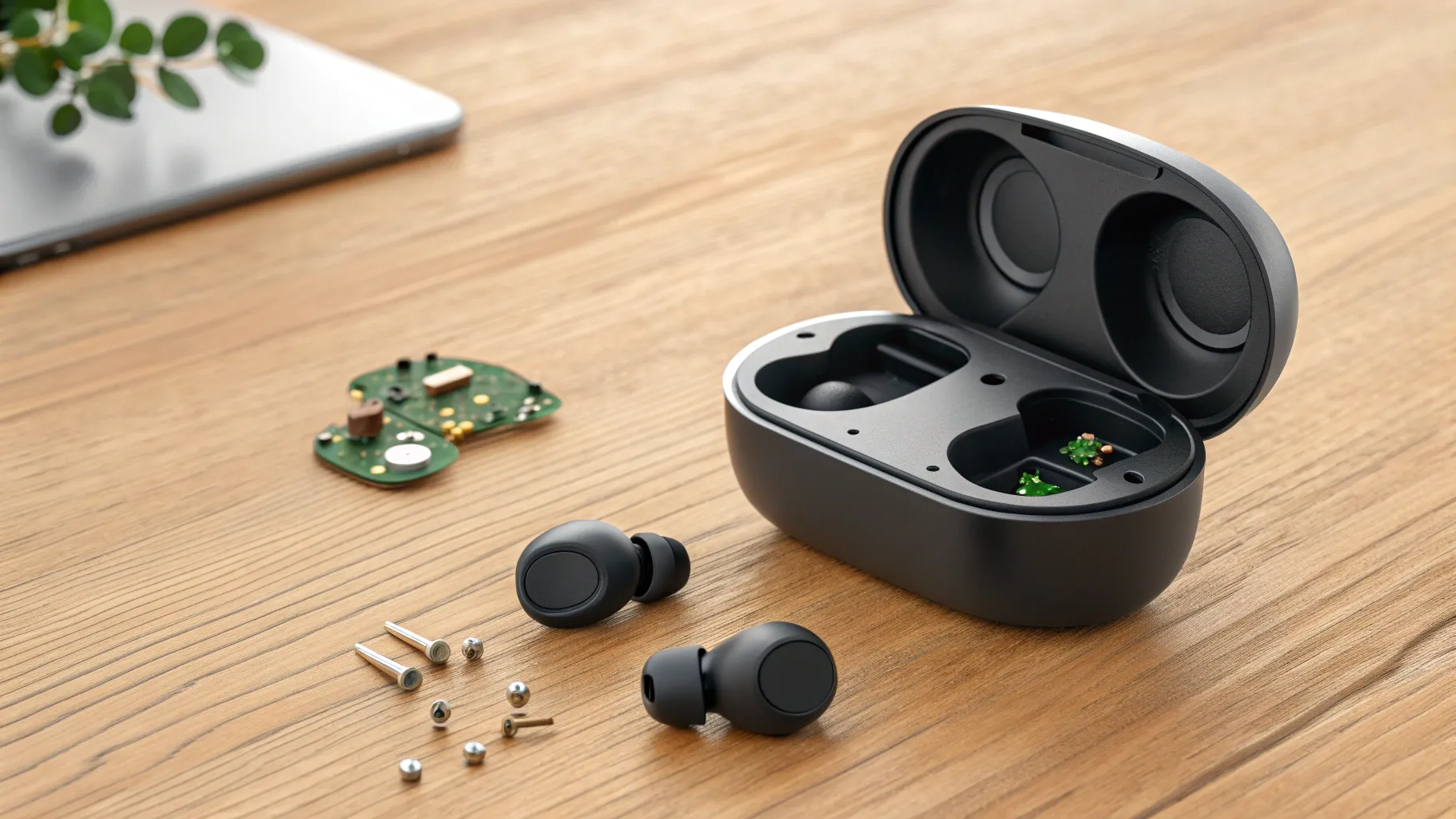
One of the most surprising and delightful features to me was the focus on repairability. In a market where some earbuds are effectively disposable, the Pixel Buds 2a case includes a replaceable battery — and the team went further to make that repair process accessible.
Here’s what the team did to make repairability practical:
- Designed an in-house repair manual and test process: The team had people attempt a battery replacement using off-the-shelf tools and their repair documentation, timing the process and gathering feedback.
- Added a pull tab to the case battery: A small ergonomic change removed minutes from the repair process and made the battery easier to extract.
- Colored the pull tab spearmint: The bright spearmint color is a visible signpost. Across the Pixel product family, spearmint indicates a user-serviceable component, making repairs and replacements more discoverable for owners and technicians.
Vanessa Powell: "We added a pull tab to the case battery so that it's easier for users to remove the case battery during repair... and another thing we did was we made this pull tab a spearmint color... it's really around providing a sustainability, repairability theme across all of our repairable components in the Pixel portfolio."
That attention to repairability is significant for sustainability. Batteries degrade over time, and making them replaceable extends product life. For consumers it reduces long-term cost and waste. The spearmint tab is a small detail with a big message: we designed these earbuds to last, and we want you to be able to give them a second life.
⚖️ Balancing power users and everyday listeners
One of the questions from the Pixel super fans was whether large companies must “stop catering to power users” in favor of general consumers. I appreciated Vanessa’s balanced response: the Pixel product line includes options for both crowds.
Our strategy is straightforward:
- Pixel Buds Pro 2: For power users who want the absolute newest features, more advanced controls, and premium extras — this is the high-end choice. It includes software and hardware features like adaptive audio, Gemini interactions, loud sound protection, and head gestures for call control.
- Pixel Buds 2a: For users who want the essentials done really well — pro-level ANC, strong battery life, personalized EQ, and repairable components — Pixel Buds 2a delivers a focused set of features at an attainable price.
That's how a product family can serve diverse needs. One model focuses on a price-value balance and durability, the other on bleeding-edge convenience and advanced functionality. From my perspective, this is the right way to think about scaling a product line: make choices that serve clear user personas rather than trying to be everything to everyone in a single SKU.
🔬 From biomedical engineering to earbuds — the unexpected path
I loved Vanessa’s personal journey because it illustrates how diverse backgrounds contribute to better hardware. She started with a degree in biomedical engineering and joined Google through Verily, working on miniaturized sensors, medical wearables, and machine learning applications. Those experiences translate surprisingly well to building high-quality earbuds.
Vanessa Powell: "I joined Google actually through Verily... focusing on the life sciences arm... leveraging miniaturized sensors, advanced technology, machine learning in applications around health and disease... now I'm here."
That blend of hardware understanding, software sensibility, and user-centered product management is exactly what modern consumer tech needs. Building small devices that deliver big experiences requires electro-mechanical know-how, deep signal processing expertise, and an acute sense for how people will use a product in the real world.
📦 How I would use Pixel Buds 2a — practical scenarios and tips
Based on what Vanessa and the team described — and from my own experience pairing similar earbuds — here are practical scenarios where Pixel Buds 2a really shine, plus a few tips to get the most from them:
Daily commute
- Turn ANC on to block bus and train noise when you want to focus. The Silent Seal 1.5 and Tensor A1 work together to reduce ambient sounds and keep your audio immersive.
- Use transparency mode briefly when you’re approaching stops or walking on busy streets so you hear announcements or approaching traffic.
Outdoor calls
- AI-powered wind suppression and voice isolation make outdoor phone calls far more reliable. You don’t need to change settings — the models work automatically to prioritize speech clarity.
- If wind is extremely strong, briefly cupping your hand around the outer microphone area (not the entire bud) can help as a physical stopgap, but in most cases the built-in models will handle it.
Working from home
- The improved ANC helps create a quiet workspace; combined with comfortable fit, these buds are suitable for long calls and focus sessions.
- Personalize the five-band EQ to boost vocal frequencies for clearer calls if you spend a lot of time on meetings and podcasts.
Fitness and mobility
- Use the twist-to-adjust stabilizer to lock in a secure fit for running, HIIT, or walking. It’s a quick mechanical tweak that can keep the buds stable through movement.
- Double-check ear tip sizes before workouts; asymmetric ear tip sizes are more common than you think and can dramatically improve fit and passive noise isolation.
Everyday maintenance and longevity
- Keep the case charged and carry it in a dedicated pocket. The pocket-friendly size makes it easy to take along wherever you go.
- When the case battery nears end-of-life, consider a repair instead of a replacement. The spearmint pull tab and replaceable battery make this a realistic option for users who want their devices to last longer.
🚀 Launch day and the team’s mindset
Vanessa described launch day as celebration plus scrutiny. I always find that honest approach refreshing: teams celebrate their accomplishments, but they also tune in to early reviews and user feedback to learn and iterate.
Vanessa Powell: "I will definitely be celebrating with the team... but for me personally, of course, I will also be tuning into... the reviews, the user feedback and just really hear what we got right and also areas that we can further improve."
That iterative mindset — shipping a product that solves core user problems, then learning from how it’s used — is the hallmark of long-lived products. It also feeds the product roadmap: the Pixel Buds Pro 2 and Pixel Buds 2a sit together in a portfolio that lets the team learn from different segments of users and evolve both hardware and software over time.
📈 Why this matters — consumer value, sustainability, and user-first design
What I find most compelling about Pixel Buds 2a is that they’re not just about adding features; they’re about solving the right problems at the right price. A few higher-level takeaways:
- Value-first design: The team prioritized essential features that move the needle for most users: meaningful ANC, solid battery life, dependable call clarity, and comfortable fit.
- Sustainability through repairability: Making the case battery replaceable and visually signposting it with spearmint encourages longer product life and less electronic waste.
- AI as practical assistance: The embedded machine learning models are tuned to solve real problems — wind noise and call clarity — rather than being a platform for gimmicks.
- Portfolio thinking: By offering both Pixel Buds 2a and Pixel Buds Pro 2, Google can meet different user needs without bloating a single product with features that may not matter to everyone.
From a consumer standpoint, this matters because it provides options for different budgets and needs while still delivering real technological improvements that affect everyday life.
🧾 Common questions I expect readers to ask
Below I answer a few practical questions based on what Vanessa discussed and what users typically want to know before buying earbuds.
Do Pixel Buds 2a have noise cancellation that rivals premium models?
In objective terms, Pixel Buds 2a deliver ANC that is significantly improved over earlier A-series models and tuned to a "pro-level" experience thanks to Silent Seal 1.5 and Tensor A1. If you want the absolute top-level ANC with all the advanced extras, the Pixel Buds Pro 2 are still the higher-end option. But the 2a brings remarkable ANC to a more accessible price point.
How long will the battery actually last in daily use?
The buds themselves can run up to 7 hours with ANC on and up to 10 hours with ANC off. Real-world time depends on volume, connection stability, and use of features like transparency mode or constant voice assistant listening. The case provides multiple charges and is more capable than the previous A-series case while remaining pocket-friendly.
Can I repair or replace the case battery myself?
Yes — the case includes a replaceable battery and the design includes a spearmint pull tab to simplify extraction. The team intentionally tested user repairability with off-the-shelf tools and documentation to make sure the process is feasible. If you’re not comfortable performing the repair yourself, a technician can do it more quickly thanks to the pull tab and the visual cue.
What does the Find My integration look like without a case speaker?
Even though the Pixel Buds 2a case lacks an internal speaker, the Find system can ring the earbuds when they’re in the case. So if you misplace the case but it’s within Bluetooth range and the earbuds are inside, you can still locate the system by ringing the buds. It’s a smart software workaround for a hardware trade-off.
How well do the earbuds handle wind and outdoor noise on calls?
Very well, relative to their category. The combination of a wind suppression model and a voice call isolation model improves outdoor call clarity. They work together automatically so you don’t have to change settings when conditions change.
🔚 Final thoughts — why I think Pixel Buds 2a are important
Pixel Buds 2a represents a thoughtful intersection of hardware, software, and product strategy. They’re not trying to mimic premium flagship earbuds feature-for-feature. Instead, they solve the most commonly reported pain points from users of the previous A-series: lack of ANC, limited battery life, and room for improved sound. In doing so they deliver a product that feels genuinely better in everyday contexts.
I appreciate how the team used deliberate trade-offs to keep the price accessible while still delivering meaningful improvements: the Tensor A1 chip enables efficient ANC and AI features, Silent Seal 1.5 enhances isolation and ANC performance, the case is pocket-friendly yet capable, and repairability features show a commitment to sustainability.
From my perspective, these earbuds are an excellent example of user-first product design. They’re practical, considerate of long-term ownership, and thoughtfully engineered. If you’re looking for a pair of earbuds that deliver great ANC, long battery life, and reliable everyday performance — without paying flagship prices — the Pixel Buds 2a are worth a close look.
📣 Where to get them and what to expect next
If you want to try a pair, Pixel Buds 2a will be available through Google Store and retailers that carry Google hardware. Expect a focused experience: solid ANC, reliable battery life, customizable EQ, improved transparency, AI-enhanced call clarity, and a case designed for both portability and repairability.
As the product rolls out, I’ll be watching early reviews and user feedback closely — just as Vanessa described. Those insights will shape future iterations and updates, and I’ll be interested to see how real-world usage patterns influence new features and improvements.
👏 Acknowledgements and next steps
Thanks to Vanessa Powell and the Made by Google podcast team for an open look at the engineering choices and product philosophy behind Pixel Buds 2a. For readers who want to dive deeper, checking out the episode on the Made by Google podcast is a great way to hear the discussion in Vanessa’s own words.
If you’re choosing earbuds right now, here’s a short decision guide from my perspective:
- If you want maximum features and the latest premium extras: consider Pixel Buds Pro 2.
- If you want solid ANC, long battery life, repairability, and value: Pixel Buds 2a are a strong choice.
- If you care most about custom audio tuning and everyday comfort: try Pixel Buds 2a and spend a few minutes switching ear tips and adjusting the stabilizer — those steps matter.
I’ll be updating my own notes as more users share their experiences. For now, I’m excited by the combination of useful AI features, improved ANC, a pocket-friendly case, and a genuine commitment to sustainability through repairability. Those are the kinds of improvements that make a product feel thoughtfully designed, not just iterated.
Thanks for reading — I hope this guide helps you decide whether Pixel Buds 2a belong in your pocket, your commute, or your daily routine.


