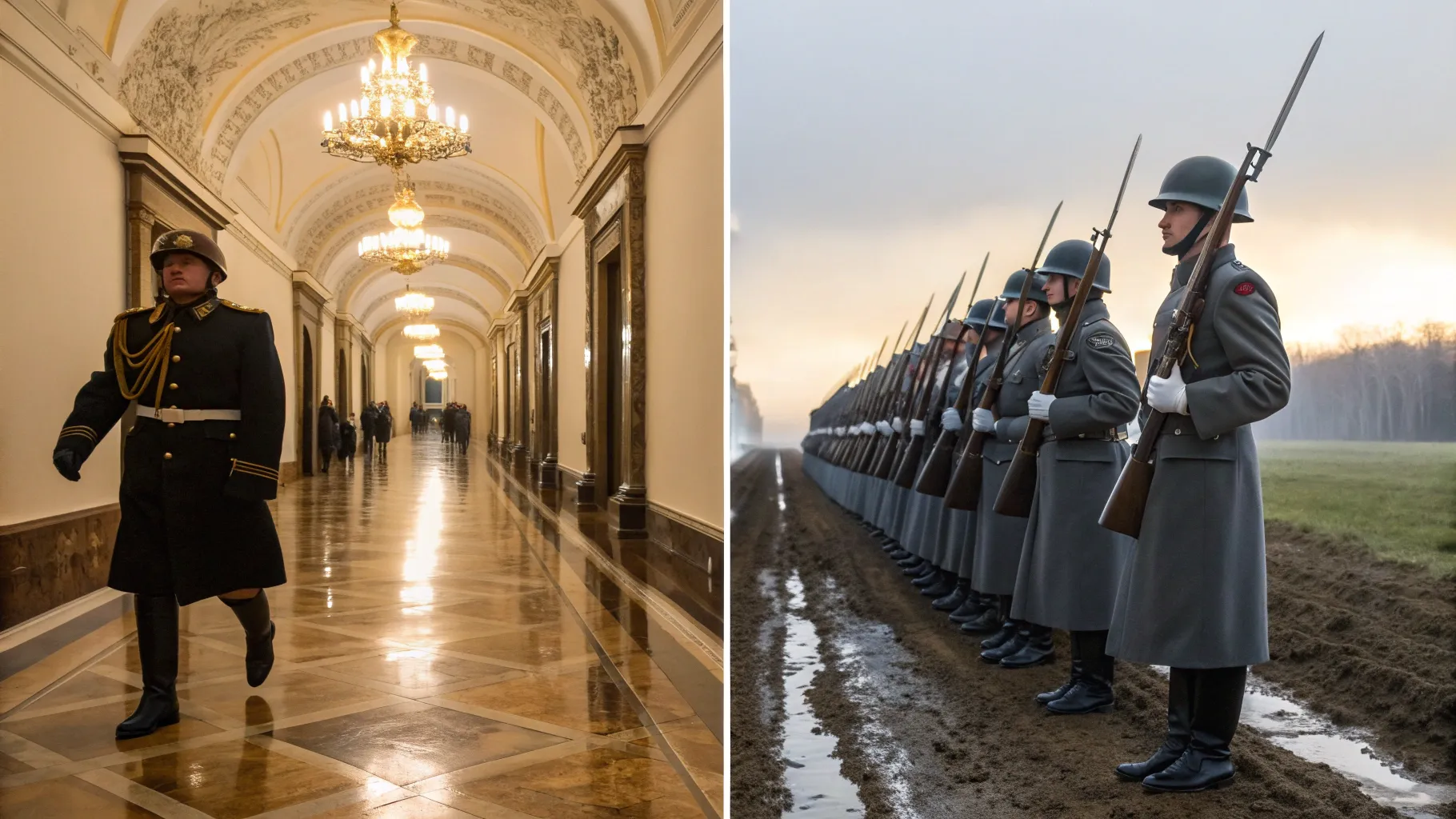
I produced the documentary "Początki Waffen-SS | Dokument v plném barvě" for my channel, The Soldier’s Diary CZ, to explain a transformation that did not begin on the battlefield but in the corridors of political power. In this report I present the origins of the Waffen-SS as a factual, investigative narrative: how a small ceremonial escort — the Leibstandarte SS Adolf Hitler — evolved into an ideologically driven, militarized force loyal directly to Adolf Hitler, and how that evolution shaped a parallel army whose actions would stain the history of the Second World War.
In the following report I combine archival narrative, eyewitness tendencies, and the interpretations of historians such as Lehmann, Veale, Wegener, and Wehle. I outline the sequence of institutional decisions and political crises that propelled the SS from party guard to combat force, and I analyze the consequences of that trajectory: rivalry with the Wehrmacht, brutal conduct in the field, and formal institutionalization as the Waffen-SS by 1940. This is a careful, first-person account intended to be clear, accessible, and rooted in the evidence and interpretations that matter most for understanding this dark chapter of 20th-century history.
🛡️ The Early Guard: From Stabswache to Leibstandarte
The very first seeds of what later became the Waffen-SS were planted in the early, precarious years of the Nazi movement. I start my reporting with the small Stabswache that protected Adolf Hitler during the chaotic political battles in Bavaria. After the failed Beer Hall Putsch in 1923 and the temporary dissolution of the Nazi Party, memories of an elite guard persisted in party circles. When the party reformed in 1925 the Schutzstaffel (SS) reappeared as a selected guard nominally subordinate to the SA (Sturmabteilung). But this was only the beginning.
When Heinrich Himmler assumed command of the SS in 1929, he began to reshape it. Himmler did not merely want a guard; he wanted an order. In my reporting I emphasize that the SS under Himmler was conceived as a closed, ideologically disciplined order, one that combined racial doctrine, ritual, and loyalty to the Führer. That change is crucial: it tells us that militarization was not an accidental by-product of wartime needs but an express ambition embedded in organizational design.
In January 1933 Adolf Hitler’s accession to power made the creation of a personal state guard politically feasible. The SS-Stabswache Berlin, led by Sepp Dietrich, was reorganized into the Leibstandarte SS Adolf Hitler (LSSAH). The LSSAH adopted traditions and symbols intended to project the image of a pretorial guard, evoking the personal protective units of former monarchs and the elite orders of Europe’s past.
Lehmann’s account — which I used as a primary narrative source during production — stresses the ceremonial quality of those early months: immaculate uniforms, disciplined parades, and visible loyalty. Yet Lehmann also records the rapid adoption of military routines: weapons training, barracks life, and maneuvers. The LSSAH became a hybrid at once symbolic and operational.
Why the Leibstandarte mattered
- It represented Hitler’s political decision to have a force that owed its allegiance to him personally.
- It functioned as a propaganda symbol — an elite, racially pure corps contrasted with the mass SA.
- It served as the organizational seed for the broader project of an armed SS.
From the public parades of Berlin and Munich to the private drills in Lichterfelde, the Leibstandarte presented itself as an embodiment of a new political-military ideal: the political soldier.
🏛️ Himmler’s Project: The SS as an Ideological Order
When I examine the SS’s evolution, I always return to Himmler’s central role. He envisioned an organization that was not merely a security service but a transformative culture—an order producing a new kind of political warrior. Wegener’s interpretation — which I draw on frequently — frames the SS as a “political laboratory”: an institution intentionally designed to merge politics, race, ritual, and military practice.
Himmler’s reforms tightened recruitment standards, elevating racial criteria, genealogical verification, and ideological reliability. The SS cultivated practices that resembled quasi-religious rites: oaths of devotion, intense political study, and a mythicized narrative of sacrifice. These features distinguished SS men from ordinary soldiers in the Reichswehr or Wehrmacht: SS loyalty was to Hitler and the Nazi racial mission, rather than to the impersonal apparatus of the state.
This is the intellectual pivot of my reporting: recognizing that the SS’s move toward armed capability was intentionally embedded within an ideological mission. That mission rationalized violence as both necessary and sacred. If I were to summarize the project in one line I would say: Himmler sought to create an elite order of political soldiers, trained and conditioned to carry out ideological warfare.
The practical consequences of Himmler’s vision
- Creation of parallel training schools and camps outside regular military channels.
- Emphasis on racial screening and political indoctrination alongside military drills.
- Institutional independence from both SA and the Wehrmacht, enabling a unique trajectory.
It is this ideological framing that explains why the SS would later take on roles that the Wehrmacht, guided by professional norms and conventions, often refused.
🔪 Night of the Long Knives: The Point of No Return
Every institution involves a moment when it shows — and proves — what it is prepared to become. For the SS that moment came in the summer of 1934 during the Night of the Long Knives. I treat this episode as a turning point: a watershed in which the SS became the executing arm of the Führer’s will, not merely a guard or a ceremonial corps.
"A baptism of blood," as many historians describe it — a brutal test that converted ceremony into execution.
Ernst Röhm and the SA had amassed vast power, and Röhm’s ambition to transform the SA into a “people’s army” posed a direct threat to the professional military class and to Hitler’s control. The Nazi leadership chose to eliminate that threat by decisive violence. Himmler and the SS — including units of the Leibstandarte under Sepp Dietrich — were centrally involved in the arrests, summary executions, and targeted murders that followed.
From a news-report perspective I present the facts plainly: the SS’s participation was not an accident; it was an instrument of policy. Hitler rewarded that service by elevating Himmler’s authority and granting the SS unprecedented autonomy. The moral point is also unavoidable: the Night of the Long Knives normalized extra-legal violence as a legitimate tool for internal political consolidation. For the SS, that normalization would have long-term consequences.
Immediate outcomes
- SS gained political legitimacy as a trusted instrument of the Führer.
- Leibstandarte’s status rose sharply, receiving resources and political favor.
- The precedent of political violence as policy became institutionalized.
Wegener’s reading underscores how deeply this event restructured internal balances of power: the SS ceased to be a subsidiary force and began to exist as a separate pole of authority within the Reich.
⚔️ From Escort to Combat Force (1935–1938)
Between 1935 and 1938 the Leibstandarte underwent a transformation from an elite escort into a fighting unit with the organization and training of a military formation. This era saw intensive training, the adoption of barracks life, and a steady expansion in size and capabilities. I report these changes because they mark the institutional maturation that would allow the SS to act on battlefields.
Lehmann’s narrative captures the lived experience inside the Leibstandarte: long training marches, weapons drills, small-unit tactics, and an atmosphere of communal sacrifice. I supplemented that internal perspective with Wegener and Wehle to highlight the political dimension: while the Wehrmacht preserved professional norms, the Leibstandarte fused those norms with political indoctrination.
Key deployments during this period — the Saar in 1935, the Anschluss in 1938, and the Sudetenland — served not just as operations but also as demonstrations. The mere presence of Leibstandarte units beside Wehrmacht units symbolized Hitler’s intention to keep a political, partisan force at the core of his expansion strategy.
Institutional shifts and public image
- Leibstandarte moved into permanent barracks and embraced a fully militarized daily routine.
- Public parades and ceremonial duties continued, but military skills increasingly dominated training agendas.
- Ritual and spectacle remained tools of propaganda to present the unit as a racial and moral elite.
Through the late 1930s the Leibstandarte expanded from a small guard into a regiment-sized formation with logistical and motorized capabilities — the institutional seed that would later grow into a division of the Waffen-SS.
🆚 Rivalry with the Wehrmacht
A central theme of this story is the rivalry between the SS and the German regular army. I present this rivalry not as trivial internecine squabbling but as a structural tension in Nazi Germany: two competing models of military identity and authority.
The Wehrmacht represented Prussian tradition, institutional professionalism, and loyalty to the state apparatus. The SS represented political zeal, ideological purity, and loyalty to the Führer. These two logics were inherently competitive. Wehrmacht officers viewed the SS as politically motivated amateurs lacking military decorum. SS leaders viewed the Wehrmacht as aristocratic, untrustworthy, and potentially disloyal.
Hitler exploited this rivalry by deliberately allowing both to coexist and by using the SS as a counterweight to the army’s power. In my reporting I show how that political calculus reshaped resource allocation, appointments, and operational prerogatives through the late 1930s: the SS’s rapid acquisition of resources and autonomy only increased army suspicion but served Hitler’s purpose.
Three fronts of tension
- Legitimacy: Should SS units be recognized as regular military forces?
- Resources: Which organization gets men, weapons, and funding?
- Doctrine: Professional caution vs. ideological audacity and brutality.
Wegener emphasizes that this rivalry was not simply destructive; it paradoxically enabled the SS’s growth. Army skepticism became a motivating force for the SS to prove itself in combat; Hitler’s balancing of institutions guaranteed SS survival and expansion.
🔥 Baptism by Fire: Poland 1939
When Germany invaded Poland in September 1939 the SS — and in particular the Leibstandarte — finally faced combat on a scale that mattered. I report that this campaign served as both a test and a defining moment. Poland was the baptism by fire for the SS’s armed formations; it revealed tactical weaknesses, demonstrated relentless aggression, and documented early examples of brutal conduct toward civilians and prisoners.
From a military perspective the Leibstandarte fought as a motorized infantry formation. Observers from the Wehrmacht criticized SS tactics: impetuous assaults, insufficient coordination, and heavy casualties compared to veteran army units. Wegener and other analysts recorded those tactical deficits: inexperience and ideological impatience often translated into operational mistakes.
But military metrics alone don’t tell the whole story. The broader significance of Poland lies in the political and moral realm. The SS — already steeped in racial doctrine and ritual — committed acts of reprisal and mass violence against civilians and captured personnel. These actions foreshadowed a pattern that would intensify on the Eastern Front.
"The baptism of fire in Poland was not only a military test; it was the unfolding of a moral and political identity."
Lehmann’s narrative describes the esprit de corps within the Leibstandarte: pride, camaraderie, and myth-making. Veale’s account, by contrast, stresses the terror practiced against civilians. My reporting reconciles these views: the internal mythology of sacrifice and heroism coexisted with acts of brutality that cannot be excused as wartime excess.
Outcomes of the Polish campaign
- SS units demonstrated aggressive combat spirit, albeit with tactical shortcomings.
- Acts of repression and mass violence occurred early and frequently, revealing a criminal pattern.
- Hitler interpreted SS performance as confirmation of their value: ideologically driven units were useful political tools as much as military ones.
After Poland the SS used the campaign’s narrative to press for recognition, recruits, and material support. The myth of fanatical loyalty and willingness to execute extreme measures did more to cement the SS’s place within Nazi power than any single tactical success.
📜 Institutionalization: The Birth of the Waffen-SS (1940)
The official moment of recognition arrived in 1940. I frame this as an institutional turning point: the creation and formal recognition of the Waffen-SS as a distinct, armed branch that could be deployed side by side with the Wehrmacht. This was not simply a name change; it was a political, legal, and bureaucratic victory for Himmler and for Hitler’s plan to possess a parallel military instrument.
After the campaigns in Poland and especially France, momentum built for formalizing the armed SS. Hitler’s political valuation of the SS’s aggression and loyalty overrode the Wehrmacht’s professional objections. The Waffen-SS label served to distinguish the combat-capable SS formations from the broader Allgemeine SS and from the Totenkopf units tasked with concentration camp duties.
The institutional consequences were profound:
- Legal recognition and administrative structures allowed Waffen-SS units to expand into brigades and divisions.
- Recruitment broadened, though ideological screening and political loyalty remained central pillars.
- Propaganda elevated Waffen-SS as an elite embodiment of racial and physical ideals, while real-world criminal actions were downplayed or concealed.
Under the Waffen-SS umbrella the Leibstandarte itself moved toward becoming an armored division, fully equipped and restructured to fight as a frontline combat corps. This formalization sealed the trajectory from personal guard to ideological army.
What institutionalization meant
- Recognition meant access to heavier equipment, motorization, and divisional organization.
- It opened recruiting doors to volunteers from occupied Europe later in the war, setting the stage for multinational SS formations.
- It reinforced the SS’s claim to be an elite military arm while shielding political crimes behind military façades.
I have argued in my film that 1940 was the decisive legal and symbolic moment when the SS became the Waffen-SS: an army distinct in ethos and purpose from the Wehrmacht and integrated into Hitler’s vision of a racially driven wartime force.
🧠 Identity, Indoctrination, and Ideology
Understanding the Waffen-SS requires attention to its identity formation. In my reporting I emphasize that training in the SS combined military skill-building with intense political and racial indoctrination. The result was a composite identity: the soldier was also a political actor, a bearer of racial mission, and a member of a quasi-religious order.
This identity-building had several components:
- Racial selection: early recruits were examined for "Aryan" lineage, with genealogical checks and an emphasis on physical attributes.
- Political education: daily political instruction sessions reinforced ideological commitments and normalized dehumanizing depictions of enemies.
- Rituals and brotherhood: oaths, commemoration of fallen comrades, and group rituals cultivated a sense of sacred duty and exclusivity.
These mechanisms created a closed culture in which dissent was improbable and obedience was valorized. Lehmann’s internal narratives celebrate that camaraderie and sense of mission. Veale and Wegener offer corrective readings: the same internal cohesion that produced bravery also enabled moral blindness and participation in atrocities.
The practical effects on combat behavior
- Unhesitating execution of orders, often without moral restraint.
- Tendency toward brutal reprisal tactics against civilians and suspected partisans.
- Ritualized valor that justified extreme actions as service to a transcendent cause.
As a news report I must be direct: ideology can shape not only decisions but habits of action. The Waffen-SS’s training did more than make better fighters — it made ideological warriors prepared to commit crimes in the name of a racially conceived mission.
☠️ Brutality and War Crimes
No account of the Waffen-SS can avoid the record of brutality. From Poland onwards, multiple SS units — not only the Leibstandarte but also Totenkopf and other formations — were implicated in massacres of civilians, unlawful executions of prisoners, and repressive security operations that blurred the line between military action and criminal terror.
Reports and investigations, contemporaneous and post-war, documented patterns: summary executions during anti-partisan actions, mass shootings of civilians, and massacres of surrendered troops. Veale’s and Wehle’s analyses emphasize that the Waffen-SS’s role in these crimes was systematic rather than incidental. In my film I present this as structural: the ideological training, the operational autonomy, and the political mandate combined to produce criminal behavior at scale.
Two features stand out in my reporting:
- Normalization of brutality: institutional rituals and propaganda dehumanized victims and framed extreme violence as patriotic or necessary.
- Impunity: SS units frequently operated with a sense of political protection that reduced legal accountability during the war, encouraging escalation.
It is important to be clear and unavoidable in language: the Waffen-SS did not simply fight harshly; many of their actions constituted war crimes and crimes against humanity. A fair and factual report must not minimize or euphemize that reality.
Examples and patterns
- Mass reprisals against villages suspected of aiding partisans — entire communities punished for alleged resistance.
- Executions of Jewish civilians and other targeted groups in occupied territories, frequently coordinated with Einsatzgruppen activities.
- Brutal treatment of prisoners of war, including summary executions and denial of protections under the laws of war.
These patterns illustrate that the Waffen-SS functioned both as a fighting force and as an instrument of terror. The political character of the organization meant the two activities were often indistinguishable.
📚 Legacy and Historical Interpretation
Assessing the origins of the Waffen-SS requires engagement with competing scholarly narratives. My documentary drew on sources representing different perspectives: Lehmann’s internal, often apologetic, recollections; Veale’s critical, evidence-driven examinations; Wegener’s interpretive framework emphasizing institutional design; and Wehle’s focus on the Wehrmacht-SS dynamic.
As a reporter and historian I do not privilege one narrative without scrutiny. Instead I present a synthesis: the SS originated as a party guard, Himmler transformed it into an ideological order, the Night of the Long Knives made it an executor of political violence, and institutionalization in 1940 transformed it into the Waffen-SS — a combat arm with a distinct political mission.
Historians continue to debate the relative weight of these factors. Some questions that remain central:
- To what extent was the Waffen-SS a military necessity versus a political instrument?
- How much did ideological indoctrination actually determine battlefield behavior?
- What role did individual agency versus organizational structure play in perpetrating crimes?
My report takes a clear position: structural design, political patronage, and ideological training combined to create a force that was predisposed to criminal conduct. That position does not absolve individual responsibility, but it insists on examining institutional causes as well as moral agency.
How historians’ outlooks complement each other
- Lehmann provides insight into internal identity and lived experience.
- Veale documents action and emphasizes legal and moral accountability.
- Wegener supplies institutional and conceptual analysis of the SS as an order.
- Wehle unpacks the rivalry and interplay between SS and Wehrmacht.
All of these angles matter. The historical verdict about the Waffen-SS is not reducible to tactical performance or battlefield bravery; it is measured also by the organization’s role in perpetrating ideology-driven crimes.
🧾 Conclusion: Why Origins Matter
In reporting the origins of the Waffen-SS I aim to show why institutional roots matter for outcomes. The SS’s transformation from a ceremonial guard into the Waffen-SS was not merely a matter of organizational growth. It was a trajectory deliberately shaped by ideological purpose, political calculation, and strategic convenience.
The LSSAH’s early evolution demonstrates how ritual, propaganda, and military training can be fused to produce a force that is both effective in combat and complicit in atrocities. The Night of the Long Knives made the SS politically indispensable to Hitler; Poland and France provided the battlefield myths that justified expansion; and 1940’s institutionalization turned ambition into formal military power.
As I close this report I stress three lessons from the story:
- Political instrumentalization of armed units can produce forces with commitments beyond professional military norms.
- Ideological indoctrination changes the moral calculus of combatants and can lead to normalized criminality.
- Institutional design and leadership patronage (in this case Himmler and Hitler) determine whether an organization will be constrained by law or freed to act with impunity.
History does not cease to matter because an institution is powerful. On the contrary, the origins of the Waffen-SS remind us that how a force is formed — the values it is asked to embody, the loyalty it is taught to swear — will shape its conduct and its legacies. That is why, as a historian and documentarian, I believe tracing those origins is not a matter of mere curiosity, but an act of civic responsibility.
If you want a visual and narrative companion to this report, I created the full-color documentary for The Soldier’s Diary CZ to present the footage, archival images, and extended analysis that support these conclusions. My goal in both film and text is the same: to make clear how politics, ideology, and institutional design combined to create one of the most infamous military forces of the 20th century — and to remind readers that institutional choices have consequences that echo long after the guns fall silent.


