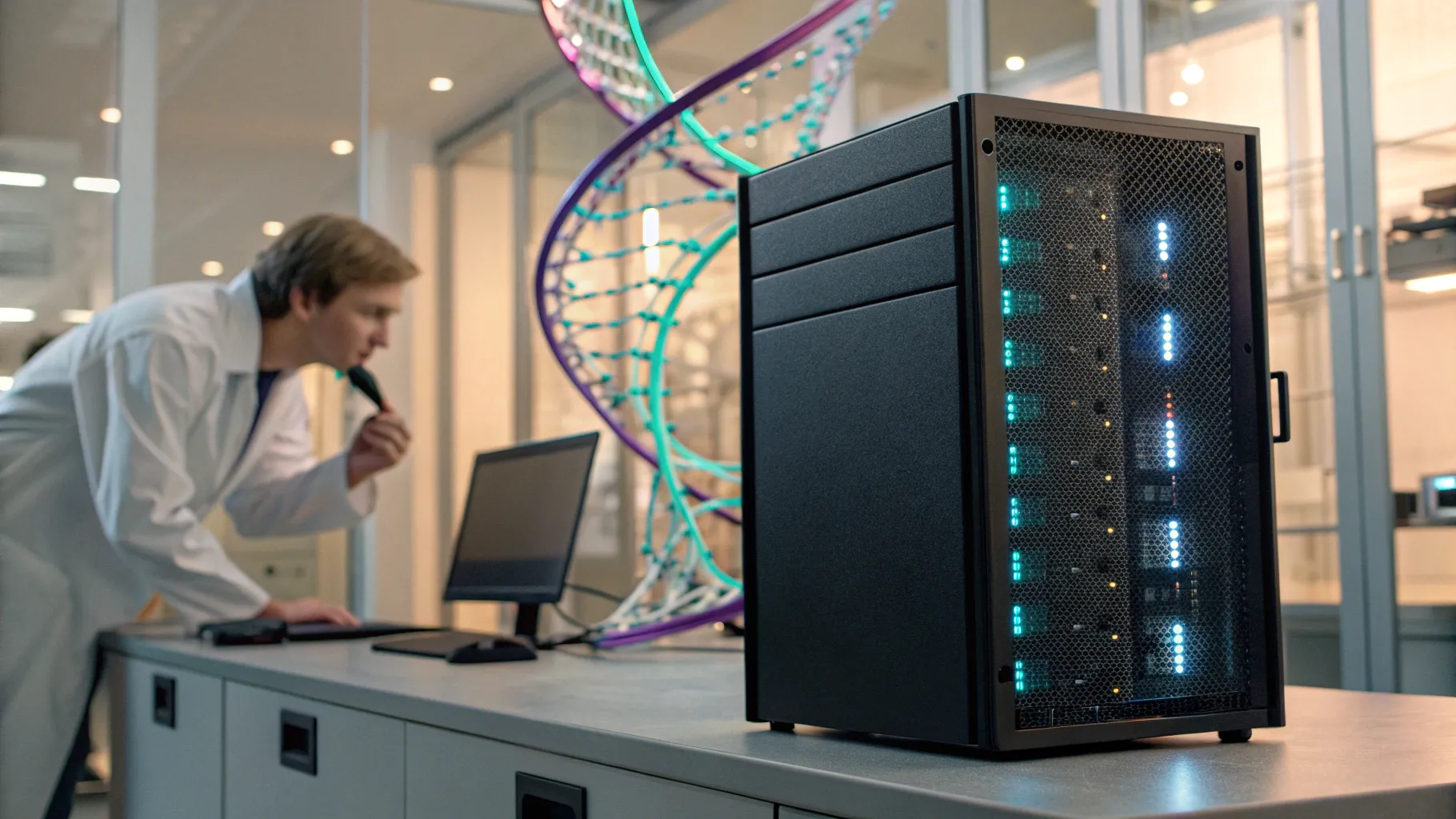
In the video I released with NVIDIA, I spoke about a major shift unfolding at the intersection of artificial intelligence and biology. NVIDIA’s DGX Spark brings data-centre class compute to the lab bench, and in that short presentation I tried to capture what this compact system means for anyone who studies proteins, designs therapeutics, or wants to run proteome-scale AI models without waiting in long queues. In this article I’ll report on those developments, explain why they matter, and lay out practical implications for researchers and teams who are ready to fold the future—faster, privately, and locally.
🔬 The changing landscape of protein science
AI is transforming the way that we understand and treat diseases. That statement is not hyperbole—it's a description of a trend that has accelerated dramatically in the last few years. Where structure determination used to be dominated by painstaking laboratory experiments such as X-ray crystallography, cryo-EM, or NMR, deep learning models are now able to predict high-quality protein structures in hours or minutes. The consequences are profound: faster hypothesis testing, new routes to drug discovery, and the ability to scan entire proteomes for structural insights that would once have required years of effort.
As someone who spends time thinking about practical impacts, I see three big pillars in this transformation:
- Speed: Models like AlphaFold 2 take tasks that historically consumed months and reduce them to minutes of compute time.
- Scale: We can now model proteome-scale datasets—thousands to tens of thousands of proteins—for organisms of interest.
- Access: When the compute moves out of distant data centres and onto researchers’ benches, more teams can iterate quickly and privately.
Those pillars are interdependent. Speed without scale is limiting; scale without access leaves the benefits concentrated in a few institutions. The DGX Spark is positioned to address that last mile—bringing high-performance AI to the people directly doing the science.
⚙️ What AlphaFold 2 changed — and what it still needs
AlphaFold 2 was a landmark moment for computational structural biology. It demonstrated that deep learning architectures could infer molecular structures using sequence data and evolutionary context, producing predictions that often match experimental quality. But it’s important to unpack what that success required and where practical bottlenecks remain.
AlphaFold 2 and similar models rely heavily on input features derived from multiple sequence alignments (MSAs). An MSA is a matrix of homologous protein sequences aligned to reveal conserved positions across evolutionary time; those conserved signals tell the model about structural constraints and residue co-evolution. To get a high-quality MSA for a query protein, pipelines typically search against enormous sequence databases—UniRef, MGnify, BFD, Uniclust, and others—producing alignments that can occupy large amounts of memory.
This is the key point: while the neural networks themselves need substantial compute, a significant fraction of the resource consumption is actually in the data preprocessing step—retrieving and holding large MSAs, performing template searches, and managing intermediate representations. When you try to run many predictions, or fold thousands of proteins in a proteome, those memory and I/O costs add up fast.
That’s why the move from research-scale runs (a handful of proteins) to proteome-scale projects (millions of residues across thousands of sequences) highlights new hardware needs: coherent, large memory; fast local storage; and GPUs with both high compute and memory capacity so the entire pipeline can run without splitting work across distant nodes.
🧠 Why on-prem AI compute now matters
Cloud and shared high-performance compute clusters have been indispensable, but they come with trade-offs:
- Queue times: Researchers routinely wait hours or days for job slots on shared clusters. For iterative science—where you run a model, inspect results, change parameters, and run again—this wait is costly to productivity.
- Data privacy: Many biological datasets are sensitive. Local compute avoids moving potentially proprietary or patient-derived data to third-party clouds.
- Cost volatility: Large-scale cloud GPU time can be expensive and unpredictable, especially for sustained proteome-scale projects.
- Latency: When you need to run experiments in tight cycles (design, simulate, refine), local access removes the friction of long provisioning processes.
By bringing powerful, energy-efficient AI systems directly into laboratories, investigators can remove these bottlenecks. On-prem devices give teams ownership of the entire stack—software, models, and data—allowing for reproducible pipelines, integrated workflows with wet-lab cycles, and faster iteration on hypotheses.
💻 Meet the NVIDIA DGX Spark — a workstation-scale AI powerhouse
I introduced DGX Spark in the video as a different class of system: not a laptop, not a full rack-sized cluster, but a personal AI supercomputer designed for digital biology. It’s compact enough to sit on a desk or a dedicated lab bench and powerful enough to run production-scale AI models used in protein structure prediction.
Here are the headline attributes that make it stand out:
- Compact form factor: DGX Spark fits into environments where space and power budgets are more constrained than typical data centres.
- Data centre-class performance: Despite its size, it offers performance approaching that of full rack systems, enabling workloads that previously required large clusters.
- Simplified workflow: Teams can run AlphaFold-like models, experiment locally, and iterate with low latency.
- Designed for biology: The system addresses specific pain points of protein AI—most notably the memory demands of MSA databases and the need for coherent memory across CPU and GPU.
In short, DGX Spark is a bridge: it connects the accessibility of a workstation with the computational muscle of a small supercomputer, enabling new categories of research to be performed at the lab bench.
🧩 The Grace Blackwell architecture — why coherent memory matters
One of the defining technical features I emphasized is the DGX Spark’s use of the Grace Blackwell architecture. That name reflects a close integration of NVIDIA’s high-performance CPU and GPU technologies—designed to deliver a unified memory space across the system.
Why does coherent memory matter? Let me put it plainly: when CPU and GPU address the same memory region without duplicating data or performing costly transfers, pipelines that require large reference datasets (like MSA databases) operate much more efficiently. Coherent memory dramatically reduces the need for temporary buffering, eliminates inefficient copying between devices, and lowers latency for memory-bound tasks.
To ground this in the protein-folding context, consider this simplified flow:
- Search databases to build MSAs and templates.
- Load MSA features and template embeddings into memory for the model.
- Run the neural network-based structure predictor (Evoformer-like modules and structure modules).
- Post-process predictions and store results.
If each of these stages requires moving gigabytes of MSA data between CPU and GPU repeatedly, throughput suffers. With coherent memory, the DGX Spark can hold MSA databases and intermediate representations in a single, addressable memory space of the system, which directly accelerates end-to-end throughput.
The DGX Spark achieves this with an architecture engineered for high bandwidth and coherent sharing across CPU and GPU domains. In practical terms, this means fewer stalls, more predictable performance, and the ability to run larger and more complex MSAs without splitting tasks across multiple nodes.
⚡ Performance highlights: up to one petaflop and 128 GB coherent memory
Technical specs are tempting to treat as marketing copy, but they matter because they translate directly to what researchers can do on a daily basis. DGX Spark advertises two practical, game-changing numbers:
- Up to 1 petaflop of compute: That level of raw performance allows me to run high-throughput inference and training tasks that used to require sizeable distributed clusters.
- 128 GB of coherent memory: This unified pool is large enough to hold substantial MSA datasets and intermediate features for many proteins, reducing the need for memory-constrained splitting strategies.
What do these numbers mean for a lab scientist? In my experience running protein AI pipelines, both the floating-point performance (petaflops) and the available coherent memory directly reduce wall-clock time for complete model runs. They also simplify the engineering required to adapt existing workflows—fewer distributed programming headaches, fewer subdivided jobs, and less need to manage complex checkpointing across nodes.
Practically, this converts to more experiments per week, faster iteration cycles, and the ability to attempt larger-scale analyses—like folding an entire small proteome or running thousands of designs through a computational filter—without moving to a cloud cluster.
⏱️ From months to minutes: the new tempo of structure prediction
The claim that structure determination has gone "from months to minutes" is central to how I framed the DGX Spark's impact. That metric involves several caveats—experimental structure determination and computational prediction produce different types of evidence—but for many tasks the comparison is instructive.
Consider three scenarios:
- Experimental structure determination: X-ray crystallography or cryo-EM experiments often require months of cloning, expression, purification, crystallization or grid preparation, and data collection. These are essential for final validation but are slow.
- Initial computational screening: A well-configured AlphaFold 2 inference can give a structural model in minutes for a single protein, enabling rapid hypothesis generation, mutational scanning, or triaging of designs.
- Proteome-scale projects: Folding thousands of proteins remains compute-heavy, but modern accelerators and optimized pipelines can perform such runs in days rather than months, particularly when the compute is local and fully available.
That shift in tempo matters for the scientific method. Faster structure prediction integrates better with agile research workflows: I can design an experiment, run a simulation, and refine the experiment in a single day. This is particularly useful in areas like enzyme engineering, where cycles of design and test benefit enormously from rapid computational feedback.
🔎 How DGX Spark removes the MSA bottleneck
One of the more technical but crucial benefits I highlighted is how DGX Spark removes the historical GPU memory bottleneck created by MSAs. Let me walk through the problem and the remedy.
When a model requires MSAs created from searches through terabytes of sequence databases, a naive approach is to break the task into multiple GPU jobs or to stream data in small chunks. Both approaches come at a cost: complex orchestration, extra I/O, and slower overall throughput. Teams often also resort to multi-node clusters, increasing the operational complexity and queueing delays.
DGX Spark approaches this differently by providing a large, coherent memory space that can hold substantial portions of MSA and template data in memory at once. That reduces the need to partition alignment features across devices, allows the model to operate with full context, and avoids the repeated data transfer overheads that limit throughput.
In practice, this means:
- Ability to run larger MSAs without splitting jobs.
- Reduced pipeline complexity—fewer hacks and less distributed engineering.
- Lower end-to-end latency for inference and retraining loops.
For researchers, the consequence is clear: more of your computational effort goes into models and science, and less into configuring and maintaining complex distributed workflows.
🔬 Real-world use cases in biology and medicine
When I talk to biology teams, certain applications come up repeatedly where local, high-performance protein AI truly changes the game. Below I outline several concrete use cases and how a system like DGX Spark accelerates them.
1. Rapid structural hypotheses and validation
For labs focused on mechanistic biology, a fast structural prediction lets you generate models that guide mutagenesis, identify putative binding pockets, or explain observed phenotypes. Rather than waiting weeks for a structural collaborator, you can iterate locally: propose a mutation, predict its structural impact, and refine your experimental design in the same workweek.
2. Drug discovery and lead optimization
Small molecule and biologics design teams benefit from being able to model target conformations and interactions quickly. DGX Spark’s throughput enables screening of large compound libraries paired with structural models or running many docking experiments to triage leads before committing to costly wet-lab assays.
3. Enzyme engineering and synthetic biology
Enzyme engineers typically run many variant designs through stability and activity predictors. Fast folding predictions allow computational selection of promising candidates, reducing experimental cycles and enabling more radical exploration of sequence space.
4. Proteome-scale annotation and comparative structural genomics
Bioinformatics groups that annotate genomes or compare proteomes across species can fold entire proteomes to reveal conserved structural motifs, predict domain architectures, or discover novel folds. Doing this locally avoids dataset transfer issues and enables researchers to iterate on annotation pipelines rapidly.
5. Variant interpretation in clinical contexts
Clinicians and translational researchers working with patient-derived variants can use structural models to assess the potential impact of mutations. Being able to process sensitive clinical data on-premises—without sending it to third-party clouds—can be a regulatory and ethical advantage.
🔒 Privacy, reproducibility, and democratization
Running protein AI locally has implications beyond pure performance. I emphasized three societal and operational themes in my presentation: privacy, reproducibility, and democratization.
- Privacy: Sensitive data—patient sequences, proprietary designs, or pre-publication datasets—can remain on-premises. This reduces exposure and simplifies compliance with institutional policies and data governance.
- Reproducibility: Controlling the entire compute environment improves reproducibility. When you own the hardware, you control software stacks, library versions, and local databases in a stable way, which matters for scientific validation.
- Democratization: Historically, only well-funded institutions could afford the compute for proteome-scale AI. A compact system like DGX Spark lowers the barrier to entry so that more research groups, startup teams, and teaching labs can participate in cutting-edge structural biology.
These are not abstract benefits. In practice, I’ve seen teams accelerate projects simply because they no longer needed to queue for remote clusters, and I’ve watched smaller groups publish work that would previously have required partnerships with supercomputing centres.
♻️ Power and cost considerations: sustainability and total cost of ownership
Any discussion of moving compute on-premises must address power consumption and cost. DGX Spark was introduced as a compact, energy-efficient solution relative to full rack systems. While absolute power draw depends on configuration and workload, there are several financial and sustainability points to consider:
- Amortized cost benefits: Buying a dedicated system can be less expensive than recurring high-volume cloud credits over several years—especially for teams with sustained computational needs.
- Energy efficiency: Modern AI systems optimize performance per watt. By reducing data transfer overhead and by leveraging efficient architectures, DGX Spark seeks to deliver compute with better energy efficiency than older cluster setups.
- Operational simplicity: On-prem hardware removes recurring provisioning overhead and cloud egress costs. For some projects, these simplifications reduce both direct and hidden expenses.
That said, every organization should run a total cost of ownership analysis that accounts for hardware acquisition, maintenance, facilities (power and cooling), and personnel time. For labs running continuous or large-scale projects, the scales often tip toward on-prem solutions; for bursty or sporadic demand, cloud remains a flexible option.
🔧 Integrating DGX Spark into lab workflows
Getting a high-performance system installed is one thing; integrating it into scientific workflows is another. From my experience helping teams adopt similar systems, here are practical steps to get the most value:
- Define primary use cases: Identify which pipelines will benefit most—AlphaFold inference, design loops, proteome scans—and quantify expected throughput.
- Prepare datasets: Local database mirrors of UniRef, MGnify, and other sequence resources should be set up to avoid repetitive network fetching. Automated sync scripts help keep reference data current.
- Containerize your pipelines: Use containers (e.g., Docker, Singularity) and version-controlled environments to ensure reproducibility and simplify software deployment across team members.
- Optimize memory use: Even with coherent memory, efficient pipelines matter. Use recommended model implementations that take advantage of unified memory and avoid unnecessary copies.
- Monitor and log: Instrument runs for resource usage (GPU, memory, I/O) so you can identify bottlenecks and scale intelligently.
- Train the team: Invest in short training sessions so biologists can run common pipelines and engineers can maintain and optimize the system.
Adopting an on-prem AI system pays dividends when the lab adopts a disciplined approach to infrastructure and workflow design. I always advise teams to start with a clear pilot project that demonstrates value within weeks—this builds momentum and defines the right KPIs for scaling usage.
📈 Benchmarks, expectations, and how to interpret performance claims
When vendors present benchmarks, it’s important to interpret them relative to real-world workflows. The "up to one petaflop" headline is a peak performance metric that matters for throughput, but end-to-end performance for a specific application (for example, AlphaFold-style inference on a set of 10,000 proteins) depends on the whole pipeline: database IO, MSA generation, model inference, and post-processing.
To set realistic expectations, I recommend teams measure three things early:
- Single-protein latency: How long does one prediction take? This metric shows the turnaround time for exploratory work.
- Throughput per day: How many predictions can you complete in a 24-hour period with your pipelines and dataset sizes?
- Cost per prediction: Calculate the marginal cost (energy, hardware depreciation, personnel) so you can compare against cloud alternatives.
Benchmarks also serve as a basis for scaling decisions. If your throughput goals exceed what one DGX Spark can deliver, you can evaluate either multiple units or hybrid strategies (local systems for iterative work, cloud for occasional bursts). The beauty of having a local resource is that you can run these experiments quickly and iterate on the right balance.
🔭 Looking ahead — what this means for scientific research
When I think about the broader research ecosystem, several forward-looking trends stand out—trends that systems like DGX Spark enable or accelerate:
- Hybrid discovery workflows: Teams will increasingly combine local high-throughput prediction with targeted experiments and cloud bursts for occasional massive jobs.
- Model-driven labs: Labs will be designed around rapid computational cycles—think of an experiment design that uses immediate structural feedback to inform the next round of wet-lab work.
- Democratization of structural biology: More institutions, startups, and teaching labs can adopt advanced structural prediction techniques, bringing new perspectives and applications into the field.
- Improved translational timelines: Faster iteration translates into faster preclinical timelines for therapeutics and diagnostics, when coupled with responsible validation and regulatory pathways.
In short, the availability of compact, powerful AI systems will change not just how quickly we run models, but how teams organize science: tighter feedback loops, more reproducible pipelines, and broader participation in high-impact structural work.
📚 Practical advice before you buy or deploy
If you’re considering adopting a DGX Spark or a similar on-prem AI system for protein AI, here are concrete recommendations I give to teams based on my experience:
- Start with a clear pilot: Choose one or two representative projects that will demonstrate value within a 3–6 month window.
- Audit your data: Ensure you have the storage and local database mirroring practices in place to feed the system efficiently.
- Plan for operations: Assign responsibility for maintenance, software updates, and backups. On-prem hardware needs operational ownership.
- Measure aggressively: Collect metrics on latency, throughput, and usage across the team so you can refine resource allocation.
- Engage with the vendor: Work with experts to optimize your pipelines for the system’s architecture—there are often software knobs that improve real-world performance dramatically.
- Think about scaling: Define the inflection point where additional units or cloud bursts will become more economical than waiting on one device.
These steps will help you avoid common pitfalls—overprovisioning, underutilizing the hardware, or failing to integrate the system into daily workflows.
🧭 Final thoughts — a new tool for an old challenge
AI is transforming the way that we understand and treat diseases.
That line sums up why I’m excited about DGX Spark. Protein structure has long been a bottleneck in understanding molecular function and designing therapeutics. By reducing latency, removing memory bottlenecks, and bringing powerful compute into the hands of researchers, we accelerate the pace of discovery.
I don’t claim this solves every problem nor replaces the need for experimental validation. Computational models and experimental data are complementary: models guide experiments, experiments validate and refine models. What a personal AI supercomputer enables is a much tighter coupling of those two halves of the scientific process.
For many teams the decision will come down to the tempo of their work. If you iterate frequently, work with sensitive data, or have ongoing, sustained computational needs, a system that delivers data centre-class performance in a compact form makes strategic sense. If your needs are highly bursty and occasional, cloud remains a good option.
Whatever your choice, the direction is clear: AI-powered structural biology is no longer a niche capability reserved for a few elite labs. The tools are becoming faster, more accessible, and more integrated into everyday research. I look forward to the discoveries that will come from more people having the ability to fold proteomes, test designs, and iterate experiments on their own schedules.
If you want to explore how a personal AI supercomputer could fit into your lab, I encourage you to evaluate representative workloads, run pilots, and talk to vendors about optimizing pipelines for your use cases. The future of protein AI is not only faster—it’s also closer, more private, and more firmly in the hands of researchers who are ready to move quickly.
For teams interested in learning more, NVIDIA provides resources and options to sign up for systems like DGX Spark and to access guidance for deploying protein AI pipelines. As I said in the video, the equipment that used to be the exclusive domain of big data centres can now sit on a lab bench—and that change will reverberate across biology, medicine, and beyond.
Sign up, test a pilot, and fold faster.


