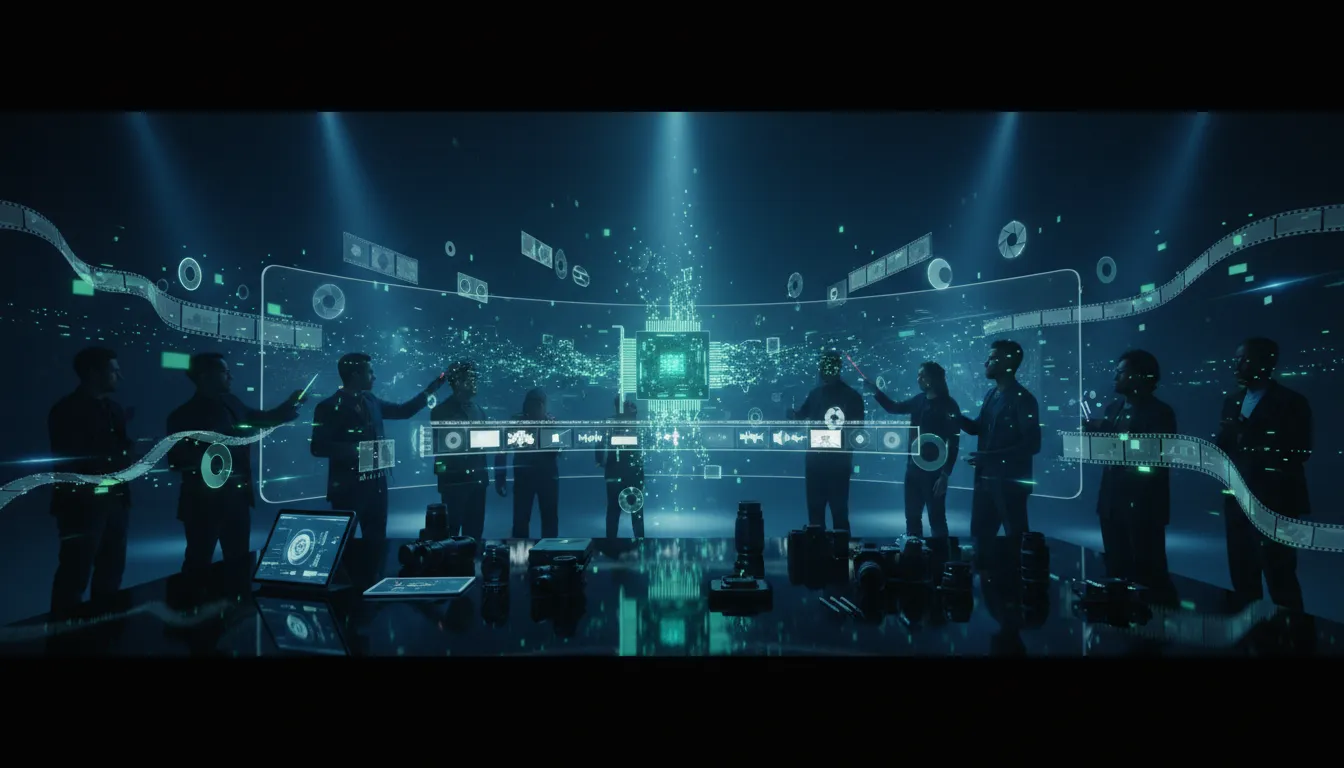
I remember the first time I saw a machine-generated image that felt truly cinematic. It was a moment of disbelief followed by possibility. Now that moment has expanded into motion. With Runway Gen 4.5, built on NVIDIA's Rubin platform, we crossed a threshold where video generation moves from clever demos into a practical creative tool. This is not incremental. It is a step into a new category—a capability that enables creators, researchers, and studios to imagine and produce visual worlds that were previously prohibitively expensive or technically out of reach.
🚀 What Runway Gen 4.5 Is and Why It Changes Everything
Runway Gen 4.5 is described as the world’s best video model. That may sound bold, but from my perspective it is an accurate reflection of how it addresses the three core pain points that have long held back convincing, usable video generation:
- Temporal coherence: sequences that maintain consistent motion and appearance across frames.
- Control and expressiveness: the ability to direct outcome through text prompts, reference images, masks, or other conditioning signals.
- Scale and quality: high-fidelity output that can be integrated into production workflows without extensive manual cleanup.
I like how the messaging captures the ambition: “We made something so you can make anything.” That encapsulates the shift from a tool that merely demonstrates capability to one that empowers broad creative use. When a model becomes flexible enough to take a prompt, a mood board, or a few reference frames and produce an editable, high-quality clip, it moves beyond novelty into utility.
Use cases jump off the page: concept reels that previously required months of VFX work, rapid prototyping for games, storyboards that play like mini-scenes, localized ad creative at scale, and immersive educational simulations. Gen 4.5 is built to serve those scenarios by providing fidelity, control, and subtlety in motion.
🔧 How NVIDIA Rubin Powers Gen 4.5
At a systems level, the breakthrough here is not just the model. It is the union of an advanced video model with infrastructure designed to train, tune, and serve models of this scale. NVIDIA Rubin is the platform that makes that union practical. From my experience working with large-scale models, a platform like Rubin is critical for three reasons:
- Speed of iteration: Training and fine-tuning video models requires massive compute and careful orchestration. Rubin accelerates experimentation by providing optimized runtimes and orchestration, so hyperparameter sweeps, dataset iterations, and model variants can happen much faster.
- Efficiency at scale: Video data is orders of magnitude larger than single images. Efficient data pipelines, mixed precision math, memory-optimized training strategies, and distributed parallelism ensure that training remains feasible and cost-effective.
- Robust serving and deployment: Generating video for production means managing inference latency, batching, and resource allocation. Rubin enables teams to deploy complex models with predictable performance and integration with downstream systems.
When you combine a generative architecture tuned for temporal dynamics with a platform that takes care of the heavy lifting—dataset sharding, model parallelism, high-throughput IO—you unlock real-world products. That is the difference between an impressive research prototype and a tool that editors and directors are willing to use in production.
🧠 The Technical Innovations Under the Hood
To deliver convincing motion, a model must understand space, time, and causality. That is easier said than done. Here are the technical areas where modern video models, including Gen 4.5, push the envelope.
Architectural foundations
Modern video generation blends ideas from image diffusion, transformers, and video-specific optimizations. Two common approaches are latent video diffusion and autoregressive video transformers. Each has trade-offs:
- Latent video diffusion: compress frames into a latent space, perform diffusion in that space, and decode back to pixels. This reduces computational cost while preserving quality.
- Transformer-based models: use attention mechanisms to model spatial and temporal relationships directly. Temporal attention allows the model to maintain consistency across frames.
Gen 4.5 leverages the strengths of these approaches while introducing specific design choices that emphasize stability and control at scale. These choices include specialized motion modules, temporal attention windows tuned for smoothness, and conditioning paths that accept text, reference images, and explicit motion cues.
Maintaining temporal coherence
Motion must look plausible. That requires the model to predict not just pixel values but trajectories, object permanence, and appearance continuity. Techniques used to enforce temporal coherence include:
- Temporal attention and recurrence: where the model references previous frames in a learned latent space.
- Motion conditioning: using optical flow, depth maps, or estimated motion vectors to guide frame-to-frame consistency.
- Perceptual loss and adversarial training: losses that encourage natural motion and reduce flicker.
These components work together to ensure that generated clips do not feel like a sequence of disconnected images but rather like a continuous scene.
Controllability and conditioning
For a creator, control is everything. I expect to be able to give a short instruction or a reference image and get back something I can refine. Practical controls include:
- Text prompts: natural language directions for scene composition, lighting, and mood.
- Reference frames or images: to set characters, costumes, or camera angles.
- Masks and inpainting tools: to replace or modify specific regions across time.
- Motion sources: skeletons, optical flow, or keyframe-based motion guides that produce reliable motion transfer.
Gen 4.5 integrates these controls so I can begin with a high-level concept, lock in critical visual elements, and iterate on motion and lighting without losing the core look.
Data and training strategies
Training video models requires carefully curated and diverse datasets. A mixture of real-world footage, synthetic renders, and simulated scenes improves generalization.
Key practices include:
- Multimodal supervision: combining captions, metadata, and temporal labels.
- Domain mixing: augmenting real footage with simulated or 3D-rendered content to teach the model about occlusion, lighting, and camera dynamics.
- Curriculum learning: starting with short, simpler clips before progressing to longer, complex scenes.
These strategies help the model learn robust priors about motion and scene continuity, reducing hallucinations and improving fidelity.
🎨 Creative Workflows: From Idea to Final Cut
Transitioning a generative model into a useful creative tool requires thoughtful workflows. Here is how I approach projects with a capability like Gen 4.5, laid out as practical steps you can follow.
1. Start with a clear creative brief
Define the scope: purpose, length, resolution, and required editability. Are you prototyping a concept reel or producing a deliverable ad? That choice determines how much time to invest in initial prompts versus downstream compositing.
2. Gather reference materials
Collect mood boards, still images, color keys, and short clips that capture camera movement or character behavior. The model will respect these references when you use them as conditioning.
3. Use iterative prompting and short seeds
Start with short clips: 3 to 5 seconds. Iterate until the motion and composition feel right. Then extend duration or refine details. This strategy conserves compute and helps you converge on a coherent look.
4. Lock key elements early
When a generated frame matches your vision—character pose, facial expression, lighting—use it as a reference image to maintain continuity. Many creators find it helpful to export these anchor frames and feed them back into the model for subsequent refinements.
5. Inpaint and composite
Use masks to modify or replace regions in time. For example, change a character’s clothing while preserving motion, or replace a background plate without reshooting. This is where the model shines compared to earlier tools: consistent edits across frames that require minimal manual rotoscoping.
6. Post-process and finalize
Color grade, denoise, and up-res as a final pass. If you need broadcast-quality output, composite generated elements into practical footage using familiar tools. The goal is to use generative AI to do the heavy lifting and leverage traditional VFX for finishing touches.
Practical tips from my experience
- Use short, descriptive prompts: emphasize the most important visual attributes first.
- Keep seed frames consistent: small changes to a reference can cause large variations in motion.
- Prefer iterative refinement: progressively expand scene length and fidelity instead of asking the model to resolve everything in one pass.
- Leverage motion conditioning: when you need precise choreography, provide a motion guide instead of relying on freeform generation.
📈 Real-World Applications and Who Benefits Most
Runway Gen 4.5 is designed to democratize high-quality video generation. Here are the sectors I see getting immediate value.
Film and episodic content
Indie filmmakers can prototype scenes and visual effects with dramatically reduced budgets. Directors can test camera moves, lighting, and color before a single day of shooting.
Advertising and marketing
Brands can generate localized creative variants at scale. Need fifty small variations of a product spot for different regions or seasonal campaigns? Generative models make that economically viable.
Game development and virtual production
Rapidly iterate on environmental concept art and short gameplay trailers. Teams can also generate cutscenes and pre-visualization material that inform design decisions early in development.
Education and simulation
From historical reconstructions to medical training scenarios, synthetic video enables immersive, repeatable, and controllable experiences that are difficult to capture otherwise.
Research and accessibility
Researchers use generated video to create controlled datasets for studying perception, motion, or human-computer interaction. Accessibility teams can create visual aids and narrated explainers that are personalized at scale.
⚖️ Ethics, Safety, and Responsible Use
With powerful tools comes responsibility. I believe it is critical to build safeguards, educate users, and adopt practices that reduce misuse. Here are the principles I rely on.
Provenance and attribution
Every generated clip should carry metadata that documents its origin, model version, and any reference content used. Clear provenance helps downstream consumers evaluate trust and authenticity.
Watermarking and detectable traces
Watermarks, embedded signals, or forensic fingerprints can help platforms and endpoints detect synthetic content. I support technical measures that allow content to be traced without degrading creative quality.
Content moderation and policy
Automatic filters should block explicit or harmful content, and human review should be available for edge cases. Policies must be transparent and consistently enforced.
Respect for training data
Training datasets should be curated with consent and fair use in mind. I favor approaches that document provenance and avoid incorporating copyrighted material without permission.
Bias mitigation
Generative models can replicate or amplify biases present in training data. Ongoing auditing, targeted fine-tuning, and diverse datasets are essential to reduce harmful outputs.
💸 Performance, Economics, and Deployment Considerations
Generating convincing video requires significant computation, but clever engineering can make it practical. Here are the dimensions I consider when moving from prototype to production.
Compute and cost
Training a large video model is resource-intensive. However, optimized training pipelines and pre-trained weights reduce the marginal cost for teams that want to fine-tune on niche domains. For inference, batch generation and efficient decoders reduce per-clip cost.
Latency and interactivity
Real-time performance is an active area of research. For many creative workflows, sub-minute generation times for short clips are sufficient. For interactive tools, model distillation, quantization, and specialized hardware bring latencies down.
Edge versus cloud
Cloud deployments enable elastic scale and are a natural fit for heavy rendering tasks. Edge inference is attractive for privacy-sensitive or low-latency applications, but it requires additional model optimization.
Business models
I see multiple viable models: platform subscriptions for creators, API-based pricing for volume generation, enterprise licensing for studios, and managed services where teams run models on dedicated infrastructure. The right approach depends on scale, control requirements, and integration needs.
🧩 How to Adopt Gen 4.5 in Your Workflow
Now for practical, actionable steps I recommend if you want to incorporate Gen 4.5-style capabilities into your workflows.
1. Experiment with prototypes
Allocate a small project to explore what the model can do: a 15-30 second concept reel or a series of short ads. Keep the scope limited so you can iterate quickly and learn the model’s strengths and limitations.
2. Define quality requirements
Are you building rough conceptual content or final deliverables? The necessary fidelity affects your choice of settings, post-processing needs, and whether you should integrate with traditional VFX pipelines.
3. Build a reference library
Collect and curate images, clips, and motion guides that represent desired styles. A well-organized reference library speeds up iteration and ensures consistent output across projects.
4. Automate repetitive tasks
Use templates and parameterized prompts for repetitive creative tasks like ad variations. Automation saves time and ensures visual consistency at scale.
5. Invest in human oversight
Maintain a human-in-the-loop for final approvals, especially for content that represents real people or high-stakes scenarios. A combined human-AI workflow yields the best quality and reduces risk.
🔭 Looking Ahead: What Comes Next
We are still at the beginning of what generative video can be. Here are the directions I expect to accelerate over the next few years:
- Interactive, real-time generation: tighter feedback loops for directors and game designers.
- Integration with 3D assets and physics: models that understand and respect geometry and physical behavior to enable realistic character interactions.
- Higher resolution and longer durations: multi-minute sequences with production-grade fidelity and continuity.
- Hybrid workflows: seamless handoffs between generative models and human artists for final compositing.
- Provenance standards: industry-wide metadata conventions that help catalog and verify synthetic media.
These improvements will broaden the set of reliable use cases and push generative video into mainstream creative production.
📚 Tools, Standards, and Community Practices I Recommend
Adopting new technology is easier when there are shared tools and practices. Here are the standards and community habits I value most:
- Metadata-first workflows: embed origin, model version, and prompt data in outputs so every asset is traceable.
- Open evaluation metrics: use standardized metrics and human evaluations to compare models and improvements objectively.
- Reproducibility: maintain seed values and reference frames so clips can be re-generated or refined consistently.
- Community-driven datasets: curated datasets with transparent licensing accelerate research while protecting rights holders.
- Active moderation practices: adopt automated filters and human review pipelines for sensitive or potentially harmful content.
💬 A Short Reflection
When I consider what it takes to move from imagination to rendered motion, the sequence of challenges is familiar: high-quality visuals, natural motion, controllability, and cost. Runway Gen 4.5 together with infrastructure like NVIDIA Rubin addresses all four in meaningful ways. That is what elevates this work from a clever trick to a practical tool for creators.
We made something so you can make anything.
That statement resonates because it flips the focus. It shifts the value from what the model can do on its own to what I can do with it. For creators, that is the most exciting part. The tool disappears and the vision becomes the center of gravity.
📌 Final Practical Checklist
Use this checklist to move from curiosity to productive use:
- Define scope: short prototype or final deliverable.
- Gather references: images, clips, and motion guides.
- Iterate fast: start with short seeds and expand duration.
- Lock anchors: export and reuse frames that match your vision.
- Use masks: isolate edits and maintain continuity.
- Post-process: color grade, denoise, and composite for final quality.
- Embed metadata: provenance, model version, and prompts.
- Maintain human oversight: review for safety, ethics, and fidelity.
Generative video is opening doors that were closed just a few years ago. For anyone working with visual storytelling, simulation, or rapid prototyping, the combination of a powerful model and a robust supporting platform is a transformative milestone. I am excited to see the diverse, imaginative, and responsible ways creators will put these tools to work.


