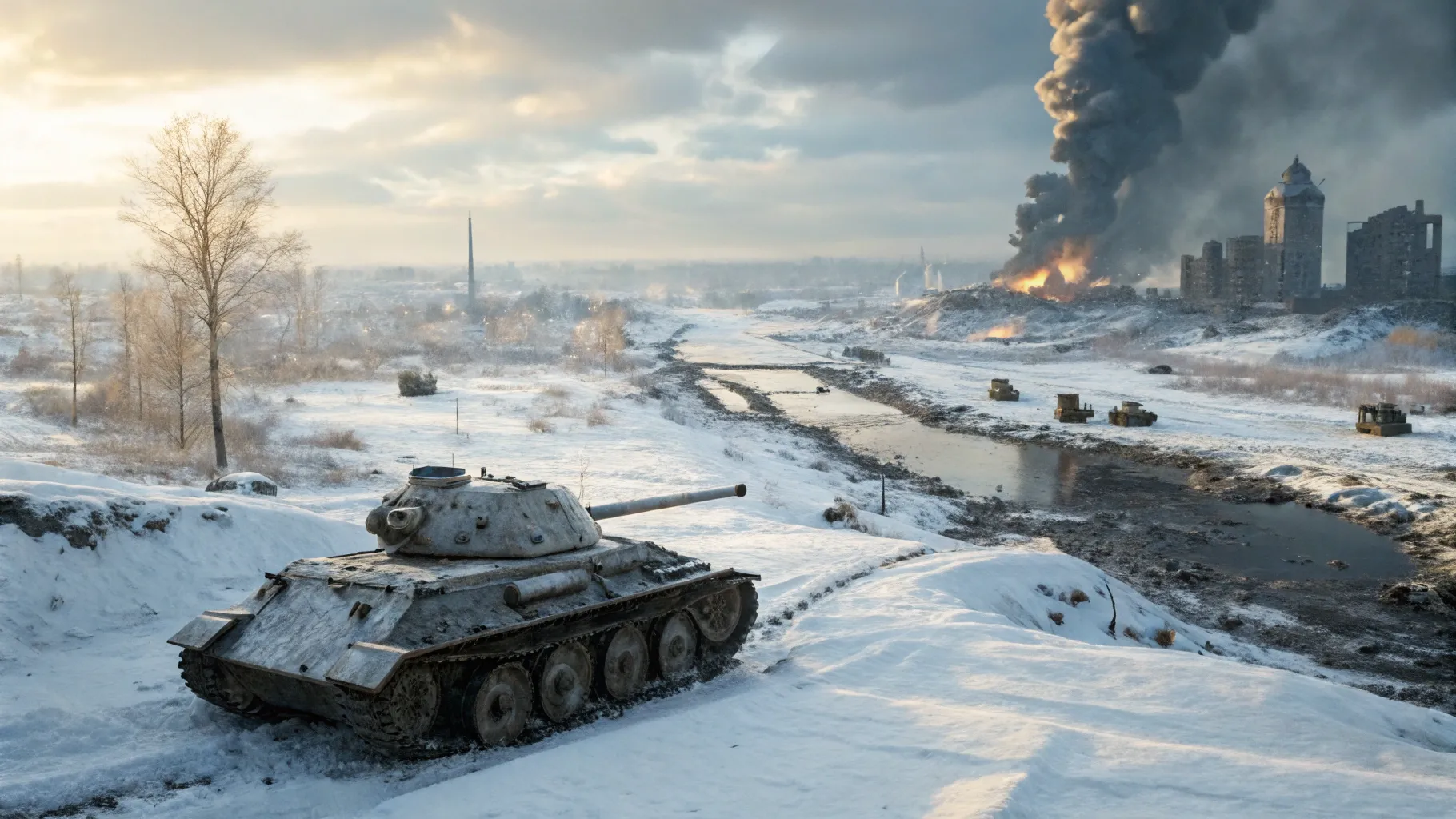
In my video for The Soldier’s Diary CZ I laid out what I believe were the decisive strategic, political and logistical errors that transformed early German dominance into eventual collapse. As a reporter and historian at heart, I examined nine critical mistakes—each distinct, each disastrous in its own way—that together sealed the fate of the Third Reich. In this article I will retell that investigation in a clear, evidence-driven news style, explain why each decision mattered, and explore how seemingly small misjudgments compounded into strategic catastrophe.
My aim here is simple: to present the sequence of errors as a coherent narrative so readers can understand not only what happened, but why it happened and what lessons remain relevant for students of military history and strategy. I report plainly, cite key turning points like Operation Barbarossa, Stalingrad, and Kursk, and draw connections between political choices—especially those made by Adolf Hitler—and the grinding realities of logistics, production and diplomacy. The Soldier’s Diary CZ provided the platform; I provide the analysis.
Below I summarize the nine central mistakes, then examine each in detail so you can see how they interlocked to produce a defeat that was as structural as it was tactical.
- Underestimating the Soviet Union and failing to plan for long logistics (Operation Barbarossa)
- Dividing forces instead of focusing on Moscow
- Declaring war on the United States
- Failing to seize air superiority in the Battle of Britain
- Neglecting the Mediterranean and the strategic opportunity in North Africa
- Industrial mismanagement: too many weapon models, too few resources
- Obsession with Stalingrad and refusal to adapt tactically
- Kursk: wasted concentration and the last great offensive
- The "total war" spiral that exhausted the homeland and defeated morale
🌧️ Underestimating the Soviet Union: Operation Barbarossa and Logistics
What happened
On June 22, 1941, more than three million German soldiers crossed the Soviet border under the codename Operation Barbarossa. In Berlin the mood was confident. Hitler and his staff believed the campaign would be quick—so quick, in Hitler’s private assessments, that “the campaign would be over before the leaves fell.” The German military captured vast territories, encircled units, and took hundreds of thousands of prisoners in the opening weeks. The Wehrmacht’s early success prompted ecstatic telegrams to the Führer and celebrated broadcasts glorified a fast collapse of Soviet resistance.
Why it was a mistake
I argued then—and I maintain now—that the core error was a deep and systematic underestimation of the Soviet Union’s resilience. That underestimation had several dimensions:
- Political and ideological bias: Nazi racial contempt for the Slavic peoples made it easy for Hitler to view the Soviet state as a fragile edifice that would crumble under a decisive blow.
- Military misreading: the purges of the Red Army in 1937 and the Soviet difficulties in the Winter War with Finland were treated as proof of ineptitude rather than temporary weaknesses followed by rapid institutional recovery.
- Logistical neglect: planners assumed German maneuver formations could keep moving without an adequate supply chain adapted to Russia’s vast distances and poor roads.
- Climate and terrain: winter, mud seasons (rasputitsa), long supply lines and rail gauge differences were either downplayed or ignored.
Consequences on the front
The consequences were immediate and cumulative. The very roads that had allowed armored columns to overrun territory turned into quagmires in autumn rains. The difference in rail gauge forced constant, slow transloading. Fuel, ammunition, spare parts and food had to travel thousands of kilometers before arriving at forward units. German transport and logistical systems were not scaled for that reality. Suddenly, outpacing logistics became front-page reality: tanks stuck in mud, engines freezing in winter, and troops lacking warm clothing.
Why the Soviets recovered
I emphasized that the Soviet Union benefited from features the Germans did not fully appreciate: enormous geographic depth, the ability to relocate industry east of the Urals, and a centralized wartime economy capable of redirecting resources quickly. Factories were physically moved, women and adolescents filled production lines, and the Red Army adapted tactics and replaced commanders as needed—because Stalin's orders made "defend at all costs" a literal command. The T-34 and new Soviet fighters rolled off assembly lines in numbers that surprised German intelligence and changed battlefield dynamics.
Lessons and accountability
Operation Barbarossa illustrates a perennial lesson: grand strategy that ignores logistics is a recipe for disaster. I also noted that intelligence failures—Abwehr and Fremde Heere Ost misjudging Soviet reserves—were not harmless. They allowed Hitler to keep betting on an early collapse that never came.
⚔️ Dividing the Forces: The Missed Chance at Moscow
What happened
Barbarossa had split the Wehrmacht into three major army groups: North (toward Leningrad), Center (toward Moscow), and South (toward Ukraine and the Caucasus). As the campaign progressed, a rift formed within the German command about priorities. Generals like Heinz Guderian argued for a concentrated, rapid push toward Moscow—the Soviet political and logistical heart. Others, including von Bock and von Leeb, favored broader operations across multiple axes to trap more Soviet field armies. Hitler himself intervened decisively: he diverted armored corps south and north to seize resources and symbolic prizes—Ukraine’s grain and Caucasus oil—rather than endorsing a single focused drive on Moscow.
Why that was a mistake
The decision to disperse the offensive fatally weakened the Wehrmacht’s most important advantage: concentrated operational momentum. Blitzkrieg doctrine depended on massed armored thrusts that achieved operational depth and shock. By splitting forces, Hitler diluted that mass. The cost was not merely geographic—it was temporal. While German formations fought in Ukraine and around Leningrad, they lost the narrow window of opportunity to strike Moscow before weather, Soviet reorganization, and evacuation of industry made decisive victory impossible.
Consequences
The strategic cost was enormous. Each day spent in secondary offensives bought the Soviets time to move factories, mobilize reserve formations (including Siberian divisions), and prepare defensive belts. When the final push toward Moscow came, it arrived late and with depleted strength. Autumn rains and early winter froze German machines and men into a positional war they were not equipped for. This decision turned what might have been a decisive stroke into a grinding attritional contest.
What could have been different?
I often pose a historical counterfactual carefully: if the German high command had concentrated on Moscow early and taken risks to keep logistics aligned, could they have paralyzed Soviet command-and-control? Possibly—but not certainly. The Red Army’s depth, the Soviet capacity to absorb initial defeats, and morale under Stalin’s orders meant that success was far from guaranteed. Still, the dispersion of forces was a self-inflicted strategic handicap that removed any chance of a clean, short campaign.
🇺🇸 Declaring War on the United States: A Strategic Miscalculation
The decision
On December 11, 1941, four days after Japan’s attack on Pearl Harbor, I reported, Adolf Hitler declared war on the United States. The decision surprised many within the German leadership. It was not required by the Tripartite Pact—which obligated mutual aid if a signatory was attacked, not if it attacked. Yet Hitler believed America already leaned toward war; he considered Roosevelt an implacable foe and saw a formal declaration as a recognition of an inevitable state of war.
Why this was a mistake
Declaring war on the United States converted a regional powerhouse into a direct antagonist. It meant Germany would face the full industrial might and global reach of the United States at a time when the Reich was heavily engaged on multiple fronts. From a strategic perspective, the cost-benefit equation was poor:
- The U.S. had immense industrial capacity that could be converted to military production almost immediately.
- Germany’s Kriegsmarine and Luftwaffe lacked the capacity to neutralize American production or its ability to project power.
- The move unified U.S. public opinion and allowed Roosevelt to mobilize American resources for global war more easily and decisively.
Immediate and long-term consequences
Within months the U.S. launched a global mobilization that dramatically increased the flow of equipment, vehicles and raw materials to Britain and the Soviet Union via Lend-Lease. Detroit factories shifted from cars to tanks and trucks; shipyards produced convoys at unprecedented rates. The war ceased to be a European contest and became a truly global industrial confrontation in which Germany was at an increasing material disadvantage.
Political motives and misreading
I argued that Hitler’s decision was driven by a mix of fatalism and ideological rhetoric. He considered Roosevelt hostile and saw the United States as part of a larger Judeo-Bolshevik conspiracy in his worldview. Yet realpolitik should have prevailed: provoking an industrial superpower while fighting a long war in the East was the strategic equivalent of tying one’s hands behind the back. The declaration accelerated Germany’s resource depletion without offering any offsetting strategic gain.
✈️ Failure in the Battle of Britain: Losing the Air War and the Chance to Invade
Context and German aims
After the fall of France in 1940, Britain stood alone in Western Europe. For Hitler, neutralizing Britain—or forcing a negotiated settlement—was central to consolidating European domination. The proposed invasion plan, Operation Sea Lion, depended on achieving air superiority over the English Channel and southern England. That role fell on the Luftwaffe under Hermann Göring.
What went wrong
The Luftwaffe began by targeting coastal shipping and radar stations, then escalated to concentrated attacks on RAF airfields. But I noted the critical structural and operational problems:
- British radar and an integrated command and control system (developed under Air Chief Marshal Hugh Dowding) gave RAF fighters timely vectoring and efficient interception despite being numerically inferior.
- German bomber types lacked the range and payload capacity for sustained strategic interdiction over Britain. Messerschmitt Bf 109 fighters had limited loiter time over Britain, leaving bombers vulnerable once escorts turned back.
- A strategic misstep came when Hitler, angered by a British raid on Berlin, allowed Göring to shift bombing from airfields to terror attacks on London (the Blitz). That relieved immediate pressure on RAF operational infrastructure and allowed British units to repair runways, reposition squadrons and rebuild strength.
Consequences
Luftwaffe losses mounted, experienced aircrew were hard to replace, and the RAF—protected by operating over home bases—continued to churn out replacements. The failure to achieve air superiority meant Operation Sea Lion could never proceed; the Royal Navy would have sunk an invasion fleet unsupported from the air. Strategically, failing to neutralize Britain left an active Western front and a secure staging ground for future Allied operations and supply. It also bolstered British morale and international support—especially from the United States.
Operational takeaways
From the point of view of an analyst, the Battle of Britain demonstrates the interplay of technology (radar), command and control, logistics (fighter range), and strategic focus. Luftwaffe doctrine excelled at close air support for fast-moving ground operations, but it was not optimized for sustained strategic bombing. The change in bombing policy—driven by emotion and prestige—was a pivotal error.
🌊 Mediterranean Neglect: The Failure to Secure North Africa and the Sea Lanes
Overview
Italy’s entry into the war in June 1940 opened the Mediterranean as a secondary theater that quickly became strategically central. Mussolini dreamed of a Mare Nostrum; Hitler initially considered the Mediterranean a sideline. Yet the region mattered deeply: the Mediterranean connected Britain to its empire, supplied resources to the Middle East, and protected communications to India and beyond.
The North African campaign
When Italian forces faltered in Egypt, the Germans sent Rommel and the Afrika Korps to stabilize the situation. Rommel’s early successes showcased tactical brilliance, but his operations were chronically constrained by logistics. Libyan ports had limited capacity; convoys from Italy suffered constant interdiction from Malta, Royal Navy surface forces and British airpower. Malta became a strategic nag: British aircraft operating from its airfields and submarines predated and degraded Axis convoy supply lines.
Strategic miscalculations
I documented several key errors:
- Hitler never made the Mediterranean a top strategic priority compared to the Eastern Front. That limited resources assigned to Sicily, Malta or North African ports.
- Failure to seize Malta decisively allowed Britain to interdict convoys, slowing Rommel’s momentum and denying him the fuel and spare parts necessary for sustained operations.
- The Balkans campaign in 1941, partly aimed at helping Italy, delayed Barbarossa and drained forces and time that could have been used elsewhere.
Consequences and turning points
By 1942–43 the strategic tide shifted. Allied supply flows improved dramatically with American material arriving via multiple routes. The Second Battle of El Alamein (October–November 1942) broke Rommel’s spearpoint. Allied landings in North Africa (Operation Torch) then squeezed the Axis between Western Allied and British Commonwealth forces. In May 1943, more than 250,000 Axis soldiers surrendered in Tunisia. The Axis failure to dominate the Mediterranean not only cost them North Africa and access to the Middle East, but also forced continued resource dispersion across multiple fronts.
🏭 Industrial Mismanagement: Too Many Models, Too Few Resources
Systemic industrial problems
From the beginning I stressed that Germany’s war economy was never on the scale of the United States or the Soviet Union. The Reich depended heavily on imported raw materials—oil, rubber and certain metals—and on synthetic fuel production that was vulnerable to Allied bombing. Despite those constraints, German industry and political leadership pursued an inefficient approach: the proliferation of numerous weapon models, constant technical tinkering, and heavy investment in exotic "wonder weapons."
The cost of diversity
German production included a bewildering variety of aircraft, tanks and naval designs. Each model required separate lines, unique spare parts, distinct training regimes and special tooling. For example, Luftwaffe production fielded Bf 109s and Fw 190s alongside a range of medium and dive bombers. Panzer lines simultaneously produced Panzer III, Panzer IV, Tiger and Panther models—each more complex than the previous and each consuming scarce steel, engines and time.
"Wonder weapons" and misallocation
Hitler’s fascination with breakthrough technologies—Me 262 jets, V-2 rockets, and super-heavy tanks like the Maus—siphoned critical resources from proven mass-production needs. These projects were technologically impressive but strategically misplaced: they arrived late, in tiny numbers, and could not change the production balance. The Me 262 and Type XXI U-boat programs, for example, were too little, too late.
Labor and sabotage
As the war expanded, labor shortages compelled the Reich to use forced labor from occupied territories. That increased output in quantity but reduced quality. Sabotage, poor motivation, and language barriers lowered production efficiency and increased defective parts reaching the front. Allied strategic bombing compounded the issue—dispersal of industry protected plants but reduced scale economies and lowered throughput.
Late reforms
In 1942–43 Albert Speer’s appointment as Minister of Armaments did improve efficiency. He streamlined models, rationalized production, and raised output—indeed, German production peaked in 1944 in many categories. But that uptick came too late. The strategic balance—numbers, fuel, transport—was already against Germany. Production increases could not replace lost manpower, nor could they erase the logistical disadvantages Germany had accepted with previous strategic choices.
🏙️ The Stalingrad Catastrophe: Obsession, Urban Combat and Encirclement
The campaign
By 1942 Hitler shifted strategic weight southward in Operation Blue. The original aim was to seize oil fields in the Caucasus—a logical move given Germany’s fuel vulnerability. Yet Stalingrad, a city bearing Stalin’s name, became an obsession. Hitler ordered the 6th Army under Friedrich Paulus to capture the city, partly for its symbolic value.
Urban warfare nightmare
Stalingrad exposed a German weakness: the Wehrmacht was optimized for maneuver warfare, not sustained, street-by-street urban combat. German bombing turned city blocks into vast rubble fields. Those ruins favored defenders—ruins made movement difficult for tanks, and buildings provided excellent positions for small-unit infantry and snipers. The Soviet command under Vasily Chuikov executed gritty, resourceful defensive tactics that exploited the terrain and the situation.
Strategic errors and Hitler's orders
I highlighted the decision-making errors: persistence in frontal assaults, refusal to allow prudent tactical withdrawal or reorientation, and a fatal faith in Luftwaffe air supply when the 6th Army became isolated. When Soviet Operation Uran in November 1942 executed a decisive encirclement, the German response was rigid. Advice for an immediate breakout was ignored; Hitler insisted that the army hold its ground. Luftwaffe promised resupply that it could not deliver sufficiently—transport planes and weather limited deliveries, and the logistical calculus was unrealistic from the start.
The collapse
Trapped, the 6th Army endured starvation, freezing, disease and mounting casualties. Paulus, promoted to field marshal in a symbolic gesture by Hitler, surrendered at the end of January 1943. Of the nearly 100,000 men trapped, few returned. The defeat was not just tactical: it broke the myth of Wehrmacht invincibility, cost Germany vast quantities of men and equipment, and shifted the strategic initiative decisively to the Soviets.
Wider implications
Stalingrad revealed the consequences of ideology-driven orders overriding battlefield reality. Hitler’s fixation on symbolism rather than strategic flexibility turned a dangerous tactical situation into an irreversible strategic defeat. I emphasized that this episode accelerated German manpower shortages and fractured the confidence of alliance partners and German high command alike.
🛡️ Kursk and the Last Large Offensive
The plan and the timing
By mid-1943 the German leadership sought to regain momentum. The proposed offensive against the Kursk salient—Operation Citadel—would gather the largest concentration of armored forces Germany had yet assembled, including many Panther and Tiger tanks. The objective: to pinch off the salient with a pincer movement and destroy the Soviet formations therein.
Why timing mattered
Here I underline an important point: timing in mechanized warfare is everything. Hitler’s insistence on waiting until new models were ready pushed the offensive from May to July 1943. That delay allowed the Soviets to construct massive layered defenses—minefields, anti-tank ditches, bunkers, and depth defenses—across the salient, informed by excellent Soviet intelligence. The delay gave the Red Army time to reinforce and to plan counter-offensives.
The battle's reality
When the offensive began on July 5, 1943, the Germans found themselves attacking prepared positions. The battle at Prokhorovka on July 12—one of the largest tank engagements in history—saw hundreds of tanks clash in brutal, close-range fighting. German losses in heavy tanks were significant, and mechanical failures among new models (Panther gearbox and clutch issues, Tiger shortages) compounded battlefield attrition. Soviet doctrine emphasized massed artillery and concentrated counterattacks, and the T-34—lighter, reliable, and easier to repair—proved resilient under the conditions.
Consequences and the end of German initiative
Kursk failed to achieve its operational goals. Worse, it exhausted Germany's remaining armored reserves and failed to reverse the overall strategic trend. The Soviets followed Kursk with major offensives that pushed the Wehrmacht back across wide sectors. Kursk marked the last large-scale German offensive on the Eastern Front; thereafter the initiative belonged to Moscow.
Reflective assessment
What stands out to me is the irony: the German commitment to technological superiority (testing new tanks en masse) undermined the operational necessity to strike before the opponent fortified. Waiting for "perfect" tools is often riskier than acting with adequate but available means. Kursk was a classic case of technological and doctrinal mismatch against strategic urgency.
🔥 The Trap of "Total War" and the Collapse at Home
The proclamation and its reality
Joseph Goebbels’ February 1943 Sportpalast speech declared "total war"—an appeal to mobilize every possible resource for the conflict. It sounded like mobilization and unity. But as I reported, the practical effect of “total war” was far more destructive: mass mobilization could not compensate for losses in manpower, the destruction of industrial centers, and the persistent drain of material across too many theaters.
Manpower and quality erosion
By 1943–44 Germany faced severe manpower shortages. Recruitment drew in teenagers and older veterans who were not mentally or physically prepared for modern mechanized warfare. The Volkssturm, organized in late 1944, conscripted civilians with minimal training and inadequate weapons to defend the Reich. The quality of frontline units deteriorated as experienced NCOs and officers were killed or exhausted, while new recruits saw minimal training before being thrown into combat.
Industrial collapse under bombardment
Allied strategic bombing targeted industrial and transportation infrastructure. Cities like Essen, Hamburg and Berlin endured sustained raids; factories were damaged or destroyed. The German response—dispersing production—protected assets but reduced efficiency. Rail systems essential for moving fuel and munitions were disrupted by bombing and sabotage, further crippling the ability to supply armies fast enough. Synthetic fuel plants and refineries became high-priority targets, and attacks there intensified shortages vital to armor and air operations.
Propaganda, policy and stubbornness
Even as the strategic situation deteriorated, propaganda dreams of Wunderwaffen (wonder weapons) persisted—Me 262 jets, V2 rockets, advanced U-boats. I critiqued this pattern: clinging to magical solutions postponed necessary political and military decisions that might have reduced losses. Hitler’s refusal to authorize strategic withdrawals, his insistence on holding territory, and his preference for sacrificial defense turned tactical retreats into annihilation. The rhetoric of total war became an instrument to demand ever-greater sacrifices without corresponding returns.
Social consequences at home
German civilians bore extreme hardship: food rationing, mass displacement, and dwindling public services. The state used Gestapo repression and propaganda to suppress dissent. Yet, despite terror, the social fabric started to fray under sustained deprivation and mounting casualties. The cost of maintaining ideological purity—refusing negotiation while the country suffered—was the near-total destruction of the nation by war’s end.
📜 Conclusion: A Chain of Errors That Became Defeat
Recap: how the mistakes interlocked
As I drew the story together in the video and now in this report, the pattern is unmistakable: the Reich’s defeat was not the result of a single failure but of a concatenation of strategic misjudgments. Underestimating the Soviet Union turned what might have been a limited campaign into a grinding war of attrition. Dividing the Wehrmacht’s forces prevented decisive blows. Declaring war on the United States invited an industrial juggernaut into the conflict. The failure to win the Battle of Britain kept hostile territory and a powerful ally of the future intact. Neglect of the Mediterranean squandered strategic opportunities. Industrial mismanagement and the pursuit of Wunderwaffen diverted scarce resources. Stalingrad and Kursk marked tactical and operational disasters that stripped Germany of both manpower and initiative. Finally, the rhetoric and practice of total war hollowed out the home front, eroded morale and eliminated political space for intelligent negotiation.
What I want readers to take away
I report these events not to assign moral equivalence or to soften the crimes of the Nazi regime—those are unequivocal and monstrous—but to extract strategic lessons. Great military power is not a substitute for sound strategy. Ideology and hubris distort perception. Logistics and production matter as much as battlefield tactics. Time can be an ally or a killer; in Germany’s case, many decisions handed the Soviets and Allies time as an ally. Finally, wars are not won by slogans or late technical panaceas; they are sustained by coherent planning, realistic assessment of enemy capabilities, and a willingness to adapt when reality diverges from preconceptions.
Questions I still explore
History is a conversation and a debate. I still ask: Could Germany have avoided total collapse by accepting early negotiated settlements? Could a different allocation of industrial priorities or an earlier strategic focus have reversed the tide? Or were the structural differences in resources and geopolitics simply too large? These counterfactuals are debated among historians, and in my view the balance of probabilities shows a combination of resource disparity and cumulative strategic errors made German victory extremely unlikely after 1941.
Final note
As the author behind The Soldier’s Diary CZ, I remain committed to examining wartime decisions with both critical distance and narrative clarity. The rise and fall of Nazi Germany is a warning: military prowess without strategic prudence, ideological fanaticism without realism, and industrial creativity without prioritization can transform early victories into catastrophic defeat. I encourage readers to study these events, ask hard questions, and learn that in strategy, as in life, humility and attention to logistics matter as much as courage and ambition.
"The campaign would be over before the leaves fell." — a private belief held by Hitler at the start of Operation Barbarossa, emblematic of a larger pattern of overconfidence that shaped the Reich’s strategic failures.
Further reading and references I used
- Operational histories of Barbarossa, Stalingrad and Kursk
- Biographical sources on Hitler, Goebbels, Guderian, Rommel and Paulus
- Studies on wartime industrial production and Albert Speer's reforms
- Analyses of the Battle of Britain and the role of radar and command and control
- Archival records and memoirs of commanders and soldiers from both sides
If you found this style of reporting useful, I hope you’ll explore the full analysis I presented on The Soldier’s Diary CZ. History rewards careful attention: each strategic choice ripples through time, and understanding those ripples helps us avoid repeating the same mistakes.


