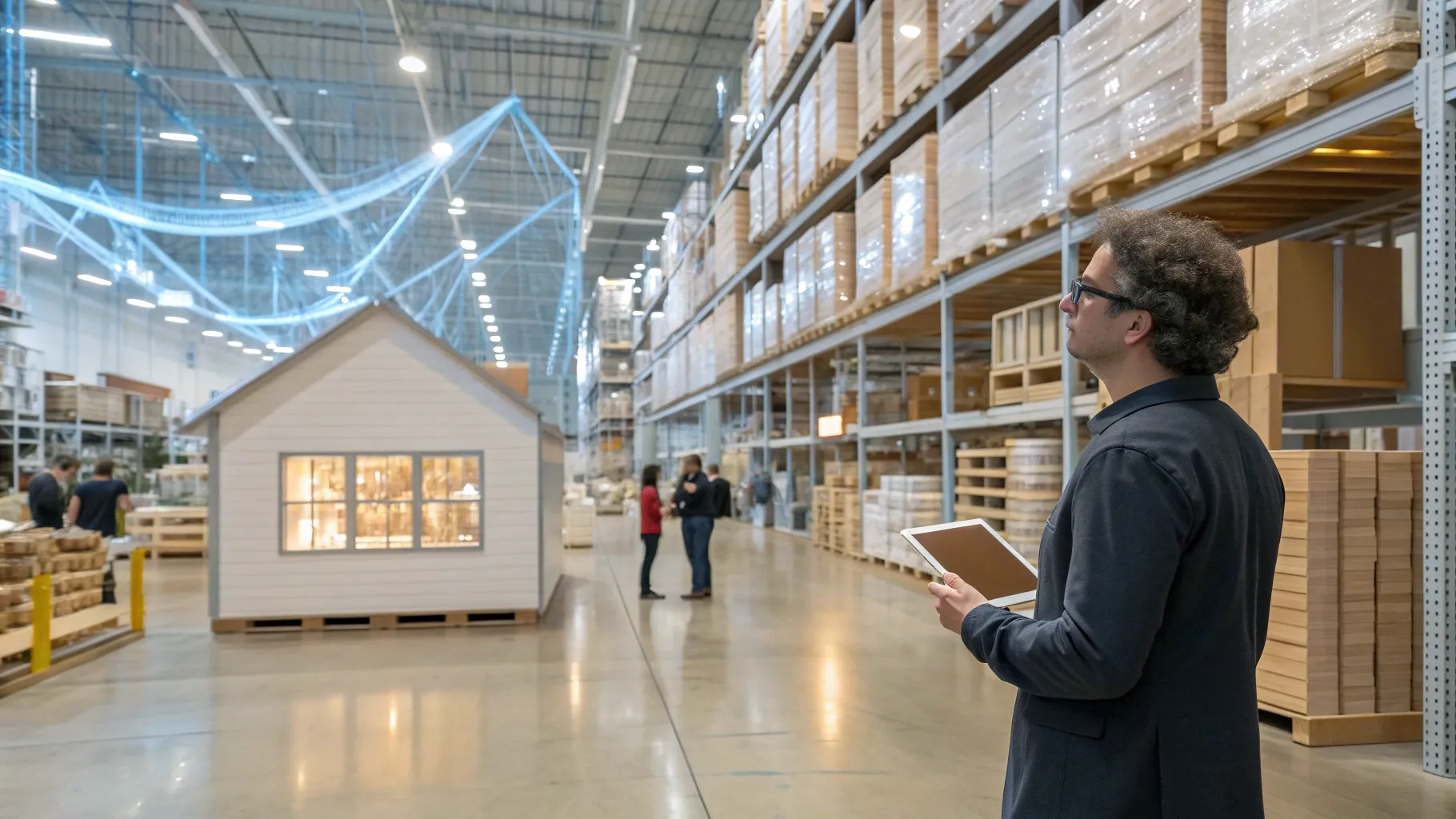
I lead digital transformation efforts at Lowe’s, and over the past several years I have had the chance to reimagine how a large home improvement retailer operates in a world where AI, digitization, and real-time 3D simulation change expectations. Our customers buy products that matter to their homes and lives, and those products last for years. Those purchases create complex journeys that start well before a customer walks into a store and extend long after the project is finished.
In this report I will walk you through the practical, human-centered approach we took to make those journeys feel connected and seamless. I will explain the three pillars that structured our work—how we shop, how we sell, and how we work—describe the technologies we used including computer vision, generative AI, and digital twins, and share operational lessons and guidance for other retailers who want to apply similar techniques.
This is a report about people, process, and engineering collaboration. It is about using technology to take away friction for customers and to give our associates real, practical superpowers. It is also about how deep partnerships between engineering teams unlock innovation at pace and scale.
Overview of the challenge and strategy 🎯
Lowe’s is a slightly different retailer from some of the other mass retailers. The purchases our customers make at Lowe’s tend to be meaningful, often involve multiple items, and typically last for years. That creates a distinctive challenge: purchase journeys are complex and multi-stage. Customers research, compare, ask for help, sometimes do trial runs, and often need follow-up support.
When you think about improving that experience, you have to address a spectrum of touchpoints. You cannot simply optimize checkout. You must look at discovery, in-store assistance, product knowledge, inventory accuracy, merchandising, replenishment, and the back-office decisions that shape how products are presented and stocked.
To tackle that challenge we organized our efforts across three main pillars: how we shop, how we sell, and how we work. That framework helped us prioritize use cases, measure impact, and deploy capabilities where the customer and associate experience could improve the most.
How we shop 🛒
The first pillar focuses on the customer experience. Our customers do important and complex projects—they install appliances, fix plumbing, build decks, replace flooring. These projects require time, planning, and sometimes expert advice. My goal in this pillar was to make customers feel supported throughout the journey, whether they are browsing online at night, checking inventory on the app, or standing in a store aisle.
Understanding customer behavior in the aisle
A pivotal capability we deployed is a computer vision system that helps associates know when a customer might need help. Imagine a customer lingering in the tile aisle looking at different grout options, or standing in front of paint chips trying to decide. A traditional store layout leaves that person on their own unless they actively ask for help. With computer vision, we can detect patterns of dwelling—when a customer spends an unusually long time in an aisle or repeatedly returns to the same fixture—and translate that into a discreet notification to our associates.
That system is not about surveillance. It is about timely assistance. We used vision models to detect presence and dwell time, paired them with simple rules and thresholds, and then surfaced a helpful, respectful prompt to an associate on the floor. The result feels almost magical: the associate appears at the right moment, answers the question, and the customer moves forward confidently.
"It does happen that the customer is in the aisle and maybe needing help. With computer vision from NVIDIA, we were able to notice that the customer is dwelling in the aisle. We put an algorithm on top of that observation and then dispatch an associate. It's a really magical experience. The associate as if on the queue comes up to answer your question."
That quote captures the exact experience we wanted to enable. But to achieve it required careful design decisions:
- Edge-first processing: For privacy and latency, we processed video signals locally on edge devices rather than streaming everything to the cloud. The models output anonymized metadata (for example, "dwell event" or "zone occupancy") not raw footage.
- Human-in-the-loop design: Notifications are gentle suggestions to associates, not mandates. Associates retain agency to respond as they see fit. This preserves the human element of customer service.
- Threshold tuning: Dwell detection thresholds differ by aisle and product category. Someone lingering in Lighting may be making a quick decision; someone lingering in Flooring may need extended advice. We tuned parameters by aisle and adjusted with feedback from store teams.
- Privacy by design: We applied privacy-focused approaches—blurring, differential processing, and aggressive data retention policies. Customer trust is paramount.
Seamlessly connected omnichannel experiences
Beyond in-store detection, we built integrations that make the digital and physical experiences feel like parts of a single journey. For example:
- Inventory-aware guidance: When a customer views an item on our app, we show aisle location and real-time stock levels. If they are in the store, we nudge store staff to ensure shelves are stocked or provide alternatives.
- Click-and-collect flow improvements: We optimized the pickup process so customers can collect ordered items quickly and with minimal friction, using AI to predict peak times and staff appropriately.
- Personalization that helps, not overwhelms: We use behavioral signals and project-level context to recommend complementary items thoughtfully—for example, suggesting underlayment and tools when a customer is buying flooring.
All of these improvements were guided by the principle that the more meaningful and long-lived the purchase, the more opportunity there is to add value with thoughtful assistance and information. When customers feel supported, they buy confidently and return for future projects.
How we sell 🧑🔧
The second pillar centers on our associates. One of the main lessons I learned is that technology should elevate people rather than replace them. Associates are the face of Lowe’s in stores; they have domain knowledge, customer empathy, and the ability to turn a complicated situation into a solved problem. My focus here was to make every associate into a "super associate" by giving them the right knowledge and tools at the right time.
Knowledge at the point of interaction
Home improvement is full of product details, compatibility questions, and project-specific nuances. No single associate can memorize everything. So we built systems that provide context-aware knowledge retrieval and decision support.
These systems combine several technologies:
- Generative AI for conversational assistance: Associates can ask a natural language question—"What caulk should I use in a wet bathroom shower?"—and receive an actionable, summarized answer that references product SKUs and best practice.
- Knowledge graphs and structured data: We combined unstructured manuals, manufacturer specs, and Lowe’s internal product data into a unified knowledge base so that recommendations are traceable and accurate.
- Mobile-integrated workflows: Associates interact with these tools through devices they already have, with minimal friction—no complex training sessions required.
"We are wanting to give our associates superpowers with AI. At Lowe's, all our efforts around generative AI is about taking away all the friction for the customers and making our associates into super associates."
That sentence summarizes the ethos behind our design choices: the goal was not novelty, but impact. We focused on use cases that save time, reduce errors, and improve the customer's perception of helpfulness.
Examples of associate superpowers
Here are concrete ways associates now operate more effectively:
- Instant product compatibility checks: An associate can scan two SKUs and get a compatibility assessment plus recommended complementary products.
- Project-specific shopping lists: Based on a customer's project description, the associate can generate a project list that includes quantities, recommended tools, and alternative brands for budget flexibility.
- Troubleshooting guidance: For technical questions—like wiring standards, tile installation substrates, or appliance clearances—the associate receives referenced, up-to-date guidance so they can advise confidently.
- Conversational commerce: Associates can process transactions, set up delivery, and configure services while remaining engaged with the customer, with AI automating administrative steps.
Training, trust, and governance
Deploying generative AI into a retail environment requires strong guardrails. I insisted on a few non-negotiables:
- Explainability: Associates need to know the source of any AI suggestion so they can judge accuracy. We link recommendations back to manufacturer documentation or internal policy.
- Continuous feedback loops: Associates provide instant feedback to improve answers and flag issues. Those signals feed model retraining and knowledge curation.
- Human override: AI is advisory. Associates can and should override suggestions when appropriate.
- Role-based access controls: Some information is for managers or back-office teams; we ensure the right data appears to the right role.
These governance practices helped us build trust with our teams and ensured the technology amplified expertise rather than replacing it.
How we work 🧭
The third pillar addresses the teams who operate behind the scenes—supply chain, replenishment, planogramming, merchandising, and assortment decisions. Here the challenge is different: decisions are strategic, often dependent on complex data, and have long-term consequences. To help people make better decisions faster, we invested in digital twin technology and real-time simulation.
What a digital twin means for retail
A digital twin is a real-time, virtual representation of physical assets and processes. For us, that includes store layouts, shelving, inventory positions, sales flows, and even foot traffic patterns. The twin lets teams simulate scenarios—What happens if we shift an endcap? What is the impact of changing aisle signage? How will replenishment needs change if a promotional event drives higher demand?
By bringing these elements into a unified, interactive 3D environment we were able to:
- Visualize supply chain ripple effects in store contexts instead of spreadsheets.
- Validate planograms in a virtual store to ensure availability and aesthetic quality before deployment.
- Run replenishment strategies against simulated demand to tune safety stock without risking out-of-stock situations.
NVIDIA Omniverse and OpenUSD
To build our digital twin, we used tools that support complex 3D environments and real-time collaboration. Open-standard formats like OpenUSD enabled us to federate data across systems, and platforms such as NVIDIA Omniverse provided a collaborative environment for engineers, merchandisers, and store planners to iterate together.
That engineer-to-engineer collaboration was the real differentiator. When a store planner and a supply chain analyst can stand in the same virtual store, rearrange a fixture, and immediately see downstream inventory implications, decision cycles compress dramatically. It’s not merely about having 3D visuals. It is about creating a shared context where different disciplines can solve problems together.
"How we work was all about associates across our office locations who are doing supply chains, replenishment, planogramming, merchandising, assortment decisions. We wanted to make sure that they have all the tools from a digital twin perspective to take the best possible decisions for customers and associates."
Operational impacts
Using digital twins and simulation we achieved a few important outcomes:
- Faster planogram rollouts: Stores received validated layout changes with fewer on-site corrections.
- Reduced out-of-stocks: Replenishment strategies tested in simulation performed more reliably post-deployment.
- Better promotion planning: Merchants could simulate promotional scenarios and estimate shelf and backroom needs ahead of time.
- Cross-functional alignment: When visual representations replace abstract spreadsheets, alignment across teams improves.
These improvements translated to tangible benefits for customers and associates: shelves that are more likely to have what customers came in to buy, clearer store layouts, and better-informed associates on the floor.
Engineering collaboration and partnership 🤝
I want to emphasize the importance of partnerships in this work. Building a modern retail stack that stitches together edge vision, generative AI, and real-time 3D collaboration requires deep technical integration. Our partnership with NVIDIA—engineer to engineer—was instrumental in making these capabilities practical.
That collaboration looked like:
- Joint problem solving: We worked side by side to adapt models and platforms to retail use cases, rather than taking generic solutions and forcing them into our workflows.
- Shared roadmaps: We aligned on priorities so platform features supported our cadence for pilots and scaled rollouts.
- Operational support: Engineering teams co-designed deployment strategies for edge devices, data pipelines, and latency-sensitive services.
"I think the magic sauce in this particular endeavor has been the engineer to engineer collaboration between Lowe's and Nvidia. We have had phenomenal partnership and I'm so excited about the possibilities."
That "magic sauce" is about more than the technology itself. It is about organizational alignment and having partners willing to iterate with you through the reality of store operations—power constraints, network variability, and the human factors of adoption on the floor.
Security, privacy, and responsible AI 🔒
As we rolled out vision systems and generative AI, we stayed vigilant about privacy and ethical use. Our customers trust us with their personal data, and we have an obligation to apply technology in ways that protect that trust.
Key practices we adopted:
- Data minimization: Vision systems output only anonymized metadata used for assistance events. We avoid storing raw video unless there is a compelling operational need sanctioned by policy.
- Edge processing for privacy and latency: Where possible, models run locally to avoid unnecessary data movement.
- Model governance: We maintain lineage for AI outputs so that associates or customers can trace the source of recommendations.
- Bias mitigation: We evaluated models for potential biases in detection or language generation and enforced mitigations where appropriate.
- Transparent policies: We communicated clearly to associates and customers how systems operate and what data we collect.
Responsible AI is not a checkbox. It is a discipline embedded into the engineering lifecycle. We created cross-functional teams—legal, privacy, product, and engineering—to ensure guardrails kept pace with deployment.
Measuring success and continuous improvement 📊
Any technology initiative needs clear metrics. For us, success meant improving both customer outcomes and associate effectiveness. Some of the high-level metrics we track include:
- Customer satisfaction indicators: Net promoter score, post-interaction surveys, and repeat purchase rates for major project categories.
- Associate productivity: Average time spent resolving customer questions, conversion rate after assisted interactions, and time saved in back-office workflows.
- Operational metrics: Out-of-stock rates, planogram compliance, and time to roll out new layouts or promotions.
- Business outcomes: Project completion rates, higher average order value for complex projects, and customer retention for services.
We established a cadence of monitoring and iterating. We treated the first deployments as pilots with short feedback loops. Associates and store managers provided daily and weekly feedback. Engineering teams used that input to refine thresholds, improve response quality, and tune recommendation logic. Over time, incremental improvements compounded into noticeable operational gains.
Change management and culture 🧭
Technology is only as effective as the people who use it. Rolling out AI in a retail environment requires deliberate change management. Here are some of the lessons I learned:
- Start with empathy: Work with store teams to understand pain points. Solutions that come from the field increase adoption.
- Train for confidence, not just capability: Associates need to understand how to interpret AI suggestions and when to override them.
- Celebrate success: Publicize case studies where AI made a tangible positive difference. Recognition motivates adoption.
- Iterate publicly: Share roadmap updates with stakeholders so they feel part of the development journey.
- Make it reciprocal: Solicit continuous feedback from associates and act on it quickly.
When frontline teams see the immediate benefits—saved time, fewer angry customers, easier access to knowledge—they become advocates. That bottom-up adoption was critical to scaling beyond pilots.
Practical implementation patterns and architecture 🏗️
For practitioners, here is a pragmatic architecture pattern that reflects how we put components together in production:
- Edge layer: Cameras and sensors connected to local compute nodes run lightweight vision models. Outputs are anonymized event metadata like "dwell_event" or "crowd_density."
- Local decision layer: Store-level microservices apply business rules to edge events and dispatch notifications to associates or trigger automated actions (for example, printing a restock request).
- Cloud services: Centralized services run heavier model inference for knowledge retrieval, generative responses, and longer-term analytics. The cloud stores aggregated metrics and orchestrates model retraining.
- Digital twin environment: A collaborative 3D platform hosts store replicas, planogram versions, and simulation scenarios. That platform integrates inventory and sales data to create live simulations.
- Integration layer: APIs connect POS, inventory systems, workforce management, and training platforms so that insights propagate to the right systems and the right people.
This architecture balances privacy, latency, and scale. It allows stores to operate independently if cloud connectivity degrades and supports centralized learning across the enterprise.
Examples: Use cases that delivered value 💡
To make these ideas less abstract, here are a few use cases we rolled out and the operational benefits they produced.
In-aisle assistance via dwell detection
Problem: Customers lingering without help led to missed conversions and frustrated shoppers.
Solution: Computer vision models detect dwell events, prompting associates to offer assistance. That prompt includes context such as aisle and product category.
Outcome: Associates reached customers at the right time, conversion for complex categories improved, and customers reported better in-store experiences.
Associate knowledge and conversational AI
Problem: Associates needed fast access to product compatibility and project guidance but had limited time to search through manuals.
Solution: A generative AI assistant synthesizes product data, manufacturer guidelines, and Lowe’s best practices into quick answers accessible on mobile devices.
Outcome: Associates reduced time spent looking up information, customers received more consistent advice, and error rates on project recommendations decreased.
Digital twin for planogram and replenishment
Problem: Planogram changes sometimes led to unforeseen stocking problems or customer confusion when rolled out across thousands of stores.
Solution: Merchandising and supply chain teams validated layout changes and replenishment policies in a shared digital twin before physical rollout.
Outcome: Rollouts required fewer in-store corrections, and replenishment strategies tested in the virtual environment reduced out-of-stock incidents.
Guidance for other retailers starting on this path 🛠️
If you are a retailer considering similar investments, here is a pragmatic checklist based on our experience:
- Identify high-impact scenarios: Focus on experiences where friction materially affects purchase decisions. Complex, long-lived purchases are strong candidates.
- Start with pilots: Small, measurable pilots reduce risk and help you learn operational constraints.
- Prioritize privacy and governance from day one: Define policies and get buy-in from legal and privacy teams early.
- Invest in data hygiene: High-quality structured data about products and inventory is the foundation for AI-driven recommendations.
- Adopt modular architectures: Decouple edge, local decisioning, and cloud services so you can iterate components independently.
- Bring associates into the design loop: Solutions that surfacing value quickly to frontline teams will scale faster.
- Choose collaborative partners: Engineer-to-engineer partnering accelerates meaningful integration and keeps solutions grounded in operational realities.
Future directions and possibilities 🚀
We have only scratched the surface of what is possible. The intersection of generative AI, real-time 3D simulations, and edge intelligence opens many promising directions:
- Real-time project assistants: Imagine a customer scanning a room with their phone and receiving a project plan that includes materials, sequence of steps, and estimated labor—delivered in seconds.
- Augmented reality support: Associates could use AR overlays to show how a configuration would look in a home, improving upsell opportunities and reducing returns.
- Fully simulated promotions: Merchants could run full-store promotional simulations to understand shelf impact, supply needs, and customer flow before any physical activity.
- Personalized, context-aware services: AI that understands the customer's project lifecycle could proactively offer services like installation scheduling or tool rentals at the right moment.
I am excited about those possibilities because they are customer-centric. They take the friction out of long and complex projects and make home improvement accessible to more people.
Final reflections and the human element ❤️
Technology is a powerful tool, but it is most meaningful when it serves people. Our investments in AI, computer vision, digital twins, and real-time collaboration were always motivated by a simple premise: make the customer journey seamless and empower our associates to do their best work.
There were challenges—data gaps, integration complexity, and the inevitable cultural changes—but the results reaffirmed the approach. When you focus on three pillars—how we shop, how we sell, and how we work—you create a coherent roadmap that ties customer experience to operational excellence.
Partnerships matter. Working engineer to engineer with technology partners allowed us to adapt platforms to real retail realities rather than shoehorning retail use cases into generic offerings. Collaboration made the difference between a conceptual pilot and a scalable program that materially improved customer and associate experiences.
Lastly, sustainable transformation takes time. Start small, measure relentlessly, prioritize trust, and scale what works. I remain optimistic about the future of retail and the role of AI to make meaningful, durable improvements in people's lives and homes.
Appendix: Key terms and technologies 📚
For readers who want a quick glossary of the major technologies and concepts referenced in this report, here are concise definitions:
- Computer vision: Machine learning models that interpret image and video to detect objects, behaviors, and events.
- Edge processing: Running compute workloads near the data source (for example, in a store) to reduce latency and preserve privacy.
- Generative AI: Models that can generate human-like text or other content from prompts, used here for knowledge summarization and conversational assistance.
- Digital twin: A virtual representation of physical systems that enables simulation, testing, and collaborative decision making.
- NVIDIA Omniverse: A collaborative platform for building real-time 3D simulations and digital twins.
- OpenUSD: An open standard for encoding complex 3D scenes and assets, enabling interoperable digital twin components.
- Planogram: A schematic that shows product placement on shelves and fixtures in a store to guide merchandising.
Closing note 📝
Reimagining retail with AI and digital twins is not an academic exercise. It is practical, hands-on work that improves the day-to-day experiences of customers and associates. Our approach at Lowe’s—focusing on how we shop, how we sell, and how we work—has proven a durable framework for prioritizing initiatives and measuring impact.
I look forward to continuing this journey and sharing what we learn along the way. If you are a fellow practitioner, I encourage you to start with a clear customer pain point, partner closely with engineering teams, and center privacy and trust at every step.


