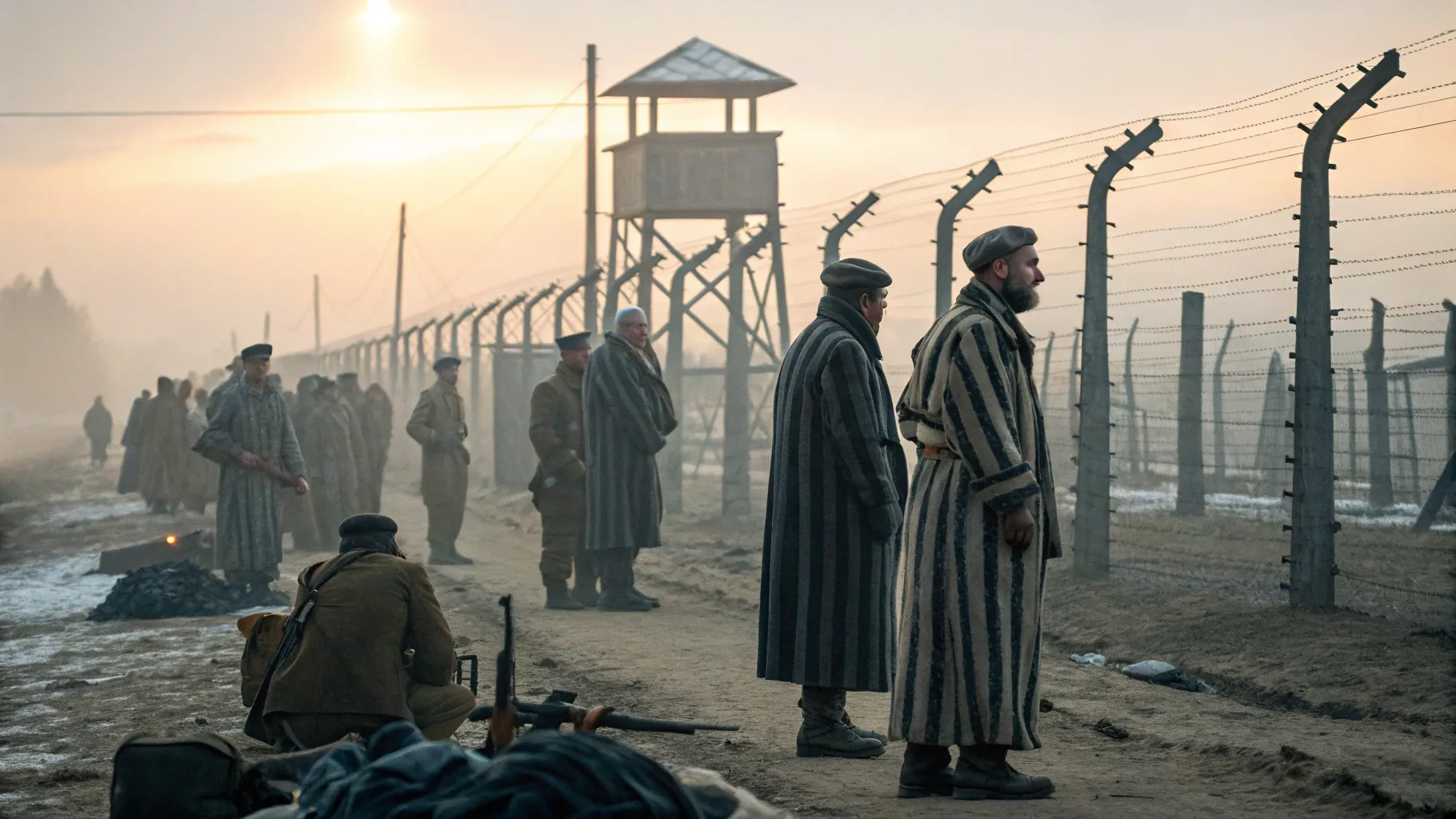
I report on one of the most unsettling and complex episodes at the end of the Second World War: the moment when liberated prisoners turned into judge and executioner of their former guards. Across Dachau, Buchenwald, Mauthausen, Bergen-Belsen and many satellite camps, the collapse of the Nazi guard system released an emotional and physical torrent that resembled justice and revenge at the same time. I have reconstructed events from survivor testimony, soldier reports and postwar investigations to explain what happened, why it happened and how those hours and days complicated the very idea of justice.
🪖 The collapse of the guard system and the instant of possibility
In the last days of April and the first days of May 1945 the rigid, terror-producing structure that had held millions under the SS began to unravel with terrifying rapidity. Guards who had paced the compounds in clinical cruelty started to show weakness. Officers were reassigned, deserting or executed for desertion. Young, inexperienced recruits filled the ranks. The ritual of power that once made the camps an iron discipline dissolved almost overnight.
Where discipline failed, the masks fell. Prisoners who had learned the cadence of every guard — the way they walked, the timbre of their voices, even their scent — realized before the Allies arrived that those guards were no longer gods. They were frightened men and women with nothing to stand on but a uniform, and that uniform was powerless in the face of collapse.
For many prisoners the logic was simple and immediate: if there was a chance to punish those who decided who lived and who died, they would not wait. The disappearance of the guard hierarchy created a moral vacuum. Into that vacuum poured an instinctual, raw need to act.
Signs that the system was breaking
- Guards arrived late to roll calls and appeared disoriented or drunk with fear.
- Some guards removed insignia, wrapped themselves in prisoner blankets or tried to hide among the starving; their ruse was usually exposed within minutes.
- Internal prisoner organizations in several camps, notably Buchenwald, had prepared clandestine plans and weapons, and they acted when the moment came.
😱 The emotional shock of liberation
Opening the gates did not deliver immediate relief for most survivors. Liberation was a sensory and emotional explosion: the smell of unburied bodies, racks of corpses in freight cars, emaciated figures like walking skeletons, convulsions of disease and a landscape riddled with death.
For the Allied soldiers who first saw these sights the shock was profound. Men hardened by combat collapsed into silence or vomited. Others responded with instant rage. In that atmosphere, the rules of war and the norms of military discipline proved fragile.
"They found not freedom but a landscape of corpses, disease and horror."
That sentence captures the moment. The person who spoke or wrote those words described the sudden fracture between law and passion. When hunger and sorrow meet the physical presence of those who caused it, reason does not necessarily win.
Prisoners experienced a different shock. Many had been reduced to numbers tattooed on skin and to a daily calculus of survival. Liberation meant new, unaccustomed choices. When they could point to a face and say, "He beat my brother to death," the reaction was immediate. The years of accumulated humiliation and death turned into a demand for retribution.
🔥 Dachau: mass executions and an explosion of violence
Dachau unfolded as a stark example of how liberation and massacre could coincide. When the 45th Infantry Division entered the camp on April 29, 1945, they found freight wagons stuffed with decomposing bodies, pit after pit of dead and thousands of living prisoners in catastrophic condition. The sight broke the discipline of both soldiers and survivors.
In the chaos the surviving SS guards attempted different responses: some surrendered with raised hands, others tried to hide among prisoners, still others begged for mercy and offered cigarettes or bread. Time and again, those pleas backfired. The past violence could not be erased by a late apology or a handout of bread.
What followed in Dachau was a mixture of shooter-led executions and prisoner-led lynchings. In multiple accounts soldiers separated identified groups of SS personnel, led them to walls and executed them on the spot. Prisoners dragged captured guards across the muddy compound, beat them with stones, iron bars and clubs, hanged some from poles, and in many other cases executed them personally.
Descriptions of the scene are brutal: smashed skulls, slit throats, bodies dragged through puddles of blood. Some soldiers even handed their rifles to prisoners and allowed them to carry out the final act. For survivors the sight of their tormentors falling, sometimes under their own hands, was a definitive end to power that had been absolute for years.
Why did this happen at Dachau?
- The magnitude of the evidence: freight cars filled with the dead created a visceral demand for immediate reckoning.
- The proximate presence of active Allied units made swift action possible and reduced the window for restraint.
- Shared outrage between soldiers and survivors eroded the boundaries of military discipline.
⚖️ Buchenwald: planned uprising and summary executions
Buchenwald provides an important contrast. Here prisoner organization mattered. A secret international committee of political prisoners had prepared for the moment of collapse and used it to seize control of key installations, including watchtowers and armories, just days before American troops arrived.
On April 11, the internal revolt erupted. Prisoners who had organized for years freed themselves and acted in a deliberate, if brutal, manner. Captured guards were assembled in the yard. The acts that followed were not simply spontaneous mob violence. They were the execution of perpetrators chosen by those who remembered every face and every crime.
Still, deliberateness did not equal judicial process. There were no lawyers, no written indictments, no impartial judges. The testimony that mattered was a survivor's memory of who had stolen bread, who had inflicted beatings, who had sent someone to death.
The result: Kapos and SS guards were beaten, hanged, shot. Some were killed quickly. Others suffered prolonged, ritualized violence intended to replicate the pain they had administered.
A revolt with a plan
- Prisoners seized weapons and key positions when they judged the SS were too few to defend them.
- They organized lists of those to be punished, focusing on the most notorious perpetrators and collaborators.
- The uprising showed how a previously powerless group could orchestrate coordinated action once opportunity and leadership aligned.
⛏️ Mauthausen and Ebensee: the quarry of punishment
Mauthausen, perched among Austrian hills and associated with the "stairs of death" where prisoners were forced to haul heavy stones, offered yet another scene of collective retribution. When American forces entered Mauthausen on May 5, they found the same grotesque evidence of systematic brutality. Prisoners who had survived the quarries, the forced labor, the death marches, reacted with an intensity born of accumulated torment.
Accounts from Mauthausen and its subcamp Ebensee describe captured guards dragged into open yards, beaten with stones and iron rods, hanged from makeshift ropes and bludgeoned until they no longer moved. Ebensee, particularly, saw indiscriminate violence against anyone wearing a uniform or insignia: young recruits, kitchen helpers, administrators — all became targets because the uniform itself symbolized the system of death.
Many survivors later described the violence as a translation of unutterable pain into action. Each blow had a name. Each strike was recited like a ledger entry: for a child, for a mother, for a brother. The acts were intimate. They were not abstract punishments. They were expressions of raw, personal grief turned into physical force.
☠️ Bergen-Belsen: disease, chaos and public lynching
Bergen-Belsen was unique in the scale of disease and decomposition survivors and liberators confronted. British troops entered on April 15 and found more than 60,000 living prisoners, many at the point of death, and over 10,000 dead bodies lying unburied. The camp was a public calamity. Epidemic threatened to spread beyond its fences.
In the collapse of control, brutality erupted. SS female guards, some of whom had delighted in inflicting pain on female prisoners, were recognized and subjected to immediate and savage reprisals. Women were dragged, struck, hanged. Men were lynched in public. Some were forced to carry corpses to mass graves before their own execution.
The British, overwhelmed and traumatized themselves, often did not intervene. Their priority became securing the camp and stopping epidemics. In practice, that meant that spontaneous and organized retributive acts continued unchecked. The visceral scene of survivors beating and killing guards while dogs and mud and filth surrounded them became one of the indelible images of the liberation.
⚖️ Where justice ends and revenge begins
Every account raises the same question: were these acts judicial justice or revenge? In the immediate hours and days the distinction blurred and often vanished.
Formal justice requires procedure, evidence and impartial adjudication. What happened at the camps was immediate, localized and emotional. The victims of the system had been denied any legal recourse for years. Demanding that they submit to distant tribunals months later might have felt to them like a continuation of their victimization.
For survivors, the need to act now was understandable. For soldiers, the sight of unimaginable cruelty justified strong reactions. But from a legal and moral standpoint the episodes create unease. They highlight how the absence of legal institutions and the presence of overwhelming, incontrovertible evidence of atrocity can produce extrajudicial vengeance.
"Was it justice or was it revenge? For those who had been reduced to tattooed numbers, the difference was irrelevant."
That observation reflects the core paradox. When the system that protects law collapses, people who have been brutalized by law itself may not seek lawfulness in response. Instead they seek the tangible restitution of dignity even if it arrives as violence.
🪪 The Allied reaction: restraint, complicity and the limits of order
The Allied response was uneven. Commanders and officers faced multiple constraints: shock, logistics, the health emergency inside camps, shortages of manpower, and their own emotional collapse. Some officers attempted to reassert discipline, assemble captured SS and hand them over to military justice. Others were overwhelmed and allowed or participated in immediate executions.
There were documented instances in which Allied troops executed captured SS outright. In other situations soldiers handed rifles and bayonets to prisoners. In yet other scenes officers formed cordons and tried to protect prisoners from the very survivors who were seeking retribution.
The reasons for this range of responses are important to recognize. Some officers saw immediate execution as a necessary catharsis or as a practical means of preventing escaped perpetrators from becoming security threats. Others opposed summary killings and tried to preserve legal process as a demonstration that the Allies represented a different moral order.
We cannot understand these variations without acknowledging the psychological reality: many liberators had themselves just fought through months or years of terror. The visceral desire for retribution and the moral outrage at what they saw were powerful forces that shaped decisions on the ground.
🔎 Organized retribution beyond the camps
Violence did not end at the barbed wire. After liberation a wave of organized reprisals swept across parts of Europe. Some of this action was chaotic and local: survivors or ex-resistance fighters identified village collaborators, accused them and carried out summary punishments, including killings and public humiliation. In many cases new authorities were weak or indifferent.
Other acts were deliberate and conspiratorial. One of the most famous groups was Nakam, Hebrew for "revenge," founded by survivors led by Abba Kovner. Nakam sought large-scale vengeance. Their most extreme plans aimed to poison water systems in German cities in retaliation for the murder of millions of Jews. That mass plan was never carried out, but Nakam did carry out smaller, targeted actions. In bakeries that supplied German prisons and POW camps, loaves were reportedly laced with arsenic. Hundreds of former SS and other prisoners of war fell ill; some accounts indicate dozens died.
Organized revenge illustrates two related themes. First, the desire for immediate and proportional retribution often mutated into efforts that reproduced the moral horror of mass killing. Second, when international legal processes felt remote or insufficient, some survivors pursued alternative, clandestine solutions.
🕊️ The long shadow: memory, guilt and unresolved narratives
The aftermath left a mixed and difficult legacy. For many survivors, the acts of retribution became a source of catharsis and a symbol of regained agency. For others, especially those who witnessed or participated in brutal lynchings, the memory of what they or their peers had done produced shame or lifelong trauma.
Allied soldiers carried nightmares. Some wrote that their worst images were not the battlefield but the camps. Many confided about having shot unarmed men or about standing by while prisoners executed guards. Those confessions reveal a moral injury that did not end with the war.
Public commemoration and later judicial processes attempted to place the episodes into a legal and historical frame. Trials in Nuremberg and other proceedings prosecuted leading Nazi figures and tried to establish that mass accountability could not be replaced by vigilante acts. Yet the image of prisoners executing their captors persisted in survivor memoirs and in the private conscience of liberating troops.
How communities remembered
- Some survivors recounted the lynchings proudly as justified acts in the face of unbearable crimes.
- Others kept silent, unable to reconcile the need for dignity with the moral cost of violence.
- Postwar historiography often summarized the events with discomfort, describing them as a "gray zone" where justice and revenge overlapped.
📚 What we can learn about justice, trauma and human behavior
These events force a difficult set of reflections about law, retrieval of dignity, and the human impulse for retribution:
- When formal justice is absent or delayed, people may turn to immediate retribution. The camps were arenas where the state had used law to punish or exterminate. When that state collapsed, victims sought to correct injustice in the only tangible way left to them.
- Evidence of atrocity, even when overwhelming, does not guarantee lawful process. The presence of mass graves, corpses in freight cars and living skeletons made moral judgment obvious. But legal judgment requires procedure, and procedure was not what survivors needed in the moment.
- Liberators were human beings, not abstract instruments of justice. Shock, trauma and rage shaped decisions on the ground. Some soldiers chose to protect prisoners and uphold legal norms. Others participated in or tacitly allowed retribution.
- Memory is conflicted. For some the retributive violence appears necessary and even redemptive. For others it remains a source of shame. History must accommodate both perspectives and refuse easy moralizing.
🕯️ Final reflections on a painful paradox
What I find most haunting about these episodes is the erasure of the line between victim and executioner. In hours and days the people who had been stripped of everything took part in acts of killing that made them, in turn, agents of violence. That transformation challenges simple moral categories.
Yet to understand is not to excuse. I do not excuse lynching, summary execution or organized plans of mass poisoning. At the same time I must acknowledge the force of survival and the demand for immediate redress that pushed people to action. In the ruins of the camps the question of what constitutes justice became urgent, messy and sometimes irretrievable.
The liberation of the concentration camps remains a story of salvation and a story of blood. It shows the best and worst of human response to extreme evil. We remember the dead and the survivors, but we must also remember how fragile institutions are when confronted with enormity. When law collapses under the weight of atrocity, the human heart may answer with equal brutality. That is the tragedy and the lesson.
Further reading and sources
I relied on survivor testimonies, the diaries and reports of Allied soldiers, and postwar documentation of camps and reprisals. For readers who want to explore more, look for primary source collections of survivor interviews, official liberation reports by Allied units, and careful histories that examine the moral complexities of the immediate postwar period.
"Liberation did not simply return freedom. It opened a wound where justice and revenge met, and the bleeding did not stop with the fall of the flag."
That final thought frames the paradox: liberation brought life and choice, but it also revealed how deeply justice had been denied. In such moments humanity displays both its capacity for compassion and its capacity for violence. Both must be remembered.


