🗺️ Overview: A new rung on the autonomy ladder
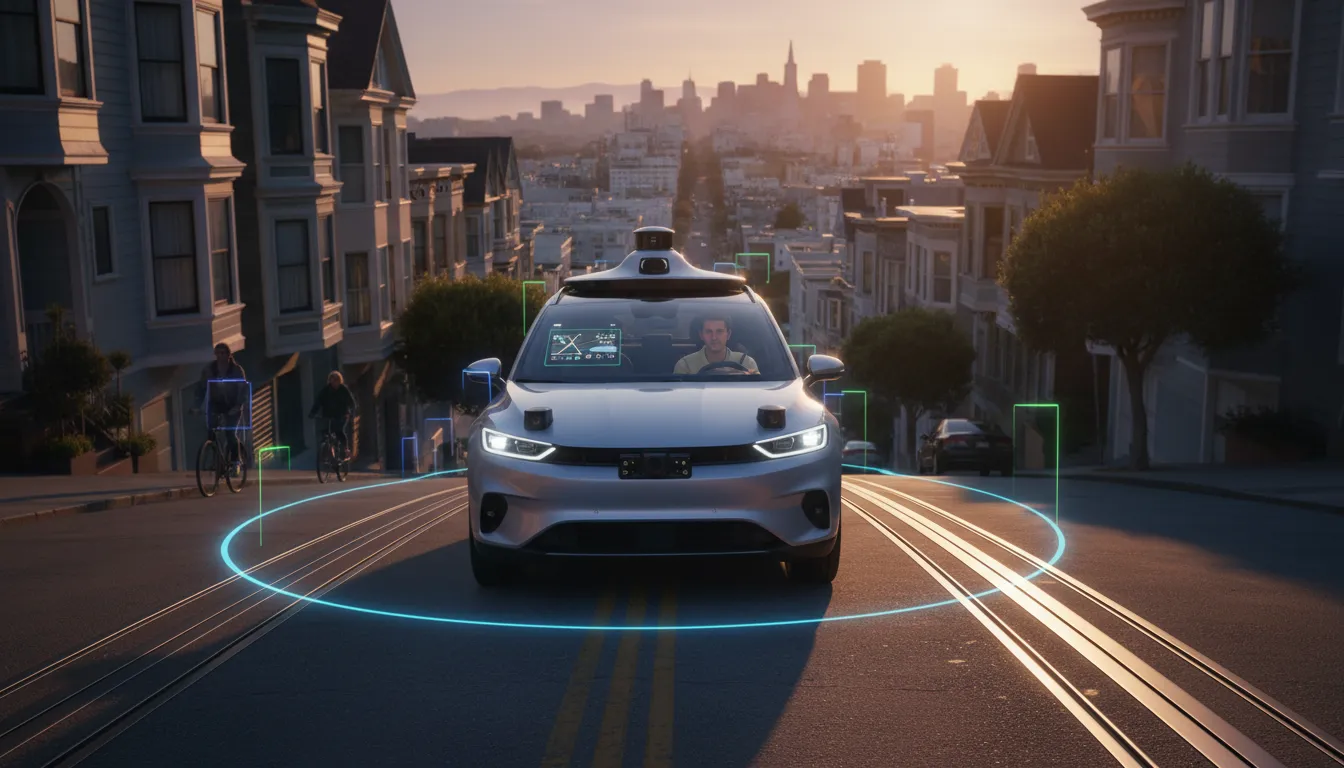
I’m reporting from the streets of San Francisco, where an NVIDIA DRIVE AV–equipped vehicle demonstrated what many are calling Level 2++. This isn’t full autonomy. It’s a meaningful step forward in the driver assistance category, blending advanced perception, planning, and human-centered interaction to handle complex urban driving scenarios that used to require a human at the wheel for everything. The demonstration highlighted how an AI-driven autonomous driving stack can take on dense traffic, pedestrians, tight turns, and the unpredictable choreography of city living while keeping a human driver engaged and informed.
In plain terms, Level 2++ refers to systems that go beyond conventional Level 2 driver assistance (lane keeping and adaptive cruise control) by widening the envelope of automated behaviors and improving safety through robust sensing and AI-based decision making. The vehicle still expects the human to supervise and be ready to intervene, but it can now manage a larger set of driving tasks reliably and smoothly.
🚦 What Level 2++ means on real roads
Regulatory categories aside, the practical meaning of Level 2++ is simple: more confidence in more situations. Instead of stepping in only on highways or well-marked roads, the system assists through urban corridors, signalized intersections, roundabouts, and congested multi-lane streets. The result is a more comfortable, less fatiguing driving experience that still preserves human oversight.
Core characteristics of Level 2++ include:
- Expanded operational envelope: The system drives in a wider variety of conditions—city centers, narrow streets, complex intersections—while still requiring driver attention.
- Advanced perception: High-precision object detection and tracking, classification of pedestrians, cyclists, vehicles, and complex scene understanding.
- Predictive planning: Anticipatory behavior that plans for likely human actions and reacts smoothly to sudden changes.
- Human-machine collaboration: Clear, timely communication to the driver about when they must take over or when the system can handle it all.
🧭 The user experience: routing, reassurance, and arrival
A simple voice prompt captures the human aspect of the demo:
"Routing to your destination, buckle up."
That line sums up the tone I want from advanced driver assistance systems: confident, clear, and conversational. It sets expectations—this is an assisted drive, not a hands-free handoff. The system takes responsibility for the driving tasks within its operational domain, but it reminds the human that they remain in the loop.
On approach to the destination the system likewise offers a final status update:
"You have arrived."
Small moments like these matter. They close the loop for the human, reduce uncertainty, and increase trust. In a city environment such as San Francisco, where streets curve, parking is tight, and pedestrians flow unpredictably, that conversational clarity helps people feel safe and informed.
🔬 How NVIDIA DRIVE AV makes it work
I want to make clear how an AI-driven stack comes together. There are three high-level domains that must work in harmony: sensing and perception, mapping and localization, and planning and control. NVIDIA’s approach integrates these with heavy emphasis on AI, high-performance compute, and redundancy.
Perception and sensor fusion
Perception starts with a rich sensor suite: cameras, radar, lidar, and ultrasonics. Each sensor type has strengths and weaknesses—cameras provide dense semantic context, radar sees through poor weather and measures velocity, and lidar gives precise 3D structure. The key is sensor fusion: combining these streams so the stack builds a single coherent model of the environment.
AI models run on the DRIVE platform to:
- Detect and classify objects like vehicles, cyclists, and pedestrians.
- Estimate object trajectories and intent—who might step into the crosswalk, who is yielding, who might run a red light.
- Segment drivable lanes, sidewalks, curbs, and temporary obstacles such as construction cones.
High-throughput neural networks process camera feeds for semantic understanding, while radar and lidar feed geometry and motion cues. Redundant sensing ensures the system still functions if one modality becomes degraded—critical for city driving when glare, fog, or occlusions occur.
Mapping and precise localization
High-definition maps remain a cornerstone of urban autonomy. They provide centimeter-level lane geometry, signal locations, and roadway semantics that help the planner make better decisions. But mapping is only part of the solution: precise localization ties live sensor observations to that map so the vehicle knows exactly where it is in three dimensions—even amid steep San Francisco hills or narrow lanes.
Localization combines GPS, IMU (inertial measurement), and visual or lidar-based matching against the map. When GNSS signals are weak, the system leans on visual and lidar cues to maintain confidence. That hybrid approach gives the vehicle the situational awareness necessary to handle complex maneuvers like navigating a multi-lane merge in heavy traffic.
Planning and control
This is where perception and mapping produce actionable outputs. The planner considers safety, comfort, and efficiency. It evaluates multiple potential maneuvers, predicts other road users’ likely motions, and chooses trajectories that avoid risk while preserving passenger comfort.
Planning in dense urban settings must balance:
- Safety buffers—maintaining safe distances from vulnerable road users.
- Traffic flow—avoiding excessive conservatism that would block intersections or cause confusion.
- Legibility—making intents clear to other drivers and pedestrians through smooth, predictable motion.
Control translates that planned trajectory into steering, throttle, and braking commands. Tight feedback loops and predictive controllers help smooth small perturbations so passengers barely notice lane centering or speed variations through arbitrary city traffic.
🧰 The compute backbone: performance and reliability
Delivering Level 2++ requires significant compute horsepower to run neural networks, perception pipelines, and real-time planners simultaneously. The NVIDIA DRIVE platform is designed to provide that processing capability while meeting automotive-grade power, thermal, and safety requirements.
Key compute considerations include:
- Low-latency processing so decisions are based on fresh sensor data.
- Parallel workloads that allow perception models, mapping algorithms, and planning stacks to operate concurrently.
- Functional safety with monitoring and fail-safe modes that gracefully revert control to the driver if necessary.
In practice, this means the platform hosts multiple AI models for perception, redundancy checks for verification, and a secure runtime that prioritizes safety-related tasks. When sensors disagree or a network yields low-confidence output, the system escalates to more conservative behaviors and communicates clearly with the driver.
🌁 Why San Francisco is a proving ground
San Francisco is a demanding urban environment: steep hills, narrow streets, dynamic pedestrian flows, frequent cyclists, complex intersections, and a mix of modern and older road infrastructure. It is exactly the type of environment that exposes edge cases and tests how robust an autonomous driving stack truly is.
Demonstrating Level 2++ performance here provides several signals:
- Robustness: If the system can manage the city’s unpredictability, it is likely mature enough for other challenging urban contexts.
- Edge case exposure: Frequent jaywalking, double-parked vehicles, and ad-hoc lane changes highlight corner scenarios that must be handled safely.
- Trust building: Human occupants tend to trust systems more when they behave predictably and gracefully in messy real-world situations.
🛡️ Safety by design: how AI and redundancy protect riders
Safety is not optional. I see safety built into every layer of a Level 2++ system. It starts with diverse sensing and continues through redundant compute and conservative fallback strategies.
Design elements that strengthen safety include:
- Sensor redundancy so a single sensor failure does not remove critical situational awareness.
- Cross-checking modules where multiple algorithms independently verify critical outputs such as obstacle positions and lane boundaries.
- Monitoring and driver engagement that ensure the human remains alert, often via camera-based driver monitoring or explicit interaction requirements.
- Conservative fallback behaviors that safely pull the system into a minimal-risk state if confidence drops—slowing the vehicle, pulling to a safe lane, or prompting the driver to resume control.
Effective communication is itself a safety feature. I noticed that calm, direct prompts reduce driver confusion and improve reaction times. Transparency about system limitations makes it more likely that the human will remain appropriately attentive.
📡 Handling unpredictable actors: pedestrians, cyclists, and human drivers
A core challenge in cities is predicting what other road users will do next. Pedestrians may hesitate, change direction, or step out unexpectedly. Cyclists often weave between lanes, and human drivers can make abrupt lane changes. The AI stack is not clairvoyant, but it can improve probabilistic forecasting by combining motion models, scene context, and learned behavior patterns.
Predictive behavior modeling includes:
- Short-term trajectory prediction based on observed velocity and heading.
- Intent estimation using semantic cues—head orientation of a pedestrian, proximity to a curb, or whether a cyclist is signalling.
- Socially-aware planning that anticipates negotiation with human drivers and yields when appropriate while maintaining safety margins.
The goal is not to eliminate all surprises, which is impossible, but to reduce their frequency and manage them safely through conservative, legible responses.
⚙️ Human-machine handoff: when and how control transfers
One of the hardest user experience problems in partial autonomy is the handoff. If the system reaches its operational limits, it must transfer control back to the human in a manner that is timely, comprehensible, and actionable.
Good handoffs follow a few rules:
- Advance warning: Give the driver sufficient time to prepare for a takeover.
- Clear context: Explain why the handoff is needed—sensor obscuration, complex driving maneuver ahead, or low-confidence perception.
- Fallback behaviors: If the human does not take over, the system executes a safe fallback, such as slowing and stopping in a safe location while continuing to attempt communication.
In the Level 2++ demonstration, the prompts were concise and unambiguous. This kind of design recognizes human attention limitations and tries to make the human’s task as simple and binary as possible: resume control now, or I will safely stop.
🔍 Real-world demo highlights and lessons
When a system operates in public streets it produces valuable insights beyond technical performance metrics. Some notable lessons from the San Francisco demonstration include:
- Behavioral nuance matters. The difference between a smooth merge and an awkward, abrupt lane change is not just comfort; it’s perceived safety. Systems that mimic human-like, predictable driving engender trust.
- Edge-case labeling. Real city driving generates many corner cases that never appear or are rare in simulated environments. Collecting and annotating those instances accelerates model improvement.
- Human factors. Voice prompts, visual feedback, and the timing of alerts dramatically influence how humans interact with the system. Simplicity beats information overload.
- Scalable testing. Running on live, dense urban roads uncovers interactions between modules that are difficult to predict in isolated tests—so integrated testing is critical.
🧭 Deployment considerations for automakers and fleets
Transitioning from demonstration to commercial deployment involves more than technical readiness. Automakers and fleet operators must consider production integration, regulatory compliance, certification, and user education.
Key operational questions include:
- How to certify safety across different jurisdictions with varying regulations and expectations.
- How to scale sensor manufacturing and ensure long-term reliability and maintenance processes.
- Over-the-air updates and how software improvements are validated and delivered safely.
- Insurance and liability frameworks that match technological capability to legal responsibility.
These considerations shape the pace and scope of real-world rollouts. Level 2++ fits a near-term commercial model: it can be offered as an advanced driver assistance package while regulators, insurers, and the public adapt to evolving capabilities.
🏙️ Urban mobility implications
Level 2++ systems have the potential to change how people move in cities. Not overnight, but incrementally. Benefits I see include:
- Reduced driver fatigue during routine segments of urban commutes, freeing humans to focus on other tasks when appropriate.
- Improved traffic flow as vehicles adopt smoother, more anticipatory driving patterns that reduce stop-and-go waves.
- Safer streets as AI reduces reaction time errors and improves detection of vulnerable road users in complex scenes.
Those gains depend on widespread adoption and careful tuning. If only a few vehicles behave predictably while others remain erratic, the benefits are limited. But as more vehicles become capable, the collective behavior can shift citywide dynamics.
🔁 Continuous learning and data strategy
An AI-driven driving stack improves with data. That means collecting, annotating, and learning from diverse driving conditions, particularly those edge cases that matter most.
A robust data strategy includes:
- Edge-case mining to prioritize rare but safety-critical scenarios.
- Federated updates so vehicles can benefit from aggregated learning while protecting privacy.
- Human-in-the-loop validation to ensure model updates behave as intended in the real world.
Updating models in production must be done carefully with rigorous validation, staged rollouts, and rollback capabilities in case an update degrades performance.
🎯 Commercialization pathway and timelines
From my view, Level 2++ is a pragmatic commercialization approach for the next few years. It allows OEMs to deliver high-value features that improve safety and comfort without waiting for full autonomy, which faces tougher regulatory and technical hurdles.
Practical steps toward commercialization include:
- Integrating the software stack with production-grade hardware and verified sensor suites.
- Running large-scale pilot programs to collect mileage and edge-case data across diverse geographies.
- Working closely with regulators to define acceptable performance metrics and certification tests.
- Creating user education and support mechanisms so buyers know how to use and trust the systems.
Fleet deployments—ride-hailing, delivery, and corporate shuttles—are particularly compelling early use cases because they enable controlled operational design domains and predictable routes that accelerate learning and business viability.
📢 Communication and public perception
Public understanding of autonomy is nuanced. Many people conflate driver assistance with full self-driving, which breeds either undue trust or unwarranted skepticism. Clear, consistent messaging is essential.
Effective communication should emphasize:
- Capabilities and limits—what the system will handle and when human attention is required.
- Safety measures—how redundancy, monitoring, and conservative fallback behaviors protect occupants.
- Real-world performance—transparent metrics and case studies from urban deployments.
When systems speak plainly and act predictably, people learn to interact properly. The short voice cues I mentioned earlier are part of that communication strategy: succinct, confident, and useful.
🧭 Policy and regulatory landscape
Regulation will shape how rapidly Level 2++ systems can be offered and where. Different regions have varying standards for driver monitoring, handoff procedures, and minimum performance. Aligning safety validation practices with regulators will help enable broader adoption.
Regulatory focus areas include:
- Driver engagement requirements to ensure the human remains attentive and capable of taking over.
- Data collection and reporting for incidents and performance benchmarks.
- Functional safety standards that apply not only to hardware faults but also to AI behavior under uncertainty.
Industry and regulators are increasingly collaborating to define pragmatic certification frameworks that encourage innovation while ensuring public safety.
🔮 Looking ahead: how Level 2++ paves the road to higher autonomy
Level 2++ is more than a feature; it’s a stepping stone. The data, user behaviors, and operational practices learned from these systems feed the development of more capable autonomous functions. Specifically, Level 2++ helps in three ways:
- Data collection at scale across diverse urban conditions that improve perception and planning models.
- Human factors research that refines how humans and machines should collaborate during handoffs and supervision.
- Validation infrastructure for evaluating behavior in the real world and refining safety cases required for higher autonomy levels.
By iterating responsibly, manufacturers can incrementally expand operational domains, increase automation, and maintain public trust—an essential currency for future progress.
📰 Why this demonstration matters now
At a time when the public conversation about autonomy oscillates between hype and skepticism, demonstrable progress in real cities matters. Showing an advanced driver assistance system operating reliably in the unpredictable theater of San Francisco streets provides tangible evidence that AI can meaningfully mitigate risk and improve mobility.
Furthermore, the industry needs intermediate milestones. Level 2++ provides consumers with immediate value while generating the technical, regulatory, and social learning necessary for eventual higher levels of autonomy.
📌 Practical takeaways for consumers and industry
Here are the practical conclusions I draw from this demonstration:
- Consumers should expect safer, more capable driver assistance features in new vehicles that can handle many urban scenarios, but they must remain engaged and informed about system limits.
- Automakers should invest in data collection, human-machine interface design, and a robust update pipeline to keep improving system performance post-sale.
- Regulators and policymakers should collaborate with industry to define performance and reporting standards that protect the public without stifling innovation.
🔚 Conclusion: steady progress with shared responsibility
The San Francisco Level 2++ demonstration shows what careful engineering, high-performance compute, and human-centered design can deliver today. It is not full autonomy, but it is a significant improvement in driver assistance capability—making urban driving safer and less stressful while preserving human oversight.
Real-world deployments like this are where technology meets people. They teach us what matters most: robust sensing, conservative planning, clear human-machine communication, and an unwavering focus on safety. The path to higher autonomy will be built on these lessons, step by step.
As systems get better at understanding and navigating complex urban scenes, I expect the benefits to multiply—safer streets, smoother traffic, and more accessible mobility options for everyone. But realizing that future requires collaboration across engineers, policymakers, automakers, and the public. Until then, Level 2++ represents a meaningful, pragmatic milestone on the road to safer, smarter cities.


