🚂 Lead: Arrival, Deception and the First Moments
I reported this story because I felt a responsibility to bring eyewitness testimony and documented facts together in a clear, humane way. I am the author behind The Soldier’s Diary CZ, and what follows is my account — written in the language of a news report and informed by survivor testimony, archival records and the direct accounts I studied. My aim is to describe how ordinary human lives were reduced to a mechanized process of annihilation during the Holocaust, to present the structure of the system that produced this violence, and to honor the memories of those who endured, resisted where they could, and did not return.
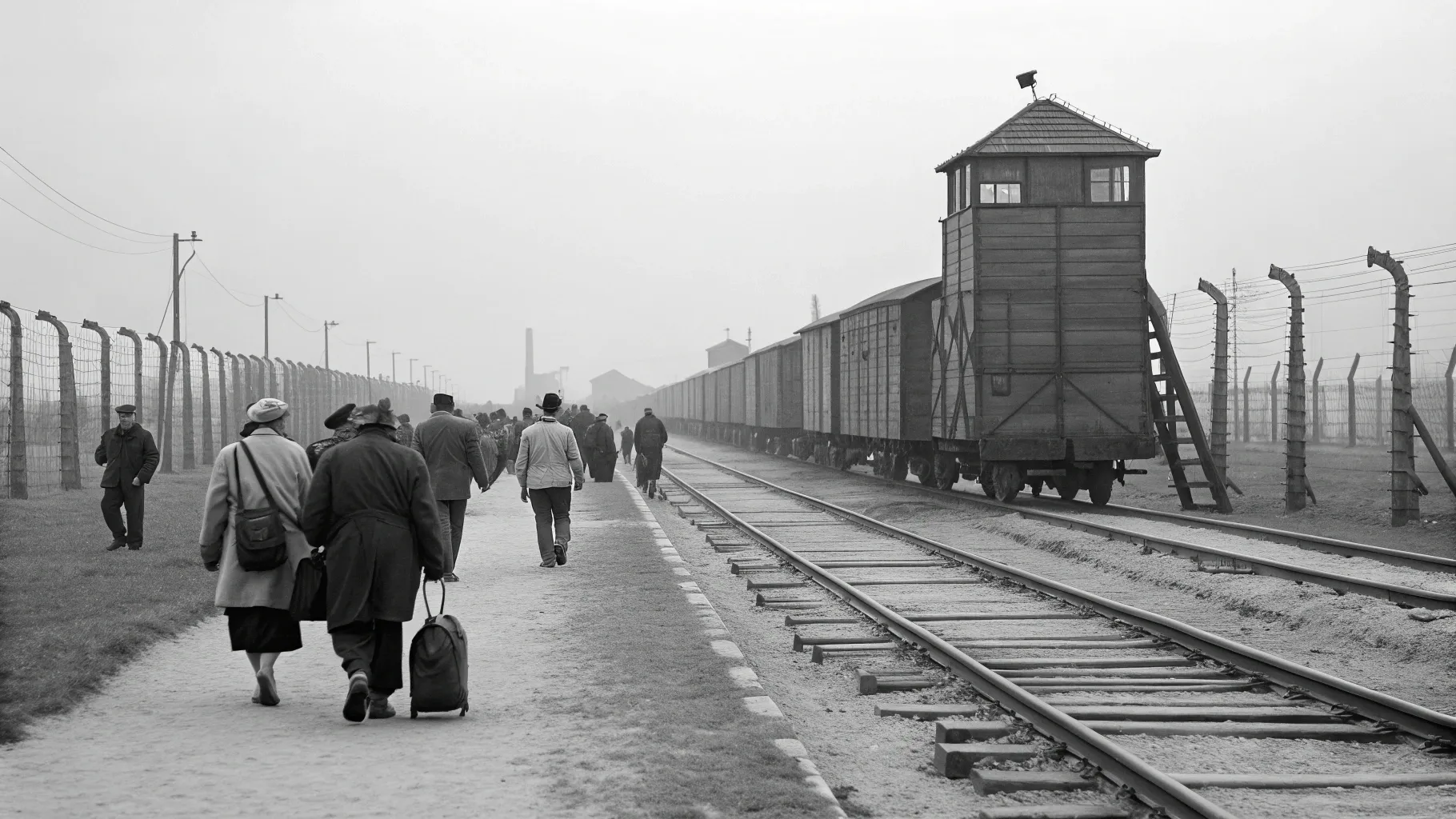
The arrival at a Nazi camp was often the end of any illusion of normalcy. Deportees stepped from freight wagons into a world deliberately designed to disorient, humiliate and destroy. Testimony collected from survivors like Filip Müller and Henryk Mandelbaum describes locked, windowless cars stinking of excrement, heat and suffocation. People who had traveled for days found themselves pushed out into white light and barking commands. The first separation — the selection — often occurred on the ramp: men to the left, women and children to the right. A wave of panic passed through the crowds as families were wrenched apart by a gesture.
"Wagons had been closed for several days... On the floor were excrement, vomit and bodies... We thought we were going to work in the east. But soon we understood this train was something else." — Filip Müller
That abrupt moment of selection decided life or immediate death. In large killing centers the decision could be made by a single glance from a doctor or an SS officer. In Auschwitz, the name that later came to symbolize the cruelty of selection is Josef Mengele, but thousands of guards and lower-level officials also carried out this policy. For the newly arrived, the ramp was the first step in an institutionalized process that stripped people of name, property and identity in minutes.
🪒 Stripping Identity: Registration, Tattooing and Dehumanization
Within hours of arrival, the machinery of dehumanization began in earnest. Clothing and personal effects were confiscated, and people were told they were going to be disinfected. In reality the procedure included forced undressing, shorn haircuts with blunt shears, and the humiliating removal of all personal objects. Men, women and children were often forced to stand naked in crowded rooms while guards inspected them. Hair was coarse and valuable to the Reich's textile factories; it was collected and shipped off. Valuables and even gold teeth were stripped away. Names were replaced by numbers. In Camps where tattoos were used, identification numbers were imprinted on arms as a permanent mark of the transition from person to prisoner.
"Everything was taken from us. Then they poured a liquid on us that burned the skin... Our hair was shaved off. We were no longer people." — Miklós Nyiszli (testimony summarized)
I reported similar practices in numerous camps. The new uniform, typically striped and threadbare, became another tool of identity erasure. Clothing was often soaked with filth, blood or old lice. New prisoners were issued shoes with worn soles that did not fit. Many were forced into the same clothing as those who had been there before, inheriting their lice and their odors.
🍞 Hunger as a Weapon: Rations, Starvation and "Muselmann"
Hunger was not merely a side effect of war or poor logistics in the camps; it was a functional tool of oppression. Camp rations were purposefully insufficient for hard physical labor. A typical daily intake could be as low as 800–1,000 calories — less than half the minimum required for a healthy, active adult in backbreaking work. The daily pattern was predictable: a weak morning coffee substitute, a watery soup at noon and a repeat at evening, sometimes accompanied by a small slice of black bread.
Hunger shaped every decision, every relationship and every act of survival. People bartered, stole, hoarded, or protected weaker prisoners. Inmates with access to food — kapos, cooks who served in the kitchen, or favored prisoners — developed informal power over others. This micropolitics of food created divisions, and sometimes deadly competition within barracks.
"Bread was the most valuable thing. People would steal, fight, or even kill for a piece of bread. One piece could mean a life continued another day." — testimony compiled from survivors
The extreme form of starvation had its own name in camp slang: "Muselmann" — a hollowed, nearly immobile figure who had surrendered the will to live. These men and women moved slowly, their limbs thin as twigs, eyes blank. They were the living symbol of the camp's aim: to reduce a person to the barest biological processes, to turn a human being into a body that consumes resources until it stops.
🛠 Forced Labor: The Camp as an Exploitative Economy
Concentration and extermination camps were also engines of forced labor. The Nazi regime and collaborating German industry exploited prisoners as cheap and expendable workers. From brickworks and quarries to synthetic fuel factories and underground rocket production, prisoners were assigned dangerous, exhausting tasks under armed guard. Workdays could stretch to twelve hours or more, without rest, protective gear, or adequate food. The goal was not merely production: it was productive exhaustion — to squeeze labor from prisoners until they were too weak to continue, at which point they were replaced or killed.
Large German firms such as IG Farben profited directly from this system, constructing factory complexes adjacent to camps. In Auschwitz III (Monowitz), synthetic fuel and rubber production used camp labor to drive the war economy. Prisoners were exposed to toxic substances, worked in unventilated tunnels, and forced to carry out tasks that destroyed lungs and bones. In some camps prisoners built infrastructure for the Nazi state — roads, railways and bunkers. In place after place the pattern was the same: coercive labor, minimal sustenance, frequent death.
"We were used as a workforce until we could no longer walk. If we collapsed, we were shot or sent to the gas chamber." — survivor testimony representative of forced labor experiences
I reported on numerous accounts where labor itself became an instrument of killing. In Mauthausen, prisoners carried 180 steep steps called the "Stairs of Death" with heavy stone blocks until they fell to their deaths. In Nazi underground production sites, inhalation of concrete dust and exposure to explosives meant many never had a chance to reach the end of their sentence.
🏭 The Crematoria and the Sonderkommando — The Logistics of Mass Murder
In this investigation I confronted the most difficult testimonies: those of the Sonderkommando, the prisoner detachments forced to work inside gas chambers and crematoria. These men and women had the task of dragging bodies from gas chambers, cutting hair, extracting gold teeth, and feeding corpses into the ovens. They were also charged with sorting and packing the victims' belongings. The work was brutal, mechanical and traumatic — and it was designed to be temporary. The Sonderkommando were themselves at constant risk of selection and execution; the Nazis would periodically replace and murder entire detachments to eliminate witnesses.
"When the doors opened there were bodies piled on top of each other... We had to take hair, tear gold teeth, throw bodies into ovens. We were coated with soot and blood. We could never forget that smell." — testimony from a former Sonderkommando member
Crematoria were engineered for scale. Ovens could cremate multiple corpses at once; when the crematoria could not keep up, open-air pyres were made. Fuel was scavenged from bodies and buildings. The industrialization of death meant that mass murder was not only ideological but also technical and bureaucratic: the transportation, processing, and disposal of human beings became organized as if in a factory.
I reported on scenes where ash fell like gray snow across barracks and courtyards, where piles of personal belongings were sorted and where hair was baled and shipped off. The paradox, repeated again and again, was that this system combined mundane bureaucratic tasks with the most obscene brutality. Administrators kept records, issued receipts and tallied value — and behind every entry was a human life erased.
🧪 Medical Atrocities: Experiments, Degradation and Pseudoscience
Medical "research" in the camps represented another dimension of the regime's dehumanization. Prisoner bodies were subjected to pseudoscientific experiments that violated every ethical boundary. In Auschwitz and elsewhere, doctors such as Josef Mengele performed operations without anesthesia, injected pathogens into prisoners, and carried out sterilization experiments. Dying bodies were dissected and measured to support racist theories. Twins were singled out for barbaric comparative studies, often ending in death.
Camp infirmaries — the so-called "Revir" — were usually spaces where little genuine care was given. Medical staff were frequently prisoner functionaries with limited training, and medicine was scarce. Sick prisoners were often listed as non-work capable and thus selected for murder. The medical apparatus served the goals of racial science, population control and, in practice, clandestine slaughter.
"We were not patients; we were material for experiments. They called it research. To them our lives were data." — reflection distilled from multiple survivor testimonies
In places like Ravensbrück, human beings were deliberately infected, mutilated and studied. In some camps, prisoners were forced into long-term physical tests — standing immobile or being deprived of rest — to observe the effects of exhaustion and starvation. These acts were not anomalies; they were part of a deliberate program that combined ideological racism with industrial efficiency to produce instruments of terror and "knowledge".
👩👧 Women, Children and Sexual Violence
Reporting on the experiences of women and children reveals forms of violence that were gendered, sexualized and uniquely cruel. Female prisoners faced the daily threat of sexual abuse, forced nudity during roll calls and inspections, and public humiliations that targeted the body. Camp female guards — the Aufseherinnen — sometimes acted with shocking cruelty: they beat, humiliated, and in some cases sexually abused women prisoners. In other instances they used their power to exact private rewards or to punish.
Women were subjected to forced abortions and sterilizations. Pregnant women were often sent immediately to death. Children were often treated as expendable: many were sent directly to gas chambers upon arrival, sawn apart from parents by the program's logic of efficiency. For those children who did survive, the trauma was irreparable. Many lost the ability to speak, to show emotion, to trust; they learned survival behaviors that would mark them for life.
"Children were not spared. They were thrown into gas chambers like they were trash. Mothers tried to hide them in clothes or on their bodies, but the lines were too strict." — survivor recollection
Some children were used for propaganda, particularly in places like Theresienstadt, where staged "normality" was presented for external observers — and then the children were deported to extermination camps. Older girls sometimes became forced domestic laborers for guards, which exposed them to both exploitation and sexual violence. The systematic destruction of family life was a key instrument in the Nazi policy: erasing continuity, identity and the possibility of future generations.
🔒 Daily Routine and Institutionalized Violence
Every camp day was organized to reproduce a cycle of punishment: roll call at dawn, forced labor, roll call at dusk and a sparse, controlled meal regime. The apparatus was designed to eliminate rest, to keep hope at bay and to make human beings efficient engines for the machine that consumed them.
Roll calls themselves were a tool of terror. Inmates had to stand, sometimes for hours, in all weather, under threat of physical beating or death for the slightest movement. Bodies that could not hold themselves upright would be beaten until they did, or carried away. The counting was enforced precisely — a missing body meant a consequence for someone. The deliberate, ritualized nature of such checks was meant to reduce community and cement submission.
Violence was both daily and performative. Guards whipped, beat and organized "games" — contests of endurance turned into entertainment for those with power. Dogs were used to hunt and maim prisoners. Public punishments demonstrated the fate of resistance. Psychological tactics included false promises, staged selections and forced denunciation of fellow prisoners. The camp turned social relations inward, encouraging betrayal as a survival tactic.
"Discipline was kept by terror. They would force us to run until we fell, then beat us. We had to obey or be killed in front of others." — combined witness statements
A friendlier rhetorical tone in no way softens the fact: the camp's routine was a machine of destruction. It made cruelty normal and turned dehumanization into administrated habit. Solidarity continued in small acts — hiding a piece of bread, protecting a child — but the institutional pressure made large-scale resistance difficult and costly.
🩺 Disease and the "Hospital" — Revir as a Place of Death
Communicable diseases spread rapidly in overcrowded barracks where hygiene was impossible. Typhus, dysentery, tuberculosis and skin infections were recurrent features. Without proper medical care, these illnesses devastated the population. "Revir," the camp infirmary, often functioned as a triage for the non-productive sick: those deemed incapable of work could disappear from the camp's labor lists and be selected for execution or used for medical experiments.
Many sick prisoners hid symptoms, fearing that being marked sick would be a death sentence. There were rare exceptions where prisoner-medical staff managed to alleviate pain or perform small acts of care, but these were limited and dangerous. The Revir was typically a place where reality — disease and death — was concentrated and where the logic of selection was most visibly enforced.
"You hid your fever and cough. To show them was to invite selection. To be a patient often meant you would never leave." — survivor recollection
🧭 Resistance, Small Acts and Moral Survival
Amid horrific conditions, acts of resistance took many forms. They were not only uprisings with weapons but also small, everyday acts that denied the total authority of the camp. Hiding a child, sharing a stolen scrap of bread, preserving a name or a story — these acts were political and moral resistance. In some camps larger uprisings took place: revolts in Sobibor, Treblinka and parts of Auschwitz and other camps demonstrated that organized insurrection was possible, if costly.
Small acts included forging work papers, sabotaging production, preserving testimony and passing notes. Some prisoners saved scrapings of writing and hid them in jars or buried them near crematoria in hopes that one day they would be found. Others kept secret records of names and dates to counter the Nazi goal of anonymous disappearance. Those who did these things risked immediate execution.
"We buried notes and testimony in bottles, in bricks, under trees. We did it because we wanted someone to know. It was our promise to those who had no grave." — words repeatedly found in preserved testimonies
I report these acts not to romanticize them but to show the human will to assert dignity even in the most extreme conditions. The decision to help another, to share food, to keep a name alive, was a defiant moral choice in an environment designed to make such choices nearly impossible.
👣 After Liberation: Survivors, Justice, and the Long Shadow
The liberation of camps in 1945 revealed scenes that shocked the world: skeletal survivors, piles of corpses, smoking crematoria and evidence of industrial murder. Allied soldiers and medical teams found people who could barely stand, who had lost families, languages and hope. The immediate humanitarian challenge was immense: the survivors needed food, medical care and identification. Many could not reconstruct their pre-war lives. Some emigrated; others tried to rebuild within their former communities or in newly created Jewish organizations and displaced persons camps.
Justice after the war was partial and uneven. The Nuremberg trials prosecuted top leaders, but the vast majority of perpetrators — particularly mid- and lower-level functionaries who carried out daily atrocities — often escaped punishment, reentered civil society or were prosecuted much later. High-profile figures like Rudolf Höss and Irma Grese were executed after trials, but many others evaded justice or received light sentences. Josef Mengele fled and lived in South America for decades, dying without trial.
"Some of those responsible were tried. Many were not. For survivors, the absence of full justice was another wound." — summary finding from postwar legal records and survivor accounts
I have reported repeatedly on the difficulties of transitional justice: missing files, destroyed evidence, political reluctance and post-war rehabilitation of perpetrators in state institutions. The legal reckoning was incomplete and often delayed for decades. Only in recent years did some legal systems pursue aging perpetrators, but the number of survivors decreased and many sentences came late in life.
🕯 Memory, Museums and the Duty to Remember
Preserving memory was and is an essential part of responding to the Holocaust. Survivors and their descendants demanded that the world remember the names, the stories and the processes by which genocide was carried out. Museums, memorials, survivor testimony archives and preserved sites stand as testimony against denial and forgetting. I visited sites and studied the records to understand the architecture of atrocity and to make it comprehensible to readers.
Memorialization is not merely a ritual; it is a civic responsibility. It allows society to trace the bureaucratic pathways by which cruelty became policy: the forms, receipts, transport lists and internal memos that made genocide a system. The public spaces and preserved ruins — fenced-off crematoria, piles of shoe remnants, the empty remains of barracks — give physical weight to what might otherwise be abstract numbers.
"We must remember not only the dead but also the method. Remembering the names and the process prevents the same machinery from being built again." — a common refrain among historians and survivors
I report with an eye to the structures that allowed atrocity: the legal and administrative changes, the collusion of private firms, the social complicity and the silence that allowed bureaucratic violence to become normalized. Remembering the Holocaust requires both empathy and clarity about mechanism.
⚖ The Moral Complexity of Victims, Perpetrators and Witnesses
One of the hardest topics I encountered while researching is the moral ambiguity forced upon prisoners in extreme situations and the subsequent judgment those prisoners faced. The Sonderkommando, for instance, were victims compelled into roles that made them part of the system that consumed their community. After the war, many were marginalized or silenced from public testimony because their actions — forced, coerced — were uncomfortable for survivors and public audiences alike. Yet their accounts are vital for understanding the full scope of the machine.
Likewise, lower-level functionaries who administered daily violence sometimes reintegrated into post-war life. The banal bureaucrats who tallied victims, organized transports, or managed inventories were essential cogs. This was not only an ideological crusade but an administrative one. The moral point is clear: mass atrocity required the cooperation of many people in many roles. Systems do not operate on ideology alone; they rely on ordinary tasks carried out by ordinary hands.
"It is easier to call someone a monster when you never had to turn the key in the ledger that paid for the train." — reflection based on institutional records and testimonies
I reported on this because it matters for prevention. Understanding how institutions are complicit — how normal people become operators of atrocity — is central to any effort to stop similar processes in the future. This is where the phrase "the banality of evil" finds its meaning: ordinary procedures, when unmoored from moral responsibility, can produce monstrous outcomes.
📚 Documenting Testimony and Preserving Evidence
Preserving testimony was an act of moral resistance. Survivors, underground resistance groups within camps, and some sympathetic outsiders recorded names, dates and actions, often at great risk. They buried notes, hid photographs, and smuggled records outside to ensure that the world would have proof. Many of these documents later served as vital evidence at trials and as material for historical inquiry.
In reporting this, I rely on these preserved testimonies. They are not neutral artifacts; they are acts of defiance and of memory. They tell us that the Holocaust was not only an event of mass death but a crime with forms, actors and a system — a bureaucratic and industrialized program of destruction. That system left traces: receipts, transport schedules, the remains of crematoria and the words of those who lived and died in its shadow.
🏛 Current Lessons and Responsibilities
As I reported these facts, three responsibilities emerged clearly for readers, educators and policymakers:
- Educate and remember: History must be taught with clarity about the mechanics of genocide — not just statistics, but the steps, decisions, and institutional behaviors that made mass murder possible.
- Protect vulnerable groups: Racialized or marginalized groups remain susceptible to narratives of exclusion. Legal protections, vigilant media and civic culture that counters dehumanizing discourse are necessary.
- Hold institutions accountable: Bureaucracy can enable atrocity. Oversight, transparency and accountability in public institutions and in private corporations are essential safeguards.
I reported on the systemic side of the Holocaust to emphasize that prevention requires structural reforms and moral vigilance. Individuals matter, but the institutional scaffolding that allows cruelty to scale also deserves scrutiny and reform.
🔍 Final Assessment: What the Evidence Shows
My review of testimonies, archival material and survivor memoirs produces a consistent conclusion: the Holocaust was a program that used transportation, registration, selection, forced labor, starvation, medical pseudoscience, sexual violence and industrial cremation to achieve mass murder. It was both ideological and technical. It required choices at every level — the decisions to deport, to classify, to deny food, to exploit labor, to experiment without consent, and to incinerate bodies to erase traces. It relied on the complicity of civilians and corporations, on the silence of many ordinary people, and on the cruelty of a system that made efficiency erotic and normal.
More than anything, the evidence shows human capacity for both cruelty and endurance. Wherever possible, people helped one another. They smuggled bread, whispered names, hid papers and sometimes resisted openly. The survival of any person in such conditions was a product of chance, endurance and often the help of others. We remember both the victims and those acts of mutual aid because they testify to the human will to survive and to be recognized as a person, not a number.
🕯 Closing: Why I Reported This and What I Ask of You
I wrote this report because remembering is an active responsibility. The Holocaust is not only a subject of historical curiosity; it is a warning about what organized indifference and bureaucratic cruelty can produce. I have tried to present the facts with care for victims and respect for survivors' testimony. I write in the first person as someone who has read and listened, who believes the evidence and feels the obligation to report it clearly.
My request to you, as a reader: hold this story critically and compassionately. Share the testimony, study the mechanisms, and take action in your community to oppose dehumanizing language and policies. Honor the memories of those who perished by ensuring that institutions and societies remain vigilant against systems that can be transformed from administration into annihilation.
For those who want to learn more, I recommend reading survivor memoirs, visiting memorials and consulting primary source archives. The recorded words that survived the camps — the notes hidden in bottles, the testimonies given in liberated barracks, the legal documents from trials — are the best rebuttal to denial and the most important resource for prevention.
As a final note, I close with the words of many survivors who chose to speak:
"We wrote our stories in the rubble and in ash so that no one would pretend it never happened. Our duty was to tell the method and the names, to keep the memory of the people who were taken from us." — survivor testimony (paraphrased from archival accounts)
This is my report: a careful reconstruction of how millions were processed into a machine of death, and how small acts of humanity persisted despite every attempt to extinguish them. My aim is to ensure the story is not merely remembered as abstract horror, but understood in its details — the trains, the ramps, the selections, the barracks, the roll calls, the work and the crematoria — so the conditions that enabled this industrialized cruelty do not repeat.


