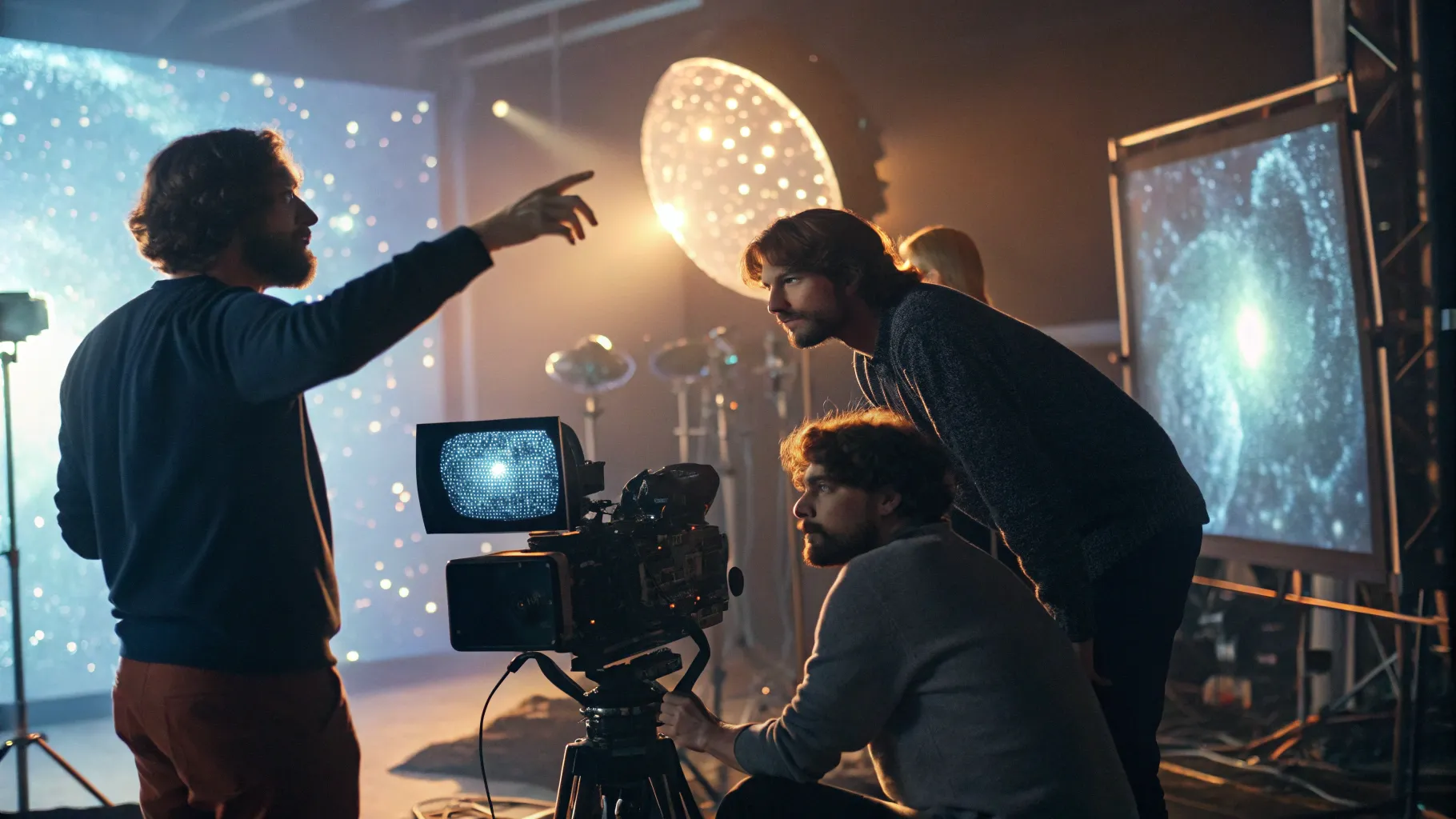
I invited a group of filmmakers and technologists into the studio to unpack something that feels both urgent and intoxicating: how generative AI is becoming a tool for cinematic imagination. In a recent episode produced by Google for Developers, I sat down with director Eliza McNitt, Ben Wiley from Google Creative Labs, and Corey Matheson from Google DeepMind to take readers — and listeners — behind the curtain of ANCESTRA, a short film that blends live action with generative AI to render a deeply personal story at cosmic scale.
What follows is a first-person, on-the-ground report of that conversation. I’ll walk you through the film’s origin, the team and technologies that brought it to life, the practical mechanics of turning prompts into pixels, and the ethical and creative questions that emerged along the way. I’ll also outline lessons learned, next technical problems the team is focused on, and a short FAQ to answer the most common questions I heard during and after the recording. My aim is to document this moment in film history: a time when new tools are not simply augmenting production but reshaping the kinds of stories we can tell.
Table of Contents
- The origin story of Ancestra 🎬
- How the team came together 🤝
- Veo, Gemini, Flow — the tech stack 🛠️
- From prompt to pixels: the creative process ✍️
- Building the pipeline and roles on set 🎥
- Personalization and using family archives 🧬
- Limitations, surprises, and "wow" moments ✨
- Ethics, boundaries, and the responsibility of creators ⚖️
- VFX, roles, and the myth of automation 🧑🎨
- Lessons learned and the future of the film industry 🔮
- Rapid-fire takeaways ⚡
- FAQ ❓
- Conclusion 🏁
The origin story of Ancestra 🎬
The spark for ANCESTRA is both intimate and cinematic. Eliza McNitt described the premise in a line that was as simple as it was sweeping: during an emergency delivery, an expectant mother draws on the strength of her ancestors — matriarchs, the cosmos itself — and channels this love into a force that saves her child. The narrative thread traces the smallest human detail — the emergency C-section, the clinic check that turned catastrophic — and stretches it outward to dying stars and cosmic landscapes.
Eliza told me that the film finds its roots in a true family moment: she was born with a hole in her heart and, on the day of her birth, her mother had to undergo an immediate C-section. That memory and family lore informed the emotional spine of the piece. Translating that visceral story into images required an approach that could move between the micro — internal bodily states, the physical panic of an operating room — and the macro — black holes, dying stars, cosmic flows. Those were precisely the kinds of visuals that generative AI models like Veo and adjacent systems could help craft.
When Eliza walked into the Google team’s lab, she arrived with an idea and a hunger to visualize the unknown. She had not written a full script yet, and the first weeks were devoted to ideation and rapid iteration. In less than three months — she arrived at the end of March and the film premiered at Tribeca on June 13 — the team moved from treatment to festival screening.
Eliza McNitt: "The beauty of this technology is that you can just go do it."
That line captures a practical truth that kept recurring during our conversation: these tools dramatically shorten the loop between imagination and visual output. They don’t replace the craft of writing or directing, but they do give creators a new way to write in images and iterate in real time.
How the team came together 🤝
ANCESTRA was not a solo effort. At its core, it was a collaboration between independent filmmakers and a deep technical research group. The project was produced in partnership with Google DeepMind and Primordial Soup, Darren Aronofsky’s production company. Aronofsky’s interest in pairing cutting-edge technology with strong directorial voices led to Eliza being recommended and rapidly embedded into a creative-technical environment.
Ben Wiley explained that the initiative started with a simple directive: put world-class generative tools in the hands of the best creative minds and see what they build. That translated into an unusually fast — and unusually integrated — collaboration. Eliza arrived, the research team demonstrated what they had, the creative team started writing and prototyping, and a production pipeline developed almost ad hoc.
Corey Matheson emphasized the hybrid nature of the team. Engineers and researchers, VFX artists, storyboard artists, cinematographers, a dedicated AI unit, a VFX supervisor, composers, and a cast all participated. The result was a deep cross-pollination of skills: researchers taught creatives how the models behaved; creatives showed researchers what was possible when given new levers; VFX teams integrated generative outputs into production-grade sequences.
From a headcount perspective, the project touched roughly 200 artists from ideation through post-production. That is an important detail: even with powerful generative models, the film required a large, skilled team to take generated footage from prototype to screen-ready.
Veo, Gemini, Flow — the tech stack 🛠️
We dove into the specifics of the technologies that powered ANCESTRA. Two names dominated the conversation: Veo (Veo 2 and later Veo 3) and Gemini, combined with tooling like Flow and bespoke interfaces the team built for collaboration. Here’s how I described them while reporting on the process:
- Veo: A generative video model that converts user inputs — prompts, reference images, motion references — into pixels. Veo operates as a conditioned video synthesizer, translating textual and visual prompts into short video clips. Early versions had constraints (e.g., clip length around eight seconds), but the model rapidly evolved while the team worked.
- Gemini: Used for image and video understanding, Gemini helped translate reference media (like family photos) into descriptive language that could be used to condition Veo. For personalizing generated footage, Gemini’s ability to extract dense descriptive metadata from images proved invaluable.
- Flow: A creative-facing interface that aggregates model capabilities and provides a UI for artists to experiment, iterate, and share short clips. Flow — and other studio tools — were instrumental in making model interactions accessible to non-technical artists.
- Custom tooling: Because each creative has a unique process, the team also built bespoke interfaces to manage prompt libraries, clip repositories, masking workflows, and version control during collaboration. These bespoke tools allowed artists to share prompts and generations, remix others' outputs, and maintain a shared visual language.
Corey described Veo as a bridge between creative intent and pixel output. But he also emphasized that the system is not magic; it is a synthesis of large-scale training on video-description pairs and clever conditioning techniques: first-frame and last-frame generation, mask-based inpainting, and image-to-video extensions.
Corey Matheson: "Veo is a video generation model that takes inputs from the user and translates them into pixels. It really relies on the creativity of an individual to push the model into interesting places."
That dependency on human creativity is a recurring theme — and a frequent antidote to the myth that generative AI is a fully autonomous creator. For ANCESTRA, artists were the ones coaxing the model into expressive territory: finding language that matched aesthetic goals, combining unexpected references, and stitching generated clips into a cohesive visual language that felt cinematic.
From prompt to pixels: the creative process ✍️
If you want to understand how a single shot was made, the story I heard follows a pattern. First, an artist or director identifies the intent — what does this beat need emotionally and visually? Second, the team determines the best blend of practical and generative tools. Third, creative teams craft prompts and provide reference images — sometimes a photograph, sometimes a scientific visualization, sometimes a microscopic image — to guide the generation. Fourth, they iterate rapidly: sample, evaluate, remix, and refine. Finally, VFX and editorial teams composite those generated clips into the shot, color-grade, and sound-design the sequence so it serves story and emotion.
There were many practical techniques the team used; a few notable methods that I reported on are:
- First-frame / last-frame generation: Seed the generated clip with a real image so the model produces a natural continuation from (or into) that frame. This is how the team could anchor an AI-generated movement to a specific actor pose or integrated live-action plate.
- Mask-based editing and inpainting: Mask a portion of a live-action video and use Veo to generate content within that mask. This allowed a hybrid of live-action and generative footage in the same shot.
- Gemini-assisted prompting: Run reference photos through Gemini to produce rich textual descriptions that can then be used as dense prompts for Veo. This helps produce content that aligns closely with the source image's lighting, color palette, or emotional tone.
- Motion matching across different domains: A particularly creative technique used in ANCESTRA involved matching the motion of one natural phenomenon to another — e.g., translating the spiral flow of water down a drain into the growth pattern of leaves. The model could emulate motion patterns while changing visual semantics, which resulted in some of the film’s most surprising images.
Ben described the process as a feedback loop between the model and the creative team. A writer-director may imagine a shot, prompt the model, watch a generation, and then edit the prompt to remove literal artifacts or to emphasize abstraction. "You get to write with Veo," Eliza told me — the generative output becomes a drafting tool, an iterative visual sketch that accelerates the writing process and enables new directions that might never have surfaced in a storyboard-only approach.
That said, prompts are not intuitive or predictable. Eliza and Ben both spoke about the "poetry of prompts" — the art and craft of finding language that unlocks a particular aesthetic. Sometimes you get the desired outcome by describing the target object directly. Other times you arrive at the same result by describing something entirely different (e.g., "microscopic imagery of cell division" to suggest vast cosmic nebulae). Using metaphors, referencing material processes, and leaning on tangible analogues often yields better results than purely abstract directives.
Building the pipeline and roles on set 🎥
One of the recurring practical takeaways was this: even if you use the most advanced generative models, classical film roles remain crucial. ANCESTRA still had a VFX supervisor (Aaron Raff), a cinematographer, storyboard artists, composers, and department heads. What changed was the introduction of a new department: the AI unit. The AI unit’s duties included handling prompt libraries, managing model outputs, curating generations, and coordinating with VFX to ensure that outputs were production-grade.
Here’s how the team organized responsibilities during the production:
- Director (Eliza McNitt): Set the story's emotional tone, supervised actors, and made final decisions about when to use generative content versus practical or VFX solutions. Eliza also iterated on scripts and storyboards in direct conversation with generated imagery.
- Creative Director / Production Lead (Ben Wiley): Served as a bridge between creative vision and generative capability, helped translate artistic goals into testable prompts and guided the overall visual language.
- Technical Lead / Research Liaison (Corey Matheson): Provided access to models, explained model possibilities and limitations, and helped develop custom tooling to make generative workflows practical for filmmakers.
- VFX Supervisor: Integrated generated footage into shots, refined renders, and ensured that compositing, lighting, and physics felt realistic and emotionally coherent.
- AI Unit: Managed prompt libraries, curated generations, documented prompting techniques, and worked closely with editorial so that generative content could be versioned and tracked.
- Actors and Department Heads: Remained central. Actor Audrey Corsa, for instance, deeply researched the role by calling Eliza’s mother to understand the lived experience the film dramatizes — a human touch that models cannot replicate.
The presence of an AI unit is, to me, a notable production innovation. It means that generative tools are being institutionalized into production pipelines, much like sound or visual effects departments once were. Early adopters are defining the "playbook" for how creative teams will collaborate with researchers and engineers.
There were also intense practical constraints. At one point Eliza asked about clip length, and the team told her the model could reliably generate roughly eight-second clips at the time. That limitation shaped shot rhythm and editing choices. Later iterations (such as Veo 3) relaxed some constraints and improved the fidelity and temporal coherence. The production therefore had to be nimble: adapt to model constraints while pushing researchers to evolve the models where it mattered for the story.
Personalization and using family archives 🧬
One of the most moving elements in ANCESTRA is a newborn representation derived from family photos. Eliza shared that shots of the baby in the film were inspired by photographs her father had taken of her as an infant. We unpacked how that was technically achieved and why it matters.
Corey explained that models like Veo are trained on large collections of paired video and text, but they lack personal, private references unless those references are incorporated via conditioning strategies. For ANCESTRA, the team used several techniques to bring in personal context:
- Image conditioning: Use a photograph as an anchor for generation by either starting the clip from that image (first-frame conditioning) or making the photograph the expected target look (using rich Gemini descriptions to construct a dense prompt).
- Descriptive augmentation: Run personal photos through Gemini to translate visual attributes into carefully chosen words. That textual representation is then supplied to Veo as part of a prompt to nudge the model toward the personal aesthetic.
- Hybrid compositing: Combine generated newborn footage with live-action plates and a final layer of VFX work to match grain, lighting, and color. This ensures the baby reads as part of the physical scene rather than a pasted-in artifact.
The team did not train a separate model on Eliza’s family photos; rather, they used the photos as conditioning artifacts and relied on Gemini’s language-based understanding to convert them into cues Veo could follow. This method balances personalization and privacy: you can produce a representation that respects the source material without creating a separate model trained on private data.
From my reporting, there were clear benefits to this approach. First, it enabled the team to depict a newborn in a way that would otherwise be extremely difficult to stage or CGI convincingly. Second, it reinforced a core message of the film — the personal is cosmic, and personal artifacts can seed universal images.
Limitations, surprises, and "wow" moments ✨
No project of this ambition is without growing pains. Eliza, Ben, and Corey all described a mixture of frustration, fright, and exhilaration across the process. I cataloged several recurring challenges and the surprises that accompanied them.
Limitations:
- Temporal coherence at scale: Early models could only produce short clips reliably. Extending those clips while maintaining frame-to-frame consistency was a technical challenge.
- Literalism vs. abstraction: The models are both incredibly literal and highly realistic; if you ask for "space" you often get Hubble-like images. To achieve abstraction, creatives had to be clever in how they referenced materials — e.g., using microscopic textures to suggest vast cosmic structures.
- Production readiness: Many models were not "production-ready." The team often had to treat model outputs as drafts and then lean heavily on VFX artists to polish and integrate those drafts into a final shot.
Surprises and "wow" moments:
- Motion transfer across domains: Translating the spiral motion of water into the growth of leaves created an emotionally resonant metaphor that felt new and cinematic.
- Personalization: Generating a newborn that felt connected to Eliza’s family photographs — anchored by the film's emotional truth — was a moment of deep artistic satisfaction.
- The actor's performance: Ben recounted being emotionally moved by Audrey Corsa’s performance — an example that reminded us the human craft of acting remains irreplaceable.
Those "wow" moments were the kind of creative gold that made all the hard work worthwhile. Ben called them "lightning in a bottle" — those rare instances where a new tool and a creative instinct match in a way that feels both unexpected and inevitable.
Ethics, boundaries, and the responsibility of creators ⚖️
One of the most important parts of my reporting was the conversation about ethics and the responsibility that comes with access to these tools. The team did not gloss over controversies; instead, they confronted them head-on.
Eliza was clear about centering humans: she intentionally anchored the film in live-action performances, human story, and direct personal artifacts. Actors, she stressed, bring a kind of interpretive, empathic labor that technology cannot replicate. Audrey the actor called Audrey McNitt’s mother to understand the lived experience of the birth day — a tactile example of human care and craft that AI cannot replace.
Ben and Corey framed their perspective around augmentation, not replacement. They argued that the models are tools — new types of cameras — that open new genres and creative avenues. Ben used the GoPro analogy: new cameras didn't make existing cameras obsolete; they created new forms of expression. Similarly, Veo and Flow, he said, create new vectors for storytelling, not automatic replacements for traditional craft.
But the speakers also spoke candidly about the hard responsibilities. Ben said he believes creators must help "shape and develop these tools in ways that are respectful of the humans that laid the ground before." Corey emphasized that early engagement between researchers and filmmakers is critical so that best practices and responsible processes can emerge organically.
Practical ethical practices the team implemented included:
- Human-in-the-loop oversight: Artists decided when and how to use generated content; models were treated as assistants rather than auteurs.
- Transparent documentation: The team produced a long "making-of" feature to explain not just what they made, but why they used AI for particular sequences and how decisions were made.
- Consent and personal archive considerations: When using family photos or personal audio, the team approached the process carefully so that the artifacts were used respectfully and with creative intent aligned to the story's emotional truth.
- AI unit and department integration: By creating an AI unit and involving all heads of department, the production ensured that choices around generative content were considered within standard production protocols, not siloed in secret experiments.
What became clear in my reporting is that ethics is not a checklist you apply at the end; it's a design principle baked into the production process from ideation to screening.
VFX, roles, and the myth of automation 🧑🎨
There are fears in the industry that VFX artists, animators, and other specialists will be displaced. The ANCESTRA project showed me a counter-narrative: when you adopt new tools, craft shifts rather than disappears. The VFX team was essential throughout; generative outputs were inputs that required artistic finishing.
Eliza described it as a practical-effects approach. Instead of asking the model to conjure abstract forms from abstract prompts, the team often described real physical phenomena that, when scaled and recontextualized, suggest the cosmic. That approach mirrors how practical effects historically created convincing illusions. In other words, the team leaned on seasoned artists to choose metaphors that would preserve the physics and tactile quality audiences intuitively read on screen.
Again, the AI unit played a central role in ensuring hand-offs between model outputs and VFX finishing were clear, documented, and trackable. VFX supervisors applied their craft to align lighting, grain, motion blur, color match, and other filmic properties so generated pixels blended seamlessly into live-action plates.
Lessons learned and the future of the film industry 🔮
After listening to the team and reflecting, I summarized several lessons that I think will be instructive for filmmakers and technologists alike.
1. Story first, technology second
Corey summed this up neatly: "It still always boils down to storytelling." No amount of technical novelty replaces the need for coherent emotional architecture. The most potent use of generative tools is when they serve story, not spectacle for its own sake.
2. Tools democratize possibility
Ben and Corey both highlighted democratization: these systems lower the barrier to entry for visual storytelling. If you are a young filmmaker, you can now prototype ambitious ideas without years of access to specialized equipment or a massive VFX budget. That will enable more personal stories to reach the screen at a level of craft previously unattainable.
3. New roles will emerge, and departments will adapt
An AI unit is now a production reality. Tooling that used to exist in research labs will move onto sets and into editorial bays. VFX artists will gain new levers and responsibilities: they will be polishers and integrators of generated material, not displaced laborers.
4. Collaborate early and often
Researchers benefited enormously from early engagement with creatives. The feedback loop between domain expertise (filmmaking) and technical capability (model design and tooling) is essential to drive practical, responsible innovations.
5. We must embed ethics and documentation
The "making-of" was not just a PR artifact — it was an act of accountability. Making visible how models were used, where they weren’t used, and why certain choices were made is a best practice for transparency and for building trust with audiences.
Rapid-fire takeaways ⚡
During the talk, I asked each guest a few quick questions. Here are the highlights that felt relevant to share to readers interested in trying this themselves:
- Experimentation is contagious: Ben is digitizing family Super 8 footage and using Veo to reimagine 1960s Disneyland sequences. He’s using tools to extend personal archives, which shows how generative video can revive family content.
- Prompts are poetic: Eliza spent part of her morning asking an AI about wormholes — creative curiosity feeds the work. Learning to prompt well is an artistic skill.
- Model tempo is accelerating: Corey noted that the quality and interest of generated video is markedly better than six months prior; audio synchronization and extended sequences are becoming increasingly compelling.
- Next problems: Bringing deeper personal context into generations — more fidelity when conditioning on archives like slides, audio, and home video — is a near-term focus for teams like Google DeepMind.
FAQ ❓
Here are the questions I was asked most frequently after publishing the interview, along with straightforward answers based on the conversation and how the team worked on ANCESTRA.
Q: What is ANCESTRA?
A: ANCESTRA is a short film that blends live-action storytelling with generative AI to visualize the interior and exterior worlds surrounding an emergency birth. It was developed in partnership with Google DeepMind and Primordial Soup and premiered at Tribeca.
Q: Who made the film?
A: The director and writer is Eliza McNitt. Key collaborators included Ben Wiley (creative director, Google Creative Labs) and Corey Matheson (senior research scientist, Google DeepMind). The project also involved hundreds of artists, a VFX team led by Aaron Raff, and Darren Aronofsky’s production company, Primordial Soup.
Q: What AI tools did you use?
A: The core tools were Veo (generative video models, including Veo 2 and Veo 3), Gemini (for image and video understanding and descriptive augmentation), Flow (a creative interface), and custom internal tooling that helped artists manage prompts, assets, and versions. The team also used standard VFX and compositing software for finishing.
Q: Did you train the model on family photos?
A: No. The team did not retrain a model on private family photos. Instead, they used conditioning techniques: they fed photos into Gemini to derive dense textual descriptions and then used those descriptions and first-frame conditioning techniques to coax Veo into generating clips with similar attributes. This allowed personalization without training a separate private model.
Q: Will this replace VFX artists and actors?
A: No. In ANCESTRA, VFX artists, cinematographers, composers, and actors were essential. Generative tools acted as new creative aids and inputs that VFX teams refined. Actors provided human emotional labor that models cannot replicate.
Q: How long did it take to make the film?
A: The production was remarkably fast. Eliza arrived at the lab on March 26 and the film premiered at Tribeca on June 13 of the same year. The compressed timeline was possible because generative tools allowed quick visual prototyping, but it also required unparalleled focus from the entire team.
Q: Are these tools ready for production?
A: Some aspects are production-ready, others are not. The film itself required heavy finishing and creative hand-off. The models are evolving rapidly — Veo 3 offered improved prompting strategies and temporal coherence compared to earlier versions — but teams should expect to combine model outputs with traditional finishing pipelines for broadcast-quality work.
Q: What are the ethical concerns I should consider?
A: Consider authorship, consent for personal archives, fairness in representation, transparency about generated content, and labor impacts. Building processes to document how AI is used (e.g., why a specific sequence was generated rather than shot practically) and involving all departments in decision-making are practical ways to address these concerns.
Q: How can I get started?
A: Experimentation is the best teacher. Tools like Flow and public documentation (e.g., Veo 3 documentation and cookbooks) can help you prototype. Start by imagining a single shot or sequence, try conditioning with references, iterate quickly, and involve VFX or post-production early so workflows are compatible.
Conclusion 🏁
Watching ANCESTRA come together felt like watching several histories converge: the history of personal storytelling, the history of cinematic effects, and the nascent history of generative AI. What struck me most during the conversation was a repeated insistence that mattered: the tools are powerful, but they are instruments in service of human storytelling.
Eliza’s story — a personal family moment refracted through cosmic metaphor — could have remained a private anecdote. Instead, by harnessing generative tools thoughtfully and ethically, she and her collaborators expanded what’s possible in cinematic language and production pace. They did not replace artists. They amplified their capacities.
If there’s a single, pragmatic takeaway from my reporting, it is this: treat these models as a new kind of camera — a tool that opens new frames of possibility but still needs craft, taste, and human judgment to make art that moves people. The film industry has always been shaped by technical innovation, and the current wave of generative media is no different. It promises new access, new voices, and new forms of cinematic expression — provided we pair technical innovation with ethical stewardship and a relentless focus on story.
I encourage anyone curious to watch ANCESTRA and the making-of documentary, to experiment with Flow and Veo, and to join this growing conversation between artists and researchers. If anything from our conversation stuck with me, it’s Ben’s optimistic challenge: keep the future bright. That is an active commitment. It is the job of creators, researchers, and audiences alike to shepherd these tools toward works that are equitable, imaginative, and humane.


