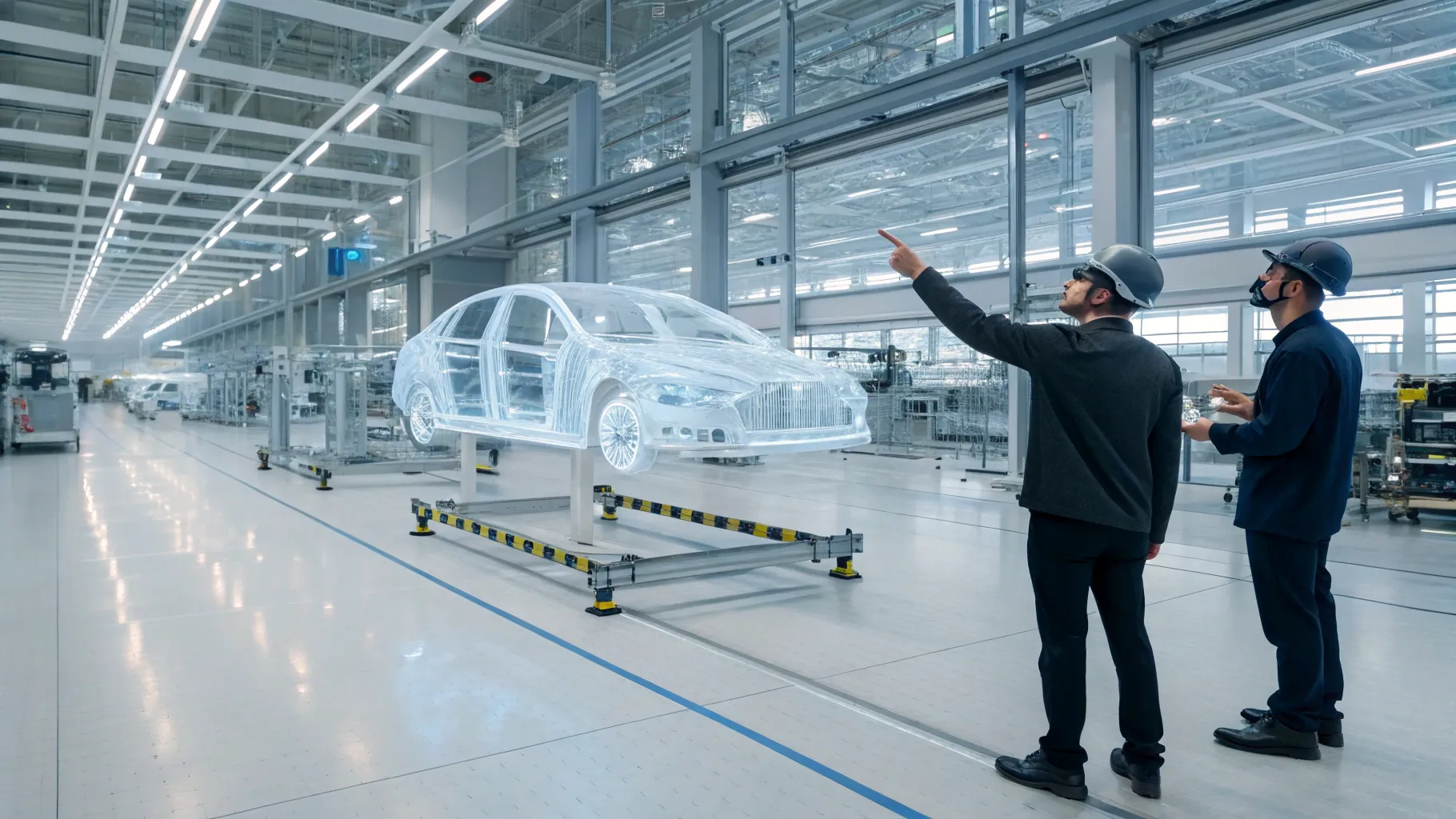
In my NVIDIA presentation at a recent mobility conference, I walked through a rapid, concrete vision for what I call industrial AI — the practical, real-world application of artificial intelligence inside factories, warehouses, and across the entire automotive lifecycle. NVIDIA produced the original talk, and in this article I expand on those ideas, explain the technology stack we use, show how we integrate AI into digital twins and robotics, and share real-world examples from partners like BMW, GM, Kion, Continental, Rockwell Automation, and Foxconn.
I wrote this to make the concept accessible whether you design cars, run a factory, manage a warehouse, build robots, or are just curious about where AI meets the physical world. I’ll explain the why, the how, and the who — and give practical next steps for organizations that want to begin or accelerate their industrial AI journey.
🔧 What I Mean by Industrial AI
When people ask me to define "industrial AI," I tell them it’s bigger than a single definition. If you ask five different people you’ll likely hear five different takes — and they’re all partly right. For me, industrial AI is the convergence of three things:
- Rich, photorealistic digital twins and large-scale simulation that model the physical world in detail;
- Vision and sensor-based AI agents that operate within, observe, and learn from those twins (and from real hardware); and
- Robotics, automation, and AI co-pilots that act on insights from twins and models to automate decision-making and control physical systems.
Put another way: industrial AI is the infusion of AI throughout the physical lifecycle of a product and its factory — from design immersion to production planning, from predictive maintenance to real-time robotic control. The combination of those three pillars yields outcomes that are far greater than the sum of their parts: faster time-to-market, dramatically reduced downtime, better quality control, and the ability to simulate and validate changes before they impact the real world.
“It’s a $10 trillion industry.” That’s the scale I used in the talk to describe the economic importance of industrial AI when you include automotive production, warehousing, logistics, and the full physical supply chain that supports modern mobility.
That number isn’t just hype. Think about the scope: millions of factories, hundreds of thousands of warehouses, tens of thousands of autonomous mobile robots (AMRs) and automated guided vehicles (AGVs) delivering parts in real time, and the global effort to produce roughly 1.5 billion cars and trucks today — and potentially two billion in the future. Industrial AI is the technology layer that will help meet that scale sustainably and safely.
🚗 The Automotive Lifecycle: From Design to Marketing
Industrial AI isn’t confined to the factory floor. In automotive, we see it across the entire lifecycle of a vehicle — design, engineering, manufacturing, validation, marketing, and after-sales. I like to walk people through a few concrete examples to make the idea tangible.
Design collaboration and virtual review
In traditional automotive development, design reviews are costly and slow. Teams collate two weeks of updates, travel to review boards, and iterate slowly. With modern digital twins and real-time rendering technology, that process becomes fluid and collaborative.
I spoke about how teams at major OEMs are already conducting real-time collaborative design reviews on mega-walls — where engineers, designers, and stakeholders can make changes live and see the implications immediately rather than waiting days or weeks. That reduces iteration time and improves decision quality. In short: sim-first, digital-first workflows speed up the creative and engineering loop.
Virtual wind tunnels and physics-infused AI
Traditionally we run computational fluid dynamics (CFD) in batch and then wait for simulation results. Now imagine a digital twin that not only runs CFD but also visually renders the result in real time and allows designers and engineers to tweak geometry or orientation and immediately observe updated aerodynamic flow visualizations.
Physics AI can accelerate and extend traditional CFD by making intelligent approximations, proposing configurations, and refining candidate designs with high fidelity. That reduces the cost and time of physical wind tunnel testing while providing actionable insights early in the design process.
Autonomous vehicle (AV) simulation at scale
When we evaluate AV systems, safety requires massive amounts of simulation. In the talk I mentioned the rough scale of what’s required — on the order of hundreds of millions of simulations to validate a wide range of scenarios and edge cases. That’s why simulation and world models are essential. You can simulate rare events, generate thousands of environmental permutations, and systematically cover combinations of actor behavior, weather, and road conditions in ways that are impossible or impractical to test physically.
“We’ll need a hundred million simulations in scenarios to feel good about the safety of an autonomous vehicle.”
But writing those scenarios by hand is prohibitively slow. That’s where AI-driven scenario generation comes in: I explained how simple natural-language prompts can seed scenario generation — for example, “place one ego vehicle in an urban setting with seven non-ego vehicles driving at 35 km/h and performing an unprotected left turn” — and an AI can create exact simulations and permutations from that prompt. Combined with large-scale compute and a world foundation model, this lets teams create, run, and analyze millions of simulations efficiently.
Marketing, configurators, and immersive experiences
Industrial AI also touches marketing. Imagine a virtual configurator that renders every color and trim combination in photorealistic detail and lets buyers "drive" the car virtually. I referenced the Lucid Gravity launch as an example of what’s possible: you can show a vehicle in a drive scene or in a consumer’s driveway and control environmental conditions in real time.
XR experiences take it further: sit in a virtual vehicle, try different seat materials, view lighting packages, and even experience how an autonomous drive might work before it’s sold. Nissan and others have created similar immersive demos where customers can explore configurations and experiences that used to require physical prototypes and showroom inventory.
🖥️ Digital Twins: From Planning to Operational
Digital twins began as static or planning models — highly useful, but often disconnected from operations. My key point is that we’re seeing a major shift from "planning digital twins" to "operational digital twins." The difference is the infusion of real-time data and AI into the twin so that it not only models what should happen, but also monitors, predicts, and actively optimizes what is happening now.
In a planning twin you might model layouts, simulate throughput, and choose an AMR path. An operational twin, in contrast, runs predictive maintenance models, adjusts parts planning, re-optimizes robot routes in real time, and even retrains robotic policies when a layout change alters navigation or task execution.
For example, if a brownfield change modifies a work cell so that robots need to take a new path, the operational twin can simulate that new path, identify potential collisions or bottlenecks, retrain or adapt the robot's policy, and deploy the updated control software — all before a costly disruption occurs on the physical floor.
Operational digital twins also support command centers and AI co-pilots that surface incidents and context-rich video snippets to human operators. That combination — simulation + real-time telemetry + AI agents — is the future of resilient, high-performing factories and warehouses.
🧩 The Technology Stack I Use at NVIDIA
To build industrial AI systems at scale, you need an integrated stack that covers world modeling, simulation, perception, robotics, and orchestration. At NVIDIA we combine a set of platforms that work together:
- Omniverse — a platform for building photorealistic, collaborative digital twins. Omniverse enables designers and operations teams to create and maintain a synchronized virtual factory or warehouse.
- Cosmos — our world foundation model that generates infinite variations of scenes and actor behaviors for simulation and training. Cosmos helps create the permutations you need to robustly test systems and train perception models.
- Metropolis — the vision AI platform that connects cameras and edge devices for inspection, monitoring, and analytics. Metropolis is the linchpin for bringing camera-based AI into the twin and into operations.
- Isaac — the robotics simulation and development environment for AMRs, AGVs, and manipulators. Isaac allows realistic simulation of robot dynamics, sensors, and control loops.
- Groot — our platform for developing humanoid-like systems and complex robotic behaviors that require high-fidelity simulation and learning.
- Mega — an orchestration layer that ties AI agents, robots, and the digital twin together to inspect behavior, coordinate responses, and monitor system health.
When you stitch these platforms together you get a closed-loop lifecycle for industrial AI: simulate, generate data, train models, validate in simulation, deploy to hardware, monitor in operation, and iterate. This loop lets teams pursue sim-first and digital-first strategies while removing much of the friction that historically slowed adoption.
Vision AI agents and camera-based inspection
I emphasized in the talk that many industrial applications are camera-centric. Metropolis connects hundreds or even thousands of cameras across a facility to provide inspection and monitoring. Those cameras feed vision AI agents that detect defects, monitor human-robot interaction safety, identify bottlenecks, and trigger alerts to a command center.
Those agents are trained with both real and synthetic data — and that’s a crucial part of the stack. To build robust perception systems, you need diverse video data that covers unusual cases and edge conditions. That’s why Cosmos and Omniverse are so important: they let you synthesize rare but critical scenarios at scale.
From prompts to scenarios
Another practical innovation I described is using prompts to generate simulation scenarios. Instead of hand-coding a thousand variants, you can write a natural-language description and have the world model produce the scenario. For AV testing, that might mean generating thousands of environmental variants; for a factory twin, it might mean producing permutations of conveyor speeds, robot trajectories, and human activity patterns.
“Place one ego vehicle in an urban setting with seven non-ego vehicles driving 35 kilometers an hour and doing an unprotected left turn.” That’s an example prompt I described — and the system can take that input and generate a detailed simulation scenario quickly.
🤖 Robots, AMRs, AGVs and Humanoids
One of the most exciting areas of industrial AI is robotics. From small vision-guided arms to mobile robots and humanoids, robotics is the primary actuator for automation. But robotics is also one of the hardest disciplines: complex dynamics, contact-rich manipulation, high variability in parts and tasks, and safety-critical constraints make development difficult.
I highlighted Isaac and Groot as two platforms designed to reduce that friction. Isaac supports everything from AMRs and AGVs to robotic arms; Groot focuses on more complicated humanoid behaviors.
Why simulation? Because many robotic tasks are too expensive or risky to learn directly in a physical factory. Training policies in simulation allows teams to iterate rapidly. When sim-to-real transfer is performed carefully — using photorealistic rendering, randomization, and domain adaptation — the gap can be small enough for policies to bootstrap into the real world and then be refined with a smaller amount of live data.
Some of the hardest tasks are those that involve fine manipulation or human-like dexterity — for example, wiring harness installation or complex part mating. Those tasks require precise perception, end-to-end control, and often force feedback. Humanoid simulation attempts to tackle these challenges by modeling articulated bodies, contact dynamics, and coordinated whole-body control.
When the digital twin includes a simulated humanoid performing complex tasks, you can assess performance, identify failure modes, and even create training curricula that combine reinforcement learning and imitation learning modalities.
🧭 AI Co-pilots and Command Centers
I described an AI co-pilot concept that I think will become ubiquitous in modern factories: a conversational, context-aware assistant that knows what’s going on across operations and can guide engineers and managers through issues.
Imagine asking a co-pilot (in plain language):
- “What is production volume today?”
- “Have we had any hiccups in the line? If so, where?”
- “Show me that instance in the line and take me to it live.”
The operational digital twin feeds the co-pilot with telemetry, synchronized camera feeds, and diagnostic data. The assistant can show the exact frame where an anomaly occurred, overlay predicted root causes from AI models (for example, a failing motor or a misaligned part), and — when integrated with external systems like ServiceNow — can open an incident, assign a technician or a robot to the task, and track remediation progress.
That integration with business workflow systems is important. For example, I mentioned ServiceNow as a partner to illustrate how an IT-style help desk model can be extended to factory incidents. Instead of reporting a laptop problem, the ServiceNow flow could be triggered by a camera-based alert in the line — and an agentic AI could coordinate what needs to happen: dispatch a robot to move a pallet, send a technician to repair a conveyor, or re-route production to a backup station.
That tight coupling between perception, decision-making, and action drastically reduces mean time to detect and resolve — and it provides a continuous learning loop where incidents become labeled data for future model improvements.
📦 Training Data Blueprint and Synthetic Data
Data is the oxygen of industrial AI. But high-quality, labeled video data is scarce, especially for rare but critical events. To address this, I explained the blueprint we’ve built at NVIDIA for solving the data problem. That blueprint is part architecture, part workflow, and part recipe. It’s not a single product; it’s a repeatable methodology teams can apply.
Key steps in the blueprint:
- Discover and retrieve relevant real-world data: Search your corpus for examples that match your target scenarios. Often there’s buried value in datasets you already own.
- Enumerate and define scenario requirements: Define the semantic and physical properties you need — e.g., pedestrians carrying umbrellas, strollers, odd lighting, occlusions — and formalize the edge cases that matter.
- Synthesize infinite variations: Use Cosmos and Omniverse to generate permutations across lighting, camera viewpoints, actor appearances, weather, and physics parameters so models see a wide distribution of training examples.
- Label and augment: Combine synthetic labels with human-in-the-loop corrections as needed, and apply augmentation strategies to improve robustness.
- Train, validate, and iterate: Use GPU-accelerated training and simulated validation to refine models before deploying to edge devices or robots.
- Continual learning in operations: Instrument the deployed systems to collect new examples and feed the loop to improve models over time.
To illustrate the power of the blueprint, I used two concrete examples from the talk:
- AV example: “Show me pedestrians carrying an umbrella crossing a road.” With the blueprint you can find any matching real footage, synthesize additional variations to cover occlusion and lighting, and then train a perception model that handles umbrellas reliably.
- Robotics example: “Show me wiring harness installation by a humanoid.” For a rare, delicate operation like that, synthetic simulation in Omniverse combined with a handful of real demonstrations can enable training that generalizes to new harnesses and installation contexts.
This blueprint addresses the most painful part of industrial AI development: acquiring and preparing the right data at the necessary scale.
🤝 Real-World Examples and Partners
Industrial AI is not hypothetical. I shared examples where these ideas are already in production or advanced pilot stages. Here are the partner stories and what they demonstrate:
BMW, Mercedes, GM (planning digital twins)
These automakers have used digital twin technologies for planning — for layout reviews, design collaboration, and sim-first engineering. The transition now is to extend planning twins into operational twins that link live telemetry and AI.
Kion (warehouse digital twin)
Kion, a major materials-handling company, worked with Accenture and NVIDIA technologies to create a warehouse twin that mirrors real operations. The twin simulates robot routing, avoids human interactions, and lets the team test brownfield changes before making expensive physical changes.
Continental (predictive maintenance)
Continental is applying AI for maintenance planning — pairing sensor and vision data with predictive models to schedule interventions before failure. That reduces downtime and optimizes spare parts logistics.
Rockwell Automation and Foxconn
These companies are exploring how digital twins, AI, and robotics work together at scale. Their involvement demonstrates that both industrial automation vendors and contract manufacturers see industrial AI as central to future competitiveness.
Accenture (system integration) and ServiceNow (workflow)
Accenture is an active systems integrator that brings these platforms into real customer environments, as exemplified by the Kion demo. ServiceNow ties operational incidents into business processes, enabling automated remediation workflows driven by AI alerts.
When you combine platforms, cloud compute, system integrators, and workflow partners, the outcome is an industrial AI lifecycle that is operationally meaningful and economically justified.
🏭 Case Study: Kion Warehouse Demo
To make the vision tangible I showed a short demo in the talk of a Kion warehouse that Accenture helped instrument. Here’s a detailed walkthrough of what that demo demonstrates and why it matters:
- Real-world capture: The demo started with a real video feed of a Kion warehouse. We used those real feeds as the baseline for fidelity.
- Omniverse twin creation: We mapped the captured environment into Omniverse to build a synchronized virtual model of the space.
- Sensing and monitoring: The twin visualized sensor coverage and the status of robots, humans, conveyors, and inventory using a traffic-light metaphor (green for nominal, red for alerts) so operators could quickly locate issues.
- Robot navigation validation: The twin simulated robot motion to ensure AMRs and AGVs follow safe routes and avoid humans in the space. This validation can be done offline before deploying new robot behavior on the physical floor.
- Brownfield testing: The demo’s power lies in testing configuration changes in simulation — validating that a new layout won’t cause deadlocks, collisions, or throughput loss before physically changing the site.
The benefits are immediate: reduced risk, lower commissioning cost, and faster scaling. Instead of trial-and-error on the real floor, teams can iterate in the twin and then use data-driven confidence to deploy changes with minimal disruption.
📈 The Road Ahead: Scale, Safety, and Economic Impact
What does adoption look like at scale? I shared big-picture estimates and hopes that show how significant this shift could be:
- Economic opportunity: Industrial AI could be a multi-trillion-dollar domain as we digitize and optimize manufacturing, logistics, and mobility at scale. The $10 trillion figure captures direct manufacturing and logistics value plus the indirect economic effects of higher uptime and faster innovation cycles.
- Manufacturing scale: Millions of factories and hundreds of thousands of warehouses globally will benefit. Each facility that adopts operational digital twins and AI stands to improve throughput, quality, and resilience.
- Automotive production: With roughly 1.5 billion vehicles produced globally and potential growth beyond 2 billion, AI’s ability to optimize production schedules, parts flow, and quality will become increasingly crucial.
- Simulation needs: Safety-critical systems like AVs may require tens of millions to hundreds of millions of simulated scenarios to reach statistical confidence in rare events — and that scale is achievable only with automated scenario generation and highly parallel compute.
All of this requires compute, but the economics of GPUs, cloud orchestration, and increasingly optimized AI models make it feasible for enterprises to adopt at meaningful scale.
⚠️ Challenges and How We Solve Them
No technology roadmap is complete without candid discussion of the challenges. Industrial AI is powerful, but the path is non-trivial. Here are the key obstacles and how we address them:
Data quality and scarcity
High-quality, labeled video data for rare events is scarce. To solve that, we combine three strategies:
- Mine existing corpora and instruments to uncover usable real data;
- Synthesize diverse, photorealistic data with Omniverse and Cosmos to augment edge cases;
- Use human-in-the-loop labeling where synthetic data falls short to correct or refine models.
Sim-to-real gap
Simulation fidelity and domain randomization are essential to reduce the sim-to-real gap. We use physics-accurate rendering, sensor modeling, randomized textures and lighting, and ensemble training techniques so models trained in simulation generalize better to reality.
Integration and orchestration
Operationalizing a twin requires stitching together perception stacks, robot controllers, workflow systems, cloud services, and enterprise IT. That’s why partners and system integrators are crucial. We focus on open standards and APIs so partners like Accenture, Rockwell, and Foxconn can integrate tailored solutions for customers.
Safety and validation
For safety-critical systems, the validation bar is high. We address this with massive scenario generation, formal verification of control logic where possible, and staged rollouts: first in simulation, then in controlled physical environments, then in monitored production.
People and change management
Digitizing a factory or warehouse requires organizational change. I stressed that technology alone isn’t enough — you need a transformation plan that includes workforce training, new roles for AI co-pilots, and clear operational KPIs to measure success.
🛠️ Practical Steps for Companies That Want to Start
If you’re wondering how to get started, here’s a practical, step-by-step roadmap I recommend based on projects I’ve worked on and seen succeed:
- Choose a high-value pilot: Identify a use case with measurable ROI — for example, predictive maintenance on a critical line, AOI for a quality-critical operation, or a brownfield layout change that risks downtime.
- Build a digital twin of the pilot area: Start with Omniverse to create a faithful digital replica of the area you want to optimize. Prioritize fidelity for sensors and interactions relevant to your use case.
- Instrument the real space: Add cameras and sensors that mirror the digital twin’s sensing model. Connect them to Metropolis for real-time streaming and analytics.
- Apply the blueprint for data: Search existing footage for relevant examples, synthesize variations with Cosmos, and assemble labeled datasets to train perception and predictive models.
- Simulate, train, and validate: Use Isaac and Groot to train robotic policies or validate workflow changes in simulation. Iterate until metrics meet your acceptance criteria.
- Deploy with a co-pilot and workflows: Integrate the twin and AI models with a command center, connect to workflow systems like ServiceNow, and define escalation and remediation actions.
- Measure and scale: Track KPIs like downtime reduction, throughput improvement, defect rate, and mean time to repair. Scale successful pilots to other lines or facilities.
This approach lets teams demonstrate measurable business value early while building the capabilities and confidence to scale industrial AI across their operations.
🔭 Conclusion: Why Now and How I See the Future
Industrial AI is not an abstract vision — it’s happening now. The technologies and partnerships exist to accelerate adoption. In the presentation, I wanted to communicate a few central convictions:
- Industrial AI offers a step change in productivity and resilience for manufacturing and logistics. When done right, it reduces costly downtime, improves quality, and speeds innovation.
- Digital twins are evolving from static planning tools into operational systems that run alongside the real world. The infusion of perception, predictive models, and robotic control creates closed-loop systems that learn and improve continuously.
- Data and simulation are central. Synthetic data generation via photorealistic twins, combined with curated real-world examples, solves the long-standing data bottleneck in perception and robotics.
- Collaboration across partners — OEMs, integrators, platform providers, and workflow vendors — is necessary to operationalize industrial AI at scale.
I came away from the conference energized by the speed at which industrial AI is being adopted. When we stitch together Omniverse, Cosmos, Metropolis, Isaac, Groot, and partner workflows, we get an industrial AI stack that solves real problems now and scales to deliver massive economic impact in the years ahead.
If you’re running a facility, building robots, or engineering mobility systems, my invitation is straightforward: pick a pilot where simulation can materially reduce risk and cost, instrument it, and let the twin and an AI co-pilot show you where the most impactful changes are. The tools are ready. The partners are ready. The opportunity — in my opinion — is urgent and immense.
Thank you for reading. If you’d like to explore this further, reach out through the NVIDIA channels or your systems integrator — many of the demos and partner projects I described are ready to be tailored to your operations.


