Introduction 📰
In my presentation for NVIDIA—titled "Generative and Agentic AI: Driving the Future of Automotive Innovation"—I laid out how generative AI and agentic systems are reshaping the auto industry. As the head of Gen AI for automotive at NVIDIA, I’m on the front lines of helping automakers and suppliers transform design, manufacturing, customer service, and in-cabin experiences. In this report-style article, I summarize the key themes I presented, expand on the technical and business implications, and share specific examples and partner work that illustrate how this transformation is already underway.
This is a fast-moving space. From enterprise deployments to embedded in-vehicle agents, companies are experimenting with models, pipelines, and architectures that touch almost every part of the automotive lifecycle. I’ll explain how NVIDIA’s approach—what we call the AI factory—bridges compute, software, and tools to accelerate that journey, and I’ll walk you through real use cases, technical architecture, partner integrations, and practical steps organizations should consider when adopting generative and agentic AI.
The context: Why automotive needs generative and agentic AI 🚗
The global auto industry faces intense competitive pressure. New entrants iterate quickly, and consumer expectations for personalization and connected experiences are rising. At the same time, product complexity has exploded. In my conversations with OEMs, it's common to hear that a complete vehicle program can involve hundreds of thousands—or in some large cases, over a million—individual requirements and traceability points. Managing that complexity without blowing timelines or budgets is the core challenge.
Yet adoption is still early. One stat I shared at the event: only about 1% of organizations have mature AI deployments. That means most companies are just beginning their journey. My role—and NVIDIA’s broader mission—is to help organizations cross that chasm with a repeatable, optimized approach that reduces total cost of ownership (TCO) and gets to production faster.
What I mean by "agent" and "agentic AI" 🤖
Language around “agents” is often used loosely. I want to be clear: an agent is more than a chatbot. An agent is a system that plans, reasons, acts, and learns. It combines multimodal perception (text, speech, vision), stateful memory, contextual reasoning, and the ability to take actions—either autonomously or by augmenting human operators. Agentic AI is thus a leap beyond single-turn assistive models; it’s a capability set that supports complex workflows end-to-end.
When you envision agents in automotive, imagine assistants that:
- Understand driver intent across speech and gesture.
- Reason over vehicle state and maintenance history to predict failures.
- Coordinate across backend services (repair shops, logistics) to resolve real-world problems.
- Act as persistent companions that remember user preferences and contexts across trips.
These are not hypothetical features; they are where automakers and suppliers are investing right now. The frontier is how to design agents that are safe, privacy-preserving, and tightly integrated with existing production flows.
How NVIDIA approaches the transformation: The AI factory 🏭
To industrialize AI in automotive, you need an end-to-end approach. I describe NVIDIA's answer as the AI factory: a combination of cloud and on-prem compute, a software platform that accelerates data curation, model training, fine-tuning and inference, and tools to operationalize the lifecycle of agents. The AI factory covers:
- Data acquisition, labeling, and curation pipelines.
- Model training and fine-tuning frameworks (including NeMo for language and multimodal models).
- RAG (retrieval-augmented generation) pipelines to ground models in verified data like repair manuals, CAD files, and regulations.
- Deployment tooling to optimize models for CPUs/GPUs and for embedded SOCs or centralized vehicle computers.
- Monitoring, safety checks, and governance to enforce guardrails and compliance.
NVIDIA provides both the cloud and the edge components—data center GPUs and embedded SOCs—so the migration from an AI-trained model in the cloud to an inference model in the car is seamless. That cross-environment consistency is a crucial practical advantage. It’s enabled by software stacks such as CUDA and NeMo that run across those domains with optimizations for each target.
Enterprise use cases: Business workflows reimagined 🧩
Enterprise change is foundational. If automakers don’t transform internal engineering and operations, in-vehicle features won’t scale or be safe. I described a broad set of enterprise use cases that benefit immediately from generative and agentic AI:
- Design and engineering acceleration (V-model augmentation).
- Connected vehicle data analytics for fleet insights.
- Supply chain optimization and demand forecasting.
- Customer service and contact center automation.
- Factory-floor agentic systems for rapid diagnostics and repair.
Two examples are especially instructive: V-model design augmentation and factory-floor agents integrated with ServiceNow. I’ll dig into those two to make the impact concrete.
V-model augmentation: Agents in design and validation 🔧
The V-model remains the dominant framework for automotive development: the left side is requirements and design, the middle is implementation, and the right side is testing and validation. Managing requirements at scale is a perennial bottleneck. Requirements must be precise, traceable, and testable—and for modern vehicles that include software stacks, sensors, and AI components, the number of requirements can balloon.
Agents can help by:
- Parsing natural language requirements and mapping them to structured test cases.
- Auto-suggesting missing requirements based on prior projects and regulatory norms.
- Proactively identifying conflicts or duplicate requirements.
- Generating test scenarios and synthetic datasets to validate behavior across edge cases.
When we introduce the right agents into the V-model workflow, we accelerate cycles and reduce rework. In practical terms, I’ve seen companies cut hours from engineer review cycles to minutes for certain tasks, which compounds into months saved across program timelines. That speed is essential to stay competitive—especially against nimble OEMs and startups with aggressive iteration cycles.
Factory floor: Monitoring, diagnostics, and safety with ServiceNow integration 🛠️
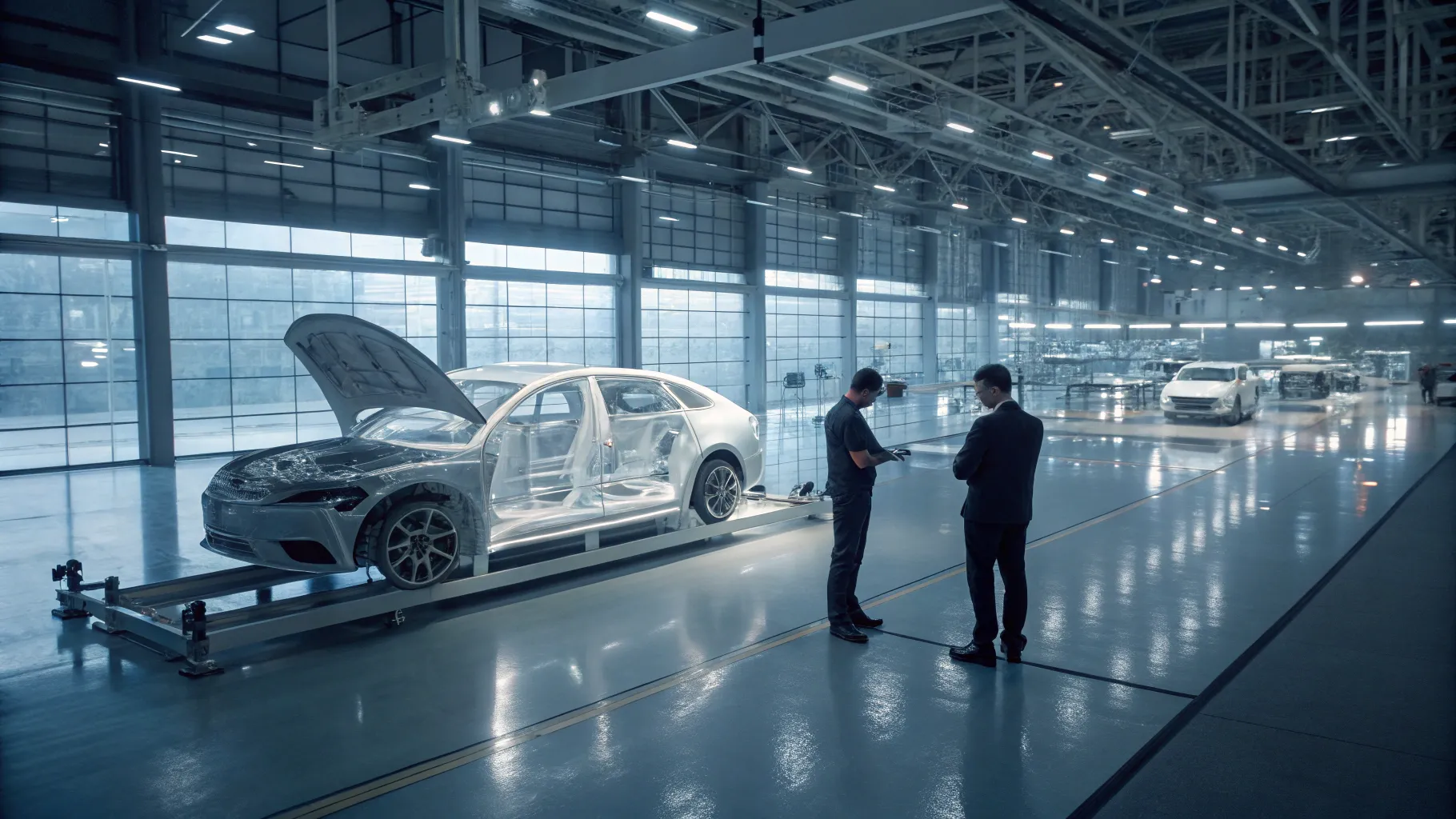
Manufacturing downtime is expensive. Every minute a production line is down can cost hundreds of thousands of dollars depending on scale. A typical scenario involves a technician receiving an alert, running through manual diagnostics, and waiting for remote support—sometimes losing hours of production time.
Agentic systems change that. Consider a three-agent pattern we’ve deployed with partners like ServiceNow:
- Monitoring AI agent: continuously processes telemetry and vision feeds to detect anomalies and localize the issue.
- Diagnostic AI agent: uses a RAG pipeline to fetch relevant repair manuals, historical logs, and troubleshooting guides, then recommends steps and highlights safety considerations to technicians.
- Procedural & Safety AI agent: ensures that diagnostics and proposed fixes adhere to safety policies and standardized procedures before any action is taken.
The combination shortens the detection-to-resolution cycle from hours to minutes in many cases. For manufacturing, that means dramatic cost savings and improved throughput. In addition, the diagnostic agent acts as an on-the-job assistant, helping less experienced technicians resolve complex issues by surfacing expert knowledge exactly when it’s needed.
In-vehicle experiences: Personalization, safety, and companion AI 🎧
In-cabin AI experiences are arguably the most visible way consumers will see agentic systems. Automakers are investing heavily in personalization, multimodal interfaces, and companion modes that go beyond navigation and voice commands. China has been particularly aggressive in bringing these features to market, but global OEMs are quickly following.
Key in-vehicle trends include:
- Multimodal assistants that combine ASR (automatic speech recognition), TTS (text-to-speech), and vision-based context to create a fluid, natural interaction model.
- Persistent memory and personalization so the vehicle remembers user preferences, routes, calendar events, and even conversational context across sessions.
- Sentry modes and safety monitoring that interpret sensor data and alert owners or law enforcement when necessary.
- Integration of self-driving capabilities with comfort and productivity features—what I called “home on wheels.”
These agents must be designed with safety-first principles. Some tasks can and should be handled locally on the vehicle (private, latency-sensitive functions), while others can leverage cloud compute for global knowledge and coordination with services like repair shops or calendars.
Predictive maintenance and roadside assistance: A hybrid agent example 🛣️
Let me give you a concrete hybrid-agent use case: predictive maintenance combined with automated roadside assistance. Imagine the following flow:
- Sensors and telematics detect abnormal tire pressure or vibration indicative of an impending flat.
- A local in-vehicle agent uses ASR and TTS to confirm the driver’s status and gather contextual data (Are you in a safe spot? Do you need immediate assistance?).
- An orchestrator decides whether to run locally (to preserve privacy and reduce latency) or to escalate to the cloud for richer decision-making.
- If cloud escalation is appropriate, the system contacts nearby repair shops, checks the driver’s calendar, manages a roadside assistance dispatch, and arranges payment/insurance if needed.
That hybrid architecture—agents both on the car and in the cloud—lets us balance privacy, cost, latency, and functionality. A purely cloud-based approach can be slow and privacy invasive; a fully embedded approach can lack the broad context needed to coordinate with external services. Hybrid agents give the best of both worlds.
Architectural blueprint: From AI factory to embedded SOCs 🧠
Turning these use cases into production requires a thoughtful architectural blueprint. In my discussion I emphasized two distinct but tightly coupled layers:
- AI factory (cloud/on-prem): where data is gathered, curated, models are trained and fine-tuned, and enterprise-scale agents are managed.
- Embedded compute (in-vehicle SOCs): where runtime agents execute inference, handle ASR/TTS pipelines, and manage low-latency perception tasks.
NVIDIA supplies both layers. Our data-center GPUs and software provide the heavy lifting for model development and lifecycle management, while our embedded SOCs and automotive-grade platforms deliver runtime performance and safety compliance in the vehicle. A key enabler is our software coherence across both domains—CUDA provides the performance foundation and NeMo and other stacks provide model tooling that runs consistently across cloud and edge.
When designing architecture, there are several patterns I recommend:
- Define a clear orchestration boundary: decide which functions must be local and which can be cloud-assisted.
- Use RAG pipelines to ground generative outputs in authoritative sources (repair manuals, safety bulletins, regulatory texts).
- Implement persistent memory modules for personalization while keeping privacy controls and opt-in mechanisms transparent.
- Build monitoring and observability from day one to capture drift, failures, and safety violations.
Why CUDA and platform consistency matter 🔁
One strategic advantage NVIDIA offers is platform consistency. CUDA has become a de facto standard for GPU acceleration. When models are trained using CUDA-optimized frameworks in the data center, we can more easily optimize those models for embedded inference on automotive SOCs. That reduces porting friction, minimizes rework, and accelerates time-to-market.
This continuity matters because automotive programs are long and safety-critical. Being able to iterate models and bring them to the car with predictable performance and validation characteristics is a competitive advantage.
The software stack: NeMo, RAG, and multimodal tooling 🧩
Under the hood of agentic systems are many software components. I highlighted a few during the talk that are particularly relevant:
- NeMo: NVIDIA’s toolkit for building, fine-tuning, and deploying conversational and multimodal models. It supports speech, language, and vision model development and is designed for large-scale, production-grade workflows.
- RAG (Retrieval-Augmented Generation): a design pattern that grounds generative models in retrieved documents so outputs can be accurate, auditable, and traceable. RAG is especially useful when agents must consult manuals, regulations, or enterprise documents.
- ASR and TTS stacks: for building responsive, natural voice interfaces that can operate both locally and in the cloud.
- Model optimization and compilation: tools that reduce model size and latency for embedded deployment without compromising safety or critical accuracy.
Together, these components make it practical to build agentic experiences that are both delightful and trustworthy.
Partner ecosystem and real-world examples 🤝
Technology alone isn’t enough. Success depends on the partner ecosystem and practical implementations. I shared a few partner examples to illustrate how these solutions are being deployed today.
ServiceNow and factory automation 🏭
On the manufacturing side, ServiceNow is an example of a partner that integrates enterprise workflows with agentic AI. By connecting monitoring agents, diagnostic RAG agents, and safety agents into ServiceNow workflows, manufacturers can automatically ticket, triage, and resolve issues faster. The result is reduced downtime and improved operational throughput.
Thundersoft and in-vehicle experiences 🚘
For in-vehicle solutions, we work closely with partners like Thundersoft, who build end-to-end systems on top of NVIDIA’s platform. Thundersoft demonstrates how multimodal agents—capable of recognizing speech, remembering contextual memories, and performing tasks like parking assistance and sentry mode—can be integrated into a daily timeline from morning to night. They show how a single platform supports many features across the user’s day.
Ford: design, contact center, and repair manual RAG 🔧
Ford is a public example of how an OEM is deploying AI across enterprise and in-vehicle spaces. They use agentic techniques for:
- Accelerating design and shortening engineering cycle times.
- Powering contact center agents to improve customer support efficiency.
- Using RAG over repair manuals to assist technicians or in-vehicle agents with precise, documented instructions.
"Ford engineers make products as good as anyone in the world. However, it's necessary to speed up to be competitive."
That quote underscores the urgency: speed and quality must coexist. Generative and agentic AI are tools to achieve that balance.
Model selection, governance, and the “which model?” question 🧭
One of the practical challenges I hear from automotive leaders is confusion about models and platforms. There are many choices—OpenAI or other foundation models like Llama, Mistral, Claude, DeepSeq, Nova—and decisions about whether to use an off-the-shelf model, fine-tune, or train from scratch. My advice is pragmatic:
- Start with the problem. Model selection should be driven by use-case requirements (safety, latency, domain knowledge, privacy).
- Use RAG and grounding to reduce hallucinations and to ensure auditable outputs for safety-critical tasks.
- Consider hybrid deployment: small, efficient models on-device for private, latency-sensitive tasks; larger models in the cloud for knowledge-intensive reasoning.
- Invest early in governance: versioned datasets, traceability, access controls, and a framework to audit model outputs and decisions.
Different vendors offer different trade-offs. Part of our role at NVIDIA is to provide the tools so customers can experiment with multiple models and converge on what works best for them while minimizing infrastructure complexity.
Safety, privacy, and regulatory considerations 🛡️
In automotive, safety is non-negotiable. Any agent that advises on driving behavior, intervenes, or affects safety-critical systems must be validated to the highest levels. That requires:
- Rigorous testing: scenario-based testing, edge-case exploration, and closed-loop simulations integrated into the V-model workflow.
- Grounded outputs: using RAG to ensure advice and directions reference validated documentation and policy.
- Clear operational boundaries: disallowing or restricting agent actions that could compromise safety without human approval.
- Privacy-by-design: keeping sensitive processing local where appropriate and giving users clear controls over what is stored and for how long.
We also recommend continuous monitoring of deployed agents for drift and unintended consequences. Human-in-the-loop frameworks and escalation policies are needed so that when an agent is uncertain, it hands off to a human operator with recommended next steps rather than taking risky autonomous actions.
Deployment playbook: How to get started with agentic AI in automotive 🚀
Based on our work with OEMs, Tier 1s, and suppliers, I recommend a staged approach comprised of these phases:
- Discovery & prioritization: identify high-value, low-risk use cases where agents can deliver measurable ROI (e.g., contact center automation, diagnostic assistance on the factory floor).
- Proof of value (PoV): build small pilots with clear success metrics and RAG-grounding to validate accuracy and safety assumptions.
- Platformization: standardize on an AI factory stack—compute, model tooling, CI/CD for ML, and deployment tooling—so pilots can scale.
- Integration & productionization: integrate agent outputs into enterprise systems and vehicle software while adding monitoring, logging, and governance.
- Scale & optimize: iterate on models, optimize for embedded deployment, and expand the agent footprint across functions.
Throughout, you should involve cross-functional teams—engineering, safety, legal, data privacy, and product—to align technical decisions with business and compliance goals.
Measuring impact: ROI, KPIs, and business outcomes 📈
Adoption will be driven by tangible business outcomes. Here are typical KPIs we track with customers:
- Time-to-resolution: reduction in mean time to detect and resolve manufacturing or maintenance incidents.
- Engineering cycle time: reduction in design and validation timelines through automated requirements mapping and test generation.
- Contact center metrics: handle time, first-call resolution, and customer satisfaction when AI assists agents or automates interactions.
- In-vehicle engagement: user retention and usage metrics for personalized, companion features.
- Operational uptime: manufacturing throughput and reduction of costly downtime.
As a simple example, shortening a production line interruption from hours to minutes can translate into hundreds of thousands of dollars saved per minute depending on the plant. For design, compressing a months-long validation cycle by even a few percentage points can mean millions in program cost savings and faster time-to-market.
Organizational considerations: Agents as first-class citizens 🧑💼
Jensen Huang, NVIDIA’s CEO, put it bluntly and presciently: the IT department of every company will become like the HR department, but for agents. By that I mean that organizations will need to think about agents as resources to be provisioned, governed, and maintained. This introduces new operational disciplines:
- Agent inventory and lifecycle management: knowing which agents exist, their capabilities, and their trust levels.
- Access control: who can deploy, update, or decommission an agent?
- Audit and compliance: traceable logs of agent decisions, inputs, and outputs for regulatory and safety verification.
- Continual training and validation: pipelines to retrain agents as data drifts or new product features emerge.
Practically, that means creating new roles and governance boards to oversee agent behavior—roles that blend software, ML, legal, and safety expertise.
Challenges and open questions 🔍
There are challenges ahead. Some of the most common I see in my work include:
- Data quality and labeling: automotive datasets are often siloed, noisy, or lack coverage for rare events that matter for safety.
- Hallucinations and trust: large models can generate plausible-sounding but incorrect answers; RAG and verification steps are essential mitigations.
- Cost and infrastructure: training and running models at scale can be expensive without the right acceleration and optimization tools.
- Skill and organizational readiness: teams need expertise across ML, embedded systems, and safety engineering.
- Regulatory uncertainty: rules for in-vehicle AI behavior are still evolving in many regions.
None of these are insurmountable. The path forward is iterative: start small, measure, learn, and scale with the right technologies and partners.
Best practices: Design principles for agentic AI in automotive 🧭
Over the course of many projects, I’ve distilled a set of design principles I recommend for organizations building agentic systems:
- Start with safety: every agent must be designed with conservative fallbacks and clear escalation channels to humans.
- Ground outputs: use RAG and authoritative datasets to ensure traceability.
- Privacy by default: keep sensitive processing local and make data retention transparent and user-controlled.
- Iterate in the open: pilot in controlled environments and publish learnings across teams to accelerate adoption.
- Measure what matters: choose KPIs tied to business and safety outcomes, not just model accuracy.
- Platformize early: invest in repeatable tooling for data, training, deployment, and monitoring to enable scale.
Looking ahead: Where agentic AI will take automotive next 🌅
Agentic AI is not just a set of flashy in-car features. It’s a foundational capability that will touch how vehicles are designed, built, sold, serviced, and experienced over their lifetimes. Here are a few trajectories I expect to accelerate in the next few years:
- Seamless cloud-edge orchestration: hybrid agents that know what to run locally and what to escalate to global knowledge services.
- Agent marketplaces: curated agents that can be deployed by OEMs or third parties with clear certifications for safety and functionality.
- Personalized mobility-as-a-service: vehicles that adapt interiors, routing preferences, and service interactions to individual users and contexts.
- Full V-model automation: design, validation, and compliance tasks increasingly automated by agents that can reason over requirements and test results.
Each of these will require careful attention to governance, verification, and interoperability standards—but the potential benefits for safety, efficiency, and customer experience are enormous.
Final thoughts and an invitation to collaborate 🤝
Enabling enterprise and in-vehicle agentic use cases is complex. There are many moving parts—models, data, compute, governance, and integration with legacy systems. That complexity is precisely why a strong platform and ecosystem matter. At NVIDIA, our value proposition is accelerated computing across the stack—data center GPUs, embedded SOCs, NeMo and other model toolkits, and partner integrations that help customers deliver production-grade solutions.
"The IT department of every company is going to become like the HR department, but for agents."
That observation highlights the cultural and organizational shifts coming. If you’re an OEM, Tier 1, or supplier, my recommendation is to begin the transformation now: prioritize high-impact use cases, partner with an ecosystem that gives you continuity from cloud to car, and adopt a staged approach that prioritizes safety and measurable ROI.
If you want to talk more, I’m always available to discuss how to turn your ambitions into a practical roadmap. We work with partners like ServiceNow, Thundersoft, and direct OEMs such as Ford to bring these ideas into production—and these partnerships show real-world results: hours cut to seconds, faster design cycles, and better, safer in-car experiences.
Thank you for reading. If you’d like a deeper dive into any of the technical components—NeMo pipelines, RAG design patterns, embedded SOC optimization, or architectural templates for hybrid agents—I’m happy to follow up with more detailed technical notes, case studies, or workshops.


