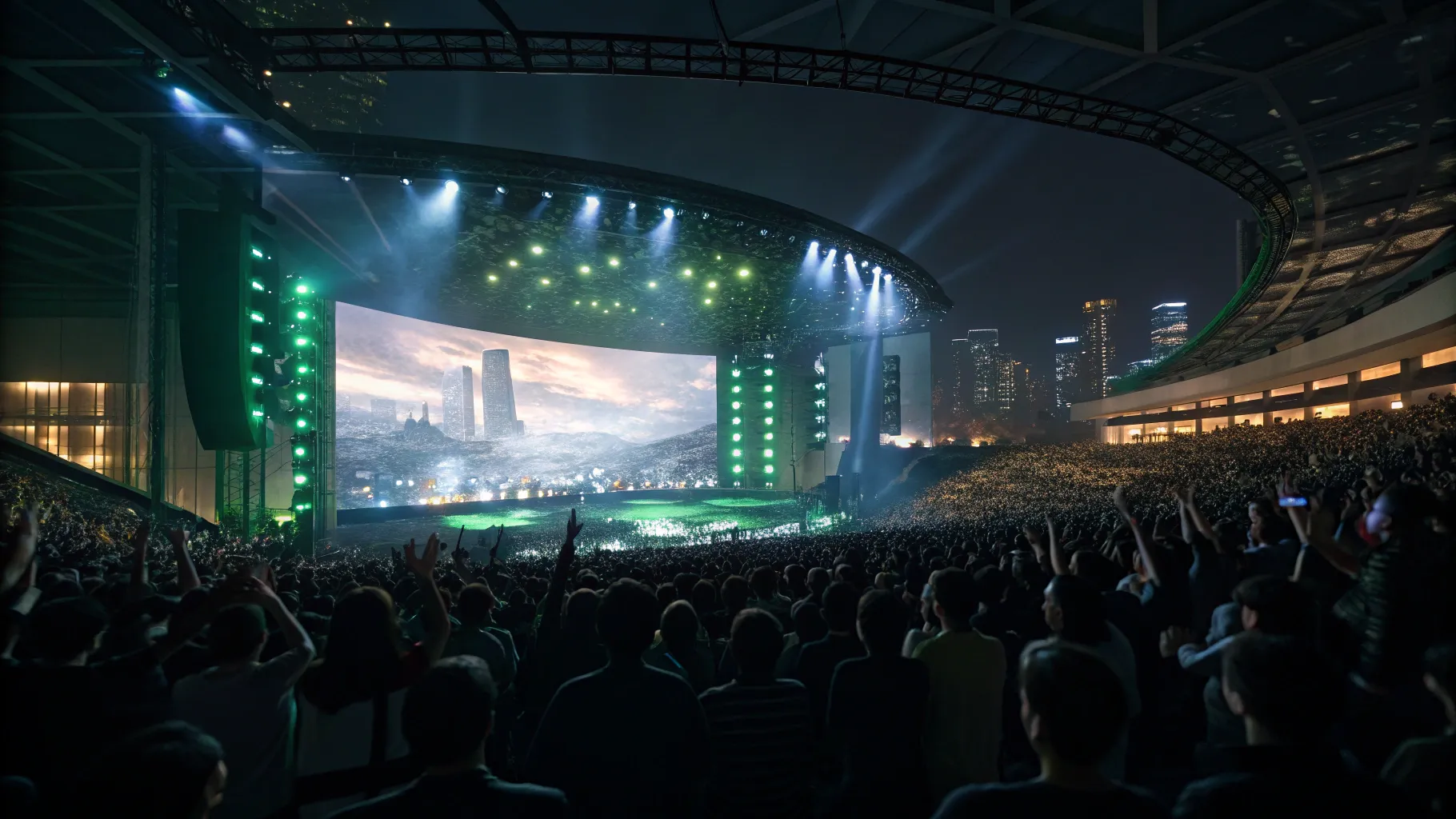
🎮 Event Overview: What I Saw at GeForce Gamer Festival Seoul
I was at the GeForce Gamer Festival in Seoul, and the energy was electric from the moment the doors opened. Fans, developers, esports pros, and hardware enthusiasts packed the venue to celebrate a major milestone: 25 years of GeForce in Korea. The event was a showcase of community passion, technical innovation, live competition, and cultural celebration, and it tied together the long relationship between the GeForce brand and Korean gaming culture.
The event combined multiple elements that together felt like a living retrospective and a forward-looking product launch. There were new RTX announcements from major Korean developers, epic StarCraft battles that reminded everyone why esports is so deeply rooted in Korea, giveaways, live musical performances, and a high-profile appearance by Jensen Huang, who captured a big moment on stage when he said one of the phrases I'll never forget:
"GeForce and Korea grew up together."
That line summed up the evening. It was a celebration of history, yes, but also a statement that the relationship between hardware, software, and community is still evolving. In this report I want to bring you a full rundown of what happened, why it matters, and what the announcements mean for players, developers, and the broader gaming ecosystem.
🗓️ The Who, What, When, and Where of the Festival
The GeForce Gamer Festival took place in Seoul, drawing a diverse crowd that included casual gamers, PC enthusiasts, pro players, content creators, and industry representatives. The festival format blended traditional expo booths and tech demos with live entertainment and competitive gaming. The result was a hybrid of trade show excitement and concert-level spectacle.
I saw attendees lined up early for demos, crowding around booths featuring the latest RTX-powered experiences. Developers from Korea's major studios—most notably NCSOFT and KRAFTON—used the stage to present their upcoming RTX integrations and to show how NVIDIA's technologies will change the look and feel of their upcoming titles. The show wasn't just about new graphics modes; it was about the whole experience: performance, responsiveness, AI-assisted features, and competitive fairness.
Throughout the day there were scheduled moments that punctuated the program: the keynote-style segments, esports segments featuring StarCraft matches, developer panels where engineers and artists explained their approaches, and closing performances. Giveaways peppered the event, giving attendees a chance to walk away with hardware, swag, and exclusive in-game items. It was the type of festival that made the combination of technology and culture feel inevitable and celebratory.
🚀 Major Announcements: NCSOFT and KRAFTON Bring RTX to Their Games
One of the central headlines of the festival was the announcements from NCSOFT and KRAFTON regarding their adoption of RTX features in upcoming titles. Both companies are household names within and beyond Korea, and their decisions to embrace NVIDIA's RTX technology will reverberate through the gaming ecosystem.
What the announcements covered
- Planned support for hardware-accelerated ray tracing to improve lighting, reflections, and shadows in major game releases.
- Implementation of AI upscaling technologies like DLSS to boost frame rates without sacrificing visual fidelity.
- Integration of game-specific optimizations to leverage NVIDIA Reflex and reduce system latency for competitive play.
- Commitments to ongoing collaboration with NVIDIA for tools and SDKs that help accelerate production workflows and runtime performance.
From what I observed and from the developer presentations, the emphasis was less on a single flashy effect and more on a sustained improvement in how games look, feel, and run on modern hardware. Developers highlighted that RTX is not merely a checkbox for "better graphics." It is a platform for enabling new artistic choices and delivering technical parity between cinematic visuals and competitive performance.
Why this matters for players and developers
When major studios like NCSOFT and KRAFTON commit to RTX features, several positive things happen simultaneously:
- Players get access to better visuals and smoother performance, especially on hardware that supports DLSS and hardware-accelerated ray tracing.
- Developers gain access to optimized toolchains that reduce iteration time and enable higher-fidelity assets to be used in real-time.
- The industry benefits from wider adoption, which encourages middleware and engine-level support that trickles down to indie and mid-size studios.
At the festival I spoke with several attendees who were excited not just by the idea of prettier graphics, but by the prospect of artists being able to realize visions that used to be restricted to offline rendering. That change alone could influence storytelling, level design, and game mechanics.
⚔️ Esports Highlight: Epic StarCraft Battles and Team Wars
StarCraft remains one of the most culturally significant esports in Korea, and the festival leaned into that history with a series of showcased matches that brought both old legends and new contenders into the spotlight. The matches were high-energy, tactical, and brutally entertaining.
The format emphasized team-based competition, often branded as Team Wars, which allowed players to strategize across map variety and match-ups rather than single-player duels. Team dynamics introduced a layer of complexity and narrative that kept the audience at the edge of their seats.
Why StarCraft still matters in Korea
StarCraft is foundational to Korean esports culture. It is not just a game; it was one of the original engines that propelled competitive gaming, broadcasting, and fandom into mainstream media. When you attend an event and see hundreds or thousands of fans reacting to a drop, a micro-management sequence, or a clever multi-pronged attack, you feel history repeating itself in a wonderful way.
I watched matches where veteran players displayed micro and macro skills honed over decades, while younger competitors brought in modern meta choices and audacious strategies. The interplay between old-school discipline and contemporary innovation created seven or eight moments of pure competitive drama, each punctuated by roaring approval from the crowd.
What the matches revealed about player skill and hardware
High-level StarCraft demands responsive controls, minimal input latency, and crisp frame rates. The festival showcased NVIDIA technologies designed for competitive gaming—such as system latency optimizations and upscaling solutions that preserve decision-making clarity even as frame rates improve.
One clear takeaway from the matches was that graphical sophistication does not have to be at odds with competitive fairness. With the right features enabled, players can enjoy enhanced visual clarity while also benefitting from reduced latency and stable performance. This is particularly important as developers add visual enhancements; maintaining a level competitive field remains critical.
🎤 Jensen Huang's Appearance: A Moment of Connection
Jensen Huang's appearance was a highlight for many in the crowd. His remarks were succinct, confident, and connected directly to the emotional arc of the evening. One line, in particular, resonated throughout the venue:
"GeForce and Korea grew up together."
That statement was more than nostalgia. It acknowledged the mutual development between a hardware brand and a gaming culture that has insisted on pushing boundaries. To me, it was a reminder that technology adoption and cultural drives are interdependent. Korean gaming culture pushed manufacturers to deliver higher performance and fidelity; in turn, those hardware improvements enabled developers to create richer experiences that deepened fans' engagement.
His presence also provided a platform for the announcements and reinforced the collaboration narrative. When an industry leader shows up at an event like this, it signals that partnerships are strategic and committed to the long haul. I left the session feeling like the technical roadmap has real momentum behind it and that the commitments made on stage will be supported by continued resources and collaboration.
🎁 Giveaways, Swag, and Community Perks
The festival was generous with giveaways and community engagement. From limited-edition merchandise to hardware raffles and in-game item codes, there were plenty of ways attendees could walk away with tangible souvenirs. The giveaways helped cement the festival as a community-first event rather than a strictly corporate showcase.
Giveaways serve more than one purpose. They are a mechanism for appreciation, sure, but they also help foster word-of-mouth, social media buzz, and goodwill. Walking through the crowd I saw people trading codes, comparing swag, and posing for photos. The tactile nature of a prize—whether a special keycap, a collectible figurine, or a GPU accessory—created micro-moments of joy that balanced the more technical segments of the festival.
How giveaways contribute to the ecosystem
- Strengthen brand affinity: Small gifts can translate into long-term loyalty.
- Encourage experimentation: Game keys and hardware trial opportunities invite players to try new features like DLSS and ray tracing on their own systems.
- Support creators: Swag and exclusive items often become content for streamers and influencers, extending event reach.
I spoke briefly with a streamer who told me how a giveaway had helped them generate content and connect more deeply with their community. For creators, festivals like this are not only about content generation; they are about shared experiences that form the basis of communities and narratives fed to audiences online.
🎶 Live Performances and Cultural Moments
The festival blended tech and pop culture seamlessly. Live music and performances punctuated the day, keeping the vibe celebratory and dynamic. Artists performed tracks that mixed electronic beats with game-inspired motifs, and their sets drew crowds that included both gamers and music fans.
This cultural angle is important. Gaming events are increasingly multimedia experiences. Music, visual art, cosplay, and performance bring new audiences and enrich the emotional texture of an event. I noticed people who might have been there primarily for the performances also stayed for developer panels or hardware demos, creating cross-pollination among different interest groups.
From a strategic perspective, the inclusion of live entertainment is not just decoration. It expands the event’s reach and creates moments that are widely shared on social platforms, extending the festival's impact far beyond the venue.
📚 Historical Context: 25 Years of GeForce in Korea
Reflecting on the 25-year milestone, it is clear that GeForce has been a constant presence during several defining eras of PC gaming in Korea: the rise of PC bangs, the golden age of broadcasted esports, and the transition to modern engines and high-fidelity graphics. When I consider the ways in which the hardware and gaming communities have co-evolved, several themes stand out.
The role of PC bangs
PC bangs—Korea's ubiquitous internet cafes—played a critical role in democratising access to high-performance gaming. They enabled many players to experience powerful GPUs, often before they could afford them at home. That ecosystem created a base of tech-savvy players accustomed to competitive environments, fast networking, and frequent upgrades. The festival celebrated that lineage, highlighting how access points and community spaces have shaped expectations for performance and interoperability.
The esports revolution
Korea's embrace of esports helped define modern competitive play. The expectations of broadcast-ready games, responsive netcode, and spectator-friendly interfaces forced hardware and software companies to prioritize smooth performance and reproducible experiences. GeForce technologies evolved alongside those expectations and helped create the infrastructure for modern streaming and professional play.
The move to modern rendering
As engines matured, the move towards real-time photorealism became feasible. Hardware-accelerated ray tracing and AI-based denoising/upscaling turned what used to be offline-quality effects into real-time experiences. The announcements at the festival were not merely incremental; they represented a broader industry shift from hardware-constrained design to a world where artists can iterate faster and achieve output that was previously reserved for prerendered cinematics.
🧠 Technical Deep Dive: What RTX Brings to the Table
For readers who want the nuts and bolts, here's the technical overview of the core RTX technologies that were discussed or demonstrated at the festival. I break this down into accessible parts so you can understand the practical implications for both players and developers.
Ray tracing
At its core, ray tracing simulates the paths that light takes in the real world, resulting in more accurate reflections, shadows, and global illumination. Hardware-accelerated ray tracing offloads these calculations to dedicated cores on modern GPUs, making real-time effects possible in games. The quality leap is usually most noticeable in reflections and natural lighting because those elements are notoriously difficult to fake convincingly using older rasterization techniques.
DLSS and AI-based upscaling
Deep Learning Super Sampling, or DLSS, uses neural networks to take a lower-resolution frame and upscale it to a higher native resolution with less perceived loss in detail than traditional upscalers. The advantage is higher frame rates without sacrificing image fidelity. For players, that means smoother gameplay and higher visual settings. For developers, DLSS allows them to target visual quality previously only achievable with higher-end hardware.
Reflex and input latency improvements
NVIDIA Reflex is a suite of technologies designed to reduce system latency and make inputs feel more immediate. This is crucial for competitive games like StarCraft, where reaction time and precision matter. The festival showcased how Reflex can mitigate latency spikes and provide a more consistent competitive environment for pros and enthusiasts alike.
RTX IO and storage handling
Efficient loading and streaming of high-fidelity assets is another area where RTX technologies intersect with platform advances. By offloading decompression and streaming tasks to the GPU, RTX IO can reduce CPU bottlenecks, leading to faster load times and smoother streaming of large textures and assets. This is an area developers mentioned when talking about open-world environments and games with dense asset streaming demands.
Developer tools and SDKs
NVIDIA’s development kits, middleware, and SDKs are designed to integrate into popular engines and workflows. At the festival, developers discussed how having solid tools accelerates the implementation of advanced features, which in turn shortens time to market for enhanced visuals and performance. These tools also help artists by enabling a more iterative workflow with faster previews and quicker debug cycles.
🔧 Practical Implications for Players and System Builders
Events like this have practical ramifications for everyday gamers and builders. If you are planning a new PC build or thinking about upgrading components, the announcements and demonstrations at the festival help clarify the most impactful considerations.
- GPU choice matters: If you want ray tracing and the best DLSS support, selecting a GPU with hardware-accelerated ray tracing cores and Tensor cores will be key.
- Balance the system: Since RTX IO and similar features can shift workloads toward the GPU, make sure your storage and CPU are also modern enough to avoid bottlenecks.
- Monitor latency: If you play competitive games, look for features like NVIDIA Reflex to reduce system latency and improve responsiveness.
- Consider resolution versus frame rate: DLSS allows you to aim for higher resolutions without sacrificing frame rates, but personal preference and monitor capabilities should guide that decision.
During the festival floor demos I saw rigs configured for different priorities: cinematic fidelity displays that emphasized ray-traced reflections and path-traced scenes, and competitive rigs that prioritized high refresh rates and low latency. Both approaches showed how diverse player needs can be met by different hardware and software configurations.
🤝 Developer Perspectives: Collaboration Drives Progress
One of the clearer themes from the panels and conversations was that these improvements are the result of close collaboration. Developers, engine engineers, and hardware architects worked together to establish practical workflows that make implementation sustainable over time. Developers discussed how NVIDIA’s SDKs and technical support helped them prototype quickly and scale features to production.
There was an emphasis on education and knowledge transfer. Panelists described training programs and joint engineering workshops. This kind of partnership is crucial because the technical complexity of modern rendering pipelines can be a barrier for smaller teams. By sharing knowledge and providing tooling, larger hardware partners can help democratize access to advanced features.
Case examples from the festival
- Developers showed examples of using denoising and AI inference to turn path-traced lighting approaches into real-time features.
- Teams discussed how DLSS enabled them to target higher-quality assets without forcing players to compromise on frame rates.
- Engine-level integrations were highlighted, showing how common engines are making it easier to toggle RTX features.
These examples underscore a broader point: modern games do not exist in isolation. They are built on shared tools, libraries, and standards that benefit from widespread adoption. When a major studio adopts certain features, it often accelerates the ecosystem as middleware catches up and smaller teams piggyback on those advances.
📣 Community Reactions and Social Media Buzz
Social channels were alive with reactions from the festival. Clips of StarCraft highlights, rehearsal shots of performances, and captioned photos of Jensen Huang’s remarks circulated widely. The hashtag activity mirrored the multi-faceted nature of the event: some posts focused on the tech announcements, others on the spectacle, and many on the personal experiences of attendees.
I tracked a few recurring reaction themes:
- Excitement about seeing Koreans studios commit to RTX features in highly visible projects.
- Nostalgic responses to StarCraft segments, especially from long-time esports followers.
- Appreciation for the festival’s mix of technical depth and entertainment value.
From my conversations around the venue and online responses afterward, it was clear that the event resonated across generations. Younger players were excited about the tangible improvements in popular upcoming titles; older attendees appreciated the historical continuity and cultural significance.
🔮 What This Means for the Future of Games in Korea and Beyond
Looking ahead, several long-term trends are clear. First, increased adoption of RTX technologies in major releases will raise the baseline for visual expectations. Players will come to expect higher fidelity out of the box, and developers who embrace these features will be able to deliver more compelling, immersive experiences.
Second, the integration of AI-based tools in game pipelines will accelerate art production and runtime enhancements, allowing artists to iterate faster and produce richer assets without crippling costs. This democratization of production tools will shape creative direction and open doors for smaller studios to compete visually with larger teams.
Third, the competitive scene will benefit from lower-latency technologies and more consistent performance across hardware tiers, preserving fairness while allowing for more advanced visual features. This balance will be essential if esports is to keep pace with the expectations of a broader audience that enjoys high production values.
✍️ Personal Reflections: Why I Left Inspired
I came away from the GeForce Gamer Festival feeling optimistic about the intersection of hardware, software, and culture. The festival was less about a single announcement and more about a collective momentum. Seeing major developers commit to production-grade RTX features, watching professionals compete in classic games, and feeling the enthusiasm of the crowd—all of it reinforced the sense that gaming culture is thriving.
There were moments that felt intentionally symbolic. When the crowd chanted "Korea!" and the emcee shouted "Team Wars Gamer Festival!", the room felt like a converging point of history and the future. Those simple exclamations captured a larger truth: community-first events like this are the places where technology becomes human. They remind us that GPUs and SDKs are ultimately tools to deepen shared experiences.
"Team Wars Gamer Festival!"
That exclamation, which echoed across the venue, was more than an event label—it was a signal that competition, creativity, and community are not separate streams but the same river that has powered gaming culture for decades.
📌 Takeaways: Practical Tips and Final Notes
For players, developers, and fans, here are the concrete takeaways I’d emphasize after spending time at the festival:
- If you are a player: Consider the benefits of DLSS and RTX for both visual fidelity and performance. If competitive play is your priority, look into systems and monitors that prioritize low latency and high refresh rates while allowing you to toggle RTX features where appropriate.
- If you are a developer: Engage with platform partners for SDK support early. The festival demonstrated how valuable tooling and shared engineering efforts can be for production schedules and feature parity across hardware.
- If you are a content creator: Festivals like this are rich sources of content and community engagement. Think beyond streaming matches; capture developer insights and cultural moments to broaden your storytelling.
- If you are an event attendee: Festivals are where industry announcements meet personal experiences. Plan for a mix of panels, demos, and live performances to get a holistic feel of the ecosystem.
In short, the GeForce Gamer Festival in Seoul was a well-rounded event that combined product announcements, technical deep dives, esports spectacle, and cultural celebration. It felt like the right kind of synergy—one that respects history while pointing clearly toward the future.
📣 Closing: Why This Festival Matters
Events like the GeForce Gamer Festival are more than PR exercises. They are cultural touchstones that gather developers, players, and industry leaders in shared spaces where decisions are announced and expectations are shaped. The festival in Seoul highlighted the critical link between hardware innovation and creative expression—especially in a market as influential as Korea's.
As I left the venue that night I reflected on a single, resonant idea: GeForce and Korea did, indeed, grow up together. That growth continues to be a collaborative process—developers push boundaries, hardware companies supply new tools, and communities demand better experiences. The next chapter will be written by those same stakeholders, and the announcements and matches I saw in Seoul will be part of the driving force that shapes what comes next.
For anyone tracking the evolution of gaming technology, the festival offered a clear message: the future is both visually richer and more responsive, and it will be shaped by partnerships and momentum that started decades ago. I am excited to see how these announcements translate into the games we play, the esports we watch, and the experiences we share.


