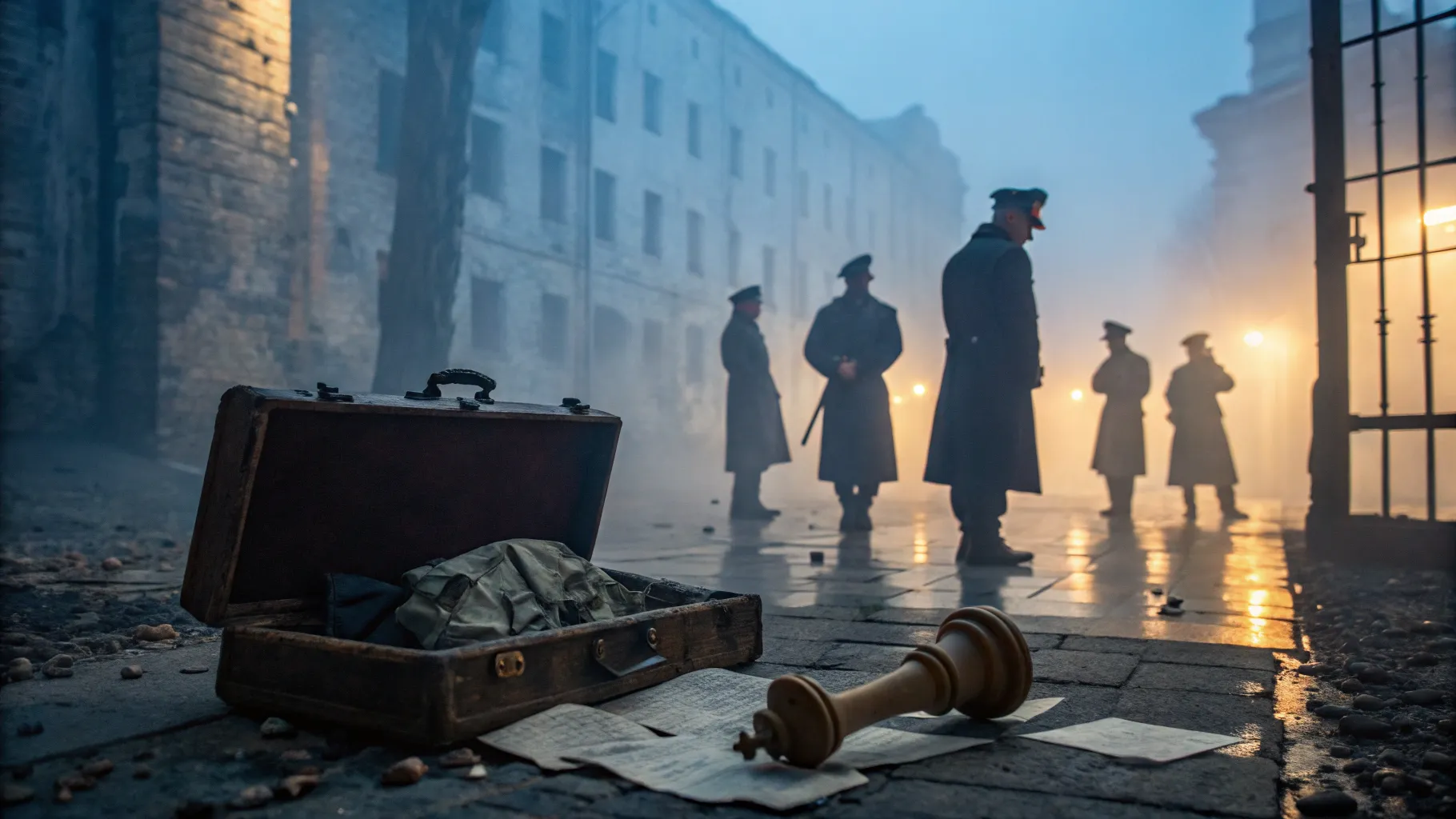
When the Third Reich collapsed in 1945, the men who had once been the apex of German military power — the marshals and field marshals who commanded armies, planned campaigns, and symbolized martial glory — found themselves at the bitter end of history. Some chose silence and suicide, others faced tribunals and long prison terms, and a few reemerged during the Cold War as contested mentors for a rearmed Germany. I have followed their fates closely because their endings hold a concentrated lesson: military competence cannot be separated cleanly from moral responsibility.
Below I report, marshal by marshal, on what became of these figures of the Wehrmacht. I draw out the trials, the sentences, the suicides, the Soviet prisons, and the memoirs that shaped postwar memory. My aim is not to recount every battle but to show how each man's final chapter embodied a particular face of defeat — pride, denial, cowardice, accountability, or reinvention.
🪖 The collapse and the dilemma of the marshals
The Reich ended in ruins and smoke. Hitler was dead. The great marshals — the gods of battle once towering as commanding figures — were suddenly men defeated by history. Some chose a single shot in a forest, others the hangman's noose in Nuremberg, and still others faded slowly in Soviet prisons. A few attempted to save their reputations through memoirs and selective silence.
All shared the same problem: their military authority was inseparable from the politics and crimes of the regime they served. The question that haunted postwar Europe and would shape the Cold War debate was simple and disturbing: could a brilliant strategist also be morally culpable for the crimes pursued under his command?
⚖️ Erich von Manstein — The strategist turned defendant
Erich von Manstein remains one of the most instructive and controversial cases. I consider him the archetype of the marshal who sought refuge in professional identity. For many officers he was a military genius, the mind behind the Ardennes maneuver that made France fall in 1940 and the operations that captured Sevastopol in 1942. His tactical brilliance was undeniable; his postwar story shows how military fame and legal responsibility can diverge dramatically.
Manstein in court
In 1949 Manstein sat before a British tribunal in Hamburg. He presented himself with his usual bearing: erect, cool, almost imperious, dressed in a neat civilian suit. His defense was straightforward and later influential in German memory. He presented himself as a professional soldier, "a man of the army" who had kept his distance from politics, only executing orders and conducting battles.
He argued that he was a soldier, a professional, foreign to the politics of the regime.
That narrative, the "clean general" thesis, would become powerful. Yet the prosecution offered documents that undermined it. Papers revealed that units under his command supported mass deportations and executions in Crimea and Ukraine and facilitated the work of Einsatzgruppen. A November 1941 order, issued by his general staff within the framework of operations in Crimea, spoke explicitly of the "elimination of Judaism" and became central evidence.
Verdict and after
Manstein was convicted in December 1949 on charges that included executions and illegal deportations and sentenced to 18 years. The sentence reflected the strength of the evidence but also the complex geopolitical moment: the Cold War was already intensifying. Western powers quickly recalibrated their priorities.
By 1953, after serving only four years, Manstein was released on health grounds. West Germany accepted him as an informal adviser during the creation of the Bundeswehr. In 1955 he published his memoir, Lost Victories, a book that celebrated operational brilliance while remaining silent on the crimes committed by forces under his command. The result was a rehabilitation of image among many readers in Germany and abroad.
Manstein's postwar life demonstrates two uneasy truths. The first is that legal condemnation and military fame can coexist. The second is that political necessities during the Cold War accelerated the reintegration of figures whose wartime records were morally compromised. Justice had been pronounced, but memory was negotiated.
🔫 Walter Model — Suicide among ruins
Walter Model is striking because his end was immediate and intimate. In the collapsing days of April 1945, Model recognized the futility of continuing to command what had become skeletal, paper units: divisions reduced to ghostly flags, exhausted Volkssturm detachments, and starving columns of soldiers and civilians heading west.
Model refused to accept formal surrender but understood there was no army left for him to lead. He issued a final order dissolving his command, freeing the men to attempt a western surrender or return home. Then, preferring death to capitulation, he walked into a forest near Duisburg and shot himself.
His suicide was not theatrical. It was a quiet act in a ruined wood, performed with the same grim efficiency he had applied to command. For Model, who had long equated leadership with sharing the fate of his soldiers, death was congruent with his own military ethic. He left no memoirs, no political defense. His body was exhumed later and reburied with other German dead in the Hürtgenwald cemetery. Model's last act reads like the end of a soldier for whom duty and identity were inseparable.
🛩️ Ferdinand Schörner — The iron disciplinarian who fled
Ferdinand Schörner stands at the extreme end of the spectrum: ruthless in command, brutal to his own troops, and ultimately cowardly in flight. Schörner rose from modest Bavarian origins to become one of Hitler's favorites by cultivating a reputation for merciless discipline.
He enforced order with public executions for those who retreated and hung deserters from trees under signs declaring their failure. Soldiers remembered his sudden nighttime appearances, his harsh demeanour, and how readily he ordered death for retreat or perceived weakness. To Hitler, such ruthlessness was loyalty personified.
From appointment to abandonment
In April 1945 Hitler appointed Schörner supreme commander of the German army — a symbolic nomination that reflected the dictator's preference for unwavering obedience rather than strategic genius. Schörner reacted accordingly: he ordered continued resistance even as reality collapsed around him.
Yet on May 8, the day unconditional surrender was signed, Schörner boarded a plane and fled to Bavaria. He left his men to be captured by advancing Soviet forces. Many who survived Soviet captivity never forgave him. One German officer later wrote that Schörner had "left us like dogs in a trap."
Capture, Soviet justice, and German trials
Schörner's flight was short-lived. He was arrested by Americans on May 18, 1945, disguised in civilian clothes and carrying false identity papers. The Americans transferred him to the Soviets, who prized the opportunity to try and punish the architects of the brutal eastern war.
In Soviet custody Schörner faced harsh interrogations and was accused of executions of civilians, deportations, and the murder of his own soldiers. In 1952 he received a 25-year sentence of forced labor. He spent a decade in Soviet prisons, degraded and broken.
Repatriated in 1955, Schörner was then tried in West Germany for murder of soldiers on the retreat. He received a 4.5-year sentence in 1957 but was released in 1960 on health grounds. He died in 1973, a forgotten man. His life offers an ugly moral lesson: cruelty as a path to promotion in a criminal regime does not guarantee honour in defeat; it often results in isolation and disgrace.
⚰️ Wilhelm Keitel and Alfred Jodl — Nuremberg and the hangman's noose
Few episodes of the postwar reckoning were as stark as the Nuremberg executions. Wilhelm Keitel and Alfred Jodl embodied the bureaucratic heart of the military machine; both ended at the gallows on October 16, 1946. Their fates were meant to be public and symbolic: the justice not only of law but of shame.
Keitel: the obedient chief of staff
Wilhelm Keitel offered a vivid portrait of slavish obedience. A career officer from Braunschweig, he rose through staff positions and, by 1938, became chief of the High Command of the Armed Forces. Keitel signed innumerable orders with an almost courtly deference to Hitler. His subordinates mockingly called him "La Keitel," a nickname that emphasized servility rather than dignity.
At Nuremberg, the prosecution piled up the documents bearing his signature: the Commissar Order, the reprisal directives, the orders authorizing brutal occupational measures. Keitel's defense was simple: obedience. He said repeatedly he was a soldier fulfilling his oath. For the tribunal, blind submission to criminal orders offered no shield.
Jodl: the operational mind
Alfred Jodl, by contrast, was the operational brain: measured, meticulous, the man who translated political intent into military mechanisms. His handwriting appeared on invasion plans, directives for reprisals, and the machinery of occupation. Jodl argued that he was a technician of war, not a political criminal. The court disagreed.
The sentence and the spectacle
Both men were convicted of war crimes and crimes against humanity. The tribunal sentenced them to death by hanging. Keitel requested a military firing squad, a plea denied. The executions were meant to puncture any lingering myth that obedience excuses atrocity.
Keitel's last words: "Long live Germany!"
The image of two senior German officers swinging on the rope — punished not by battlefield death but by legal judgment and public humiliation — sent an unmistakable message: command responsibility matters. The Nuremberg hangings formally rejected the argument that high rank and obedience absolve criminal action.
❄️ Ewald von Kleist and Wilhelm von Leeb — Moscow's long captivity
Ewald von Kleist and Wilhelm von Leeb represent the other side of the postwar reckoning: the old Prussian school reduced to prisoner numbers in Soviet jails. Both had been distinguished commanders in the early successes of 1940 and 1941, and both experienced a slow, humiliating decline behind iron bars.
From triumph to transport
Von Kleist, admired for his armored offensives in 1940 and major roles in Barbarossa, and von Leeb, the former commander of Army Group North during the siege of Leningrad, were both captured by Western forces in 1945 and soon transferred to Soviet custody. The transfer signaled Soviet intent: these men would be shown as exemplars of Nazi aggression against the East.
The journey eastward was not merely logistical; it was symbolic. Maps and uniforms gave way to wooden benches, insufficient rations, and the stench of transport cars. In Moscow their lives narrowed to subsistence, interrogation, and the constant presence of accusation. The Soviets did not merely want convictions; they wanted a theatrical humiliation, a moral victory for their people after devastation.
Trials and sentences
Von Kleist was tried and sentenced to life imprisonment for the devastation on Ukrainian and Caucasus soil, for deportations, and for facilitating carnage. Von Leeb, older and sicker, received a 25-year sentence; he did not survive long in captivity, dying in 1956. Von Kleist endured almost a decade in Vladimir prison before dying there in 1954.
Their deaths in Soviet jails were anti-climactic and tragic in a different register. There was no Nuremberg spectacle, no publicized execution. Instead, these old marshals faded under the grind of prison routine: cold cells, illness, thin bread, and days that repeated without meaning. For many Germans, they became invisible casualties of a verdict rendered in another political and moral order.
🕊️ Albert Kesselring — Italy, the Ardeatine caves, and contested memory
Albert Kesselring is a case study in ambiguity. Known among his men as "the smiling Albert," he cultivated a paternal image and proved an effective defensive commander in Italy. Yet his name is forever stained by the Ardeatine massacre — the mass execution of 335 civilians and prisoners in reprisal for a partisan attack in Rome.
The crime and the tribunal
The March 1944 reprisal order that led to the Ardeatine caves massacre became the central charge against Kesselring in his 1947 trial before a British military tribunal in Venice. Kesselring did not personally pull the trigger, but his position as the commanding officer in Italy meant responsibility for actions taken by units under his authority. He acknowledged issuing or approving reprisals but insisted these actions were part of wartime practice.
The tribunal was unmoved. In May 1947 he was sentenced to death. The verdict shocked many who knew Kesselring as an officer who had shown concern for his troops and who had commanded with skill. The sentencing prompted a vigorous advocacy campaign, including petitions from British officers who had served in Italy and argued for his clemency.
Commutation, release, and public life
Under pressure and in the shifting context of the Cold War, Kesselring's death sentence was commuted to life imprisonment, and in 1952 he was released on health grounds. He returned to West Germany, wrote memoirs titled A Soldier Until the Last Day, and cultivated a public image of the misunderstood professional soldier. He received warm receptions at veteran gatherings and died in 1960, his reputation divided between respect for his defensive skill and condemnation for the massacre that occurred under his watch.
Kesselring's case shows how legal punishment can be softened by political advocacy and shifting priorities. It also demonstrates how memoirs and the passage of time can reshape public memory, sometimes at the expense of victims' narratives.
🌫️ Gerd von Rundstedt — The slow fade of the Prussian aristocrat
Gerd von Rundstedt occupied a unique place among the marshals. He was neither spectacularly brilliant nor openly fanatical. Instead he represented continuity: an embodiment of Prussian military tradition that spanned the Kaiserreich, the Weimar years, and Hitler's rise. In defeat, Rundstedt faded rather than faced dramatic justice.
A career of service and reluctance
Born in 1875, Rundstedt's military career began long before tanks and air power eclipsed cavalry. He commanded large armies in Poland, France, and the Soviet Union. Yet he was often characterized as indifferent, tired, and detached — a man who asked repeatedly for retirement and who argued at times that the war was unwinnable.
Detention, release, and a quiet end
After the war he was detained by the Allies but ultimately was not tried. His advanced age and frail health spared him the spectacle of a public tribunal. In 1950 he was released on medical grounds and returned to Hanover, where he lived quietly until his death in 1953.
Rundstedt's ending is instructive: he was neither publicly executed nor lionized in memoirs. Instead, he became the melancholic symbol of an aristocracy that had pledged service across regimes and had failed to account morally for how that service had been used. The unresolved question surrounding him remains: what moral responsibility does a high commander bear when crimes occur under his overall command even if he did not sign the orders? Rundstedt's life invites that uncomfortable reflection.
🏛️ Wilhelm List — The Balkan commander who aged in prison
Wilhelm List's career synthesized quick operational success with the brutality of occupation. His campaigns in Poland, the Balkans, and Greece demonstrated organization and speed; his subsequent policies in occupied Greece and Yugoslavia showed how reprisals, hostage-taking, and collective punishments were integrated into occupation strategy.
From triumph to indictment
List commanded the 14th Army in Poland and later led campaigns that quickly subdued Yugoslavia and Greece in 1941. Yet the speed of conquest was accompanied by a policy of harsh repression. Under List's direction, German forces executed reprisals in the Balkans with appalling ratios of civilians killed per German casualty and leveled entire villages as warnings.
In 1948 List faced the hostages trial, one of the subsequent Nuremberg proceedings focused on reprisals and hostage-taking in the Balkans. Documents bearing his signature and testimony from survivors showed that these were not local aberrations but deliberate policies sent from the top.
Sentence and decline
List was convicted and sentenced to life in prison. Yet like many others, geopolitical shifts intervened. By 1952 he was released for health reasons and spent his final years in Garmisch-Partenkirchen, removed from public life and largely forgotten. He died in 1971 at the age of 91.
His story underscores an uncomfortable truth: some commanders paid with confinement and long decline rather than dramatic execution. Their slow dissolutions into obscurity should not be read as exoneration; rather, they are a form of historical erasure that deprives victims of public acknowledgment.
🔍 The postwar gray zone: memoirs, rehabilitation, and Cold War politics
By the early 1950s the geopolitical landscape had changed. The Cold War made the rearmament and integration of West Germany into the Western bloc a strategic priority. That shift created incentives to rehabilitate certain military figures. When I examine who regained honor and who did not, patterns emerge clearly: tactical value, public advocacy, and political expediency shaped outcomes as much as legal facts did.
Two related processes mattered most.
- Memoirs and image management. Men like Erich von Manstein and Albert Kesselring wrote accounts that emphasized operational genius and alleged separation from Nazi politics. These books found receptive audiences among military professionals and an anxious West that wanted experienced commanders to shape a bulwark against the Soviet Union.
- Political pressure and utility. The United Kingdom and the United States at times reduced sentences or released prisoners to facilitate West German rearmament. Manstein's release in 1953 and Kesselring's reprieve in 1952 illustrate how political calculus overrode prior judicial decisions.
This gray zone produced a polarized memory: for veterans and conservative audiences, these men became the face of a "professional" Wehrmacht. For survivors, victims, and many in Eastern Europe, they remained perpetrators or enablers of brutal occupation policies. The tension between these narratives shaped decades of historical debate and public commemoration.
How memoirs shaped military education
Manstein's Lost Victories is a clear example. He recounted maneuvers, explained operational thinking, and blamed Hitler for strategic failures. American and British officers read his analyses in military academies. Students of war learned from his tactical insights while the darker aspects of his record were minimized or ignored in those same contexts.
The consequence was a generation of military professionals who admired German operational skill without always confronting the moral architecture that enabled it. That imbalance would fuel later scholarly work aimed at dismantling the "clean Wehrmacht" myth and reasserting the inseparability of strategy and atrocity.
🧭 Lessons and legacy: accountability, myth, and memory
As I look back over these stories, several lessons become unavoidable.
- Command responsibility matters. Nuremberg affirmed that high rank cannot shield one from liability for crimes executed under a commander's authority. Keitel and Jodl's executions emphasized that direct obedience is not a defense when orders are criminal.
- Justice is uneven and political. The varying fates of Manstein, Kesselring, Schörner, Rundstedt, Kleist, and List show that legal outcomes depended on diplomatic needs as much as on evidence. The Cold War reordered priorities.
- Memory is constructed. Memoirs, rehabilitation campaigns, and institutional usage of former officers shaped public memory in ways that often obscured victims' experiences. The myth of the apolitical professional soldier persisted for decades until historians reexamined the archives.
- Victims' narratives endure. The silence of victims in many postwar reconstructions did not last. Over time, the testimonies of those who suffered under occupation and reprisal policies have reshaped historical assessments and public commemorations.
There is no neat moral closure here. Two of the most famous marshals, Manstein and Kesselring, lived into postwar decades, wrote books, and were at times honored by veterans. Others, like Keitel and Jodl, perished on the gallows. Some vanished behind Soviet walls and died anonymous deaths. Model chose his own death. Schörner avoided honor and died in obscurity. Rundstedt faded away quietly.
Each ending was itself a verdict: sometimes legal, sometimes historical, sometimes merely the silence of the dead. Together their fates form an epitaph for the era they helped create and destroy. I remain convinced that analyzing these final chapters is essential not only for military history but for understanding how societies reckon with the complicity of institutions and the moral costs of obedience.
Closing reflection
The fall of the Reich stripped these men of public grandeur and exposed the consequences of their choices. Military skill and courage on a battlefield cannot wash away participation in a regime of mass violence. The postwar years proved messy and political, but the core moral question endures: how do we assess and remember those who were brilliant at war yet complicit in crimes against humanity?
I report these stories not to settle debates but to insist that the past be remembered in full — the maneuvers and the murder, the tactical brilliance and the terrible decisions. Only by holding both truths together can we hope to learn the proper lessons of that catastrophic time.


