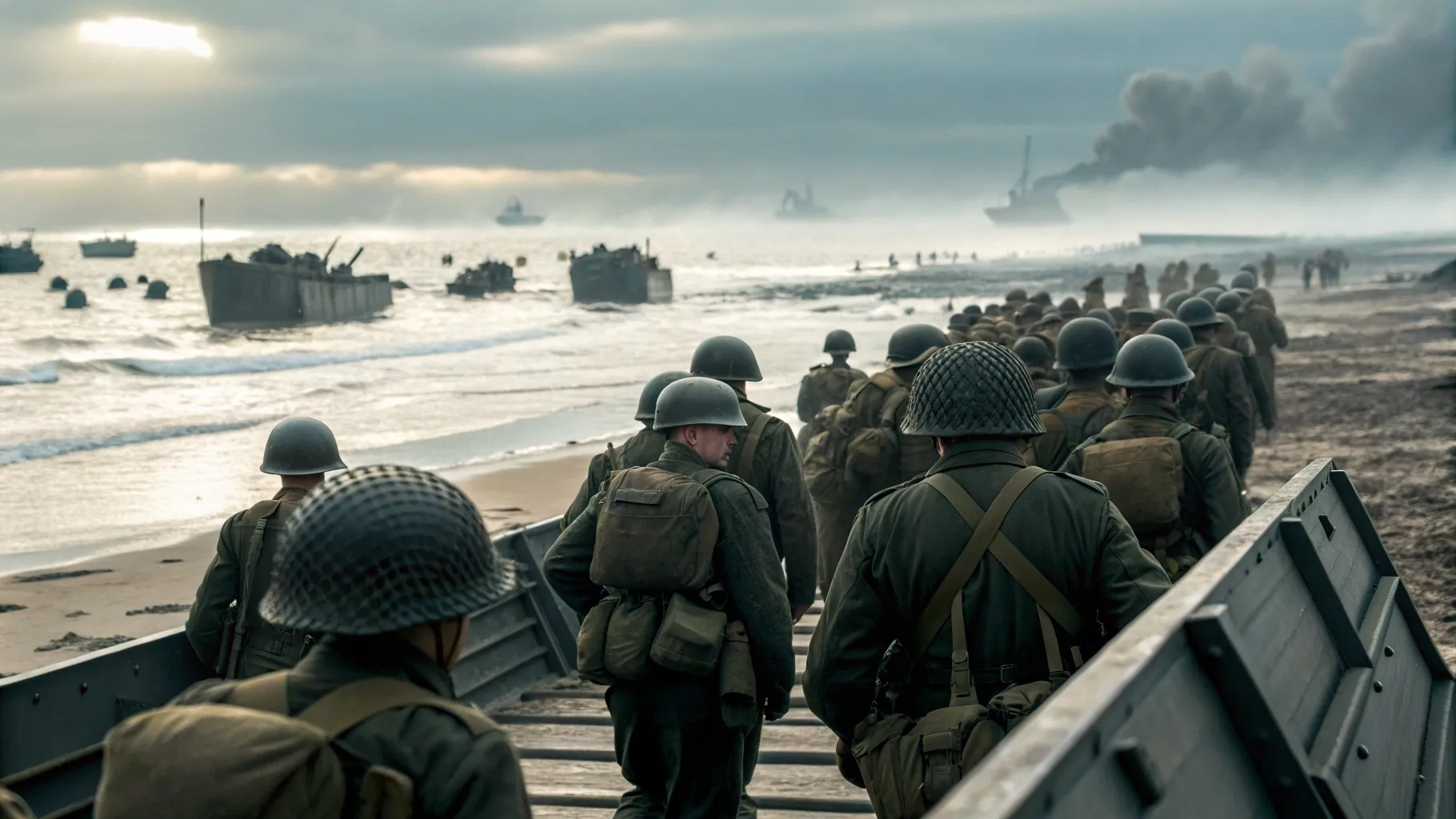
June 6, 1944 — I published a detailed account titled "Hrůza Dne D z pohledu spojeneckých sil" on my channel, The Soldier’s Diary CZ, to present the human truth behind the operation code-named Overlord. As a historian and storyteller, I felt compelled to report what those months of secret preparation, the decision in a rain of meteorological uncertainty, and the first hours ashore truly meant for the men who crossed the Channel. This article is written in the spirit of that report: a news-style narrative from my perspective, informed by survivor testimony, official records, and the intimate moments preserved in letters and diaries.
🔒 The Secret Buildup: Britain Becomes a War Machine
From the spring of 1944, Britain was transformed into a single vast machine of invasion. I followed the trail of preparation: coastal towns jammed with convoy traffic, farm buildings converted into hangars and stores, and hundreds of thousands of Allied troops billeted across the countryside. It is hard to overstate the scale: more than 1.5 million American soldiers were already on British soil, Canadian divisions arrived by the thousands, and seasoned British units returned from desert campaigns and the retreat from the continent to await orders.
Every detail was hidden behind a web of secrecy that touched the lives of civilians and soldiers alike. Documents printed with strict confidentiality stamps were handled under double locks. Sailors and dockworkers faced two layers of guard checks at Southampton piers. Men were forbidden to write uncensored letters. A single misplaced envelope containing classified routes or dates could trigger alarms in SHAEF (Supreme Headquarters Allied Expeditionary Force).
Logistics formed the backbone of the plan: unusual works were constructed at night, thousands moved cement, steel, cable, and generators under black curtains; roads became columned arteries of convoys. British towns from Cornwall to Kent watched columns of jeeps, camouflaged tanks, and foreign insignia stream by. Entire villages found themselves cut off by military movements. Railway stations closed, mail became irregular, and beaches were fenced off to civilians for miles.
I remember describing this in the video as an operation so vast it turned Britain into "a living organism" — a monstrous coordination of factories, depots, airfields, medical units, and men — quietly breathing and waiting for the order to move.
✈️ The Air Campaign: Bombers That Prepared the Way
The campaign in the skies was decisive and relentless. From January through June 1944, RAF Bomber Command and the U.S. Eighth Air Force struck the transportation network supporting Germany’s Atlantic defenses. The aim was surgical: cut railheads, destroy marshalling yards, sabotage bridges, and burn fuel depots so that when the seaborne armada landed, Germany's ability to move reinforcements would be in disarray.
I reported how the plan, led by Air Marshal Arthur Tedder and executed by a rotating storm of B-17s, Lancasters, Halifaxes, and Liberators, was not primarily designed to rend cities but to fracture the logistic skeleton of the Atlantic front. Between March and June, more than 75,000 tons of bombs were dropped on 33 strategic railway centres — Caen, Saint-Lô, Rouen, Le Mans, Amiens among them — in an effort to sever vital arteries. Every damaged bridge, every derailed train could buy hours or even days for the beachheads.
The scale of the sorties was staggering: night after night, aircraft passed over northern France in such dense formations that the countryside below looked like a rolling storm. I spoke in the video about the psychological impact — for those on the ground and for the crews in the air. Bomber crews, often very young, faced a brutal calculus of survival. Many planes never returned. The mission’s success was measured incrementally: each crippled logistics node was one fewer train available on D-Day.
🕵️♂️ Intelligence and the Resistance: The Invisible Front
Parallel to the bombs, there was another campaign underway — a quieter, bloodier, and more intimate form of warfare: sabotage carried out by the French Resistance, British and American special forces, and saboteur teams trained to cut the German supply lines from within.
I covered how operatives were given precise instructions from London: break the railway network at over 500 key locations in the days leading to the invasion, cut communications, booby-trap locomotives, and blow viaducts. These acts were high-risk and often one-shot operations. A single effective explosion on a main line could delay an armored division for days.
The OSS and the British SOE coordinated missions that put lightly armed men against lethal infrastructure. Many of those raiders were local partisans who had waited years for a chance to act. Their knowledge of terrain, schedules and routines amplified Allied bombing. Even when the Resistance did not survive, the cost they extracted from the Wehrmacht was significant.
Sources I used for the report included aerial reconnaissance interpreters stationed in High Wycombe and London who matched photographic evidence to target lists within hours. I emphasized the often-overlooked point: success on D-Day was not just the product of ships and boots, but of a network of intelligence, sabotage, and localized bravery that made the land safer for the initial assault.
☁️ The Decision and the Weather: Eisenhower’s Gamble
Weather is a fickle general. The invasion was scheduled for June 5; then, a pressure system over the Atlantic and rising winds postponed it. I described in my report the tension-packed meeting that unfolded in Southwick House near Portsmouth: Eisenhower and his top commanders surrounded by maps that wallpapered the room, staring at charts and forecasts. Meteorologist Group Captain James Stagg told the command that a short weather window — a brief lull — would open on June 6.
Eisenhower's choice was simple to describe and unimaginably heavy to make. He told his staff later he had no guarantee, only a forecast. Still, at 0415 on June 6, he gave the order that would reverberate across the continent: "Okay, let's go." It was a single sentence that I have replayed many times during research and in the video, because within it sat half a million lives, the morale of nations, and the potential unraveling of the Allied campaign if it failed.
On the German side, error and misjudgment compounded the Allies’ advantage. Field Marshal Rommel was in Germany, Rundstedt expected an invasion at Pas-de-Calais, and many German units were holding a war game at the very hour Allied craft moved. Rain and bad weather had pacified some watchfulness. That combination of secrecy, misdirection, and a risky meteorological opening made the decision possible — yet the human cost that followed was a toll no forecast could account for.
⚓ Crossing the Channel: The Armada Moves
What I called a "living road" across the Channel is the right image: more than 5,000 vessels of every size and function slowly came together. LSTs, LCIs, LCTs, destroyers, amphibious tanks, supply barges, tugs — columns that in any other context would have been a fleet without precedent. The English coast held a hush. Men in the ports finished last meals, sealed orders in envelopes, taped unit insignia, and checked rifles.
At 0200 on June 6 the five assault sectors — Utah, Omaha, Gold, Juno and Sword — were aligned as the focal points. Mine-sweepers and patrol craft streamed ahead. Artificial ports — Mulberry harbors — were under tow. The idea was audacious: pull prefabricated piers across the water and assemble them off the Normandy coast to create temporary harbors capable of supporting the immense weight of men, vehicles, and materiel.
Ships carried more than soldiers: they carried the psychological hope of a front opened in Europe. On board, the mood tilted between quiet extraordinary moments of camaraderie and scared silence. Officers distributed letters, men tucked photographs into helmets, and some prayed. The sea, at times deceptively calm, became the last barrier between training and pure survival. When the first ramps dropped, the face of modern warfare would be revealed.
🪂 The Airborne Assault: Chaos Behind Enemy Lines
The first soldiers to be inside France were not the men who slogged up the beaches at dawn, but the airborne troops who jumped and glided through the night. I described in my video how the airborne regiments — the U.S. 82nd and 101st Airborne, and the British 6th Airborne — carried a different burden: shock, disorientation, and the mission to seize vital points such as bridges and causeway exits.
Planes and gliders left in waves. On the night of June 5, C-47s hummed across the Channel carrying men, radios, explosives, and courage. The Pathfinders — who dropped the first beacons — were often the key to accurate assembly; when they failed or were blown off course, the maps and compasses in each soldier’s pack were sometimes insufficient. Wind, cloud cover, and heavy anti-aircraft fire scattered formations. Men landed miles from their drop zones, tangled in trees, pinned in wet marshes or shot while still descending.
One image I recount and re-told: the paratrooper John Steele, who famously hung from the church tower at Sainte-Mère-Église. Others drowned in flooded fields that Rommel had ordered inundated; everything they carried became a weight that could kill. Units were broken into small, isolated groups — three, four, five men — without leaders or radios. Yet in that confusion, improvisation was born. Men who never before served together assumed command and formed ad hoc formations. Major John Howard's gliderborne coup at Pegasus Bridge is a celebrated exception: his Horsa gliders landed within 50 meters of the bridge, allowing his force to capture and hold a crucial crossing until they were reinforced.
The airborne operation was part genius and part desperate necessity. Its costs were high, but its successes — the captured bridges, disrupted communications, and the general confusion sown among German commanders — were vital in preventing a rapid German counterstrike in the early hours.
🩸 Omaha: The Beach That Swallowed Dawn
Omaha Beach deserves an entire dispatch. I reported its story as an unfolding disaster at sunrise, where training and plans collapsed under the weight of German fire. Men from the 29th Division and the 1st Division, among others, boarded landing craft in the dark, seething with salt air and fear, and struck a coastline lined with reinforced bunkers and interlocked fields of fire.
When ramps dropped at roughly 0730, many men were killed before they even left the boats. German MG 42s chewed through waves of attackers; antitank hedgehogs and mines trapped men in the shallows. Rising tide and murderous obstacles amplified the carnage. Numerous landing craft were swept off course by currents, plunging men into sectors for which they had no orders.
Naval gunfire, intended to soften German positions, fell short or overshot. Bombers, constrained by the proximity of friendly forces, released their loads with insufficient effect. The result was a killing zone that bled the assault units white. At one point during my research interviews and in the video, I noted that some commanders briefly considered canceling the Omaha assault because of the losses and confusion.
Yet even at Omaha, individual acts of improvisation and courage carved routes through the defenses. Small groups, often led by noncommissioned officers or lieutenants who assumed command in the aftermath of officer casualties, found seams in the German beachhead. Men dug themselves into shell craters and returned fire, used satchel charges and improvised "flamethrowers" made from fuel cans to clear pillboxes, and slowly pushed inland. By midday some units achieved small footholds beyond the seawall; by evening, despite more than 2,000 killed or seriously wounded on Omaha alone, men had gained enough ground to allow follow-on forces to land and consolidate positions.
🛡️ Utah: Mistakes, Leadership, and Adaptability
Utah’s story is one of adaptation. Strong currents carried many landing waves south of their intended objectives — a navigational error that could have destroyed the sector’s chance of success. Instead, leadership on the ground, particularly Brigadier General Theodore Roosevelt Jr., turned the error into an advantage. Roosevelt reportedly summed it up with laconic pragmatism when he said, "We'll start the war from here."
That pragmatic decision was decisive. Although initial waves landed off-target, they encountered less intense opposition and were able to secure a beachhead quickly. The 4th Infantry Division consolidated terrain, linked with paratroopers who had disrupted German movements inland, and began the process of expanding the lodgement. The example of Utah shows that, in war, flexibility beats rigid plans when the environment refuses to cooperate.
🍁 Juno: Canadian Tenacity on the Sand
Juno Beach, where Canadian forces led the assault, saw ferocious fighting against well-prepared defensive positions. I wrote about the Canadians' approach and highlighted how Royal Winnipeg Rifles, Regina Rifles, and other units took the brunt of concentrated fire as they crossed water and sand cluttered with obstacles and mines.
Despite strong resistance and heavy casualties, Canadian troops showed remarkable cohesion. The presence of specialized tanks and coordinated assaults, combined with sustained infantry determination, allowed the 3rd Canadian Division to punch through and reach critical routes inland toward Courseulles-sur-Mer and the road to Caen. House-to-house fighting, urban assaults, and minefields slowed progress, but the Canadians persisted throughout the day and set the stage for the larger breakout.
I pointed out in the report that in many accounts Juno has been praised for the speed with which Canadian units reorganized amidst chaos and began moving toward objectives that would be vital in the days to come.
🇬🇧 Gold & Sword: British and Commonwealth Coordination
The British sectors — Gold and Sword — combined tank innovation, engineering work, and determined infantry assaults. I discussed how specialized armor, the so-called "Hobart's Funnies" — modified Shermans, flail tanks for mines, and other unusual designs — played a critical role in breaching obstacles and neutralizing bunkers. Royal Engineers labored under direct fire to clear paths through minefields and anti-tank obstacles.
At Sword, 3rd British Infantry Division confronted stiff machine-gun nests and sniper fire from coastal villas. In some sectors, tanks equipped with Petard mortars and Churchill AVREs were instrumental in dismantling concrete pillboxes. By the day’s end, the British and Commonwealth forces had expanded their beachheads and linked with paratrooper positions to ensure that some beaches were consolidated sufficiently to support subsequent operations.
In a number of moments I described as news-style highlights, the British secured towns such as Ver-sur-Mer and established forward points that prevented immediate German counterattacks from cutting off the lodgement. But the road ahead would remain contested as night fell and exhausted men dug in for expected counterstrikes.
⏱️ The First Hours on Land: Chaos, Courage, and Command
Once ashore, the predictable became unpredictable. There was no single, continuous front; rather, a scatter of pockets, small fortifications, and isolated units. Command and control — radios, maps, and prearranged plans — often failed. I reported how officers and NCOs improvised, how ad hoc leadership filled gaps when command structures were broken, and how small bands of men linked up to form temporary platoons and companies tasked with local objectives.
Medics, clerks, cooks — roles that in training were peripheral — became central as men were wounded, dying, or exhausted. Every unit dealt with the same basic set of imperatives: stabilize the beachhead, evacuate the wounded, clear obstacles, and push inland enough to give follow-on units secure lanes for vehicles and supplies.
Though it was a military operation with a plan, the human dimension was raw and relentless. I emphasized the scene at Omaha where bodies and equipment littered the sand; men often stepped over the dead to move forward. In the face of chaos, small acts of leadership turned the tide in local sectors. Rangers scaled cliffs at Pointe du Hoc to destroy artillery pieces, sometimes finding only empty mounts and then scouring the countryside until they located and demolished the guns. These are the details that I included to show war as a concatenation of micro-decisions made under fire.
⚕️ Medical Aftermath and Civilian Impact
Casualty care was a massive, immediate challenge. As beaches became clogged with wounded and dying, medical personnel improvised triage centers in shell craters, wrecked homes, and abandoned huts. I recounted how casualty clearing stations stacked bodies and labels in brutal arithmetic: who could be saved, who could not, and who would be left for the sea.
Civilians were caught in the crossfire. In the villages behind the beaches, families hid in cellars and basements; some braved the front lines to carry the wounded on wheelbarrows or help shelter soldiers. I remember describing a poignant scene: a French woman stepping out with a white sheet to signal surrender or neutrality, offering to help with food or milk. The presence of children among the rubble, playing with spent cartridge cases, juxtaposed with the mechanized and bloody reality of battle underscored how D-Day was a collision between large-scale strategy and intimate human lives.
Hospitals, field aid stations, and impromptu surgical tents faced shortages of morphine and bandages. Medical staff worked with stoic tenderness amid the smell of cordite and blood. They wrote letters for dying men who could not speak. Their work was as crucial to the invasion’s continuity as the ferrying of fuel and ammunition.
📦 Logistics: Mulberries, Supply Lines, and the Long Game
I emphasized in my report that D-Day was not merely the act of landing soldiers; it was a logistical enterprise on an unprecedented scale. The Mulberry harbors — prefabricated, floating docks towed across the Channel — were built out of purpose-made caissons and floating roadways to turn the sea into a temporary port. Units towed and assembled these structures in secrecy. When operational, they allowed the Allies to land tanks, trucks, ammunition, and food in volumes that ordinary beaches could not sustain for long.
Engineers and port units labored night and day to construct these supply lifelines. Without them, the invasion would likely have stalled at a fragile headland. I included in my research the stark point that initial days after D-Day were as much about building and expanding supply capacity as they were about the fighting itself. Every mile of road inland had to be cleared of mines and obstacles; every bridge had to be repaired or rebuilt. Each hour lost meant fewer reinforcements and less fuel for tanks operating inland.
🕯️ Remembering the Cost: Graves, Letters, and Memory
One of the main themes I returned to while reporting was the cost of D-Day: massive, immediate, and personal. Temporary graves appeared on fields where cows once grazed; white crosses were hammered into sod as soldiers or local men buried the dead. Newspapers and later documentaries captured faces that announced both victory and sorrow. I included memories from veterans who returned to visit those beaches and spoke about a silence that sometimes felt heavier than the guns had been.
What stayed with me most, and what I wanted viewers to understand, was how ordinary human rituals — flowers at a grave, the playing of a bugle at a burial — transformed the blank strategic maps into a human geography of loss. Letters sent home, left unfinished on desks, and the notes sewn into uniforms became the artifacts of D-Day’s human story. Those small objects — a photograph tucked inside a helmet, a rosary, a medal — were often all that remained for grieving families.
📜 Lessons and Legacy: Strategy, Courage, and the Opened Door
The long-term strategic payoff of D-Day was clear: the establishment of a western front that would force Germany to fight on two major axes. But in my coverage, I stressed that the operational lessons were complex. The Allies learned about the limitations of naval and air bombardment against hardened positions, the decisive value of specialized engineering armor, and the necessity for flexible leadership on the ground when plans break.
Humanly, D-Day remains a study in courage, improvisation, and endurance. The soldiers who survived the day were irrevocably changed. Many never spoke at length about their experience, but when they did, their words were spare, precise, and haunted. In public memory, D-Day is rightly commemorated as a turning point; but the memory must also include the price paid by individuals and communities.
Even years later, landscapes bear the scars. Cities like Caen, Bayeux and Saint-Lô were devastated and had to be rebuilt from rubble. In those towns the civilian cost was enormous: homes destroyed, families displaced. But those towns also became living memorials — places where battle, reconstruction and remembrance intermingled.
✅ Conclusion: Reporting What D-Day Meant
When I made the video and wrote this companion report, my goal was to present D-Day as more than a date and a set of coordinates. It was a day whose horror, bravery, and improvisation are best told from the ground up. I reported the mechanics of the operation — the secrecy, the air campaign, the naval armada, the Mulberry harbors — and the human stories that gave it meaning: Major John Howard’s glider coup, John Steele on a church spire, Theodore Roosevelt Jr.'s quick decision at Utah, the improvisations on Omaha, and the relentless courage of Canadians on Juno.
In pure military terms, D-Day opened the door to liberation. In human terms, it was an event of brutal contradiction: planning and improvisation, victory and terrible loss, the machinery of industry and the fragility of individual life. I close this dispatch with gratitude to historians, veterans, and the local communities who preserved testimony. Their voices allowed me to report not just the facts, but the feeling of June 6, 1944 — the fear, the determination, the noise, and the silence that followed.
Key Facts at a Glance
- Date: June 6, 1944
- Allied troops landing: More than 150,000 soldiers on D-Day
- Naval fleet: Over 5,000 vessels of various types participated
- Troops in Britain prior to invasion: Over 1.5 million U.S. troops stationed in the UK
- Bomb tonnage (March–June): Over 75,000 tons dropped on strategic rail and transport centres
- Beaches: Utah, Omaha, Gold, Juno, Sword
Further Reading and Remembrance
If you would like to explore more, I encourage you to look at first-person testimonies, unit histories, and documentary archives that preserve the eyewitness accounts of those who were there. My video on The Soldier’s Diary CZ provides a visual complement to this report, drawing together testimony and archival imagery in a narrative I hope honors those who participated.
"OK, let's go." — Dwight D. Eisenhower, the order that began the invasion on June 6, 1944.


