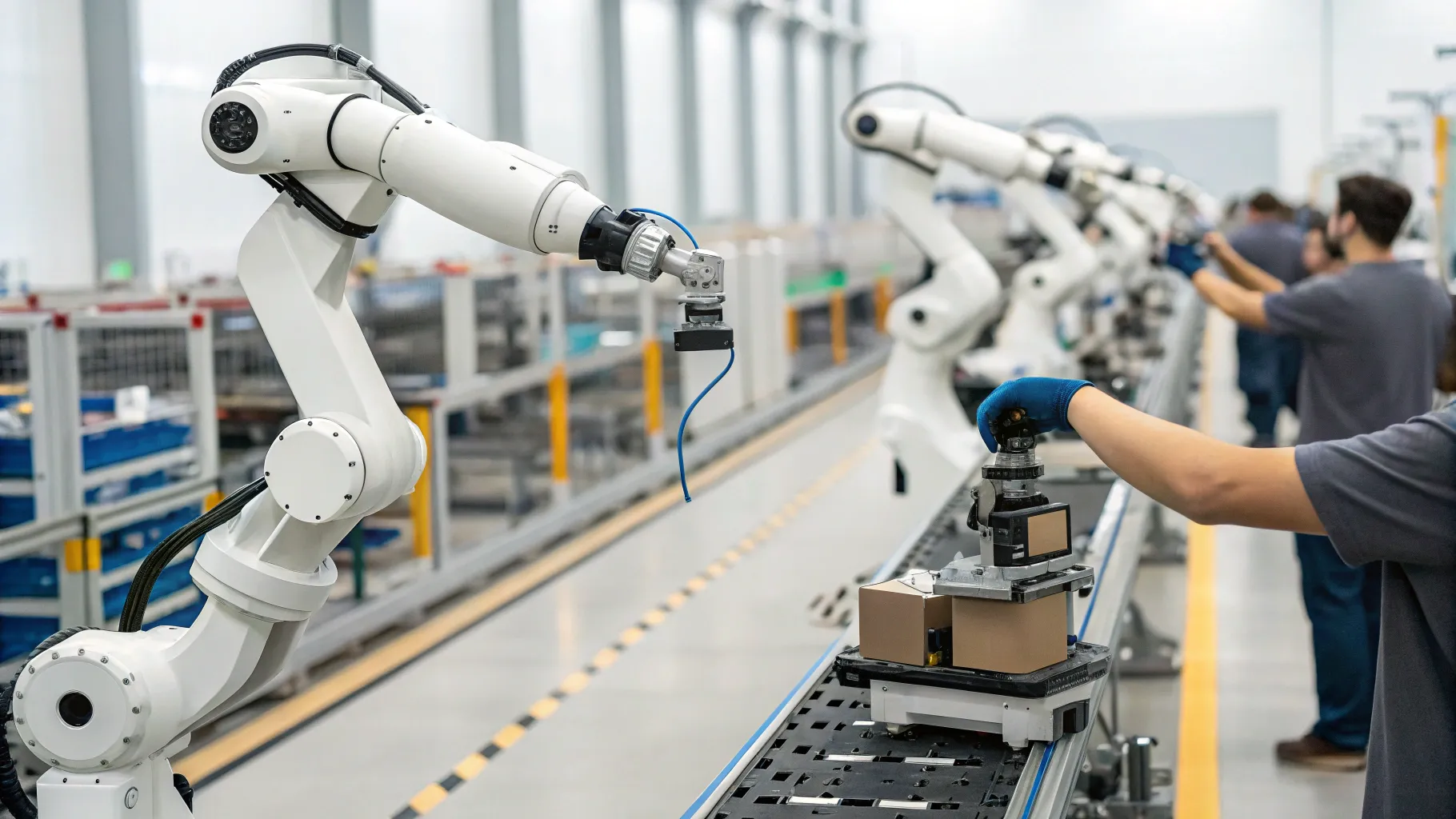
In a recent video I produced for NVIDIA, I explored how collaborative robots — or cobots — are reshaping factory floors by bringing AI-driven vision and agility to tasks once considered too variable or complex for traditional automation. The story focuses on a strategic collaboration between Universal Robots, InBolt, and NVIDIA: how the UAPLUS ecosystem and NVIDIA’s Jetson and Isaac tools are accelerating the adoption of cobots in manufacturing. In this article I report on that collaboration, describe the technical breakthroughs, and explain why this matters to manufacturers who want robust, flexible automation on their lines.
🔎 Executive summary
Collaborative robots are designed to work alongside people, and they’re becoming easier to deploy, program, and integrate. Universal Robots has cultivated the world’s largest ecosystem for robotics innovators—UAPLUS—with hundreds of partners. NVIDIA has been working with Universal Robots for years to deliver an AI Accelerator package that brings Jetson hardware and Isaac software to cobot developers. InBolt is one of those partners; by adopting NVIDIA Jetson and Isaac technologies they dramatically increased compute performance, reduced latency for vision-based algorithms from ~100 ms to single-digit milliseconds, and unlocked new automation use cases previously too complex for deterministic robots.
This report-style article covers why cobots matter, how the ecosystem approach removes barriers to automation, and what concrete results companies like InBolt are seeing when they combine robot hardware, AI compute, and mature software frameworks.
🤝 Why cobots are different and why they matter
As someone who has spent time on factory floors and in labs, I often find the same refrain: manufacturers want automation, but they don’t always know how to scale it across variable, complex tasks. Traditional industrial robots excel at repetitive, predictable motion in guarded environments. But the real world of manufacturing — diverse part geometries, inconsistent part presentation, mixed SKUs on conveyors, and human workers sharing space — demands something different. That’s where collaborative robots, or cobots, change the equation.
Cobots are fundamentally designed to be safe around people, easy to program, and flexible to redeploy. Instead of encasing a robot in safety fencing and dedicating it to a single operation, you can place a cobot on a production island next to an operator, hand it a new tool or part, and reconfigure it for a different SKU in hours rather than weeks. That operational flexibility dramatically reduces the total cost of ownership for automation and opens up automation to small- and medium-sized manufacturers who previously couldn’t justify the capital expense or engineering overhead.
In the video I produced for NVIDIA, a Universal Robots representative summarized this succinctly: “Collaborative robots are robots that have been designed inherently to work close along people. They’ve been designed to be easy to use, easy to deploy and easy to collaborate with.” That’s the promise: a robot that augments rather than isolates human labor.
🏗️ The UAPLUS ecosystem: building an open foundation for robotics innovators
One of the persistent bottlenecks in robotics adoption is fragmentation. Hardware, perception, and application software are often developed in silos, creating an integration problem for manufacturers. Universal Robots addressed that by creating the UAPLUS ecosystem, a partner community that makes it easier for innovators to develop, validate, and commercialize cobot solutions.
When I reported on the ecosystem in the video, the numbers stood out: UAPLUS had grown into the world’s largest ecosystem for robotics innovators, with more than 380 partners. That scale matters because it means manufacturers have access to a wide range of application-ready solutions — grippers, vision systems, software plugins, and complete turnkey cells — that are already tested on Universal Robots hardware.
UAPLUS reduces friction by providing consistent APIs, integration standards, and certification paths. Instead of each robotics vendor reinventing the integration stack for every new sensor or compute module, they can rely on a common platform that accelerates time-to-deployment. The ecosystem is designed “to exactly solve that problem” of getting advanced robotics technologies onto factory floors.
🚀 NVIDIA partnership: accelerating cobots with AI compute and software
Universal Robots and NVIDIA have been collaborating for over eight years, and that relationship crystallized around what we call the AI Accelerator for Universal Robots. From my perspective, the AI Accelerator is both a product and a gateway: it’s a package that brings NVIDIA Jetson hardware and NVIDIA Isaac software tools into the Universal Robots ecosystem. The goal is straightforward — enable partners and developers to build AI models and deploy them directly on cobots.
Why is that important? Because adding AI perception and inference at the edge changes what cobots can do. Instead of relying on fixed, rule-based sensing (photoelectric sensors, limit switches, or simple vision checks), a cobot with onboard AI can interpret visual scenes, handle variability, and make decisions in real time while operating safely alongside humans.
As I highlighted in the video, the AI Accelerator isn’t just about raw performance. It’s about unlocking the library of NVIDIA Isaac technologies that help teams build and optimize perception and robotics algorithms. With Jetson compute, developers get lower latency, higher throughput, and the ability to run larger neural networks — all in a package intended for edge deployment.
🔬 InBolt case study: bringing human-like intelligence to robots
I visited InBolt’s team and saw first-hand how adding Jetson-based compute changed what they could offer customers. InBolt specializes in equipping robots with vision systems — in their words, “we give robots eyes and brains.” Their algorithms handle significant variation in parts and presentation, enabling use cases like mounting or handling parts that move on conveyors, a common challenge in automotive and other industries.
Before integrating NVIDIA’s Jetson platform, InBolt ran their perception stack on a legacy computing platform. They were constrained by latency and limited inference performance. After adopting Jetson and integrating the NVIDIA Isaac libraries, they achieved a step function improvement: tasks that previously had computation times around 100 milliseconds for depth-image processing were reduced to a few milliseconds. That change in latency is not just a speedup; it enables new control strategies, increases throughput, and — critically — improves the reliability needed in manufacturing environments.
InBolt’s own assessment made the point clearly: “Having access to the Jetson enables us to increase the performance of our core algorithms.” They also told us that overcoming computing bottlenecks unlocked new automation opportunities that were previously too complex to automate reliably.
⚙️ Why edge AI performance matters in manufacturing
Manufacturing is unforgiving: to automate a process, you must meet very high thresholds of repeatability and reliability. In many industries, an automation solution must approach or exceed 99.99% reliability before a production manager will trust it. Even small flurries of false detections, latency spikes, or misclassifications can cost time, scrap, or safety incidents.
Edge AI compute addresses these concerns in several ways:
- Deterministic latency: Running inference locally on Jetson reduces round-trip time to cloud services and avoids network jitter.
- Higher throughput: Faster inference means you can sample sensors more frequently and react to changes on high-speed conveyors or multi-sku lines.
- Privacy and security: Keeping images and sensor data on-premises reduces the exposure of IP and sensitive production details.
- Energy and cost efficiency: Jetson platforms are optimized for power-efficient AI performance, making them suitable for factory deployment without significant HVAC or power infrastructure upgrades.
InBolt’s reduction of depth-image processing time from 100 ms to a few milliseconds illustrates the real-world impact. That order-of-magnitude improvement translates into smoother control loops, tighter grasping tolerances, and the ability to handle fast-moving parts that a legacy compute platform would drop or mis-predict.
🎯 From perception to action: how AI models are deployed on cobots
Integrating AI into a cobot involves more than training a convolutional neural network. The full pipeline includes data collection, model training and validation, optimization for the target hardware, and seamless integration with robot motion planners and safety systems. Let me walk you through the key stages I described in the video and expanded here.
Data collection and annotation
High-quality labeled data is the foundation. For tasks like bin-picking, part inspection, or screw-driving, you need images representing the full range of part variations, orientations, occlusions, and lighting conditions. InBolt and other integrators often build custom rigs to capture a wide variety of scenarios, including deliberately hard or edge cases that could break an automation solution.
Model training and simulation
Once we have data, we train models using frameworks such as PyTorch or TensorFlow. NVIDIA’s Isaac SDK and associated tools help accelerate this by providing simulated environments that mirror real-world physics. Simulation is especially useful for data-efficient training — you can generate edge-case scenarios without months of real-world collection. Simulation also enables safe validation of robotic motion planners reacting to perception outputs.
Optimization for Jetson
After a model achieves acceptable accuracy, we must optimize it for edge execution. This step often includes model pruning, quantization (e.g., FP16 or INT8), and converting the model to a runtime format optimized for NVIDIA hardware, such as TensorRT. The AI Accelerator bundle exposes libraries and optimized runtimes so developers can focus on solving the application problem rather than low-level performance tuning.
Integration with robot control and safety
Perception outputs must be transformed into action: target poses, grasp points, or inspection decisions. That information flows into the robot control stack, which must balance performance and safety. Collaborative robots typically run in force-limited modes and have built-in collision detection — but when you add AI perception, you also need to ensure the decision loop respects safety constraints, human presence, and real-time requirements.
Field validation and continuous learning
Manufacturing environments evolve. A vision model that worked well six months ago might degrade as suppliers change part finishes or as ambient lighting changes. The best deployments use monitoring to detect drift and a feedback loop for continuous model updates. NVIDIA’s platform tools make it simpler to collect telemetry and push updates to Jetson devices securely.
🧩 Real-world applications where cobots shine
Cobots combined with AI-powered vision are enabling a wide range of applications across industries. Using the work done by Universal Robots, InBolt, and NVIDIA as a guide, here are several high-impact scenarios where cobots are already making a difference.
- Mixed-SKU bin picking: Traditional robots struggle when parts are randomly oriented. With robust vision and AI, a cobot can identify, localize, and grasp parts from a dense bin with high throughput.
- Pick-and-place from moving conveyors: In automotive and electronics assembly, parts often move on belts at high speeds. Low-latency depth sensing and inference allow cobots to synchronize with conveyor motion and perform dynamic grasps.
- Automated quality inspection: AI perception detects surface defects, missing components, or dimensional deviations faster and more accurately than rule-based systems.
- Human-robot collaboration stations: Cobots can assist operators by holding parts, presenting components, or handling sub-assemblies while humans perform fine tasks, reducing fatigue and improving ergonomics.
- Adaptive machine tending: Cobots can load and unload machines with variable part presentations, reducing changeover time between SKUs.
For each of these applications, the combination of a flexible cobot platform (Universal Robots), partner innovations (InBolt), and edge AI compute (NVIDIA Jetson) creates a solution that is practical to deploy at scale.
📈 Quantifying benefits: throughput, cost, and reliability
Manufacturers evaluate automation investments across several dimensions. When I spoke with the teams involved, three metrics consistently rose to the top as decision drivers: throughput, cost of ownership, and reliability.
Throughput increases when perception latency and motion planning are optimized. InBolt’s reductions in compute time allow the cobot to operate at higher cycle rates because the perception loop no longer bottlenecks the arm motion. Faster perception enables the robot to react sooner and more precisely, which in turn increases parts-per-hour without sacrificing quality.
Cost of ownership is influenced by several factors: hardware amortization, deployment time, maintenance, and the need for highly specialized integrators. Cobots and the UAPLUS ecosystem reduce these costs by lowering the barrier to entry for integrators. Pre-certified integrations, standard APIs, and off-the-shelf algorithms shorten deployment timelines and reduce engineering effort.
Reliability is the hardest metric to achieve because it requires systematic validation across corner cases. Achieving “industrial-strength” reliability often means meeting six- or seven-sigma expectations; in manufacturing parlance, that sometimes translates to 99.99% uptime or better. Edge AI compute with Jetson helps because it removes network dependencies and provides consistent inference performance under varying conditions.
🧭 Overcoming common deployment challenges
Deploying cobots in a live production environment is not without hurdles. Below I summarize the typical challenges and strategies we’ve used to overcome them.
Challenge: Variable part presentation
Parts may arrive on conveyors in different orientations, with occlusions, or with varying surface finishes. Vision systems must be robust enough to handle this variability.
Strategy: Combine a data-centric approach with active sensing. Use depth cameras and multi-view perception to reduce ambiguity. Train models on augmented datasets and leverage simulation for rare cases.
Challenge: Tight cycle times
High-speed conveyors or short takt times require perception and control loops that operate deterministically and with low latency.
Strategy: Move inference close to the sensor and control — run on Jetson hardware at the edge. Optimize models with TensorRT and quantization. Co-design the perception and motion planners so that they share a consistent update rate.
Challenge: Integration complexity
Combining third-party sensors, grippers, vision stacks, and robot arms introduces integration risk and maintenance overhead.
Strategy: Leverage certified ecosystem partners and standardized interfaces. The UAPLUS ecosystem is useful here: solutions that are validated within UAPLUS reduce the amount of integration engineering required and make future maintenance easier.
Challenge: Safety and human interaction
Cobots operate near people, so perception errors can lead to unsafe situations or unnecessary stops.
Strategy: Use multi-layer safety: hardware-level torque and force-limited controls on the cobot, redundant sensing for human presence (e.g., 2D/3D safety scanners), and conservative motion planning that respects human workspaces. Implement clear escalation paths and operator training so humans understand how the cobot will behave.
🧠 The role of collaboration: why no single company can solve everything
One theme I emphasized in the video is that no single company can solve all problems across the manufacturing sector. Each plant, product line, and production challenge has unique demands. It takes collaboration across hardware vendors, software developers, system integrators, and, critically, the manufacturers themselves to design and implement robust automation.
That’s why ecosystems like UAPLUS and partnerships like the one between Universal Robots and NVIDIA matter. They knit together the strengths of each player: reliable robot arms, powerful and efficient edge AI compute, and specialized perception and application expertise from partners like InBolt. The result is a stack that manufacturers can adopt more quickly and with more confidence than a one-off integration project.
From my vantage point, fostering this kind of collaboration is essential to scale robotics beyond isolated success stories and into a mainstream manufacturing capability.
🛠️ Best practices for manufacturers starting with cobots
If you’re a manufacturing manager or automation engineer thinking about introducing cobots, I recommend the following practical steps based on lessons learned from multiple deployments.
- Start with a pilot: Select a use case with clear ROI and low disruption risk — a semi-structured pick-and-place or a machine-tending task are good candidates.
- Partner with validated vendors: Use solutions from ecosystem-certified partners to reduce integration time. UAPLUS-certified components, for example, come with known compatibility and support paths.
- Prioritize data collection: Build a dataset early that captures edge cases. Use simulation to supplement real data and accelerate model training.
- Measure and iterate: Define KPIs for throughput, quality, and uptime. Use them to guide continuous improvements and model retraining.
- Plan for scalability: Choose edge compute and software stacks that can be easily replicated across multiple cells and lines.
- Invest in operator training: Cobots change workflows. Train teams to maintain, troubleshoot, and collaborate with robots safely.
🔮 What comes next: the future of cobots on factory floors
The convergence of flexible robot hardware, high-performance edge AI compute, and an expansive ecosystem of application partners points to an exciting future for cobots. Here are several trends I expect to accelerate:
Smarter perception and multi-modal sensing
Vision will be joined by tactile sensing, force sensing, and audio analysis to give robots a richer understanding of tasks. Multi-modal fusion reduces ambiguity and improves robustness for tasks like assembly where touch matters as much as sight.
On-device continual learning
Rather than periodic retraining in centralized servers, on-device learning approaches will enable cobots to adapt faster to minor changes in parts or processes, with human oversight to maintain safety and quality.
Higher-level orchestration
Cobots will increasingly be part of a larger autonomous factory fabric where scheduling, material handling, and quality assurance are coordinated by higher-level AI agents. This will require standardized data interfaces and reliable edge/cloud synchronization.
Lower engineering barriers
As toolchains mature (simulator-to-deployment workflows, pre-optimized perception stacks, certified hardware combinations), more manufacturers — including small and medium enterprises — will be able to deploy automation without bespoke, expensive engineering projects.
Industry-specific domain models
Pre-trained models tailored for particular industries (electronics, automotive trim, consumer goods) will become common. These domain models will reduce the amount of training data and validation required for each new deployment.
📣 Takeaway: cobots, ecosystems, and the practical path to automation
From where I stand, the recipe for bringing advanced robotics to the factory floor is clear: democratize access to AI compute and software, build large ecosystems of certified partners, and enable real-world validation and deployment workflows. The Universal Robots UAPLUS ecosystem, combined with NVIDIA’s Jetson platforms and partners like InBolt, demonstrates how that recipe can transform manufacturing tasks previously considered too variable or manual to automate.
When teams focus on integration, lifecycle management, and operator collaboration, cobots become more than a headline—they become reliable tools that increase throughput, reduce ergonomics issues, and create flexible production capacity. I’ve seen production lines reimagined when perception latency drops from 100 ms to a few milliseconds: cycle rates improve, error rates fall, and new use cases emerge that were previously impractical.
In short, the era of cobots augmented with edge AI is here. Manufacturers who embrace ecosystems and leverage optimized edge compute platforms will have a distinct advantage in deploying automation that is safe, scalable, and economically compelling.
📚 Further resources and next steps
If you want to explore this topic further, start by mapping your highest-variance tasks and imagining how vision-guided automation could reduce cycle time or error rates. Reach out to ecosystem partners who provide validated integrations, and ask about edge AI acceleration options like NVIDIA Jetson and Isaac tools. When you pilot a cell, measure rigorously and use lessons from the pilot to build repeatable templates for future deployments.
For those interested in a deeper technical dive, investigate:
- NVIDIA Jetson family device capabilities and power/performance trade-offs.
- NVIDIA Isaac SDK and simulation tools for training and validation.
- Best practices for model optimization (pruning, quantization, TensorRT conversion).
- UAPLUS partner directories to find pre-certified sensors, grippers, and integrators.
📝 Closing thoughts
As someone who has worked alongside teams at Universal Robots, InBolt, and NVIDIA, I can say I’m optimistic. The combination of collaborative robot design, mature edge AI platforms, and a thriving partner ecosystem reduces the historical barriers that kept advanced robotics out of many factories. The results are tangible: systems that are easier to deploy, more reliable in real-world conditions, and ready to evolve as manufacturing needs change.
“Getting advanced robotics technologies to the factory floors has always, in the history of robotics, been a main bottleneck. And actually, in the way we work with our ecosystem, it's designed to exactly solve that problem.” — Universal Robots representative
That quote captures the essence of what I reported in the video and what I’ve described here: solving manufacturing’s bottlenecks requires an ecosystem-level approach and the enabling compute and software to bring perception and action together. The work by Universal Robots, InBolt, and NVIDIA is an example of how that approach unlocks new use cases and reliable automation at scale.
If you’re considering cobots for your production line and want to talk through pilots or architectures, I’m available to help guide next steps. The future of factory floors is collaborative, intelligent, and achievable — and I’m excited to see how these technologies enable smarter, safer, and more productive manufacturing.


