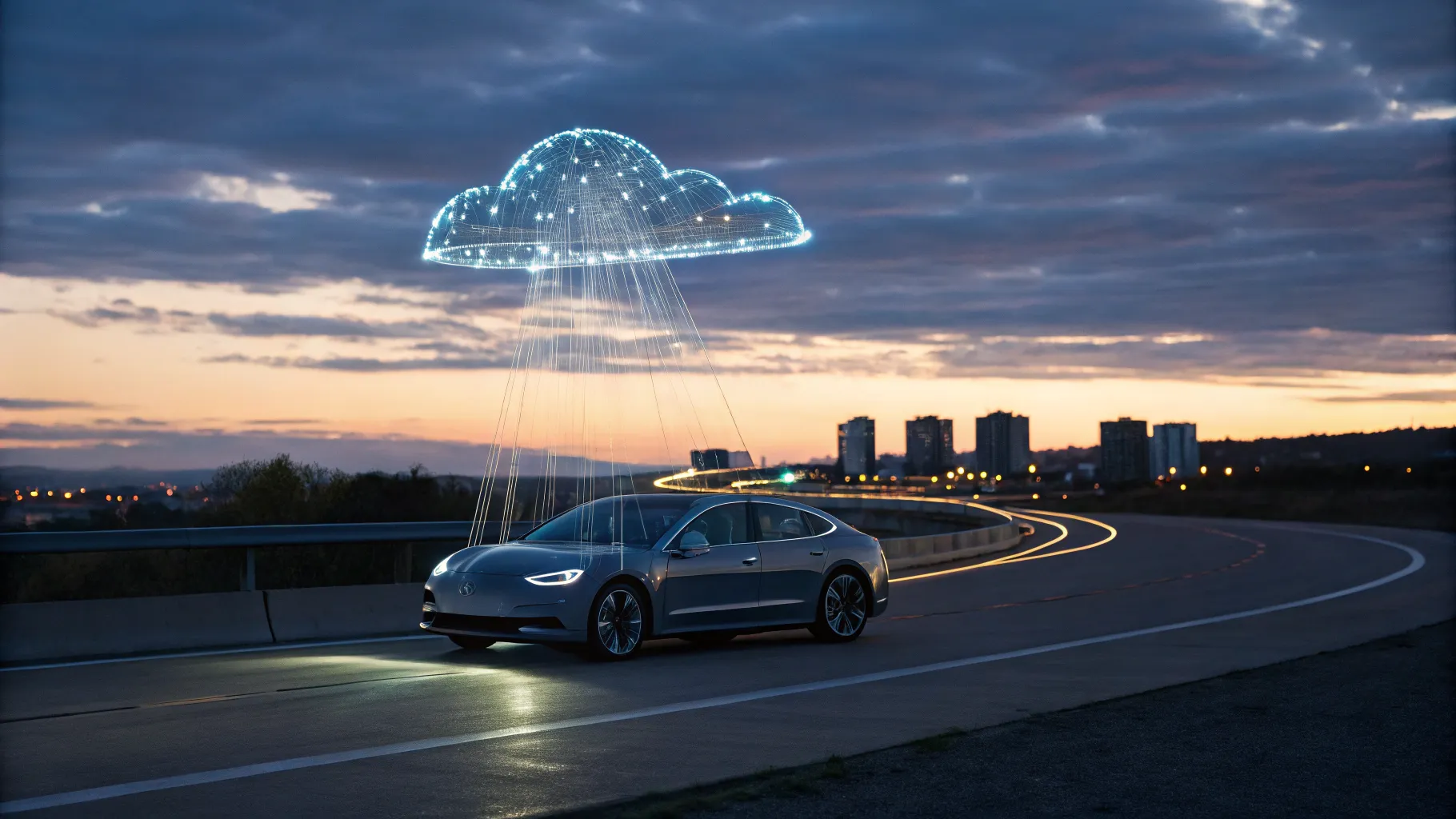
In my presentation for NVIDIA, I laid out a clear, practical roadmap for building safer self-driving cars — and how a cloud-to-car platform, powered by modern AI, simulation, and rigorous safety methodologies, makes that roadmap achievable. As someone who lives and breathes this problem, I want to use this article to report the state of play, the technical building blocks, and the operational practices that today’s autonomous vehicle (AV) teams must embrace to move from promising prototypes to dependable, production-grade systems.
This story is both technical and practical. It explains why autonomous driving is uniquely difficult, why “miles driven” alone is the wrong safety metric, what a modern AV data flywheel looks like, and how a combination of world foundation models, neural reconstruction, synthetic data, and automotive-grade safety practices converge to create safe vehicles at scale. I’ll also explain the in-car compute considerations, why new hardware (for example, Blackwell-based Thors) matters, and how NVIDIA’s Halos methodology codifies safety know-how into tools, SDKs, and evaluation capabilities that partners can use and trust.
🚗 Why autonomous driving is a story of AI evolution
When we talk about self-driving cars today, we’re really talking about the cumulative result of several waves of AI innovation. Each wave changed what’s possible and shifted the engineering bar that teams must meet to build systems that are both capable and safe.
It helps to see the progression as a timeline of ideas and capabilities:
- Image-based deep learning: The revolution that began with convolutional neural networks such as AlexNet showed that GPUs plus lots of labeled image data could solve visual recognition tasks better than prior methods. That gave us the perception building blocks.
- Multimodal perception: Over time we extended perception beyond single images — combining vision, audio, and text and building richer world models of what sensors were seeing. That allowed systems to interpret scenes with more context.
- Generative AI: With models like GPT and generative image models, the ability to synthesize outputs from high-level inputs became practical. That led to powerful user-facing experiences and new kinds of training data generation.
- Agentic AI: Agentic or “reasoning” models elevated the stack to systems that can break problems into subproblems, chain reasoning steps, and select actions with deliberation. This is the intelligence behind digital assistants and chatbots.
- Physical AI: Our present frontier: not just understanding or answering, but making safe physical actions in the real world. Robotics and autonomous driving fall squarely into this domain, and here the stakes — injury, property damage — make safety the absolute priority.
These waves are not theoretical; they dictate system architecture, workflow, and tooling. For example, once you move from static images to long sequences of video with temporal context, the data volumes and the compute requirements explode. When you add agentic reasoning, the model needs to simulate potential futures and explain — and that requires both hardware that’s efficient at token generation and software that can be validated against real-world behaviors.
🔁 The cloud-to-car loop: why the end-to-end pipeline matters
When people ask me about autonomous driving, they often focus on the on-board computer — that is, the hardware and models running in the car. That’s important, but it is only part of the picture. The real differentiator is the entire loop from sensors on cars in the field, to cloud training and simulation, back to optimized, validated models in cars.
Automotive AI is an ecosystem problem:
- The cloud needs to handle petabyte-scale datasets, provide efficient training, and automate labeling—otherwise the cost of building robust models becomes prohibitive.
- Simulation is essential for covering long-tail scenarios that you cannot practically capture in the real world.
- On-car compute must be both fast and safe: it must run advanced models with real-time guarantees and must be architected for redundancy and detectability.
- There must be a tight, efficient data loop — the faster you can find, fix, and validate an issue, the safer your fleet becomes.
So when I describe NVIDIA’s automotive work, I emphasize three domains we invest heavily in: training and data processing in the cloud; simulation and synthetic data generation for validation; and in-vehicle compute stacks that run production-grade inference and runtime safety monitors. Less than half of our automotive effort is simply the in-car computer — the rest is the tooling, dataset engines, simulation, and enterprise services that enable a modern AV program.
📊 Rethinking metrics: it's not just miles driven
Autonomous driving teams commonly report metrics like "miles driven without disengagement." While such metrics are informative, they are insufficient on their own. If we want meaningful measures of AV team maturity, we need to look at operational and engineering throughput:
- Data-to-insight latency: How long does it take to collect a problematic log, process it, find the root cause, and implement a fix?
- Training turnaround time: When you have a new dataset or a curated set of clips, how quickly can you retrain and evaluate models?
- Validation coverage and replay: How efficiently can you reconstruct a recorded event in simulation, replay it, and validate a fix across permutations?
I often say that the teams who are fastest at closing the data loop — from car to cloud and back to car — build the safest AV products. Speed of iteration matters more than just raw mileage because the long tail of rare events is where safety is won or lost.
🧩 The long-tail problem and a three-part data strategy
Autonomous driving is most challenging because real-world driving contains a vast number of rare, safety-critical scenarios. These long-tail events — misbehaving road users, unusual objects, extreme weather, ad-hoc street furniture, or atypical vehicle loads — cannot be captured exhaustively by real-world fleets alone.
To build a data strategy that scales, you need three capabilities:
- Smart in-car capture: The in-field cars must run intelligent software that captures only the most informative segments of sensor data — a fraction of a percent — because storing or transmitting everything is infeasible. This is an AI problem: detecting rare or interesting events on-device and prioritizing them for upload.
- Reconstruction and replay: Once you have the log, you must be able to recreate the event in simulation (SIM) exactly. That lets engineers root-cause, fix, and replay with new software to confirm the fix. It also creates a canonical scenario you can permute.
- Synthetic data generation: Even with captured events, you need permutations — night, rain, snow, different actor behaviors, different object types. Physically accurate synthetic generation fills in the distributional gaps with high-fidelity, testable scenarios.
Only by combining those three elements do you get a practical, cost-effective way to cover the vast decision space an AV must handle. The pipeline effectively multiplies real-world data into many testable variants so models can generalize safely.
🛰️ Building the data flywheel: capture, curate, create
Let me describe the flywheel in concrete terms — a cycle that advances model capabilities while keeping validation rigorous and repeatable.
Step 1: Capture. Cars on the road run a lightweight event detection stack that flags and stores short clips or metadata when anomalous events occur — a dog in the road, an erratic lane merge, an object falling from a truck. Because bandwidth and storage are limited, intelligent selection is critical.
Step 2: Ingest and automatic annotation. High-fidelity video clips are uploaded to the cloud where an automated pipeline annotates, curates, and indexes the clips. Manual labeling at the scale required for modern video-language-action models is not feasible; automation is necessary. This pipeline transforms raw drives into searchable, semantically rich datasets.
Step 3: Synthetic amplification. We use a world foundation model and scene transfer tools to take a captured clip and convert it into a photorealistic scene in simulation. Then we permute the actors, weather, lighting, and object types to ramp the clip into many variants — for example, turning a daytime single-pedestrian scenario into hundreds of night/rain/added-pedestrian permutations.
Step 4: Train and reason. The training stage consumes both captured and synthetic video clips. Modern AV models are often trained on long clips (many seconds) to capture temporal context and memory. We increasingly rely on big vision-language-action models that can chain-of-thought reason about what to do next, not just predict a single action. Those models are also evaluated in SIM at scale.
Step 5: Validate and deploy. For every regression or high-priority scenario, we reconstruct the event in SIM using neural reconstruction engines. We then launch targeted experiments across permutations and only push code that passes the tests. The loop completes when the updated model is deployed back into cars, where the monitoring software watches for regressions and new long-tail events — and the cycle continues.
🧠 World foundation models for driving: Cosmos Predict, Transfer, Reason
A core innovation I discussed was a family of world foundation models we call the Cosmos suite. Each model addresses a distinct need in the loop:
- Cosmos Predict: A model that ingests sensor inputs — cameras, lidar, map semantics — and produces trajectories for the ego vehicle and other agents. It’s essentially a world model that translates perception into safe motion plans. We designed it to be open source so partners can fine-tune it on their data and optimize it for their chosen compute platform.
- Cosmos Transfer: A neural scene transfer model that converts real-world sensor captures into photorealistic simulated scenes. It lets you take an actual clip and "transfer" it into SIM so you can change weather, time of day, or actor composition while retaining the geometry and semantics of the original capture.
- Cosmos Reason: A reasoning head that adds chain-of-thought capabilities to other models. This is the agentic piece: it can decompose a driving problem into steps, evaluate alternative actions, and provide rationale — both for better decisions and for explainability.
Why these three? Because they power the transformation from a single captured event into a validated improvement across a whole range of conditions. More importantly, when you add reasoning capability to a world model, the system can generalize: it can make intelligent decisions in novel situations it hasn't seen before.
"It takes sensor input in from the car ... and it actually generates the trajectory output of the car, and it's also generating the trajectory output of all the other actors on the road." — Jensen Huang
That quote captures the intent: the world model is not just about prediction, it’s about holistic scene understanding and safe behavior synthesis.
🎛️ From data to training: video-language-action models and long clips
Self-driving models today are moving away from networks that process single frames and toward models that consume long video clips — sometimes tens of seconds of context. Why? Because driving decisions depend on memory. If a car stopped at a traffic light for 15 seconds and then the light changes, the vehicle must retain the temporal context to know whether it’s waiting for a pedestrian, a train, or just congestion.
Video-language-action models are large, multimodal systems that combine vision and temporal tokens with language and actions. They’re trained to interpret a video clip and output a plan or a set of actions. When we add the "action" modality and a reasoning head, the model starts to approximate human-like deliberation: it can mentally simulate possible futures, weigh trade-offs, and choose a safe trajectory.
However, these gains come at a cost. The models are compute- and memory-intensive. When deployed on a moving vehicle, latency matters: the car may be traveling at highway speeds, and perception-to-action loops must meet tight deadlines. This is why hardware architecture is changing to support efficient token generation and better memory bandwidth for chain-of-thought workloads.
⚙️ Meet Thor: in-car compute built for reasoning models
The in-vehicle computer must do two competing things well: it must run perception with deterministic, real-time guarantees, and it must execute reasoning and planning with the throughput needed for token generation. To meet that need we built Thor — an automotive compute platform based on the Blackwell architecture and designed to support FP4 arithmetic for memory-efficient inference.
Why FP4 matters: When models generate tokens while reasoning about multiple alternative futures, memory bandwidth is the bottleneck. FP4 enables higher memory efficiency — roughly twice the memory efficiency compared with older formats — which translates directly into faster token generation and lower latency. That makes chain-of-thought reasoning practical inside a car.
In other words, the hardware stack is not an afterthought; it’s a co-design problem. If you want to run large video-language-action models with chain-of-thought reasoning in a car, you need a platform optimized for both throughput and memory efficiency.
🛡️ Safety by design: NVIDIA Halos and a rigorous methodology
Physical AI has no room for ambiguity. A misprediction is not a bad customer experience — it’s a potential safety event. That’s why we built a safety methodology and set of tools called NVIDIA Halos, which packages design-time and runtime guardrails, SDKs, test suites, and assessment processes that are targeted at automotive-grade safety.
Halos is about three things:
- Design-time guardrails: Architect the system to be fault-tolerant and redundant. That includes sensor diversity (multiple modalities like camera, lidar, radar) and algorithmic diversity (different perception algorithms running in parallel so agreement increases confidence).
- Runtime monitoring: Build monitors and filters that validate inputs and outputs. For example, if a camera is blinded or a lidar becomes saturated, the monitoring layer detects it and signals the planner to fall back to a safe mode.
- Automotive-grade infrastructure: Ensure that every test is itself verified and that the software factory follows safety standards. Unit tests, function tests, and scenario-based tests must be connected to ensure that passing tests equates to real-world safety.
These practices are not cheap. They require sustained engineering investment. NVIDIA has invested heavily in this area — tens of thousands of engineer-years — to assemble a robust set of tools and methods. We don't just ship code; we help partners assess their stacks and recommend improvements in a way that maps to certifiable safety practices.
"We don't ever want to cause an accident. The investment in safety for autonomous driving is significant." — Jensen Huang
🧰 Practical toolkit: neural reconstruction and the replay loop
When an AV experiences a disengagement or other anomaly, engineers need to diagnose and fix the problem quickly. The core capability that enables this is a neural reconstruction engine — a tool that transforms recorded log data into a simulated scene that accurately reproduces sensor observations and the physical behavior of actors.
The replay loop looks like this:
- Record the event in the car with compressed, prioritized logs.
- Upload and reconstruct the scene in SIM with a neural reconstruction engine.
- Run the original software stack in SIM to reproduce the issue and identify root cause.
- Iterate on fixes, run the fixed stack in SIM across permutations, and validate there are no regressions.
- Only then deploy the fix back to the fleet when all tests pass.
This replay mechanism is the verification backbone for end-to-end reasoning models. You cannot definitively certify a model that learns an end-to-end input-to-trajectory mapping unless you can reproducibly replay real failures and validate them in simulation.
🔎 Searchable datasets: video dataset search and curation
Finding relevant clips in a massive dataset is a daily problem for AV teams. If an engineer needs "all clips with fork/merge intersections with pedestrian crossings in low light," manual search is prohibitively slow. That’s where an intelligent video dataset search, powered by foundation models, becomes critical.
With a strong dataset search tool you can:
- Query semantically for scenario types and get ranked results.
- Use model-generated captions (from Cosmos Reason) to tag clips for quick retrieval.
- Create curated subsets instantly for targeted training and validation.
Intelligent search shortens the time from problem discovery to model retraining by orders of magnitude.
🔬 Synthetic data that behaves like reality
Not all synthetic data is created equal. For simulation to be useful for training and validation, the synthetic scenes must be physically accurate and photorealistic so that models trained on them generalize to real sensor inputs. This includes accurate lighting, sensor noise models, and correct interaction dynamics among actors.
We use physics-based rendering, sensor modeling, and scene-understanding transfer (Cosmos Transfer) to create datasets that are indistinguishable from real-world captures for the purpose of training and validating perception and planning models. That fidelity is what lets us multiply a few thousand valuable hours of captured data into millions of hours of high-quality variations that an AV model can learn from.
⚖️ Explainability: why reasoning models matter for UX and debugging
Reasoning models do more than improve decision quality; they provide explainability. When a car behaves unexpectedly, a reasoning head can generate a human-readable rationale. Imagine the car slowing down unexpectedly and the dashboard showing: "Slowing because pedestrian with stroller entering crosswalk." That kind of feedback has two benefits:
- User trust: Riders can understand system behavior and feel more comfortable in edge cases.
- Engineering insight: Captions and chain-of-thought outputs can be stored in datasets and used to categorize and triage events for further analysis.
Explainability is therefore both a customer-experience feature and a debugging tool.
🤝 Partnering across the ecosystem: OEMs, Tier 1s, and software vendors
Building safe autonomous vehicles is not a single-company endeavor. It requires collaboration across OEMs, Tier 1 suppliers, software vendors, cloud providers, and regulatory bodies. NVIDIA's role is to provide a platform — software stacks, simulation tools, foundation models, and validated hardware — that partners can adopt and extend.
We work with a broad set of partners worldwide: OEMs such as Mercedes-Benz and Volvo; car makers in the U.S. like Lucid; autonomous driving software teams including Waymo; as well as multiple Chinese AV companies. The goal is to provide a common, high-quality stack so that safety best practices and validated tooling are accessible to the whole industry.
One tangible output of this engagement is a functionally safe Level 2+ stack that launched in Germany on Mercedes-Benz cars and is slated to expand globally. That is an example of a production-grade deliverable that packages hardware, software, and safety practices into a vehicle feature.
📈 How to measure progress: operational KPIs for AV programs
Based on what I’ve witnessed and built, the following KPIs are practical indicators of an AV program’s maturity:
- Data capture efficiency: Percent of drives that have meaningful, prioritized logs versus raw data volumes collected.
- Time-to-replay: How long it takes from event capture to running that event in SIM with a reconstructed scene.
- Fix deployment latency: Time from problem discovery to fleet-wide software update deployed and validated.
- Iteration throughput: Number of model/feature iterations per month and the percentage that pass simulation validation before road testing.
- Synthetic coverage ratio: The ratio of synthetic permutations to real-world captures for high-priority scenarios — a measure of how well you have amplified real data into robust training sets.
Programs that optimize these metrics will iterate faster and maintain higher safety margins.
🔁 Example workflow: from a disengagement to a validated fix
Let me walk through a concrete example that illustrates the end-to-end process we recommend and operationalize:
- Event capture: A car in the fleet experiences an uncomfortable event during a left turn — a bicyclist appears to the right of the turn path unexpectedly. The on-car prioritization software stores a 30-second clip and priority metadata and uploads it to the cloud.
- Automated curation: The uploaded clip is automatically annotated: lanes, actors, tracked trajectories, and timestamps. Cosmos Reason generates captions identifying the “bicyclist encroaching from right” scenario.
- Reconstruction: Neural reconstruction recreates the exact 3D scene in SIM using recorded sensor data and map semantics.
- Root cause analysis: Engineers replay the original software stack in SIM to reproduce the uncomfortable behavior. They find the perception missed the partially occluded bicyclist due to a rare glare condition.
- Permutations and training: Using Cosmos Transfer, the team generates multiple variants: varying the bicyclist’s approach angle, lighting (glare at different intensities), and adding traffic to increase complexity. These are converted into a training set.
- Model update: The team fine-tunes Cosmos Predict and its perception front-end on the augmented dataset, then runs the new model in SIM across thousands of permutations.
- Validation: The updated model passes all synthetic permutations and reproduces safe behavior in replayed scenarios. Runtime monitors detect no regressions in other core safety tests.
- Deployment: The validated model is deployed incrementally to the fleet. Telemetry and monitors look for regressions; none are observed.
This example demonstrates why capture + reconstruction + synthetic amplification + reasoning + validation is not just a theoretical pipeline — it’s the practical path to safe, scalable AV deployment.
🔐 Security and regulatory alignment
Safety in the automotive context is inseparable from security and regulatory compliance. Data integrity, access control, model provenance, and the reproducibility of tests are all part of a credible safety case. The Halos toolkit and the workflow I described are built with these constraints in mind:
- Data governance: Controlled access to logs and models; auditable pipelines for how datasets are curated and used.
- Model traceability: Versioned models tied to specific datasets and test results so you can reproduce why a model made a decision.
- Assessment and certification: Tools and processes designed to map to regulatory frameworks and to support third-party assessment and verification.
We also provide assessment services to partners — the ability to independently evaluate a partner’s stack and give prescriptive recommendations is a service that raises the baseline of safety across the industry.
🌍 Real-world partnerships and deployments
Industry momentum is tangible. At the time of writing, we’re working with a broad array of OEMs and AV projects. Highlights include:
- Production deployments of a Level 2+ function in Mercedes-Benz vehicles across Germany, integrating our compute, software stacks, and Halos methodology.
- Collaborations with Volvo and Lucid on next-generation vehicle launches in Europe that integrate our Thor compute and software infrastructure.
- Supporting other leading AV organizations — both in the U.S. and China — across training, simulation, and in-car compute.
These deployments are proof that the cloud-to-car stack is not hypothetical. It’s in cars that people drive every day. Each deployment iterates on the same core principles: rigorous data pipelines, simulation fidelity, reasoning-capable models, and automotive-grade safety practices.
🧭 Roadmap: where we go from here
The path forward is clear: continue investing in foundation models for perception and planning, elevate simulation fidelity, improve hardware efficiency for chain-of-thought workloads, and push for industry-wide adoption of safety-by-design methodologies.
Concretely, I expect to see:
- Faster iteration cycles: Shorter times from event capture to validated deployment as tooling and automation improve.
- Tighter hardware/software co-design: More platforms like Thor that are architected specifically for token-generation workloads and multimodal video-language-action inference.
- Broader adoption of reasoning models: Explainable decisions will become a standard requirement, not a luxury.
- Regulatory convergence: Clearer frameworks for assessing and certifying AI-driven vehicle features so consumers and regulators can have confidence in what’s being deployed.
📝 Final takeaways: how teams should prepare today
If you are building an AV program or working with partners who are, here are practical priorities I recommend focusing on right away:
- Invest in an intelligent capture strategy: Don’t log everything; log the right things. Prioritize event detection on-device so you can get high-value signals with low bandwidth.
- Automate annotation and search: Build or adopt tools that automatically annotate video, generate captions, and enable semantic dataset search.
- Adopt a robust reconstruction/replay capability: If you can’t reproduce failures in SIM, you can’t verify end-to-end models.
- Use synthetic amplification prudently: Generate realistic permutations of real events to strengthen generalization — but ensure physical fidelity.
- Design for redundancy and validation: Emphasize sensor diversity, algorithmic diversity, and runtime monitors.
- Measure iteration velocity: Aim to shorten time from issue discovery to validated deployment; it’s the truest measure of an AV team’s safety posture.
📣 Closing report
Driving the future of mobility requires more than better models or faster chips. It requires a complete, industry-quality engineering and safety ecosystem: a data flywheel that captures and amplifies rare events, foundation models that perceive and reason, simulation that’s faithful and scalable, hardware that supports novel reasoning workloads, and safety methodologies that codify how systems are designed, monitored, and certified.
At NVIDIA, we’ve assembled this end-to-end platform — from Cosmos models to Thor compute to Halos safety tooling — and we’re working with partners across the automotive ecosystem to make sure the capabilities translate into safer roads for everyone.
"The companies who are best are the ones who have a loop from the cloud to the car that's most efficient." — Jensen Huang
That quote sums up the operational imperative: safe autonomy isn’t a single breakthrough — it’s an engineering discipline. I believe that with rigorous tooling, principled safety practices, and relentless iteration, we can build AI-defined vehicles that are demonstrably safer than human drivers and ready to meet the world’s expectations.
Further reading and next steps
If you’re part of an AV team, I encourage you to audit your pipeline against the flywheel I described. Measure your time-to-replay, your dataset search capabilities, and your synthetic coverage. If you’re an OEM or tier supplier, ask whether your in-car compute is aligned with chain-of-thought workloads and whether your software factory is built to automotive-grade verification standards. Those are the practical actions that will accelerate the path from promising research to dependable road safety.
Thank you for reading. I look forward to continuing this work across the industry so we can deliver safer, smarter mobility to everyone.


