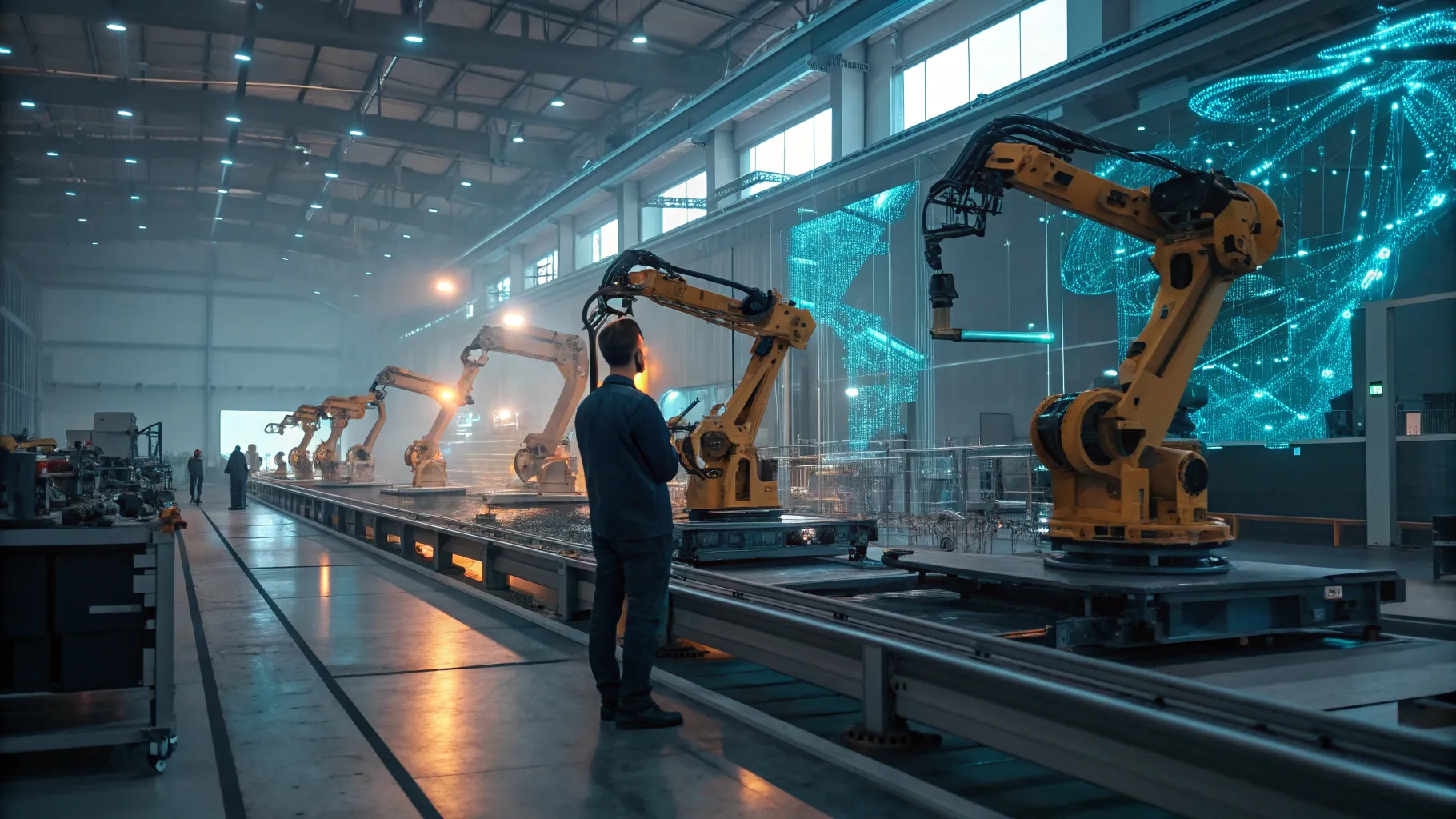
🔧 Why AI Is Reshaping Manufacturing
I believe we are at the beginning of a fundamental shift in how physical goods are designed, built, and delivered. Artificial intelligence is not just another optimization tool. It is becoming the central nervous system for modern manufacturing, enabling speed, precision, and flexibility at scales that were unimaginable a few years ago.
Over the past decade, manufacturing has faced relentless pressure: complex global supply chains, volatile demand, rising labor and energy costs, and heightened expectations for product quality and customization. AI addresses those pressures by turning data into action in real time. That combination of intelligence, automation, and connectivity is creating a pathway for production to return closer to end markets, particularly in the United States.
When I say that AI will be a key driver for the establishment of manufacturing yet again in the United States, I mean that the competitive calculus has changed. Rather than choosing low labor cost locations as a default, companies can now achieve lower total cost, faster time to market, and better customer responsiveness by investing in AI-powered, highly automated factories closer to their customers.
🤖 What I Mean by an AI-Native Factory
"So we believe that AI really will be a key driver for the establishment of manufacturing yet again in the United States, which is going to be smarter."
"So we think of it as more of an AI native factories that we want to build."
That phrase—AI-native factory—captures more than a factory that uses AI tools. An AI-native facility treats AI as a foundational design principle. It has intelligence embedded at every level, from the sensor on the shop floor to the systems that schedule deliveries.
Here are the defining characteristics of an AI-native factory:
- Data-first design: every process and machine is instrumented to produce reliable, high-quality data.
- Continuous learning: models are trained and iterated continuously using live production data, not just periodic batch updates.
- Real-time control: decisions that used to be made manually or at coarse time scales now happen in milliseconds at the edge.
- Digital twins: physics-based and ML-driven simulations mirror the factory in software, enabling what-if analyses and rapid reconfiguration.
- Human-in-the-loop operations: AI augments skilled operators, offering recommendations, automating mundane tasks, and escalating exceptions.
- End-to-end integration: design, supply chain, production, quality, and after-sales systems work in a coordinated, feedback-driven loop.
When these elements come together, I don’t just see incremental improvement. I see manufacturing processes that can adapt in real time to demand fluctuations, supply disruptions, and changes in product design without large increases in cost or lead time.
⚙️ Key Technologies Powering AI-Native Factories
Building an AI-native factory requires a stack of technologies working together. Here are the pieces I consider essential and how they fit together:
1. Sensors and IoT
Sensors are the eyes and ears of the factory. High-fidelity vibration sensors, temperature probes, force sensors, and high-resolution cameras are the raw inputs that feed models. Without quality data, no amount of sophisticated modeling will provide reliable results.
2. Edge computing
Many factory decisions must happen with low latency and without relying on a distant cloud. Edge devices running optimized inference models enable real-time control for robotics, anomaly detection, and closed-loop quality corrections.
3. Accelerated computing
Training the models that power digital twins or complex vision systems requires significant compute. Accelerated processors enable rapid experimentation, faster model iterations, and shorter time from concept to deployment.
4. Robust data platforms
A scalable architecture for ingesting, storing, and processing time-series data, video, telemetry, and metadata is non-negotiable. Data pipelines must support both offline model training and online model serving.
5. Simulation and digital twins
Simulations let me test changes safely and at low cost. A digital twin of a production line or individual machine enables virtual commissioning, predictive maintenance, and optimization before physical changes are made.
6. MLOps and continuous delivery
Operationalizing models demands rigorous versioning, monitoring, validation, and rollback strategies. MLOps practices make it possible to maintain model performance and safety as production conditions evolve.
7. Secure connectivity and cybersecurity
Connectivity must be reliable and secure. Operational technology networks have different requirements than enterprise IT, and security must be baked into every layer to protect IP, product integrity, and worker safety.
Each technology is critical on its own. But the real power comes when these components are combined into a reproducible, scalable platform that supports continuous improvement across the entire plant.
📊 Concrete Benefits: Speed, Quality, Flexibility
I’ve seen AI deliver measurable gains across three dimensions that matter most to manufacturers: speed, quality, and flexibility.
- Speed: AI reduces cycle times by automating decision-making at the edge, speeding up inspections with real-time vision systems, and optimizing throughput with predictive scheduling. Faster iteration lowers time to market.
- Quality: Computer vision and sensor fusion systems detect defects earlier and with higher precision than human inspection alone. Predictive maintenance keeps machines within tolerances, increasing yield and reducing scrap.
- Flexibility: AI-driven scheduling and adaptive robots let lines switch products with minimal downtime. That flexibility enables profitable small-batch and customized production runs.
Here are specific examples of impact I would expect from an AI-native line:
- Predictive maintenance: reducing unplanned downtime by 30 to 50 percent and extending asset life.
- Automated quality inspection: improving defect detection rates while cutting inspection costs by half or more.
- Throughput optimization: increasing overall equipment effectiveness (OEE) by 10 to 25 percent through better sequencing and bottleneck management.
- Energy efficiency: fine-grained control of process parameters can lower energy use and emissions per unit produced.
Those numbers depend on the starting point and the maturity of the factory, but the pattern is consistent: AI amplifies the value of sensors and automation investments and unlocks gains that were previously inaccessible.
🧑🏭 Workforce and Skills: Humans Plus AI
One of my strong convictions is that AI will augment rather than simply replace human skill. The relationship between humans and machines in an AI-native factory is collaborative. Machines take on repetitive, hazardous, or highly precise tasks, while people focus on problem solving, process improvement, and oversight.
That shift creates demand for a different skill mix on the shop floor and in engineering teams:
- Data literacy: operators and technicians need to understand dashboards, model outputs, and basic data troubleshooting.
- AI system operation: new roles for model stewards, MLOps engineers, and edge system administrators will appear.
- Cross-disciplinary problem solving: people who can bridge mechanical, electrical, and software disciplines will be highly valuable.
- Continuous learning: on-the-job training, apprenticeships, and partnerships with technical schools will be essential to reskill existing workers.
Companies that invest in workforce development will unlock far more value from AI. I recommend pairing every digital upgrade with a training program that empowers operators to use AI outputs and provide feedback that improves models.
🏭 Designing and Deploying an AI-Native Factory
Turning the idea of an AI-native factory into reality is a program, not a single project. It requires careful sequencing, stakeholder alignment, and a pragmatic approach that balances ambition with early wins.
Here is a practical, phased approach that I use when planning deployments:
Phase 0: Strategy and alignment
- Define business outcomes and the metrics that matter: OEE, yield, throughput, cost per unit, time to market.
- Map the value chain to identify high-impact use cases that align with strategic priorities.
- Secure executive sponsorship and cross-functional teams that include operations, IT, engineering, and HR.
Phase 1: Pilot and prove
- Pick a constrained, high-value use case that can be measured quickly, such as automated visual inspection or predictive maintenance for a critical asset.
- Instrument the equipment with the necessary sensors and begin capturing data.
- Deliver a Minimum Viable Model (MVM) that provides clear insights and measurable impact.
Phase 2: Scale and industrialize
- Move from isolated pilots to fleet-wide rollouts using standardized hardware and software stacks.
- Implement MLOps pipelines for continuous model retraining and validation.
- Create governance and data quality processes to maintain model reliability.
Phase 3: Integrate and optimize
- Integrate AI outputs into planning, supply chain systems, and the enterprise resource planning layer.
- Use digital twins for ongoing optimization and scenario planning.
- Establish continuous improvement loops with frontline teams to refine models and workflows.
Throughout each phase, success depends on these constant practices:
- Short feedback loops between operators, data scientists, and engineers.
- Rigorous monitoring of model drift and key production KPIs.
- Change management to align processes and incentives with new capabilities.
📈 Building the Right Partnership Ecosystem
Manufacturing systems are complex, and no single company will have all the capabilities necessary to build an AI-native factory quickly. I recommend an ecosystem approach built around these partnership roles:
- Hardware providers for sensors, compute at the edge, and networking.
- Software vendors offering domain-specific AI models, MLOps platforms, and digital twin tools.
- System integrators who can bring together OT and IT and handle on-site deployment and testing.
- Consulting and training partners supporting organizational change and upskilling.
- Academic and research partners to collaborate on advanced modeling and workforce pipelines.
When I architect partnerships, I look for vendors with open APIs, strong security practices, and a track record in industrial environments. Interoperability and modularity reduce vendor lock-in and make future upgrades easier.
🇺🇸 Policy, Investment, and the American Manufacturing Comeback
There are macroeconomic and policy levers that will accelerate the adoption of AI in manufacturing and enable a reshoring of production capacity. I see several areas where focused investment and public-private collaboration can make a difference:
- Incentives for capital investment: tax credits, grants, and programs that lower the initial cost of deploying AI infrastructure will bring forward projects that otherwise would be deferred.
- Workforce development: national and local programs to build AI and advanced manufacturing skills through community colleges, apprenticeships, and employer-driven training.
- Chip and semiconductor investments: ensuring access to advanced compute is critical for AI training and inferencing across factories.
- Standards and open platforms: encouraging interoperability and open data standards reduces integration friction and accelerates ecosystem innovation.
- Resilient supply chains: policies that promote diversification and secure supply chains for critical components reduce risk and improve national competitiveness.
With the right ecosystem of policy, capital, and talent, I see the United States regaining a stronger manufacturing footprint—one that is smarter, more resilient, and technologically advanced.
⚠️ Challenges and Pitfalls to Watch For
Adopting AI in manufacturing is not without risk. I want to be candid about the potential pitfalls and how to mitigate them:
- Poor data quality: inaccurate or inconsistent sensor data leads to unreliable models. Invest in data validation and calibration from day one.
- Cybersecurity vulnerabilities: increasing connectivity expands the attack surface. Treat security as a first-class requirement, not an afterthought.
- Integration complexity: legacy equipment and disparate systems create friction. Use modular integration layers and prioritize interoperability.
- Change resistance: success depends on frontline adoption. Involve operators early, and design interfaces that augment rather than replace their expertise.
- Vendor lock-in: proprietary platforms can limit future flexibility. Favor open standards and components that can be swapped out as technology evolves.
- Model drift and brittleness: real-world production conditions change. Implement continuous validation, monitoring, and roll-back mechanisms.
Addressing these risks requires planning, governance, and a realistic roadmap that prioritizes sustainable improvements over one-off headline projects.
🔍 Measuring Success and Demonstrating ROI
Companies need concrete ways to track progress and justify further investment. I recommend tying AI initiatives directly to KPIs that reflect both operational performance and business outcomes.
Important KPIs include:
- Overall Equipment Effectiveness (OEE) to track utilization, performance, and quality.
- Unplanned downtime to measure the impact of predictive maintenance.
- Yield and scrap rates as indicators of quality improvements from AI-driven inspection and control.
- Cycle time and throughput to capture speed gains from process optimization.
- Energy consumption per unit to demonstrate sustainability benefits.
- Time to market for new product introductions facilitated by faster iteration and digital twins.
For each KPI, define the baseline, the target improvement, and the timeline for achieving that improvement. Early pilots should have clearly measurable outcomes so that results can be translated into a business case for scaling.
🚀 A Practical 12–24 Month Roadmap
If I had to lay out a roadmap for a typical manufacturer aiming to become AI-native, it would look like this:
Months 0–3: Strategy and quick wins
- Identify top 3 high-impact use cases tied to business outcomes.
- Set up governance, define KPIs, and secure sponsors.
- Begin data collection on candidate lines or assets.
Months 3–9: Pilot and validate
- Deploy edge sensors and compute for pilot use cases.
- Deliver an MVP model and demonstrate impact against KPIs.
- Establish MLOps and data platforms for continuous training.
Months 9–18: Scale and integrate
- Roll out successful pilots across multiple lines and plants.
- Integrate AI outputs into MES and ERP systems.
- Standardize hardware, software, and processes for maintainability.
Months 18–24: Optimize and transform
- Use digital twins to optimize multi-line and supply chain interactions.
- Deploy advanced orchestration for multi-site scheduling and sourcing.
- Institutionalize training programs and create career pathways for the new roles.
This is an aggressive timeline, but with focused leadership, a clear business case, and the right partners, it is achievable. The goal is to move from isolated proofs of concept to a factory-level capability that delivers sustained value.
✅ Examples of High-Impact Use Cases
To make the roadmap tangible, here are specific use cases that repeatedly deliver ROI in real manufacturing environments:
- Automated visual inspection: deploy cameras and computer vision models at critical quality checkpoints to detect surface defects, misalignments, and assembly errors with higher accuracy and speed than manual inspection.
- Predictive maintenance: use vibration, temperature, and current signatures to predict failures days or weeks ahead, enabling planned maintenance windows rather than costly unplanned stoppages.
- Adaptive process control: use closed-loop models to adjust welding parameters, machining feeds, or chemical process conditions in real time to maintain tolerances and improve yield.
- Supply chain orchestration: combine demand forecasting with production capacity models to optimize sourcing, inventory, and scheduling for just-in-time manufacturing.
- Human-robot collaboration: enable safe, flexible collaboration where robots handle repetitive heavy lifting and humans perform inspection and fine manipulation tasks.
Each use case reinforces others. For example, better predictive maintenance increases line availability, which in turn makes scheduling optimizations more effective.
🔁 Continuous Improvement and the Feedback Loop
One of the biggest changes an AI-native factory embraces is the concept of continuous learning. Models improve as they see more real-world variations. Operators provide feedback that helps correct false positives or new failure modes. Engineering teams iterate faster because simulations and digital twins reduce the need for costly physical experiments.
That cycle—collect data, train models, validate in simulation, deploy at the edge, monitor performance, and incorporate operator feedback—is the engine of ongoing value creation. I prioritize building that loop into the organization rather than treating AI as a one-time project.
📣 Practical Recommendations to Get Started
If you are leading manufacturing transformation, here are the practical steps I recommend you take right away:
- Pick a measurable pilot with clear ROI and senior sponsorship.
- Instrument properly—start with the right sensors and sampling rates to capture meaningful signals.
- Build a minimal data platform that supports both training and online inference.
- Adopt MLOps early to prevent model sprawl and ensure repeatability.
- Invest in training for operators and technicians as part of the deployment budget.
- Design for security from day one, and involve your cybersecurity team early.
These steps reduce risk and make the benefits of AI tangible to the organization, which is critical for securing broader investment.
🔮 Final Thoughts and a Call to Action
AI is not a magic bullet, but it is a transformative capability that makes manufacturing smarter, faster, and more resilient. When I talk about building AI-native factories, I’m talking about a holistic reinvention of the production system—one where data, models, people, and machines operate in a continuous, intelligent loop.
There is an economic opportunity here. By embracing AI at scale, manufacturers can reshore production, shorten supply chains, and deliver more value to customers. That evolution will require technology, capital, standards, and, perhaps most importantly, people who are willing to learn new skills and work with intelligent systems.
If you are responsible for manufacturing strategy, treat AI as a strategic capability. Start with measurable pilots, invest in people, and build the infrastructure that supports continuous learning. Do that, and I believe you will not only improve existing operations but also unlock new business models and market opportunities.


